Honda Rebel 1100 Specs, Top Speed & Performance Review
TL;DR
- The Honda Rebel 1100 is powered by a 1,084cc parallel-twin borrowed from the Africa Twin, making approximately 87 hp and 72 lb-ft of torque
- Top speed is approximately 113-115 mph based on real-world tests
- 0-60 mph takes roughly 3.8-4.2 seconds in Sport mode, making it one of the faster cruisers in its price class.
- MSRP starts at $9,999 for the standard and $10,799 for the DCT (Dual Clutch Transmission) version
- It’s a genuine performance cruiser that punches above its weight, though its aggressive power delivery and 31.1-inch seat height make it a poor fit for short or newer riders.
Honda Rebel 1100 Full Specs at a Glance
The Rebel 1100 uses the same 1,084cc SOHC parallel-twin from the Honda Africa Twin CRF1100L. That’s not a coincidence – it’s a deliberate decision that gives a cruiser-styled bike genuine mid-size adventure bike performance.
| Specification | Honda Rebel 1100 (2025) |
|---|---|
| Engine | 1,084cc parallel-twin, SOHC, 4-valve |
| Bore x Stroke | 92.0mm x 81.4mm |
| Compression Ratio | 10.1:1 |
| Peak Horsepower | ~87 hp @ 7,500 rpm |
| Peak Torque | ~72 lb-ft @ 6,250 rpm |
| Transmission | 6-speed manual or 6-speed DCT |
| Wet Weight | 481 lb (manual) / 500 lb (DCT) |
| Seat Height | 27.9 in (lowered) / 31.1 in (standard) |
| Fuel Capacity | 3.4 gallons |
| Wheelbase | 62.6 in |
| Front Suspension | 41mm telescopic fork, 4.3 in travel |
| Rear Suspension | Twin shocks, preload adjustable |
| Front Brake | Single 330mm disc, 2-piston caliper |
| Rear Brake | Single 240mm disc, 1-piston caliper |
| ABS | Standard |
| MSRP (2024-2025) | $9,999 (manual) / $10,799 (DCT) |
Sources: Honda USA press specifications, 2021-2025
What the Rebel 1100’s Engine Actually Delivers on the Road
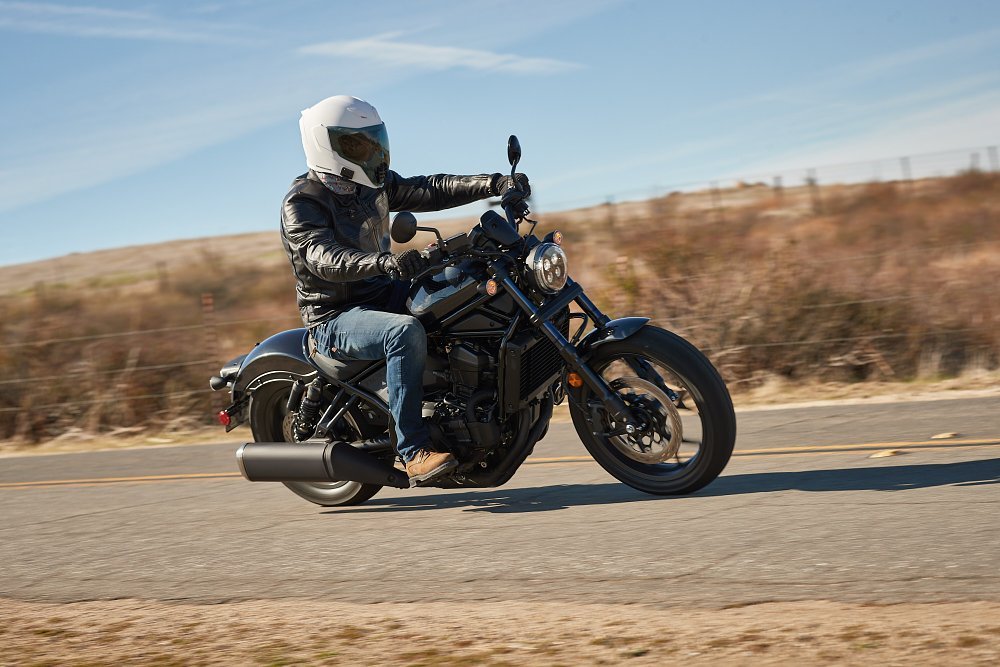
The 1,084cc parallel-twin is the best thing about this bike. At low RPM it pulls like a diesel – thick, wide torque that lets you lug through town in a higher gear without the engine complaining. By 4,000 rpm, it’s properly moving. By 6,000 rpm, it’s fast enough to remind you that 481 lb of cruiser accelerating hard is a serious situation.
Honda quotes peak torque at 72 lb-ft. For context, the Harley-Davidson Sportster S – its most direct competitor – makes 90 lb-ft from its 1,252cc Revolution Max engine (Harley-Davidson, 2023). The Rebel gives away some grunt down low but revs more freely, which suits riders who like to work an engine rather than just feed it throttle and wait.
Riding modes make a real difference here. In Standard mode the power delivery is linear and predictable. Switch to Sport mode and the throttle response sharpens noticeably – it’s not just a Honda marketing distinction, you feel it within a block.
Honda Rebel 1100 Top Speed: What Real Tests Show
The Rebel 1100’s top speed is approximately 113-115 mph based on independent road tests. Cycle World recorded 113 mph in their 2021 test, and Motorcycle.com’s testers put it in the same range. Honda doesn’t publish a top speed figure.
That number is honest for a 481 lb cruiser with upright ergonomics and no fairing. Wind resistance is the limiting factor at that point, not power. If you sit the bike flat on a salt flat in a full tuck, you’d push a little past that. On a public road in normal riding position, 100 mph is where the wind starts working against you.
For everyday riding – highway pulls, two-up touring, canyon carving at sane speeds – the Rebel 1100 has more than enough. You’re not buying this bike because you need 150 mph. You’re buying it because it looks good, rides well, and doesn’t make you feel like you’re piloting furniture.
Rebel 1100 Acceleration: 0-60 mph and Real-World Feel
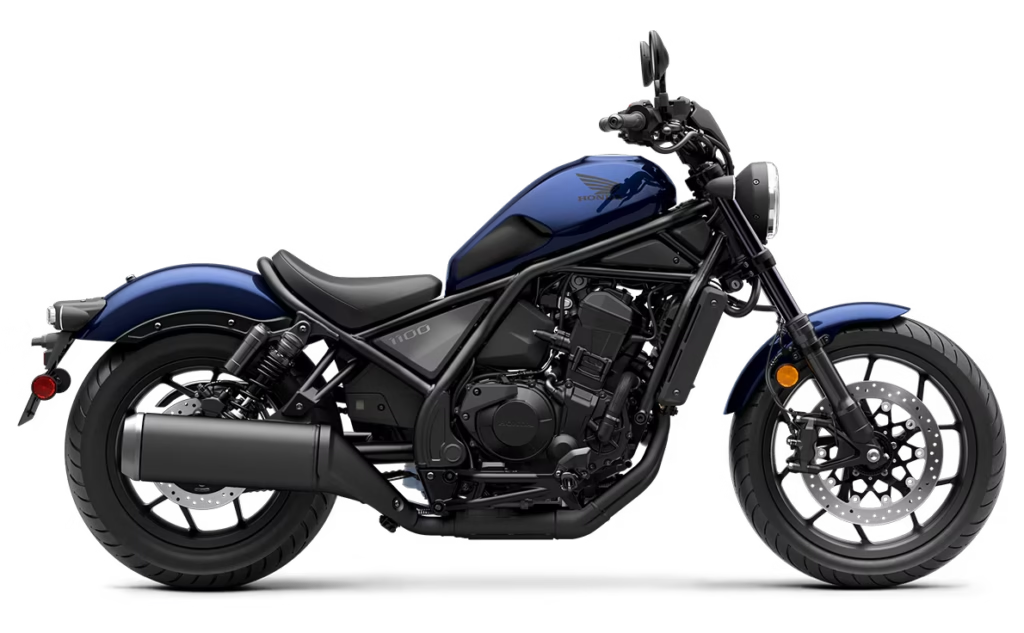
The Rebel 1100 hits 60 mph from a standstill in approximately 3.8-4.2 seconds (Motorcycle.com, 2021; Cycle World, 2021). That’s quick for a cruiser – quicker than most riders expect the first time they open it up.
The DCT version is slightly faster to 60 because it eliminates clutch slip and human shift timing. If you’re chasing stoplight-to-stoplight times, get the DCT. If you want the engagement of a proper manual gearbox, the six-speed manual is slick and well-spaced.
The quarter-mile number sits around 12.0-12.3 seconds at roughly 107-109 mph (Cycle World, 2021). That’s faster than a Harley Sportster S at the same test (Cycle World, 2021) and competitive with sport-naked bikes costing significantly more.
Riding Modes, DCT, and How Honda’s Electronics Package Works
The Rebel 1100 has three riding modes – Standard, Sport, and Rain – plus Honda Selectable Torque Control (HSTC), which is Honda’s name for traction control. ABS is standard on all versions.
HSTC operates across three levels and responds quickly without being intrusive. On wet pavement, it’s genuinely useful. Most riders leave it on Level 1 or 2 and forget about it, which is exactly what good electronics should feel like.
The DCT version deserves a real mention. Honda’s Dual Clutch Transmission (DCT) is the same unit used across their Africa Twin and NC750 lineup – it’s been in production since 2010 and it works (Honda, 2021). You get Drive mode, Sport mode, and a manual shift option via buttons on the left bar. It’s not a lazy choice; a lot of experienced riders prefer it for city traffic and longer touring days.
What the Rebel 1100 Gets Right and Where It Falls Short
The Rebel 1100 is genuinely good at being a mid-to-large cruiser that doesn’t feel dumbed down. The engine is the real thing. The chassis handles better than the styling suggests – there’s 33 degrees of lean angle on the right and 30 on the left before you start grinding (Honda, 2021), which is enough for spirited riding on real roads.
Fuel economy is a genuine positive. Expect 45-50 mpg in mixed riding (Cycle World, 2021), which means that 3.4-gallon tank gives you a real-world range of around 150-165 miles before the reserve light appears.
The honest drawbacks: The 31.1-inch seat height is taller than most naked cruisers in this class and will leave shorter riders tiptoeing. Honda does offer a lowering kit that brings it to 27.9 inches, but that’s an extra purchase. The suspension is adequate – it’s not embarrassing – but the rear shock is basic and riders who load the bike heavily or hit a lot of rough roads will feel its limits. An Ohlins or even a mid-spec aftermarket unit is a worthwhile upgrade if you tour.
The braking system is the one area where Honda played it safe. A single 330mm disc up front with a two-piston caliper is fine for street riding, but it’s undersized relative to the bike’s weight and performance. A Brembo upgrade or even a second disc would match the engine’s capability better.
How the Rebel 1100 Compares to Its Main Competitors
| Bike | Engine | Horsepower | Torque | Wet Weight | MSRP |
|---|---|---|---|---|---|
| Honda Rebel 1100 | 1,084cc parallel-twin | ~87 hp | ~72 lb-ft | 481 lb | $9,999 |
| Harley-Davidson Sportster S | 1,252cc V-twin | ~121 hp | ~90 lb-ft | 502 lb | $15,299 |
| Yamaha V-Star 1300 | 1,304cc V-twin | ~74 hp | ~87 lb-ft | 617 lb | $10,999 |
| Kawasaki Vulcan S | 649cc parallel-twin | ~61 hp | ~46 lb-ft | 498 lb | $8,199 |
| Royal Enfield Super Meteor 650 | 648cc parallel-twin | ~47 hp | ~38 lb-ft | 476 lb | $6,999 |
Sources: Manufacturer press specs, 2023-2025
The Rebel 1100’s strongest case is the price-to-performance ratio. It’s $5,000 cheaper than the Sportster S, makes competitive horsepower, and is significantly lighter than the V-Star 1300 despite a larger real-world presence. The Kawasaki Vulcan S and Royal Enfield are genuinely lighter on the wallet but give up a lot in displacement and outright power.
Frequently Asked Questions About the Honda Rebel 1100
What is the Honda Rebel 1100’s top speed?
The Honda Rebel 1100’s top speed is approximately 113-115 mph based on independent tests by Cycle World and Motorcycle.com (2021). Honda does not publish an official top speed. Real-world maximum speed in normal riding position is limited by aerodynamics before the engine runs out of power.
How fast does the Rebel 1100 go from 0-60 mph?
The Rebel 1100 reaches 60 mph in roughly 3.8-4.2 seconds, depending on mode and rider technique (Motorcycle.com, 2021). The DCT version is at the faster end of that range. That’s competitive with many middleweight sport bikes and significantly quicker than most cruisers at this price.
Is the Honda Rebel 1100 good for beginners?
It’s not a beginner bike. The 1,084cc engine is tractable at low RPM, but the throttle response in Sport mode is sharp, and 481 lb is a lot of motorcycle to manage for a new rider. If you’ve been riding for at least two years and are comfortable on a 500-650cc bike, the Rebel 1100 is a reasonable step up. Total beginners should start on a Rebel 500 or similar.
What is the fuel economy of the Honda Rebel 1100?
Real-world fuel economy on the Rebel 1100 is 45-50 mpg in mixed riding (Cycle World, 2021). With the 3.4-gallon tank, that translates to approximately 150-165 miles of usable range. Highway-only riding at steady throttle can push closer to 52-55 mpg.
What is the difference between the Rebel 1100 and the Rebel 1100 DCT?
The Rebel 1100 DCT uses Honda’s Dual Clutch Transmission instead of a conventional manual clutch and gearbox. The DCT adds approximately 19 lb to the wet weight (500 lb vs. 481 lb) and $800 to the price. It shifts faster than most human hands in aggressive riding, handles stop-and-go traffic more easily, and includes a manual shift mode via handlebar buttons. The manual version gives more direct engagement and is preferred by riders who want full control of the powerband.
Does the Rebel 1100 have traction control and ABS?
Yes. All Rebel 1100 models include ABS as standard and Honda Selectable Torque Control (HSTC) with three levels of intervention. Both systems are active at all speeds and cannot be fully disabled, which is typical for Honda’s current lineup.
Key Takeaways
- The Honda Rebel 1100 makes approximately 87 hp and 72 lb-ft of torque from its 1,084cc Africa Twin-derived parallel-twin engine.
- Top speed is around 113-115 mph; 0-60 mph takes approximately 3.8-4.2 seconds.
- At $9,999 for the manual and $10,799 for the DCT, it’s one of the best-value performance cruisers on the US market in 2025.
- The 31.1-inch seat height and assertive power delivery make it a better fit for experienced riders than beginners.
- Fuel economy of 45-50 mpg is genuinely good for a 1,000cc-class engine.
- The front braking setup is the weakest link relative to the engine’s performance level.