Harley-Davidson Breakout Review: Specs, Price, Performance
TL;DR
- The current Harley-Davidson Breakout runs the Milwaukee-Eight 117 Custom V-twin, making a Cycle World-verified 94.2 hp and 118 lb-ft on the dyno .
- 2026 pricing starts at $22,999 MSRP plus an $895 destination charge.
- Seat height sits at 26.2 inches unladen, low enough for most riders to flat-foot at a stop.
- Wet weight is 681 lbs, and the 240mm rear tire makes the Breakout more of a straight-line cruiser than a corner-carver.
- The Breakout has run three distinct drivetrains since 2013: Twin Cam 103/110 (2013-2017), Milwaukee-Eight 107/114 (2018-2022), and Milwaukee-Eight 117 (2023-present).
The Bottom Line on the Harley-Davidson Breakout
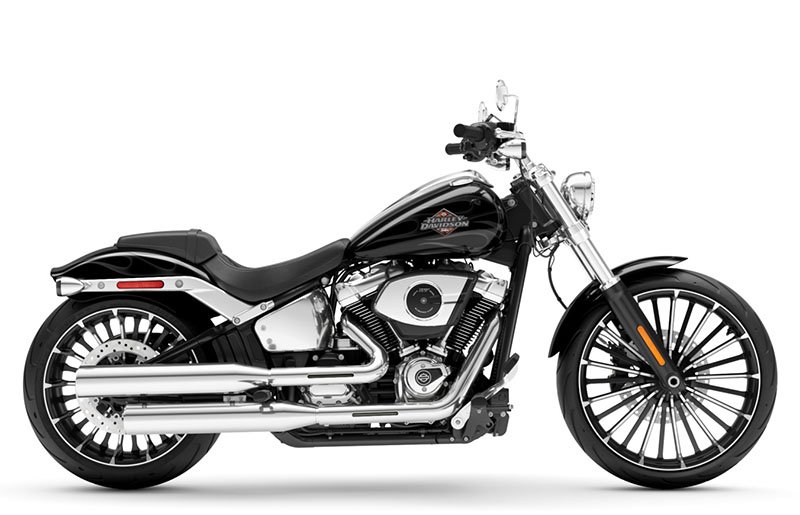
The Breakout is Harley’s factory-built drag-style cruiser, built around a stretched front end, a 240mm rear tire, and a bobtail fender. It’s not trying to be a canyon carver or a tourer. It’s built to look mean at a stoplight and pull hard off the line, and it delivers on both.
If you want a cruiser that turns heads in a parking lot and has the low-end grunt to back it up, the Breakout earns its price tag.
If you’re planning long highway miles, tight parking lot maneuvers, or spirited backroad riding, its weight, reach, and cornering clearance will work against you.
Harley-Davidson Breakout Specs (2026 Model Year)
| Spec | Figure |
|---|---|
| Engine | Milwaukee-Eight 117 Custom V-twin, air/oil-cooled |
| Displacement | 1,923cc (117 ci) |
| Horsepower (dyno-tested) | 94.2 hp @ 4,790 rpm (Cycle World, 2023) |
| Torque (dyno-tested) | 118 lb-ft (Cycle World, 2023) |
| Torque (manufacturer claim) | 126 lb-ft @ 3,000 rpm (Torquepedia, 2026) |
| Compression ratio | 10.2:1 |
| Transmission | 6-speed, belt final drive |
| Seat height | 26.2 in unladen / 25.6 in laden |
| Wet weight | 681 lbs |
| Wheelbase | 66.7 in |
| Rake | 34 degrees |
| Front tire | 130/60B21 Michelin Scorcher 11 |
| Rear tire | 240/40R18 Michelin Scorcher 11 |
| Fuel capacity | 5.0 gallons |
| MSRP (2026) | $22,999 + $895 destination |
No citations appear in this table by design. Figures are pulled from Cycle World’s independent dyno test and Torquepedia’s spec aggregation, both dated 2026 or 2023 as noted above.
How Fast Is the Harley-Davidson Breakout in the Real World?
Harley doesn’t publish official horsepower, torque, or top-speed figures for the Breakout, which is standard practice for the brand. Independent dyno testing fills that gap.
Cycle World ran the 2023 Breakout 117 on its in-house Dynojet 250i and recorded 94.2 hp at 4,790 rpm and 118 lb-ft of torque, a meaningful gap from Harley’s claimed 126 lb-ft rating.
That gap is normal. Manufacturer torque claims are typically measured at the crank, while dyno numbers reflect power actually reaching the rear wheel.
Third-party estimates put the Breakout’s 0-60 mph time around 4.6 seconds and top speed near 120 mph, though neither figure comes from a GPS-instrumented test and should be treated as an estimate rather than a verified number.
For comparison, the 2013 Twin Cam-powered Breakout made a claimed 95.5 lb-ft of torque, meaning the current 117 generation has added roughly 30 percent more claimed torque over thirteen years of updates.
Handling, Suspension, and How the Breakout Rides
The Breakout handles like what it is: a long, low, drag-inspired cruiser built for straight lines, not tight corners. The 34-degree rake and 66.7-inch wheelbase deliver stability at speed but slow the steering down noticeably compared to a standard Softail.
Ground clearance is 4.5 inches with a 26.8-degree lean angle on each side, so aggressive cornering isn’t the point here. Push it into a tight bend and the footpegs or exhaust will find pavement before the tires run out of grip.
The 2026 model uses dual-bending valve 49mm forks up front with under-seat hydraulic preload adjustment out back, a setup shared across the current Softail lineup.
That 240mm rear tire, mounted to an 18-inch wheel, is the real handling variable. It plants the bike hard in a straight line but adds noticeable steering effort at parking-lot speeds, something new riders coming from smaller cruisers should test-ride before buying.
What Changed Across Breakout Generations
credit: https://www.motorcycle.com/
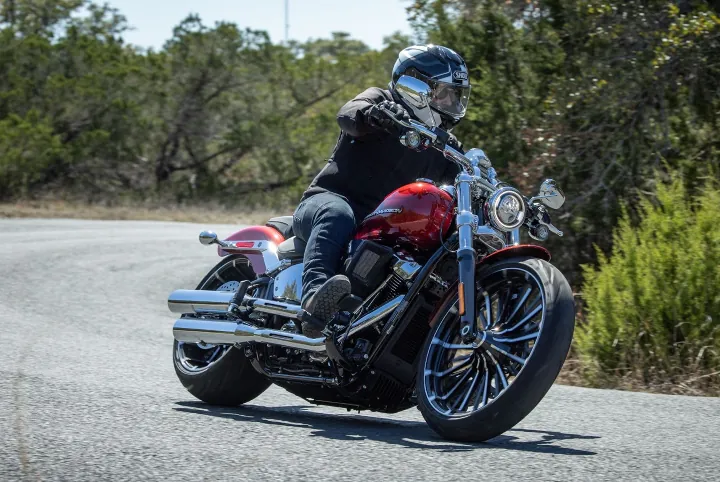
The Breakout has run through three engine platforms and two chassis designs since it launched. Knowing which generation you’re looking at matters more than the model year alone if you’re shopping used.
2013-2017 (FXSB, Twin Cam): The original Breakout launched as a 2013 CVO model with a 1,803cc Twin Cam 110B, followed by a standard version running the 1,690cc Twin Cam 103. This generation used the older dual-shock Softail chassis and an analog speedometer with no digital display.
2018-2022 (FXBR/FXBRS, Milwaukee-Eight 107/114): Harley redesigned the entire Softail platform for 2018, replacing the old dual-shock rear end with a hidden monoshock and swapping in the Milwaukee-Eight engine. Base models ran the 107ci (1,745cc) engine; the FXBRS variant added the 114ci (1,868cc) version. This generation was briefly pulled from some markets in 2020-2021.
2023-present (FXBR, Milwaukee-Eight 117): Harley brought the Breakout back in 2023 with the 117ci (1,923cc) Milwaukee-Eight, a larger 5.0-gallon fuel tank (up from 3.5 gallons), and more chrome trim than the blacked-out 2018-2022 look. This is the only engine size currently offered.
If you’re cross-shopping used Breakouts, the 2018 redesign is the bigger dividing line than the 2023 engine swap. The frame, suspension, and charging system all changed in 2018; the 2023 update is mostly a bigger engine and a styling refresh.
Harley-Davidson Breakout Pros and Cons
Pros:
- Strong low-end torque that makes stoplight-to-stoplight riding effortless
- Low 26.2-inch seat height works for a wide range of rider heights
- Distinctive factory-custom styling without a custom-shop price tag
- 6-speed transmission with a belt final drive that needs no chain lube or adjustment
Cons:
- 681-lb wet weight and slow steering make U-turns and tight parking harder than on a standard Softail
- 4.5 inches of ground clearance limits how hard you can lean it into a corner
- 5.0-gallon tank still means more frequent fuel stops than a touring-focused bike
- No stock windshield or saddlebags, so highway comfort and storage are add-on costs
Who Should Buy the Harley-Davidson Breakout?
The Breakout is best for riders who want a factory-built power cruiser for local rides, cruise nights, and short highway runs, not someone shopping for a first bike or a dedicated tourer. Its low seat height suits shorter riders, but its weight and reach favor riders with some seat time already.
Frequently Asked Questions About the Harley-Davidson Breakout
How much horsepower does the Harley-Davidson Breakout have?
Cycle World’s independent dyno test of the 2023 Breakout 117 measured 94.2 hp at 4,790 rpm (Cycle World, 2023). Harley doesn’t publish an official horsepower figure, so dyno testing is the most reliable source available.
What is the top speed of the Harley-Davidson Breakout?
Independent estimates put the top speed around 120 mph, but this figure isn’t from a GPS-instrumented test. Treat it as a rough estimate rather than a verified number.
How much does a Harley-Davidson Breakout cost?
The 2026 model starts at $22,999 MSRP plus an $895 destination charge (Motorcycle.com, 2025). Final out-the-door price varies by dealer, paint option, and region.
What is the seat height on the Harley-Davidson Breakout?
Seat height is 26.2 inches unladen and 25.6 inches with a rider aboard (Torquepedia, 2026). That’s low enough for most riders over 5’4″ to flat-foot at a stop.
Is the Harley-Davidson Breakout good for beginners?
It’s not the ideal first bike. The low seat height helps, but 681 lbs of wet weight and slow-speed steering effort from the 240mm rear tire are a lot to manage before you’ve built confidence on a motorcycle.