Indian FTR 1200 Top Speed, Specs & Review
TL;DR
- The Indian FTR 1200 reaches a GPS-verified top speed of 147.3 mph and runs 0-60 mph in 3.32 seconds
- Indian claims 120 hp and 87 lb-ft of torque from a 1,203cc liquid-cooled V-twin; rear-wheel testing shows 112 hp at the tire.
- Three trim levels are available: base FTR ($13,499), FTR Sport ($15,749), and FTR R Carbon ($17,249) for 2024.
- The 3.4-gallon underseat fuel tank limits real-world range to roughly 100-125 miles per fill — a consistent real-world compromise.
- Best suited to experienced riders who want a flat-track-inspired naked with genuine performance rather than just distinctive looks.
Indian FTR 1200 Full Specifications
| Spec | Detail |
|---|---|
| Engine | 1,203cc liquid-cooled 60° V-twin, DOHC |
| Bore x Stroke | 102 mm x 73.6 mm |
| Compression Ratio | 12.5:1 |
| Claimed Power | 120 hp @ 7,750 rpm |
| Claimed Torque | 87 lb-ft @ 6,000 rpm |
| Rear-Wheel Power | 112 hp (MotoStatz dyno, 2022) |
| Transmission | 6-speed, slipper clutch, chain final drive |
| Frame | Steel trellis |
| Front Suspension | 43mm inverted fork (Sachs, adjustable on Sport/R Carbon) |
| Rear Suspension | Monoshock (Sachs on base/Sport; Öhlins on R Carbon) |
| Front Brakes | Dual 320mm Brembo discs |
| Rear Brake | 265mm single disc |
| Front Tire | 120/70-17 |
| Rear Tire | 180/55-17 |
| Wheelbase | 60.0 in (1,524 mm) |
| Seat Height | 31.7 in (805 mm) — 2024 base and R Carbon |
| Wet Weight | 514-518 lb (233-235 kg) |
| Fuel Capacity | 3.4 US gallons (13 L) |
| MSRP (2024) | $13,499 / $15,749 / $17,249 (base / Sport / R Carbon) |
Indian FTR 1200 Top Speed: What the Data Actually Shows
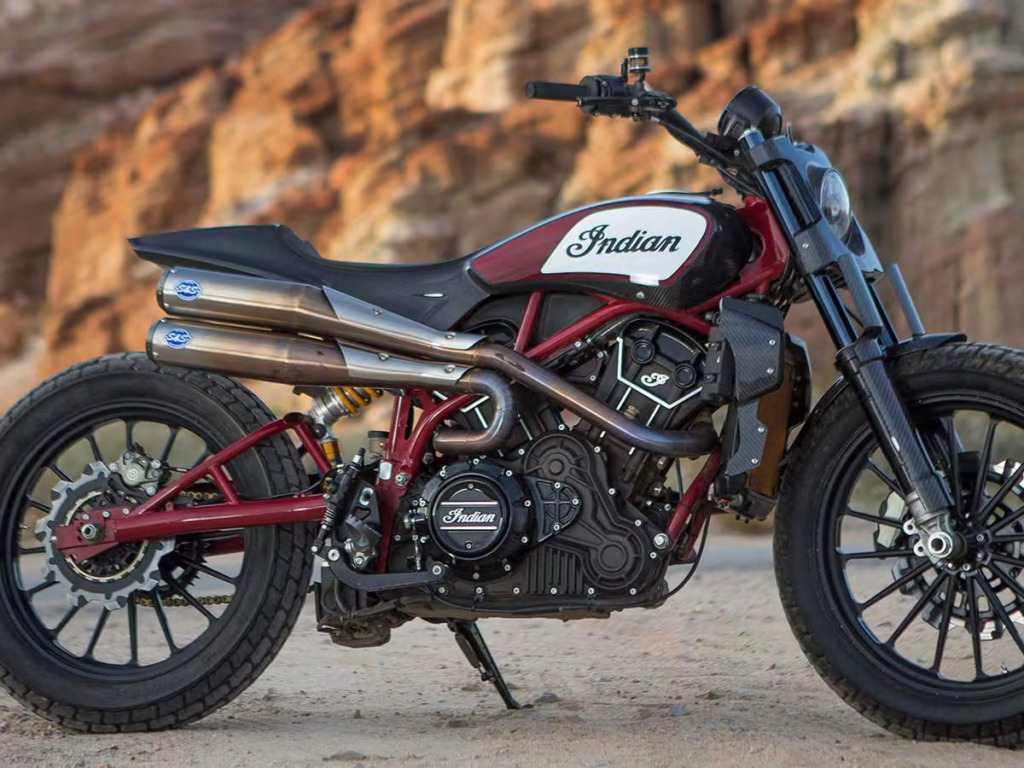
The Indian FTR 1200 reaches a GPS-verified top speed of 147.3 mph, recorded by MotoStatz under instrumented conditions with a rider tuck (MotoStatz, 2022). Indian Motorcycle publishes no official top speed figure, so that’s the most reliable independent data point available.
That 147 mph comes with a caveat: the FTR’s upright street-tracker riding position works against you at high speed. A taller rider sitting normally can expect meaningfully lower personal top speed — MotoStatz flags this specifically. Some market variants also ship with a factory speed limiter that clips the ceiling further.
The 120 mph quarter-mile trap speed confirms the engine pulls hard at the top end. There’s genuine momentum past 100 mph, even if the wind starts to win the argument without a fairing in the way.
Acceleration: 0-60 mph, Quarter Mile, and In-Gear Performance
The FTR 1200 runs hard off the line. MotoStatz recorded a best 0-60 mph of 3.32 seconds, 0-100 mph in 6.82 seconds, and a quarter mile of 11.20 seconds at 120 mph (MotoStatz, 2022). The 60-130 mph Dragy pull comes in at 9.86 seconds — rapid enough for the street, though a 600cc supersport will have it covered past 100 mph.
| Test | Result | Source |
|---|---|---|
| 0-60 mph | 3.32 sec | MotoStatz, 2022 |
| 0-100 mph | 6.82 sec | MotoStatz, 2022 |
| Quarter mile | 11.20 sec @ 120 mph | MotoStatz, 2022 |
| 60-130 mph | 9.86 sec | MotoStatz, 2022 |
| Top speed (GPS) | 147.3 mph | MotoStatz, 2022 |
The 0-60 run requires a gear change before 60 mph arrives, which costs time. The stock tires — Metzeler Sportec units on 2023+ models — also break traction easily on hard launches, which pushes the traction control into action before the front wheel gets a chance to unload properly. In real street riding, none of that matters. The FTR launches with authority from a rolling start, and the torque hits immediately off the bottom, which is where most actual street accelerating happens anyway.
Engine and Powertrain: Where the 1,203cc V-Twin Earns Its Keep
The FTR’s 1,203cc, liquid-cooled V-twin is a purpose-built motor, not a repurposed cruiser engine. It shares its 60-degree architecture with the Scout but got entirely new cylinder heads, cams, crankshaft, and valvetrain for this application (Cycle News, 2019). The result revs freely past 8,000 rpm — which for two 600cc pistons is genuinely impressive.
Indian claims 120 hp and 87 lb-ft of torque at the crank. Rear-wheel dyno testing shows 112 hp and 82 lb-ft at the tire (MotoStatz, 2022). The torque peak at 6,000 rpm keeps the usable power band well within street-speed territory. There’s a slight midrange dip on the dyno plot, but it’s not felt on the road — throttle response is immediate and continuous.
Two features worth noting: the ride-by-wire throttle enables engine map changes across the three ride modes on Sport and R Carbon trims, and the rear cylinder deactivation system kills the rear jug at idle to cut heat soak in traffic. The 12.5:1 compression ratio means premium fuel. Budget accordingly.
Chassis and Suspension: Built for Corners, Not Cruising
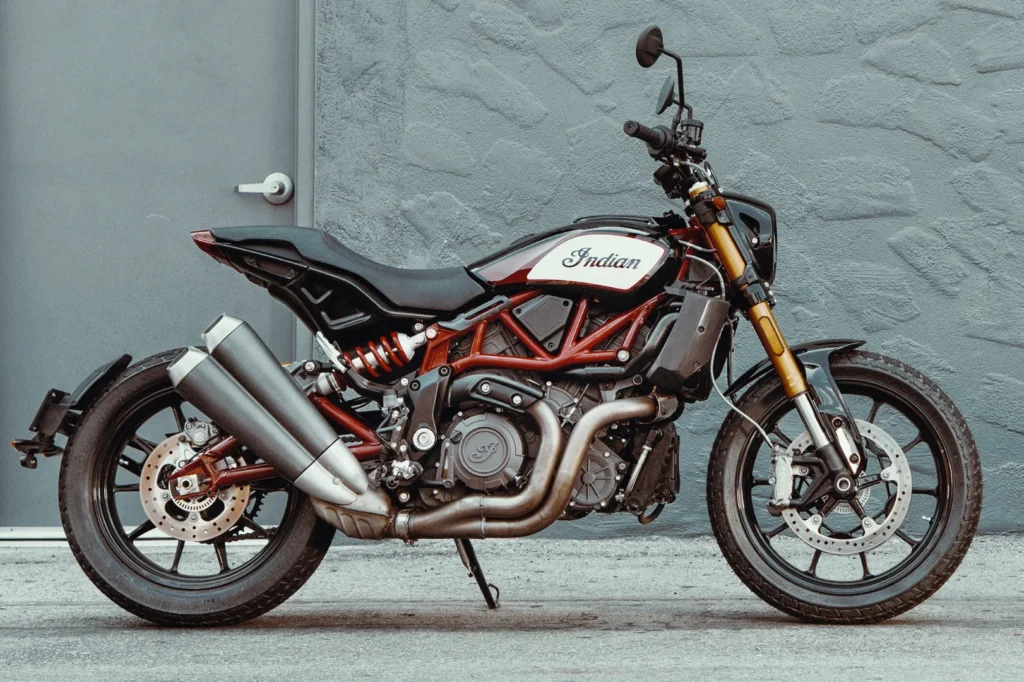
The FTR’s steel trellis frame is the defining chassis decision. It’s rigid, light for what it is, and uses the engine as a stressed member — a design approach borrowed from European sportbike practice. The 25.3-degree rake and 60-inch wheelbase give the FTR a planted feel in faster corners without making it sluggish through tighter turns.
Suspension spec depends on trim level. The base FTR and Sport run 43mm Sachs inverted forks with a Sachs rear monoshock — fully adjustable on the Sport, preload-and-rebound-only on the base. The R Carbon steps up to Öhlins at both ends.
Suspension travel is 120mm front and rear on 2023+ models, down from 150mm on the original 2019 bike. The tighter travel, combined with the switch to 17-inch wheels on both ends, pushed the FTR firmly toward streetfighter behavior. Turn-in sharpened and road feel improved; the tradeoff is a stiffer ride on rough pavement.
The move to Metzeler Sportec tires in 2023 addressed one of the most consistent criticisms of early FTRs. The original Dunlop DT3-R flattrack rubber behaved poorly on grooved pavement and in the wet. The Metzelers are a real improvement in all-conditions road behavior.
Electronics and Rider Aids: Which Trim Gets What
The FTR’s electronics package varies significantly across trims, so it’s worth mapping before you buy.
The base FTR ($13,499) has standard ABS — non-switchable — and no traction control or ride modes. The throttle response mirrors the Sport’s Standard mode, but you can’t change it (FTR1200 Forum, 2020).
The FTR Sport ($15,749) adds the full stack: a six-axis IMU, lean-angle-sensitive cornering ABS, switchable traction control, wheelie and rear-lift mitigation, stability control, and three ride modes (Rain, Standard, Sport). Rain mode drops output to 93 hp and softens the throttle map. The Sport also gets the 4-inch Ride Command TFT touchscreen with Bluetooth, GPS navigation, and a USB charging port.
The FTR R Carbon ($17,249) runs identical electronics to the Sport, adds Öhlins suspension and carbon fiber bodywork, and includes a dual Akrapovic exhaust as standard.
| Feature | FTR Base | FTR Sport | FTR R Carbon |
|---|---|---|---|
| ABS | Standard (non-switchable) | Cornering, switchable | Cornering, switchable |
| Traction Control | None | IMU-supported, switchable | IMU-supported, switchable |
| Ride Modes | None | Rain / Standard / Sport | Rain / Standard / Sport |
| TFT Display | No (analog/LCD) | Yes (4-inch Ride Command) | Yes (4-inch Ride Command) |
| Suspension | Sachs (limited adjust) | Sachs (fully adjustable) | Öhlins (fully adjustable) |
| Exhaust | Stock | Akrapovic slip-on | Dual Akrapovic |
Strengths and Real Limitations
The FTR 1200 earns its price on the road. The torquey V-twin delivers instant, linear thrust without a sudden hit that catches riders off guard. The dual 320mm Brembo fronts are confidence-inspiring and don’t fade. The trellis frame communicates road texture without getting nervous, and the riding position is upright enough for daily riding without compromising canyon runs.
The real limitations are equally well-documented. The 3.4-gallon underseat fuel tank is the FTR’s most persistent frustration — expect a fuel warning light around 100-125 miles and a practical range just above 130 miles at best (RevZilla, 2022; MCN, 2021). Indian couldn’t simply bolt on a larger tank because what looks like the tank is actually the airbox; the fuel cell lives under the seat to centralize mass. That’s a logical engineering decision that produces an inconvenient real-world outcome.
At 514-518 lb wet, the FTR is also heavy for a naked bike. That weight is most obvious at slow speed and full lock in parking lots. At highway speed, it becomes a stability asset.
Who Should Buy the Indian FTR 1200
The FTR 1200 suits riders with some experience who want a naked motorcycle with genuine performance credentials and a visual identity that isn’t shared with half the bikes in the parking lot. The base model at $13,499 is capable but stripped — no traction control, no ride modes, no TFT. It’s the purist buy.
The Sport at $15,749 is the version most riders should consider. The full electronics stack, Akrapovic exhaust, and Ride Command display make it a genuinely more complete machine, and the IMU-assisted safety net matters in variable weather conditions.
Skip the FTR if you regularly ride beyond 120 miles between fuel stops, or need real long-distance capability. The tank won’t support it.
Frequently Asked Questions About the Indian FTR 1200
What is the top speed of the Indian FTR 1200?
The Indian FTR 1200 reaches a GPS-verified top speed of 147.3 mph under instrumented test conditions with a rider tuck (MotoStatz, 2022). Indian publishes no official top speed figure. Some market variants ship with a factory speed restriction; unrestricted bikes hit the rev limiter in sixth at approximately 147 mph.
How fast does the Indian FTR 1200 do 0-60 mph?
MotoStatz recorded a best 0-60 mph of 3.32 seconds and a quarter mile of 11.20 seconds at 120 mph (2022). Real-world times vary with rider weight, temperature, and traction — the stock tires break traction easily on hard launches.
What are the key differences between the FTR, FTR Sport, and FTR R Carbon?
The base FTR ($13,499) has standard ABS with no traction control or ride modes. The FTR Sport ($15,749) adds IMU-supported cornering ABS, switchable traction control, three ride modes, and a TFT touchscreen. The FTR R Carbon ($17,249) carries the same electronics as the Sport but upgrades to Öhlins suspension and carbon fiber bodywork, with a dual Akrapovic exhaust included (Cycle World, 2024).
What is the fuel range of the Indian FTR 1200?
Expect 100-125 miles per tank. The 3.4-gallon underseat tank is the FTR’s most consistently cited limitation (RevZilla, 2022). Fuel economy averages 33-40 mpg depending on riding style.
How heavy is the Indian FTR 1200?
The FTR base and Sport weigh approximately 514 lb (233 kg) wet. The R Carbon comes in at 518 lb (235 kg). This puts it on the heavier end of the naked segment; the mass is most obvious at slow-speed maneuvering.
Does the Indian FTR 1200 have traction control?
The base FTR does not have traction control — only standard, non-switchable ABS. The FTR Sport and R Carbon include IMU-supported, lean-angle-sensitive traction control that integrates with the three ride modes and is fully switchable (Rider Magazine, 2019).
What to Know Before You Buy
- Indian claims 120 hp and 87 lb-ft of torque; rear-wheel dyno testing measures 112 hp and 82 lb-ft.
- GPS-verified top speed is 147.3 mph; 0-60 mph comes up in 3.32 seconds (both from MotoStatz, 2022).
- The FTR Sport at $15,749 is the most complete buy — it adds IMU electronics, ride modes, and a TFT display that the base model lacks entirely.
- The 3.4-gallon underseat tank limits real-world range to around 100-125 miles, which is the single most consistent owner complaint across every long-term review.
- 2023+ models improved significantly with Metzeler Sportec tires on 17-inch wheels at both ends, replacing the original flat-track Dunlop DT3-Rs that misbehaved on wet and grooved roads.