Ducati Multistrada V2 Top Speed, Specs & Review
TL;DR
- The Ducati Multistrada V2 makes 115 hp and 68 lb-ft of torque from an all-new 890cc V-twin, replacing the old 937cc Testastretta engine
- No independently instrumented top speed or 0-60 mph test has been published for this generation yet; Ducati’s claimed output is the only figure available
- US pricing starts at $15,995 for the base V2 and $19,295 for the electronically-suspended V2 S
- Wet weight without fuel is 439 lb for the base V2, 18 kg lighter than the outgoing 937cc model
- Seat height adjusts between 830-850 mm (32.7-33.5 in), with low and high seat accessories extending that range further
What’s the Ducati Multistrada V2’s Top Speed?
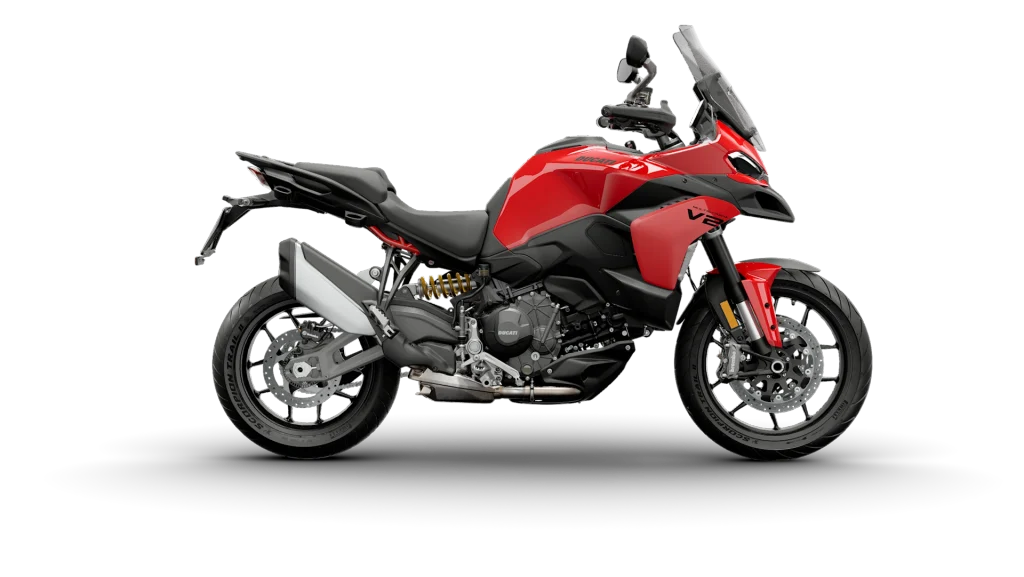
Ducati hasn’t published an official top speed figure for the current-generation Multistrada V2, and no independent publication has run an instrumented test yet, per a check of MotoStatz and major test outlets (MotoStatz, 2026). That’s not unusual for a bike that’s still relatively fresh to market; magazines with proper test gear tend to get to flagship models first.
What we do know: this is a 115 hp middleweight adventure-tourer with a fairly tall stance and a windscreen, not a stripped-down sportbike. Bikes in this class with comparable power-to-weight typically land somewhere in the 130-140 mph range, but that’s an estimate based on class norms, not a measured number for this specific bike.
If you need a hard figure for a spec sheet, treat anything you see online as unverified until a named publication runs the test.
How Fast Does the Multistrada V2 Accelerate?
There’s no published 0-60 mph time for the 2025-2026 Multistrada V2 from an instrumented test yet either. Ducati’s own launch materials focus on horsepower and torque curves, not acceleration runs, and outlets that rode it at the Valencia press launch delivered first-ride impressions rather than dragstrip numbers.
What the reviewers did report is useful context. More than 70% of peak torque is available by 3,500 rpm, and that number stays above 75% all the way to 11,000 rpm. That’s a wide, flat torque curve, which usually means strong roll-on acceleration in the midrange even without eye-popping 0-60 numbers. It’s the kind of delivery you feel rolling out of a tight corner in third gear rather than on a dragstrip clock.
Full Ducati Multistrada V2 Specs
| Spec | Multistrada V2 | Multistrada V2 S |
|---|---|---|
| Engine | 890cc, 90-degree V-twin, liquid-cooled | 890cc, 90-degree V-twin, liquid-cooled |
| Power | 115 hp @ 10,750 rpm | 115 hp @ 10,750 rpm |
| Torque | 68 lb-ft (92.1 Nm) @ 8,250 rpm | 68 lb-ft (92.1 Nm) @ 8,250 rpm |
| Compression ratio | 13.1:1 | 13.1:1 |
| Transmission | 6-speed, Ducati Quick Shift up/down 2.0 | 6-speed, Ducati Quick Shift up/down 2.0 |
| Front suspension | 45mm Marzocchi fork, manual adjustment | 45mm Marzocchi fork, Ducati Skyhook electronic suspension |
| Rear suspension | Fully adjustable monoshock | Electronic Skyhook monoshock |
| Front brake | Dual 320mm discs, Brembo 4-piston monobloc, Cornering ABS | Dual 320mm discs, Brembo 4-piston monobloc, Cornering ABS |
| Wet weight (no fuel) | 439 lb (199 kg) | 445 lb (202 kg) |
| Seat height | 32.7-33.5 in (830-850 mm) | 32.7-33.5 in (830-850 mm) |
| Fuel capacity | 5.02 gal (19 L) | 5.02 gal (19 L) |
| US MSRP | $15,995 | $19,295 |
Source: Ducati.com factory spec sheet, 2026 model year.
What Changed From the Old Multistrada 950/V2?
The short answer: almost everything. Ducati swapped the previous 937cc Testastretta engine, which used desmodromic valves and a belt-driven cam system, for a completely new 890cc V-twin with conventional valve springs and variable intake timing instead, according to the factory’s own technical rundown (Ducati, 2026).
That switch away from Desmodromic actuation is a bigger deal than it sounds if you’ve wrenched on Ducatis before. Desmo valves don’t use springs to close, which traditionally meant tighter tolerances and pricier valve service.
The new 890 V2 engine uses springs like a Honda or Yamaha, and Ducati stretched the valve clearance check interval out to 45,000 km (28,000 miles), a big jump from what older Testastretta-powered Ducatis needed.
The frame changed too. Out goes the steel-tube trellis, in comes a V4-style aluminum monocoque that uses the engine as a stressed member. Combined with a new double-sided aluminum swingarm, Ducati shaved close to 40 pounds off the previous model’s wet weight. If you’ve ridden the old 950, the new V2 is meaningfully lighter and quicker-steering in the parking lot alone.
Base V2 vs. V2 S: Which One Do You Actually Need?
The base Multistrada V2 and the S share the identical 115 hp engine, frame, and brakes. The $3,300 gap between them comes down almost entirely to suspension.
The base V2 runs a manually adjustable 45mm Marzocchi fork and shock; you set compression and rebound damping by hand and it stays put until you change it again. The V2 S swaps in Ducati’s Skyhook electronic suspension, which adjusts damping on the fly based on riding mode, plus a one-button “Minimum Preload” feature that drops the rear end for easier stops.
For a commuter or a rider who sets up their suspension once and leaves it, the base V2 does the job and saves real money. If you’re touring two-up with variable loads, or you just want the suspension to adapt automatically between a canyon road and a gravel fire road, the S earns its premium.
Is the Multistrada V2 a Good Beginner Bike?
Probably not your first bike, but it’s a reasonable second bike for someone who’s outgrown a 400-650cc machine. At 115 hp and 439 lb, the V2 isn’t as intimidating as the 170 hp V4 Multistrada, and the seat can drop as low as 810 mm with the low-seat accessory for shorter riders.
That said, five customizable ride modes (Sport, Touring, Urban, Enduro, Wet) plus Ducati Traction Control and Cornering ABS give a newer rider real safety margin. Set it to Urban or Wet mode and the power delivery gets noticeably tamer than what you’ll find in Sport. It’s a bike that can grow with you rather than one you’ll outgrow in a season.
Maintenance: What Does Owning a Multistrada V2 Actually Cost?
Oil service is due every 15,000 km (9,000 miles) or 24 months, whichever comes first. Valve clearance checks stretch to 45,000 km (28,000 miles), which is a genuinely long interval for a Ducati twin and reflects the move away from Desmodromic valves.
Budget for Motul or an equivalent full-synthetic oil at each service, and expect the Pirelli Scorpion Trail II tires the bike ships on to need replacing sooner than the drivetrain does if you ride it hard in the twisties.
The chain and sprocket final drive (15-tooth front, 40-tooth rear) is standard fare, so a DID or RK replacement chain and basic chain lube maintenance apply just like on any other chain-drive middleweight.
Frequently Asked Questions
What is the top speed of the Ducati Multistrada V2?
No independently instrumented top speed test has been published for the current 890cc Multistrada V2. Ducati doesn’t publish an official top speed figure either. Treat any specific number you see elsewhere as an estimate, not a verified result.
How much horsepower does the Multistrada V2 have?
115 hp at 10,750 rpm and 68 lb-ft of torque at 8,250 rpm, according to Ducati’s official specs for the 890cc V-twin engine.
What’s the difference between the Multistrada V2 and V2 S?
The V2 S adds Ducati Skyhook electronic semi-active suspension and the Ducati Multimedia System as standard, for a $3,300 premium over the base V2’s manually adjustable suspension.
How much does a Ducati Multistrada V2 cost in the US?
The base V2 starts at $15,995. The V2 S starts at $19,295 in Ducati Red, or $19,695 in Storm Green.
Is the Multistrada V2 heavier than the Multistrada V4?
No, it’s significantly lighter. The V2 weighs 439 lb wet without fuel, while the V4 weighs 505 lb, a difference of 66 pounds that shows up immediately in low-speed handling.
What size engine does the 2025-2026 Multistrada V2 use?
An all-new 890cc, 90-degree V-twin with variable intake valve timing, replacing the previous model’s 937cc Testastretta desmodromic engine.