Harley-Davidson Battery Size Chart by Year (2026 Guide)
TL;DR
- Harley battery sizing splits by model family and generation, not by year alone; a 2015 Softail and a 2015 Sportster take different batteries.
- Touring models built 1997-2023 (FLH/FLT/FLR) use a Yuasa GYZ32HL equivalent: 32Ah, 500 CCA.
- Softail and Dyna models from 1991 onward mostly use a GYZ20HL equivalent: 20Ah, 320 CCA.
- Sportsters from 2004-2023 downsized to a GYZ16HL equivalent: 16Ah, 240 CCA.
- Always confirm against your VIN and the case-side label on your old battery before ordering; running production changes mid-year on some platforms.
Battery group size on a Harley isn’t a single number you can memorize once. It shifts by frame family (Touring, Softail, Dyna, Sportster, V-Rod) and by generation within that family, because Harley redesigned battery trays and charging systems at different points for each platform. Grab your VIN and know your specific model before you order.
Harley-Davidson Battery Size Chart by Model and Year

credit: https://www.afbmotorcycles.co.uk/
This chart is built from Yuasa’s motorcycle battery application data, the primary aftermarket supplier most Harley dealers and independent shops use for factory-equivalent replacements.
Group sizes below are given as capacity (amp-hours) and cold cranking amps (CCA) at 0°F, which is how battery output is actually rated in the powersports world.
| Model Family | Model Years | Capacity | CCA | Common Group Equivalent |
|---|---|---|---|---|
| Touring (FLH/FLT/FLR) | 1997-2023 | 32 Ah | 500 | GYZ32HL |
| Touring (FL/FLH) | 1985-1996 | 21 Ah | 350 | YTX24HL |
| Touring (FL/FLH) | 1965-1984 | 29 Ah | N/A (conventional) | YHD-12H |
| Softail (FX/FL) | 1991-2023 | 20 Ah | 320 | GYZ20HL |
| Softail (FXST/FLST) | 1984-1990 | 20 Ah | 320 | GYZ20H |
| Dyna (FXD, all) | 1991-2017 | 20 Ah | 320 | GYZ20HL |
| FX/FXR series | 1979-1994 | 20 Ah | 320 | GYZ20H |
| Sportster (XL/XLH/XR1200X) | 2004-2023 | 16 Ah | 240 | GYZ16HL |
| Sportster (XL/XLH) | 1987-2003 | 18 Ah | 310 | YTX20HL / YTX20H |
| V-Rod (VRSC) | 2007-2017 | 20 Ah | 320 | GYZ20HL |
| V-Rod (VRSC/VRSCR) | 2002-2006 | 16 Ah | 240 | GYZ16H |
| Street (XG) | 2014-2021 | 16 Ah | 240 | GYZ16HL |
| Pan America | 2021-present | 16 Ah | 240 | GYZ16HL |
Two things jump out once you see the whole lineup side by side. First, Touring bikes have carried the biggest battery in the catalog since 1997 for a reason: they’re running audio systems, heated grips, and full lighting packages that smaller platforms don’t.
Second, the Sportster dropped from an 18Ah battery to a 16Ah battery starting in 2004, when Harley switched to a smaller, lighter charging system on that platform.
How to Find Your Exact Battery Group Size
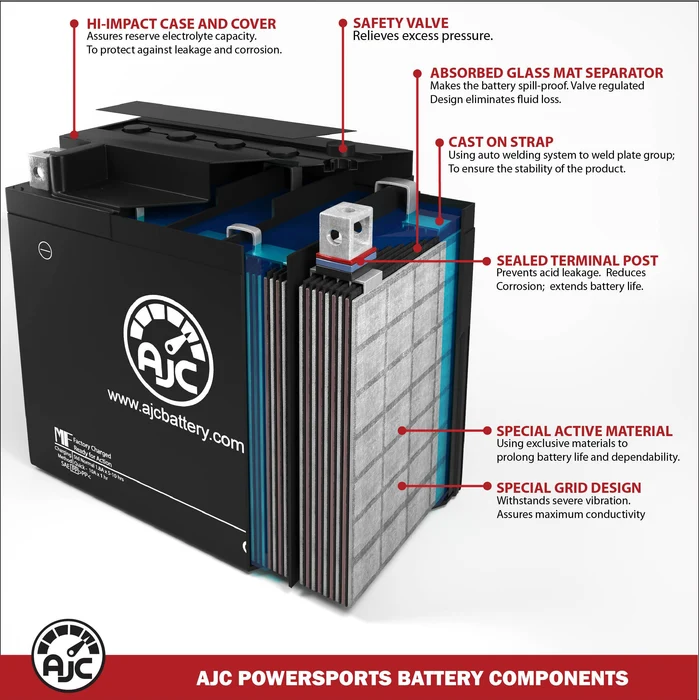
The fastest way to confirm your battery size is to pull the physical battery and read the part number printed on the case.
That number cross-references directly to a Yuasa or Harley OEM equivalent, and it accounts for any mid-generation running changes the chart above can’t capture at a glance.
If the battery is dead or already removed, your owner’s manual lists the OEM battery number in the electrical section. Every Harley manual includes this in the specifications chapter, usually right next to the fuse panel diagram.
Your VIN also narrows things down fast. The 10th character identifies model year, and a quick VIN decode confirms whether you’re dealing with the pre- or post-2004 Sportster charging system, for example, which matters because those two eras take different battery capacities.
Dealers can pull exact fitment from your VIN in their parts system in under a minute, and it costs nothing to ask before you buy.
AGM, Conventional, and Lithium: What Actually Fits
Modern Harleys from the 1990s onward almost universally use AGM (absorbent glass mat) batteries, which are sealed, spill-proof, and vibration-resistant.
That’s the GYZ-series designation you see throughout the chart above. Older bikes from before the mid-1980s often specified conventional flooded-cell batteries instead, which need periodic water top-offs and sit upright only.
Lithium iron phosphate (LiFePO4) batteries are a newer aftermarket option that can cut weight by more than half compared to an AGM unit of equivalent CCA.
They work fine on most Harleys, but only if your charging system and battery tender are compatible with lithium chemistry; some older stock charging systems weren’t designed for the different voltage curve lithium batteries produce, so check with the battery manufacturer before swapping.
Stick with AGM if you want a straightforward factory-equivalent replacement with no compatibility questions. Choose lithium only if you’re chasing weight savings on a race build or a project bike and you’ve confirmed charger compatibility first.
Common Mistakes When Replacing a Harley Battery
Getting the group size right is only part of the job. Polarity, terminal type, and hold-down all have to match too, or the new battery won’t seat correctly even if the Ah rating is identical.
- Buying by CCA alone: A higher CCA battery that’s physically too large for the tray won’t fit the factory hold-down bracket, and forcing it risks cracking the case against the frame.
- Ignoring polarity: Left-hand and right-hand terminal batteries aren’t interchangeable without an adapter kit; check the terminal layout on your old battery, not just the size.
- Skipping the charge-before-install step: AGM batteries ship partially charged and need a full charge cycle before their first start, especially after sitting in a warehouse or on a store shelf.
- Reusing a corroded terminal bolt: Old stainless hardware that’s pitted from acid exposure won’t seat cleanly on a new battery and can cause a poor connection that mimics a bad battery.
Seasonal Battery Care for Harley Riders
Cold weather is when a marginal battery finally quits, because CCA output drops as temperature drops, and a battery that started fine in July can fail to turn the engine over in January.
Riders in northern states should test battery voltage every fall before storage season, not wait for a no-start morning to find out it’s weak.
A battery tender rated for your battery’s chemistry (AGM or lithium) is the single cheapest insurance against a dead battery, whether the bike sits for two weeks or five months. Plug it in during any storage period longer than a few weeks, and check terminal corrosion at the start of every riding season.
Frequently Asked Questions About Harley-Davidson Battery Sizes
What size battery does a Harley Touring model use?
Touring models built from 1997 through 2023, including Road King, Street Glide, and Road Glide, use a 32Ah battery rated at 500 CCA, equivalent to a Yuasa GYZ32HL. Earlier Touring bikes from 1985-1996 used a smaller 21Ah battery instead.
Is a Sportster battery the same size as a Softail battery?
No. Sportsters built 2004-2023 use a 16Ah, 240 CCA battery, while Softails from 1991-2023 use a larger 20Ah, 320 CCA battery. The two platforms have different charging systems and electrical loads, so the batteries aren’t interchangeable without modifying the tray.
Can I put a lithium battery in an older Harley?
Sometimes, but you need to confirm your charging system and any battery tender you use are rated for lithium chemistry first. Lithium batteries have a different charge voltage curve than AGM, and using an incompatible charger can damage the battery or fail to charge it properly.
How do I know if my Harley battery is AGM or conventional?
Check the case label. AGM batteries are sealed and labeled “maintenance-free” or “AGM,” while conventional batteries have removable vent caps for adding water. Nearly every Harley from the 1990s forward shipped with AGM from the factory.
Why did my Sportster battery get smaller in newer model years?
Harley redesigned the Sportster charging system starting in the 2004 model year, moving to a lighter-duty electrical system that didn’t need the larger 18Ah battery used on 1987-2003 models. The 16Ah GYZ16HL-equivalent battery has been standard on Sportsters since.