
How Many Volts is a Motorcycle Battery
TL;DR
- A standard motorcycle battery is a 12-volt battery, just like a car battery.
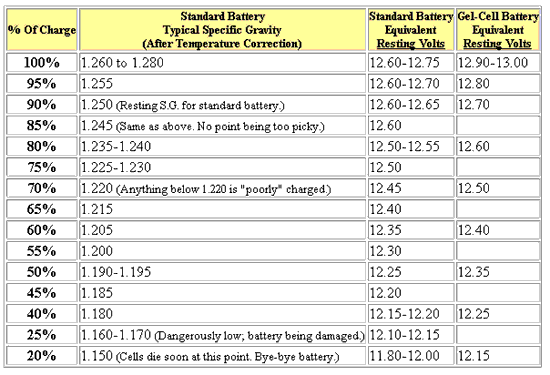
- A fully charged, resting battery reads 12.6 to 12.8 volts; below 12.0 volts at rest means the battery is significantly discharged.
- While charging, voltage rises to 14.4 to 14.7 volts – that’s normal output from your bike’s charging system.
- Lithium iron phosphate (LiFePO4) batteries are also 12-volt nominal but rest higher, around 13.2 to 13.4 volts when fully charged.
- A reading below 11.5 volts at rest almost always means the battery is sulfated and needs replacement.
The Short Answer: Motorcycle Batteries Are 12 Volts
A motorcycle battery is a 12-volt battery. That applies to nearly every street bike, cruiser, adventure bike, and sportbike sold in the US since the mid-1970s. Whether you’re riding a Honda CB500F, a Harley-Davidson Sportster, or a Ducati Panigale, the battery under the seat is a 12V unit.
The only common exceptions are older bikes from the 1950s and 1960s, which often used 6-volt electrical systems. If your bike predates 1970, double-check before you buy a replacement.
Small-displacement off-road bikes and scooters under 50cc sometimes run on a 6-volt system even into the 1980s, so if you’re dealing with a vintage enduro or a moped, verify the system voltage before buying anything. For anything built after 1980 with street registration, you’re almost certainly on 12V.
What “12 Volt” Actually Means – and Why the Numbers Change
A motorcycle battery labeled 12 volts is a nominal voltage rating, not the actual voltage you’ll read at any given moment. The real number shifts depending on the battery’s state of charge, temperature, and whether the engine is running.
Here’s what you’ll actually measure with a multimeter at different states:
| Battery State | Voltage Reading (12V Lead-Acid) |
|---|---|
| Fully charged, resting (engine off 2+ hours) | 12.6 – 12.8 V |
| Healthy but not full | 12.3 – 12.5 V |
| 50% discharged | 12.0 – 12.2 V |
| Deeply discharged | 11.5 – 11.9 V |
| Dead / sulfated | Below 11.5 V |
| Engine running (charging system output) | 13.8 – 14.7 V |
The resting voltage is the most useful number. To get an accurate reading, the bike needs to sit with the engine off for at least two hours – ideally overnight. A battery that was just charged or just used will show a surface charge that inflates the reading temporarily.
How Voltage Differs Between Battery Types
Not all motorcycle batteries behave the same way on a voltmeter. The chemistry inside determines what a “full” reading looks like.
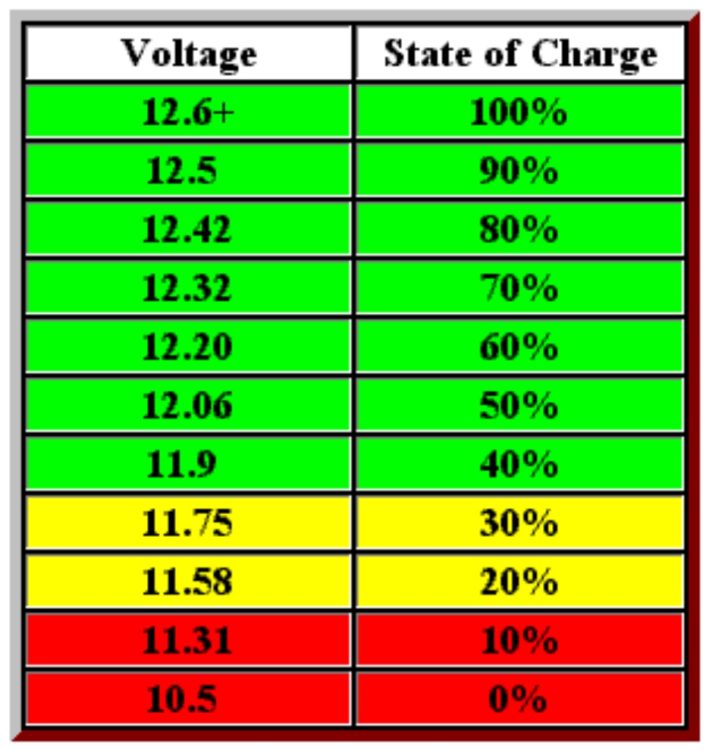
Lead-acid (conventional flooded): The oldest design, still common on budget bikes and older models. A fully charged flooded battery reads 12.6 to 12.8 volts at rest. These need periodic electrolyte checks and don’t tolerate deep discharge well.
AGM (Absorbed Glass Mat): The most common OEM fitment on modern bikes. Same nominal voltage as flooded, with a resting full-charge reading of 12.6 to 12.8 volts. More vibration resistant and sealed, so no electrolyte maintenance. Brands like Yuasa and Odyssey dominate this category. AGM batteries also recover better from partial discharge cycles than flooded units, making them a better fit for commuter bikes that get short rides and frequent stop-start use.
Lithium iron phosphate (LiFePO4): Increasingly popular as an aftermarket upgrade. LiFePO4 batteries are still sold as 12-volt replacements, but their chemistry produces a higher resting voltage. A fully charged LiFePO4 reads approximately 13.2 to 13.4 volts. The discharge curve is also flatter, meaning voltage stays high until the battery is nearly empty, then drops quickly.
One important note: LiFePO4 batteries require a lithium-compatible charger. Charging a lithium battery with a standard lead-acid charger can overcharge it and shorten its life significantly.
How to Test Your Motorcycle Battery Voltage at Home
Testing battery voltage takes about two minutes and requires only a basic digital multimeter. You can get a usable multimeter for under $20 at any auto parts store.
Step 1: Set your multimeter to DC voltage. Look for the V with a straight line (DC), not the wavy line (AC). Set the range to 20V DC if your meter isn’t auto-ranging.
Step 2: Let the bike sit. The engine should be off for at least two hours to allow the surface charge to dissipate. Testing right after a ride will give you a falsely optimistic reading.
Step 3: Connect the probes. Touch the red probe to the positive terminal and the black probe to the negative terminal. Reversed connection won’t damage most modern multimeters, but it will display a negative number.
Step 4: Read and record the voltage. Compare your reading to the table in the previous section.
Step 5: Test with the engine running. Start the bike and rev it to around 3,000 RPM. The voltage at the battery terminals should climb to 13.8 to 14.7 volts. A reading below 13.5 V at that RPM suggests a charging system issue – likely a faulty stator or regulator/rectifier, not the battery itself.
What Charging Voltage Should a Motorcycle Put Out?
When the engine is running, the charging system – specifically the stator and regulator/rectifier – converts AC power from the alternator into regulated DC voltage to charge the battery and power the bike’s electronics.
The target output is 13.8 to 14.7 volts at the battery terminals. Think of it like a trickle feed: enough to top off the battery without overcharging it.
| Charging System Reading (Engine Running, ~3,000 RPM) | What It Means |
|---|---|
| 13.8 – 14.7 V | Normal, charging system is healthy |
| Below 13.5 V | Undercharging – stator or R/R may be failing |
| Above 15.0 V | Overcharging – regulator/rectifier likely failed |
Overcharging is more dangerous than undercharging. A failed regulator/rectifier can push 16+ volts into the system, boiling electrolyte in a flooded battery, damaging an AGM, and potentially destroying the ECU or other electronics. If your bike is cooking through bulbs frequently, that’s a red flag worth chasing with a multimeter before you assume it’s just bad luck.
When Low Voltage Means It’s Time to Replace the Battery
A battery that reads below 12.0 volts after a full overnight charge – not after sitting discharged for a week, but after a proper charge – is telling you it can’t hold a charge anymore. At that point, charging it again is wasting time.
The specific failure threshold most battery manufacturers and mechanics use is 12.4 volts after a full charge. If a fully charged battery can’t reach 12.4V at rest, replace it.
A load test is even more definitive than a resting voltage test. Most auto parts stores (AutoZone, O’Reilly, NAPA) will perform a battery load test for free. The test applies a controlled load to the battery while monitoring voltage drop. A healthy battery holds above 9.6 volts under load; one that drops below that is done.
Signs the battery is failing beyond voltage readings alone: the starter sounds sluggish or slow even after a fresh charge, the bike cranks fine when warm but won’t start on a cold morning, or the battery loses charge sitting for more than a week with no parasitic draw.
Battery life on a motorcycle averages three to five years under normal use, though that range assumes regular riding and proper winter storage. A battery left to sit all winter without a maintenance charger – something like a Battery Tender Plus or a NOCO Genius 1 – will lose a full year of service life for every season it sits discharged. If you’re in a cold climate and you’re not putting the battery on a tender from October through March, you’re shortening it faster than you think.
Frequently Asked Questions About Motorcycle Battery Voltage
How many volts should a fully charged motorcycle battery read?
A fully charged lead-acid or AGM motorcycle battery should read 12.6 to 12.8 volts at rest, with the engine off and no load on the electrical system. Measure it after the battery has sat idle for at least two hours for an accurate baseline reading.
Is 12.2 volts enough to start a motorcycle?
Sometimes, but it’s marginal. At 12.2 volts, the battery is roughly 50% discharged. Some bikes will crank, others won’t – it depends on engine displacement, temperature, and how healthy the battery’s internal resistance is. A battery sitting at 12.2 volts after being parked overnight should be charged before you rely on it.
Why does my motorcycle show 14 volts when running?
14 volts (more precisely, 13.8 to 14.7 V) is the normal output of a healthy charging system. The regulator/rectifier steps down the stator’s AC output and regulates it to this range. It’s not overcharging; it’s exactly what the battery needs to stay topped off while the engine runs.
Can a motorcycle battery be too old to hold voltage even if it tests okay at rest?
Yes. Resting voltage is a state-of-charge test, not a capacity test. An old battery can show 12.6V at rest but collapse under the load of cranking the starter. A proper load test – available free at most auto parts stores – is the only way to assess true capacity.
What voltage is too low to jump-start a motorcycle?
If the battery reads below 10.5 volts, a jump start may not work reliably and could stress the donor battery. A battery that dead is better served by a slow overnight charge with a smart charger like a Battery Tender Plus or a NOCO Genius before attempting to start the bike.