How to Choose Motorcycle Boots
TL;DR
- The right motorcycle boot depends on your riding style first – a sport boot built for track days is a poor choice for all-day commuting, and vice versa.
- Look for CE Level 1 or Level 2 ankle protection (rated under EN 13634:2017) as the minimum for street riding.
- Fit matters more than price: a boot that slips at the heel or pinches the instep will distract you mid-corner.
- Waterproofing is a feature, not a given – most entry-level boots are dry-weather only unless they specify a membrane like Gore-Tex or a proprietary liner.
- Budget $100-$200 for a solid commuter boot; serious sport or adventure riding warrants $200-$400 and up.
Why Your Boot Choice Is a Safety Decision, Not a Style One
Motorcycle boots are the one piece of gear riders most often cheap out on, and the injury data makes that a bad trade. According to the Motorcycle Safety Foundation (MSF, 2023), foot and ankle injuries account for roughly 30% of all rider injuries in low-speed crashes – the kind that happen in parking lots and intersections, not on racetracks. A leather ankle boot with CE-rated protection is the difference between walking away stiff and walking away in a cast.
The right boot also affects your riding. A stiff sole gives you reliable feel on the pegs and keeps your heel planted on the footrest under hard braking. A soft-soled boot – or worse, a sneaker – flexes under load and can slip off the peg at exactly the wrong moment.
Boot Types by Riding Style: Where to Start
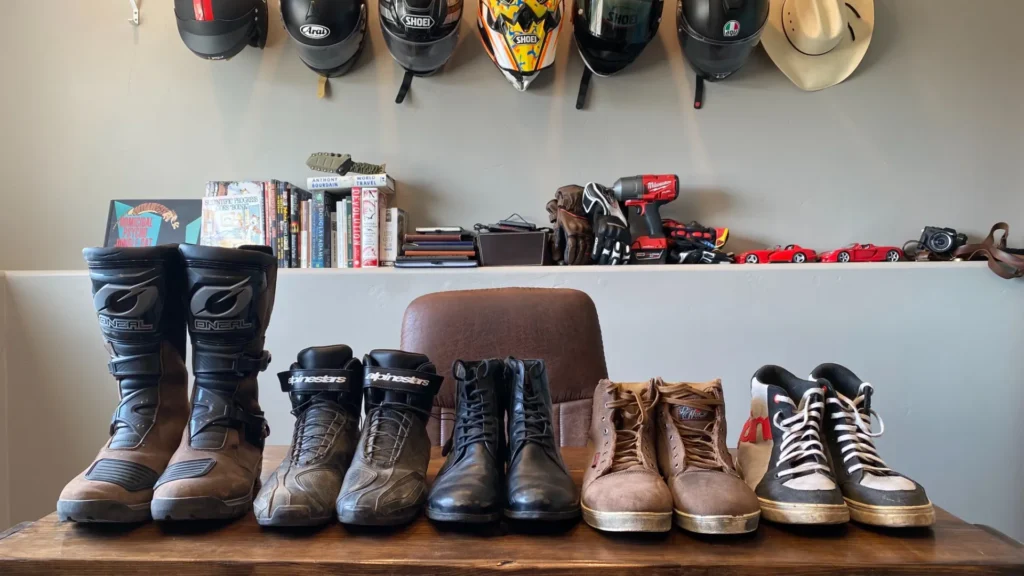
The fastest way to narrow down your options is to match the boot to how you actually ride. Here’s how the main categories break down:
| Boot Type | Best For | Notable Features | Typical Price Range |
|---|---|---|---|
| Sport / Track | Sportbikes, track days | Rigid ankle cuffs, toe sliders, low profile | $150-$500+ |
| Adventure / Dual-Sport | ADV, off-road, gravel | Tall shaft, toe protection, oil-resistant sole | $200-$600 |
| Touring | Long-distance, highway | Comfort padding, waterproof lining, wide fit | $150-$450 |
| Urban / Commuter | City riding, daily use | Casual look, ankle armor, light waterproofing | $80-$250 |
| Cruiser | Harley-Davidson, Indian, choppers | Leather pull-on or lace-up, heel, ankle armor | $80-$300 |
If you commute Monday through Friday and hit a weekend canyon run once a month, a touring or commuter boot covers both without sacrificing too much in either direction. Buying a dedicated track boot for street use means walking around in something with the ankle flex of a ski boot – fine for 20 minutes on a circuit, miserable after two hours in traffic.
What to Actually Evaluate When You’re Comparing Boots
CE Protection Rating and Ankle Support
The EN 13634:2017 standard is the accepted certification for motorcycle footwear in the US and Europe. Boots are rated on four criteria: abrasion resistance, cut resistance, transverse rigidity (how well the sole resists bending), and ankle energy absorption. Each gets a score of 1 or 2, with Level 2 being higher protection.
A boot labeled CE Level 1 on all four counts is acceptable for street riding. Level 2 ankle protection is worth paying for if you ride at speed or do any track work. Always check the label – “motorcycle-styled” boots sold without a CE rating offer no tested protection at all.
Sole Construction and Grip
The sole is your contact point with the peg and the ground. Look for a sole that’s oil-resistant (rubber compound specified as such on the product page), non-slip on wet pavement, and stiff enough across the toe box that it doesn’t fold under your foot on the peg.
Touring and commuter boots often use a thicker, lug-style sole for walking comfort. Sport boots go thin and rigid for maximum feel. Neither is wrong – just make sure the sole matches how much time you spend off the bike each day.
Closure System: Buckles, Zippers, and Laces
Buckles are the most secure and durable. They’re standard on adventure and track boots for a reason: they don’t work loose on long rides, and there are no ends to get caught in the chain or footpeg. Zippers are convenient and work fine when backed by a snap or velcro flap. Laces are the weakest option on a motorcycle boot – if you’re buying lace-ups, check that the laces are internally routed or that the boot has a lace cover.
How to Get the Fit Right
A correctly fitted motorcycle boot holds your heel firmly in place with zero lift when you walk. If your heel lifts more than a few millimeters on the upstroke, the boot is too big and your foot will move independently of the footpeg.
Try boots on with the socks you plan to ride in – thin sport socks for sport/commuter boots, thicker wool or mid-weight socks for touring. Your toes should have roughly a thumb’s width of room at the front. The ankle cuff should close snugly but without pinching the Achilles tendon or the ankle bones.
Expect some break-in stiffness with full-leather boots. Synthetic and textile boots are usually comfortable on day one but may soften and lose structure faster over time. If a boot is painful out of the box rather than just stiff, it’s the wrong shape for your foot – sizing up won’t fix a width or arch mismatch.
Waterproofing: What the Labels Actually Mean
“Water-resistant” and “waterproof” are not the same thing. A water-resistant boot has treated leather or a tight weave that sheds light spray but soaks through in sustained rain within 20-30 minutes. A waterproof boot uses a sealed internal membrane – Gore-Tex is the most common, but Dainese’s DryaX, Alpinestars’ DryStar, and REV’IT!’s SEESMART are all reliable proprietary equivalents.
If you ride year-round or commute in the Pacific Northwest, Pacific Coast, or anywhere that gets regular rain, spend the extra $50-$80 for a membrane. A wet foot inside a boot is a cold foot, and cold feet mean slower, stiffer inputs on the controls. If you ride mostly in summer in a dry climate, a non-waterproofed boot with a quality leather upper is lighter and breathes better.
What to Expect at Each Price Point
You don’t need to spend $400 to get protected, but the budget tiers are fairly honest guides to what you’ll get.
Under $100: You’ll find synthetic commuter boots and work-boot-adjacent styles. CE ratings at this price are rare and often unverified. Fine for very short, low-speed urban trips; not suitable for highway riding.
$100-$200: The most practical range for most riders. Brands like TCX, Forma, and Fly Racing offer CE-rated ankle protection, decent waterproofing options, and real sole construction at this price. Alpinestars’ Stella and regular SMX lines, and Sidi’s entry adventure models, start here.
$200-$400: Adventure boots from Alpinestars (Corozal, Belize), Sidi (Adventure 2), and Forma (Adventure) land here. Full-grain leather sport boots from TCX and Dainese are in this range too. Expect Gore-Tex liners, CE Level 2 ratings, and genuine multi-year durability.
$400 and up: Track-focused boots from Sidi (Mag-1, Vertigo 2), Alpinestars (Supertech R), and Dainese (Axial D1) live here. The difference is in the structural protection – calf armor, heel cups, toe box reinforcement, and ankle torsion limiters that a street boot doesn’t have. Worth it if you’re doing track days or racing; overkill for commuting.
Three Mistakes Riders Make When Buying Boots
Buying fashion-first without checking the CE label. A boot that looks like a motorcycle boot and costs $120 at a general retailer is usually not CE-rated. It’s an aesthetic choice, not a safety one.
Sizing up to compensate for a narrow fit. If a boot pinches across the instep, going half a size larger won’t fix it – it’ll just give you a boot that’s too long and too wide everywhere except where it hurts. Look for a brand with a different last shape (TCX and Sidi cut differently from Alpinestars, for example).
Ignoring sole wear. A boot’s sole is a wear item. Check the heel and toe block every season. A worn-through heel changes your foot position on the peg and reduces the boot’s energy absorption in a slide. Most boots can be resoled by a cobbler for $30-$60, which is far cheaper than a new pair.
Frequently Asked Questions About Choosing Motorcycle Boots
What is the minimum protection level I should look for in a motorcycle boot?
CE Level 1 under EN 13634:2017 is the accepted minimum for street riding. This rating covers abrasion resistance, cut resistance, sole rigidity, and ankle impact absorption. Boots without a CE rating have no standardized protection guarantee, regardless of how they look or how much they cost.
Can I wear regular work boots or hiking boots on a motorcycle?
You can, but it’s a significant trade-off. Work boots and hiking boots lack the ankle torsion limiters and impact-absorbing ankle cups built into motorcycle-specific footwear. They also tend to have laces rather than buckles, which creates a snag hazard near moving parts. For short, low-speed rides they’re better than sneakers; for any real distance or speed, they’re not a substitute.
How do I know if a boot is genuinely waterproof?
Look for specific membrane branding in the product description: Gore-Tex, Dainese DryaX, Alpinestars DryStar, REV’IT! SEESMART, Sidi Tecno 3 Gore, or TCX WP. If the listing just says “water-resistant” or “treated leather,” assume it will soak through in sustained rain. Waterproof membranes are almost always called out by name because they’re a selling point.
How long should a good pair of motorcycle boots last?
A quality leather boot with CE-rated construction, maintained with leather conditioner once or twice a season, can last 5-10 years of regular riding. Synthetic boots typically run 3-5 years before the materials fatigue. The sole wears faster than the upper on most boots and can often be replaced. Replace any boot immediately if the ankle cuff loses rigidity, the sole delaminates, or the CE-rated armor cracks.
Do I need different boots for summer and winter riding?
Most riders get away with one pair by choosing a touring or adventure boot with a waterproof liner and using wool socks in winter. If you live somewhere that gets genuine cold weather, a dedicated cold-weather boot with an insulating liner – like the Alpinestars Corozal Adventure Drystar or the Sidi Adventure 2 Gore – is worth having. Heated boot liners (Gerbing, Warm & Safe) are also an option if you already have a good boot that just runs cold.