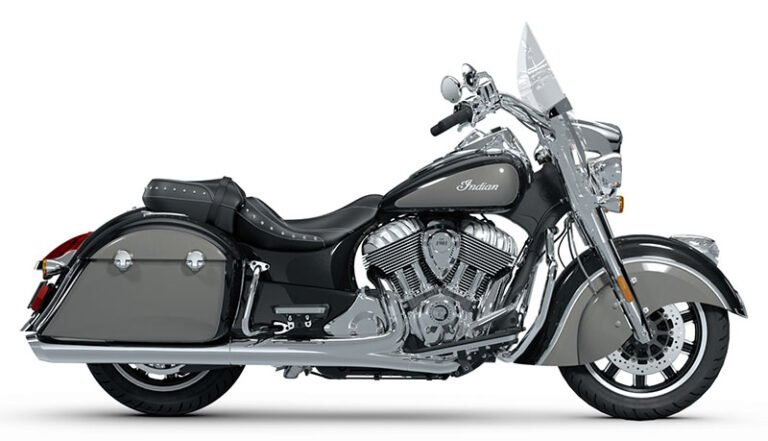
Indian Challenger Top Speed, Specs & Review
TL;DR
- The Indian Challenger top speed is approximately 125 mph, governed electronically; Indian publishes no official figure.
- The PowerPlus 108 (1,768cc) claims 122 hp and 128 ft-lbs at the crank; on the dyno, Cycle World measured 103.1 hp and 113.1 ft-lbs at the rear wheel.
- The PowerPlus 112 (1,834cc) — added to the Challenger lineup from 2025 — claims 126 hp and 133 ft-lbs, plus a full IMU-based electronics suite as standard.
- The 2020 Challenger ran 0-60 mph in 4.1 seconds and covered the quarter mile in 12.7 seconds
- The 2026 Challenger Limited starts at $27,999; Dark Horse 112 starts at $31,999
Indian Challenger Specs at a Glance
| Specification | PowerPlus 108 | PowerPlus 112 |
|---|---|---|
| Displacement | 1,768cc (108 cu-in) | 1,834cc (112 cu-in) |
| Engine type | Liquid-cooled, 60° V-twin | Liquid-cooled, 60° V-twin |
| Claimed horsepower | 122 hp (crank) | 126 hp (crank) |
| Claimed torque | 128 ft-lbs @ 3,800 rpm | 133 ft-lbs @ 3,600 rpm |
| Rear-wheel HP (dyno) | ~103 hp | Not independently tested as of this writing |
| Rear-wheel torque (dyno) | ~113 ft-lbs | Not independently tested as of this writing |
| Bore x stroke | 108mm x 96.5mm | Not publicly disclosed |
| Compression ratio | 11.0:1 | Not publicly disclosed |
| Fuel system | Closed-loop injection / 52mm dual bore | Closed-loop injection / 52mm dual bore |
| Transmission | 6-speed, wet multi-plate clutch | 6-speed, wet multi-plate clutch |
| Final drive | Belt | Belt |
| Front suspension | 43mm inverted fork, 130mm travel | 43mm inverted fork, 130mm travel |
| Rear suspension | Preload-adjustable mono-shock, 114mm travel | Preload-adjustable mono-shock (electronically adjustable on Elite), 114mm travel |
| Front brakes | Dual 320mm semi-floating discs, Brembo calipers | Dual 320mm semi-floating discs, Brembo calipers |
| Rear brake | Single 298mm floating disc | Single 298mm floating disc |
| Front wheel | 130/60-19 | 130/60-19 |
| Rear wheel | 180/60-16 | 180/60-16 |
| Seat height | 26.5 in (673mm) | 26.5 in (673mm) |
| Wet weight | ~804 lbs (365 kg) | ~804 lbs (365 kg) |
| Fuel capacity | 6 US gal (22.7L) | 6 US gal (22.7L) |
| Wheelbase | 65.6 in (1,668mm) | 65.6 in (1,668mm) |
| US MSRP (2026) | $27,999 (Limited) | $31,999 (Dark Horse 112) / $32,499 (Limited 112) |
Sources: Indian Motorcycle official specs (2025–2026); Cycle World dyno data (2024); Total Motorcycle specifications (2025)
Indian Challenger Top Speed: What the Numbers Actually Mean
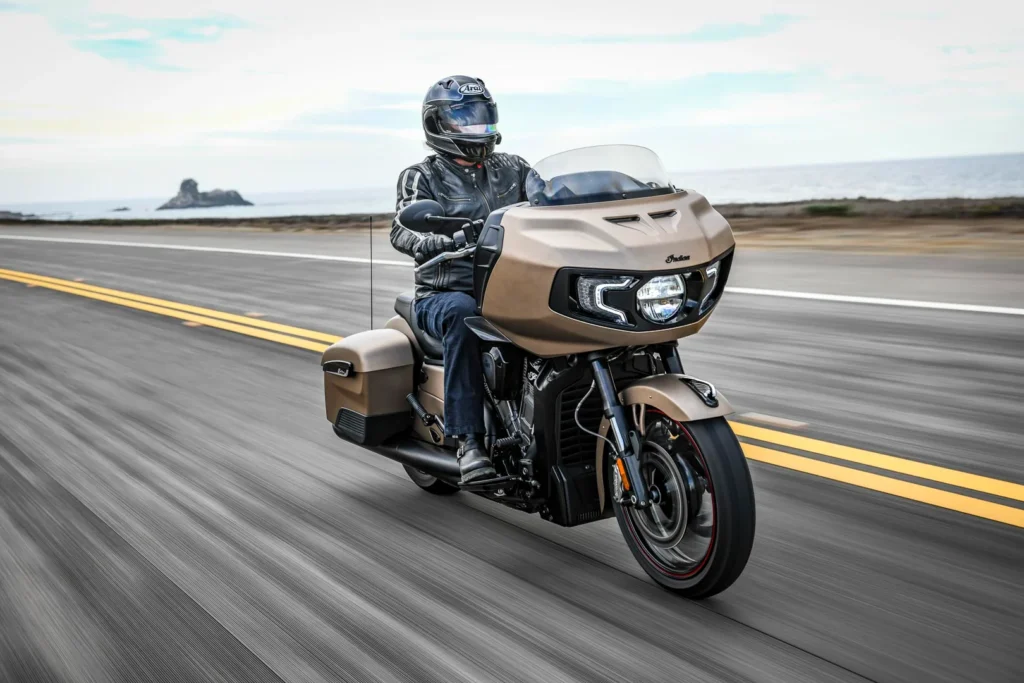
The Indian Challenger top speed is approximately 125 mph, governed electronically. Indian does not publish a factory top-speed figure. Multiple sources – including Top Speed (2022) and owner-forum data from Indian Motorcycles Forum – report the limiter engaging right around 125 mph in 6th gear.
That limiter is not a knock on the engine’s capability. The PowerPlus is a long-stroke V-twin tuned for low-to-mid-rpm torque, not a screaming sportbike motor. At 2,500 rpm indicated, the bike is already doing 60 mph in 6th gear (Rider Magazine, 2020). Wind drag on a 804-lb bagger with a large fairing multiplies fast above 100 mph, and the tires are H-rated (speed rated to 130 mph, with a meaningful safety margin below that ceiling). The electronic limit is there for good reason on a production touring machine.
That 125-mph ceiling is plenty for real-world use. Highway triple-digit passes are where this engine actually shines, not at the speed limit’s edge.
Acceleration Data
| Metric | Recorded figure | Source |
|---|---|---|
| 0-60 mph | 4.1 seconds | Top Speed / zeroto60times.com, 2022 |
| Quarter mile | 12.7 seconds | Top Speed / zeroto60times.com, 2022 |
| Indicated RPM @ 60 mph | 2,500 rpm | Rider Magazine, 2020 |
No independent GPS or instrumented acceleration data has been published for the 2025–2026 PowerPlus 112 variant as of this writing.
PowerPlus Engine: Two Sizes, One Character
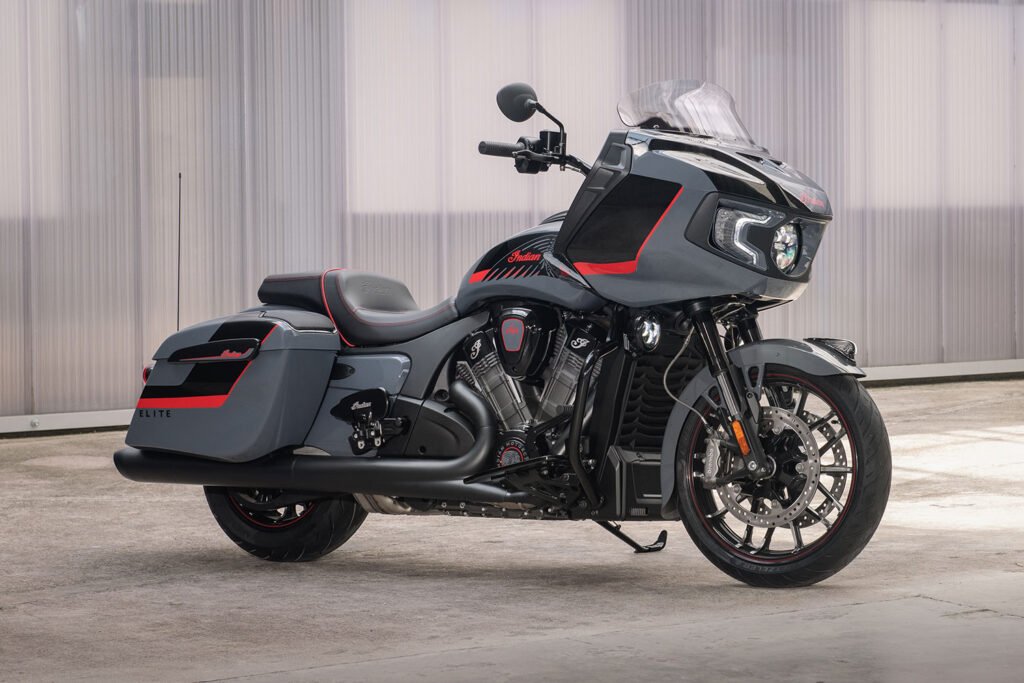
The PowerPlus V-twin is liquid-cooled — a deliberate break from the air-cooled tradition of American touring bikes. Indian introduced it with the 2020 Challenger at 1,768cc (108 cu-in), claiming 122 hp and 128 ft-lbs at the crank (Indian Motorcycle, 2019).
On a Dynojet dyno, Motorcycle Cruiser and Cycle World each recorded approximately 103 hp and 113 ft-lbs at the rear wheel (Cycle World, 2024; Motorcycle Cruiser, 2019). Those are honest figures — about 15% drivetrain loss, consistent with a belt-drive touring machine. What matters more than the peak is the torque curve: it sits above 100 ft-lbs from 2,000 rpm to near redline at 5,250 rpm (Motorcycle Cruiser, 2019). That flat shelf is why the bike feels so easy on a loaded two-up pass through a mountain grade.
For 2025, Indian added the 1,834cc PowerPlus 112 to the Challenger lineup. New pistons and a revised ECU pushed output to 126 hp and 133 ft-lbs at 3,600 rpm (Ultimate Motorcycling, 2025). The 112 costs roughly $3,000–$4,500 more depending on trim and bundles the full IMU-based electronics suite as standard — something 108 buyers need to step to a higher trim to access.
Chassis, Suspension, and Why This Bagger Actually Handles
The Challenger sits on an aluminum perimeter frame, not the steel tube frames typical of older American tourers. The fairing mounts to the frame, not the fork legs — so the chassis handles steering inputs without the fairing adding mass and dive to every turn-in. That chassis-mount design also lets Indian run a 43mm inverted telescopic front fork, the kind you’d normally see on a sportbike.
Front suspension travel is 130mm; the rear runs 114mm on a preload-adjustable monoshock. The Challenger Elite steps up to an electronically adjustable Fox rear shock, controllable through the Ride Command touchscreen — a real convenience when carried weight changes between day-trip and full touring loads (Motorcycle.com, 2025).
Gear Patrol’s 2023 road test noted the 60-80 mph passing surge as the bike’s real calling card — the move that matters on the highway, not the drag-strip launch (Gear Patrol, 2023). The Brembo braking hardware — dual 320mm semi-floating discs, four-piston calipers, 298mm rear rotor — delivers proportional stopping feel, even heavily loaded.
Electronics and Ride Aids by Trim Level
The Challenger’s electronics ladder is worth mapping clearly, because it differs significantly by trim.
The base 108 trim gets ABS, selectable ride modes, cruise control, keyless ignition, and the 7-inch Ride Command display with Bluetooth, AM/FM, and Apple CarPlay.
The Dark Horse and Limited trims (108 and 112) add Smart Lean Technology via a six-axis Bosch IMU: lean-sensitive ABS, lean-sensitive traction control, and drag torque control. The 112-equipped trims go further, bundling a Rider Assist Package that adds blind spot warning, rear collision warning, tailgate warning, bike hold control, and electronically linked brakes (Indian Motorcycle, 2025).
The 2025 Elite (108-powered, limited to 325 units globally) and 2025 Elite-spec 112 variants add an electronically adjustable Fox rear shock, adaptive LED headlight, heated grips, and a 400-watt four-speaker PowerBand audio system (Motorcycle.com, 2025).
| Feature | Base 108 | Dark Horse / Limited | 112 trims | Elite |
|---|---|---|---|---|
| ABS | Standard | Lean-sensitive | Lean-sensitive | Lean-sensitive |
| Traction control | — | Lean-sensitive | Lean-sensitive | Lean-sensitive |
| Drag torque control | — | Yes | Yes | Yes |
| Blind spot / collision warning | — | — | Yes | Yes |
| Electronically linked brakes | — | — | Yes | Yes |
| Rear suspension | Manual preload | Manual preload | Manual preload | Electronic (Fox) |
| Audio | 100W (2-speaker) | 100W (2-speaker) | 100W (2-speaker) | 400W (4-speaker) |
What the Challenger Gets Right (and Where It Falls Short)
The PowerPlus engine is the Challenger’s biggest advantage. On the same Dynojet dyno, the 2020 Challenger produced 103 hp at the wheel versus the Harley-Davidson Street Glide Special’s 80.7 hp — a 22+ horsepower gap that you feel in the seat (Motorcycle Cruiser, 2019). Liquid cooling means the engine handles stop-and-go traffic without heat-soaking your right leg.
The King of the Baggers racing program is not just marketing. Indian’s Challenger won the MotoAmerica series in 2020, 2022, and 2024, with Tyler O’Hara (twice) and Troy Herfoss each earning the championship (Indian Motorcycle Racing, 2024). That program directly pushed development of the 112 engine and its electronics. For the record books: a race-spec S&S Indian Challenger hit 196.576 mph (316.3 km/h) at Bonneville in 2025 to set a class land-speed record (New Atlas, 2025) — a modified machine, not a production bike, but the engine architecture is the same.
The areas that require a realistic look:
Weight. At approximately 804 lbs wet, parking lot maneuvering demands full attention on crowned surfaces or side hills. It’s not heavier than class competitors, but riders new to large tourers will feel it.
Base trim electronics. The base $27,999 Challenger skips lean-sensitive ABS, which the Dark Horse carries standard. On an 800-lb machine, that’s a meaningful gap for newer riders.
Fuel range. A 6-gallon tank at 36-40 mpg means 200-225 miles of realistic range before the low-fuel warning appears (Rider Magazine, 2020). Plan stops accordingly on long-distance days.
Who Should Buy the Indian Challenger
The base Challenger at $27,999 suits experienced cruiser riders moving up to a fixed-fairing bagger who want modern engine technology and noticeably more power than Harley-Davidson’s comparable offerings. The belt drive, 6-speed transmission, and included saddlebags make it a practical touring machine without add-ons.
The Dark Horse or Limited 108 ($29,999–$30,999) is the practical sweet spot. The Smart Lean electronics suite — lean-sensitive ABS and traction control via the Bosch IMU — genuinely matters at 804 lbs, and the pricing is fair for what you get.
The 112-equipped Dark Horse or Limited ($31,999–$32,499) makes sense for riders covering serious loaded miles. The IMU Rider Assist Package adds radar-based blind spot warning, rear collision warning, and bike hold control — useful at interstate speeds and in traffic. The extra 4 hp and 5 ft-lbs over the 108 are most noticeable in the 60-80 mph passing range.
The Elite is for collectors and riders who genuinely want limited-edition paint and production exclusivity. At $38,499 (2025), the premium over a Limited is steep for what amounts to upgraded audio and custom finishes you can partially replicate through accessories.
Frequently Asked Questions
What is the top speed of the Indian Challenger?
The Indian Challenger top speed is approximately 125 mph, governed electronically. Indian does not publish an official top speed. That figure appears consistently across owner forum reports and multiple third-party sources (Top Speed, 2022; Indian Motorcycles Forum). The limiter reflects the tire rating and real-world bagger use, not an engine limitation.
How much horsepower does the Indian Challenger make?
Indian claims 122 hp at the crank for the PowerPlus 108 and 126 hp for the PowerPlus 112. At the rear wheel, the 108 engine measured approximately 103 hp and 113 ft-lbs of torque on a Dynojet dyno (Cycle World, 2024; Motorcycle Cruiser, 2019). The 112 has not yet received a published independent rear-wheel dyno test as of 2026.
How fast does the Indian Challenger reach 60 mph?
The 2020 Challenger covered 0-60 mph in 4.1 seconds with a 12.7-second quarter mile (zeroto60times.com, 2022). Those figures are from the PowerPlus 108 in its original spec. The 112-powered Challenger is slightly quicker — but no published instrumented result is available yet.
What is the difference between the Indian Challenger 108 and 112?
The 108 displaces 1,768cc and makes 122 hp / 128 ft-lbs; the 112 displaces 1,834cc and makes 126 hp / 133 ft-lbs. Beyond the displacement increase from new pistons and ECU tuning, the 112 includes the full IMU Rider Assist Package as standard — blind spot warning, rear collision warning, tailgate warning, bike hold control, and electronically linked brakes. The 108 in Dark Horse or Limited trim does get lean-sensitive ABS and traction control, but skips the radar-based safety aids.
How heavy is the Indian Challenger?
The Indian Challenger weighs approximately 804 lbs (365 kg) in wet running order (Total Motorcycle, 2025). That is heavy for the segment, but it sits in line with what you’d expect from a fully faired American bagger loaded with electronics, audio hardware, and saddlebags.
Does the Indian Challenger have ABS?
Yes — ABS is standard on all Challenger trims. The base 108 has standard ABS. Dark Horse, Limited, and above get lean-sensitive ABS via a six-axis Bosch IMU. The 112-equipped models add electronically linked front-rear braking on top of lean-sensitive ABS.
Key Takeaways
- The Indian Challenger top speed is approximately 125 mph (electronically governed); no factory figure is published.
- PowerPlus 108 produces 103 hp / 113 ft-lbs at the rear wheel on a Dynojet; the 112 adds 4 hp and 5 ft-lbs at the crank over that baseline.
- The 0-60 time of 4.1 seconds and 12.7-second quarter mile (2020 model, PowerPlus 108) make the Challenger one of the quicker American baggers on paper.
- The 112 engine is the right choice if you plan serious loaded touring — the IMU Rider Assist Package adds blind spot radar and electronically linked brakes as standard.
- At 804 lbs, this bike demands respect at low speeds; at highway speeds it earns it back.
- The Dark Horse or Limited 108 at $29,999–$30,999 hits the best value balance in the lineup for most buyers.
- Indian’s three MotoAmerica King of the Baggers championships (2020, 2022, 2024) are a real data point; the race program directly shaped both the 112 engine and its electronics package.