Yamaha MT-07 Top Speed, Specs & Review
TL;DR
- The Yamaha MT-07 hits a GPS-verified top speed of 133.8 mph.
- It reaches 60 mph in 3.73 seconds and runs the quarter-mile in 11.97 seconds at 115.8 mph.
- Power comes from a 689cc liquid-cooled CP2 parallel-twin making 72–74 hp at 8,750–9,000 rpm and 50 lb-ft of torque at 6,500 rpm.
- Wet weight is 403 lb (183 kg), seat height is 31.7 in (805 mm), and U.S. MSRP starts at $8,599 for 2025–2026.
- The MT-07 is one of the best all-around middleweight naked bikes under $9,000 — strong enough to be genuinely fun, light enough for daily riding, and forgiving enough for riders still building skills.

Yamaha launched the MT-07 in 2014 as the entry-level member of its “Master of Torque” naked lineup, sitting beneath the MT-09 and MT-10. It’s been Yamaha’s top-selling street motorcycle in North America every year since, and for good reason: the bike delivers a disproportionate amount of riding satisfaction for the money. For 2025, Yamaha gave the MT-07 its fourth-generation overhaul — ride-by-wire throttle, three riding modes, a 5-inch TFT display with Garmin StreetCross integration, an assist and slipper clutch, and updated lightweight forged wheels. The 2026 model adds radially mounted front brake calipers and 41mm KYB inverted forks (Yamaha Motor USA, 2026).
2026 Yamaha MT-07 Full Specs
| Spec | Detail |
|---|---|
| Engine | 689cc liquid-cooled DOHC parallel-twin, 4 valves/cyl |
| Bore x Stroke | 80.0mm x 68.6mm |
| Compression | 11.5:1 |
| Peak Power | ~72–74 hp at 8,750–9,000 rpm |
| Peak Torque | 50 lb-ft (68 Nm) at 6,500 rpm |
| Fuel Delivery | Fuel injection with YCC-T (ride-by-wire, 2025+) |
| Transmission | 6-speed with assist and slipper clutch |
| Final Drive | Chain |
| Front Suspension | 41mm KYB inverted fork, 5.1 in travel |
| Rear Suspension | KYB single shock, adjustable preload and rebound, 5.1 in travel |
| Front Brake | Dual 298mm disc, ABS |
| Rear Brake | 245mm disc, ABS |
| Front Tire | 120/70ZR17 Dunlop Sportmax Q5A |
| Rear Tire | 180/55ZR17 Dunlop Sportmax Q5A |
| Seat Height | 31.7 in (805mm) |
| Wet Weight | 403 lb (183 kg) |
| Fuel Capacity | 3.7 gal |
| Fuel Economy | ~57 mpg (estimated) |
| MSRP (US) | $8,599 |
Source: Yamaha Motor USA, 2026.
The CP2 Engine: What the 270-Degree Firing Order Actually Does

The MT-07’s 689cc parallel-twin is not a standard parallel-twin. Yamaha offsets the crank pins by 90 degrees, creating a 270-degree firing order — the same architecture used in the YZF-R1 and MT-10. This is Yamaha’s “Crossplane” (CP2) design, and it makes a real difference you’ll feel rather than just read about.
A conventional parallel-twin fires both pistons together in a 360-degree sequence. That produces a smooth, buzzy character with bland throttle response — functional, but forgettable. The CP2 layout offsets combustion events, reducing rotational inertia from the pistons and crank. The result is a more direct connection between throttle input and rear-wheel response. Torque pulses hit with more character, the engine pulls harder out of corners, and the whole bike feels more alive at low and medium speeds.
Peak power sits at 72–74 hp at 8,750–9,000 rpm depending on year and market. Torque peaks at 50 lb-ft (68 Nm) at 6,500 rpm — right in the middle of where real-world riding happens. You don’t have to chase the top of the tach to feel the engine working. Most of the MT-07’s best performance arrives between 4,000 and 8,500 rpm, which covers 90 percent of what you’ll do on public roads.
For 2025, the addition of ride-by-wire via Yamaha’s YCC-T (Yamaha Chip Controlled Throttle) sharpened throttle response further and enabled three riding modes: Standard, Sport, and Rain. Each mode adjusts throttle mapping and traction control sensitivity. Rain mode dials back the aggression considerably — useful for spring commuting when the roads are still damp and leaf-littered.
Yamaha MT-07 Top Speed and Acceleration Numbers
The MT-07 top speed is 133.8 mph, recorded via GPS by MotoStatz (2026) using a lightly modified bike with a decat exhaust and ECU flash. A completely stock machine is expected to run slightly slower, likely in the 128–131 mph range depending on rider size and conditions.
Here’s the full acceleration breakdown from MotoStatz GPS testing (2026):
| Run | Time |
|---|---|
| 0-60 mph | 3.73 sec |
| 0-100 mph | 8.14 sec |
| Quarter-mile | 11.97 sec @ 115.8 mph |
| Top speed | 133.8 mph |
That 3.73-second 0-60 mph time requires a near-perfect launch — the CP2 engine wants to wheelie off the line, which makes it entertaining but complicates optimal elapsed times. Average riders at average weight will typically run 0-60 in the 4.0–4.3 second range on a stock bike, with quarter-mile times in the mid-to-high 12-second bracket.
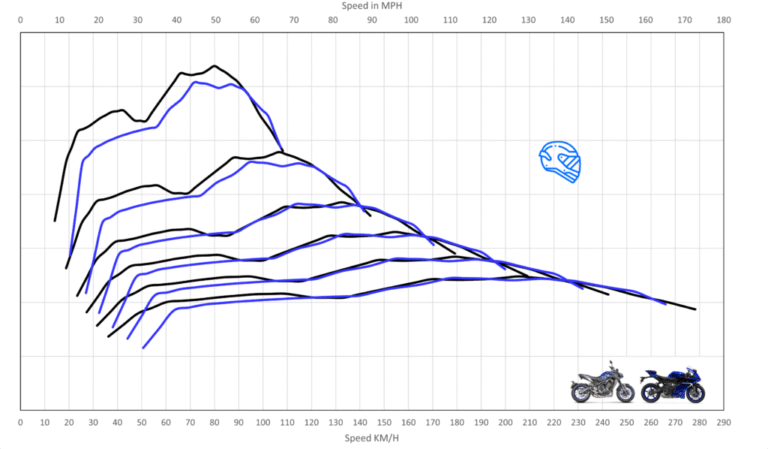
Above 100 mph, the MT-07’s lack of fairing makes itself known fast. With no wind protection, the air load above that speed turns into a full-body wrestling match. You’ll get to 133 mph if you’re determined, but you won’t want to stay there. The MT-07 was never designed as a high-speed touring machine, and the numbers above 100 mph confirm it. Where this bike really shines is between 30 and 90 mph — the speed range that covers every canyon road, back road, and light-to-light sprint you’ll actually encounter.
Handling and Chassis: Why the MT-07 Feels Smaller Than It Is

Pick up the MT-07 and push it out of the garage, and the 403-pound wet weight disappears immediately. The steel diamond frame keeps mass centralized, and the relatively short 54.9-inch wheelbase gives the bike a nimble, point-and-shoot character that encourages aggressive cornering. It steers with a 24.3-degree rake and 3.7 inches of trail — geometry that’s quick without being nervous.
For 2026, Yamaha upgraded the front end with 41mm KYB inverted forks and radially mounted brake calipers (Yamaha Motor USA, 2026). The previous generation used conventional forks with basic compression and rebound adjustment. The inverted setup is stiffer under heavy braking and more resistant to flex during hard corner entry. The rear KYB monoshock offers preload and rebound adjustment — enough to dial in support for a passenger or dial out harshness on broken pavement.
Stopping power comes from dual 298mm front discs with ABS, gripped by those new radial-mount calipers. Brake feel is good, with progressive initial bite that transitions to strong stopping without the abrupt initial grab that catches newer riders off guard. The Dunlop Sportmax Q5A rubber fitted to both ends is a genuine upgrade over older OEM tire choices — it heats up quickly and hangs on well through extended corner sequences.
The one area where the chassis shows its price-point origins is suspension adjustability. You get preload and rebound on the rear, and spring preload only on the front. Riders over 180 pounds or those who push the bike hard on track days will want to look at upgrading the rear spring rate and possibly the front spring weight once the original fork oil starts degrading.
Electronics, Tech, and What Changed in 2025 and 2026
The biggest story for 2025 was the electronics package. Ride-by-wire was new, traction control was new, and the instrument cluster went from a basic LCD to a 5-inch TFT color display with Bluetooth connectivity, Garmin StreetCross navigation integration, and self-canceling indicators.
Traction control operates on two settings in Standard and Sport modes. It’s not the multi-axis IMU-based system you’d find on the MT-09, but it catches wheelspin in slippery conditions without being intrusive. For 2026, the hardware additions — radial-mount calipers and inverted forks — were the primary changes. There’s still no quickshifter standard, which is a legitimate gap at this price point. A Yamaha quickshifter is available as an official accessory and is worth adding if you spend time on the highway or enjoy aggressive back-road riding.
Ergonomics and Real-World Ride Comfort
The MT-07’s riding position is genuinely comfortable for most riders in the 5’6″ to 6’2″ range. The 31.7-inch seat height sits riders in a relaxed upright posture with a natural bend in the knees and wrists that land on the bars without stretching or cramping. The seat itself is firm — fine for rides under an hour, tiring past 90 minutes. A gel pad or aftermarket seat is worth considering if longer days are on the agenda.
Vibration through the bars and pegs is noticeable above 7,000 rpm. It’s not harsh, but it’s present. Riders comparing the MT-07 to something like the Honda CB650R will notice the Honda runs smoother at highway speeds, while the Yamaha gives more tactile feedback from the engine that most riders find appealing rather than annoying.
The footpeg position is slightly rear-set compared to a pure commuter, which encourages a slight forward lean that helps with control during spirited riding without punishing the wrists or back. Two-up capability is there but marginal — the seat narrows quickly, and the 3.7-gallon tank limits range at commuter speeds to roughly 160–180 miles per fill-up before reserve.
Frequently Asked Questions About the Yamaha MT-07
What is the top speed of the Yamaha MT-07?
The Yamaha MT-07 top speed is 133.8 mph, recorded via GPS testing by MotoStatz (2026) on a bike fitted with a decat exhaust and ECU flash. A completely stock MT-07 will realistically hit 128–131 mph depending on rider weight, wind conditions, and how well you can tuck behind the minimal wind protection.
How fast is the MT-07 from 0 to 60 mph?
GPS testing by MotoStatz (2026) recorded 0-60 mph in 3.73 seconds with a near-perfect launch. Most real-world riders on stock bikes will see 4.0–4.3 seconds. The CP2 engine wants to lift the front wheel on hard launches, so consistent times require throttle discipline and good clutch control.
Is the Yamaha MT-07 good for beginners?
The MT-07 is better described as beginner-friendly than as a pure beginner bike. The 72–74 hp output and tendency to wheelie under hard acceleration mean it demands respect, but the torque curve is forgiving, the seat height is manageable at 31.7 inches, and the ABS and traction control (2025+) provide meaningful safety margins. Riders coming from a 300cc or 400cc class bike who have solid fundamentals will adapt to it quickly.
How does the 2025 MT-07 differ from older models?
The 2025 MT-07 brought ride-by-wire throttle (YCC-T), three riding modes, two-setting traction control, an assist and slipper clutch, a 5-inch TFT display with Garmin StreetCross and Bluetooth, self-canceling indicators, and lighter forged wheels. The 2026 model added 41mm KYB inverted forks and radially mounted front brake calipers. Pre-2025 bikes use conventional throttle cables and a basic LCD display with no electronic rider aids.
What is the Yamaha MT-07’s fuel economy?
Yamaha rates the MT-07 at approximately 57 mpg under the standard WMTC test cycle. Real-world economy depends heavily on riding style. Steady highway cruising at 70 mph and moderate throttle use returns roughly 55–65 mpg. Frequent hard acceleration and high-rpm riding will drop that into the low-to-mid 40s. With a 3.7-gallon tank, expect 160–200 miles per fill-up depending on how hard you’re riding.