Yamaha MT-10 Top Speed, Specs & Review
TL;DR
- The Yamaha MT-10 top speed is 160.3 mph, recorded via GPS-instrumented testing; US-spec bikes with stock ECU typically top out closer to 150 mph due to tighter emissions calibration.
- 0-60 mph takes 3.08 seconds and 0-100 mph arrives in 5.60 seconds — fast enough to pace most fully faired superbikes below triple-digit speeds.
- The engine is Yamaha’s 998cc crossplane inline-four (CP4), carried over from the YZF-R1 and retuned for stronger low- and mid-range pull.
- 2026 MSRP is $14,999 for the base MT-10 and $17,499 for the MT-10 SP, both per Yamaha Motor USA.
- It’s the right bike for experienced riders who want R1 firepower in a more streetable, naked package — and the wrong one for anyone who hasn’t ridden something powerful before.
Yamaha MT-10 Full Specs (2026)
Specs pulled directly from Yamaha Motorsports USA (2026).
| Specification | MT-10 (2026) |
|---|---|
| Engine | 998cc, liquid-cooled DOHC inline-4 (CP4), 16 valves |
| Bore x Stroke | 79.0mm x 50.9mm |
| Compression Ratio | 12.0:1 |
| Fuel Delivery | Fuel injection with YCC-T |
| Peak Power | 141 hp @ 11,500 rpm (wheel; dyno-tested) |
| Transmission | 6-speed, wet multiplate clutch with assist & slipper |
| Final Drive | Chain |
| Front Suspension | 43mm KYB inverted fork, fully adjustable; 4.7-in travel |
| Rear Suspension | KYB piggyback shock, fully adjustable; 4.7-in travel |
| Front Brakes | Dual 320mm discs, Brembo radial master cylinder, ABS |
| Rear Brake | 220mm disc, ABS |
| Front Tire | 120/70ZR17 Bridgestone Battlax Hypersport S22 |
| Rear Tire | 190/55ZR17 Bridgestone Battlax Hypersport S22 |
| Seat Height | 32.9 in (835mm) |
| Wheelbase | 55.3 in |
| Wet Weight | 467 lb |
| Fuel Capacity | 4.5 gal |
| Fuel Economy | 36 mpg (estimated) |
| MSRP (Base) | $14,999 (Yamaha Motor USA, 2026) |
| MSRP (SP) | $17,499 (Yamaha Motor USA, 2026) |
Yamaha MT-10 Top Speed and Acceleration Numbers
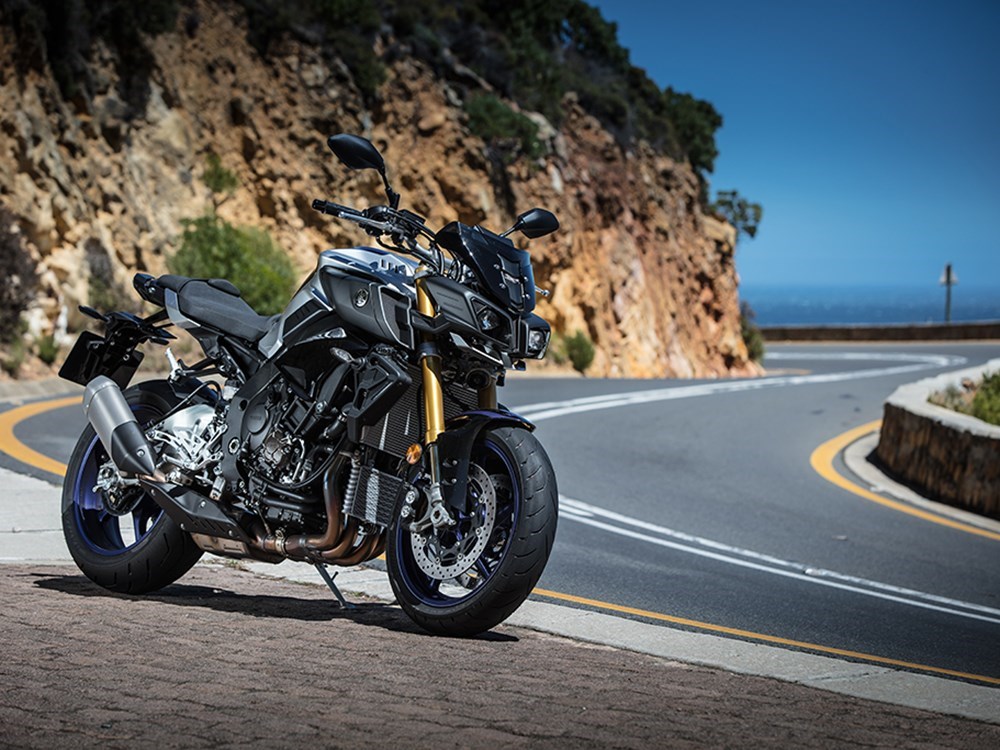
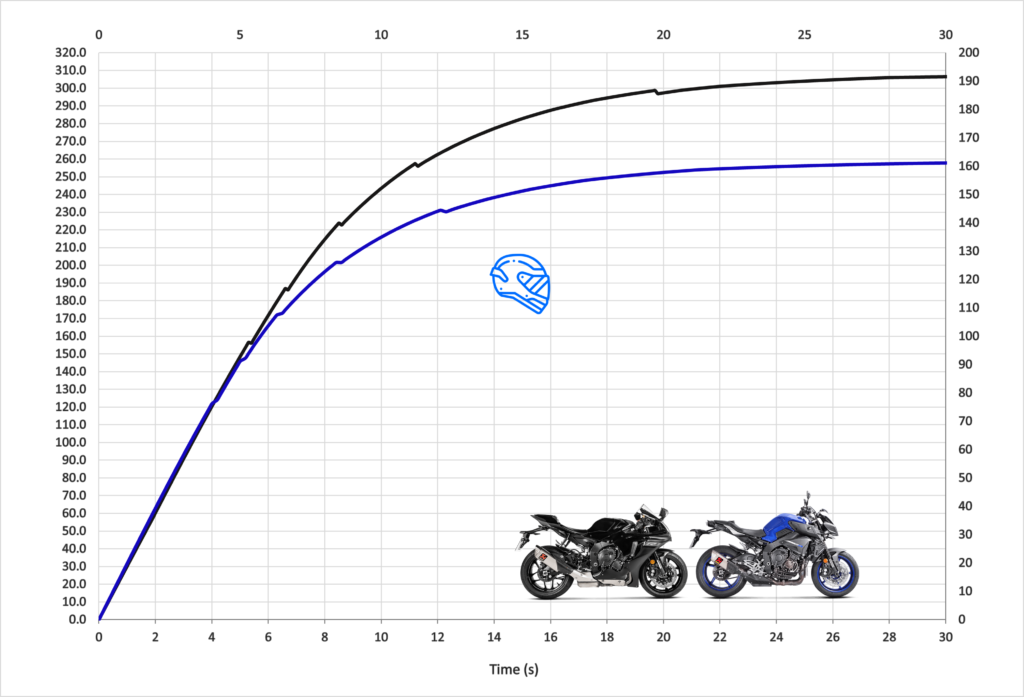
The MT-10 top speed is 160.3 mph, recorded by MotoStatz using GPS instrumentation (2026). That said, there’s a meaningful asterisk for US buyers: stock American-spec MT-10s are calibrated with tighter emissions settings that roll power off around 10,500 rpm instead of the full 11,500 rpm you get on Euro-spec models. In practice, that means most unmodified US bikes top out closer to 150 mph. Flash the ECU and the limiter effectively disappears.
Below are the full GPS-tested acceleration figures (MotoStatz, 2026):
| Speed Target | Time |
|---|---|
| 0-60 mph | 3.08 sec |
| 0-100 mph | 5.60 sec |
| 0-130 mph | 8.96 sec |
| 0-150 mph | 14.24 sec |
| Quarter mile | 10.49 sec @ 138 mph |
| Top speed | 160.3 mph |
Here’s what those numbers mean in context: anything that covers 0-100 mph in under six seconds is genuinely, dangerously fast. The MT-10 does it in 5.60. That’s on the same level as fully faired superbikes from ten years ago, and it arrives with a crossplane howl that makes the experience feel even more extreme.
The big caveat is that the MT-10 is a wheelie machine. An unassisted launch in first gear with a heavy throttle hand is going to send the front skyward before you’ve hit 30 mph. Even skilled riders get wide spread in 0-60 results because putting the power down cleanly from a standstill is legitimately tricky without the launch control that the SP variant adds. Once you’re rolling and the revs are above 4,000 rpm, the power is staggering — the bike keeps pulling with conviction all the way to redline.
The CP4 Engine: What Makes It Different
The MT-10 runs Yamaha’s CP4 crossplane inline-four — the same architecture that underpins the YZF-R1, but retuned specifically for road use. Crossplane crank timing fires each cylinder 90 degrees apart instead of the conventional 180/180/180/180 pattern used in most four-cylinders. The practical result is a more irregular firing pulse that reduces intake back-pressure between cylinders, giving the engine a torque character that’s closer to a V-four than a typical screaming inline.
On the road, this means the MT-10 feels distinctly different from something like a Honda CBR1000RR-based naked. At 5,000 rpm it pulls with purpose. Between 4,500 and 8,000 rpm — the range where most street riding actually happens — the MT-10 makes more power and torque than the R1 it shares DNA with (MotoStatz, 2026). Above 8,000 rpm the R1 eventually wins, but on a public road, you’ll never see that crossover.
At highway cruise, 70 mph in sixth gear sits the engine at a relaxed 5,100 rpm. It’s not a buzzy, uncomfortable machine on long runs.
Chassis, Suspension, and Brakes
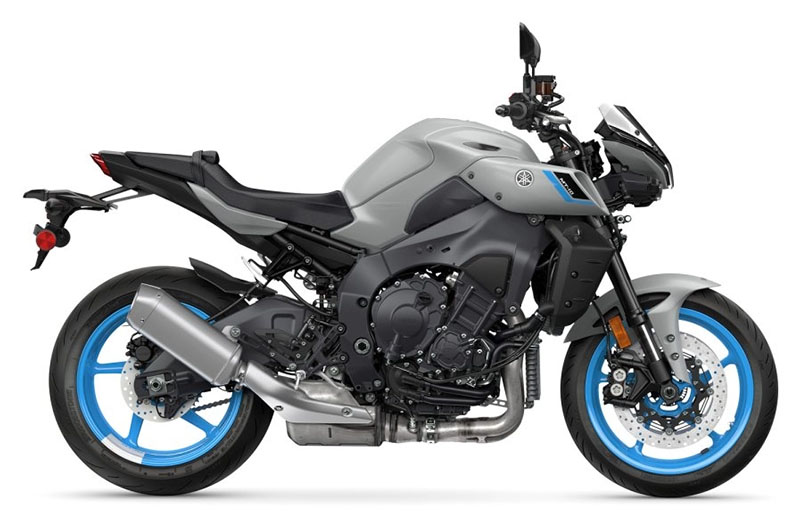
The chassis is a Deltabox aluminum frame — proven Yamaha architecture that prioritizes steering precision and light handling feel over straight-line stability. At 467 lb wet, the MT-10 is no lightweight by sport-naked standards, but the weight carries low and the 55.3-inch wheelbase keeps the geometry sporty without going to the unforgiving extreme of a pure track tool.
Both ends run fully adjustable KYB suspension — a 43mm inverted fork up front with 4.7 inches of travel, and a piggyback reservoir shock out back with the same travel. The SP variant adds Ohlins electronic suspension (ERS) with separate high- and low-speed compression damping adjustment, which is a meaningful upgrade for track days or back-road blasting where conditions change constantly.
Braking hardware on the 2026 model is strong: dual 320mm front discs with a Brembo radial master cylinder and ABS standard. The Brembo master was added in the 2022 refresh and it made a real difference — feel at the lever is precise and progressive, not grabby. Rear braking is a single 220mm disc with ABS. The Bridgestone Battlax Hypersport S22 tires fitted from the factory are genuinely capable rubber, not the mediocre spec tires you find on some bikes at this price point.
Electronics Package
The MT-10 base model ships with a solid electronics suite by any standard. You get four riding modes (Sport, Street, Rain, and a customizable B mode), a five-level traction control system (TC), and a quick shifter as standard equipment. ABS runs all the time and can’t be disabled on the base model.
The SP takes this further with a six-axis Inertial Measurement Unit (IMU) enabling lean-angle-sensitive traction control and ABS, plus Ohlins ERS with electronic damping adjustment and launch control. If you’re planning track days alongside street riding, the SP’s hardware is genuinely useful rather than just a spec-sheet checkbox.
One honest weak point: the MT-10 does not have cornering ABS or a slide control system on the base model the way some rivals do at lower price points. It’s not a dealbreaker on the street, but worth knowing if you’re cross-shopping hard.
What It’s Actually Like to Ride
The MT-10 is not subtle. Everything about it is tuned for feel and excitement over comfort or all-day touring. The riding position puts you upright with a slight forward lean — more aggressive than an MT-09, less extreme than a pure sport position. At 32.9 inches, the seat height is accessible for average-height riders, though the wide seat and weight make slow-speed maneuvering something you’ll want to practice before showing off in a parking lot.
Below 4,000 rpm the CP4 engine has a slightly lumpy, uneven character. The crossplane firing order means it’s never perfectly smooth at low revs — which some riders love because it feels alive, and others find slightly annoying in stop-and-go traffic. It’s not a deal-breaker, but it’s worth knowing.
Open the throttle above 5,000 rpm and every complaint evaporates. The sound from the stock exhaust is genuinely good — not as theatrical as an Akrapovic slip-on would make it, but distinctive and satisfying in a way that most four-cylinders aren’t.
Who should buy the MT-10: Experienced riders who want a road-going machine with genuine superbike performance, daily-usable ergonomics, and a character you can’t get from a more conventional four-cylinder. It rewards smoothness and technique.
Who should not: New riders, returning riders who’ve been off bikes for years, or anyone who finds the MT-09 already demanding. The extra power and weight aren’t forgiving.
Pros and Cons
Pros:
- CP4 crossplane engine with genuinely addictive character and sound
- Superbike-level straight-line performance in a naked package
- Strong factory suspension and Brembo master cylinder (no upgrade needed for street)
- Bridgestone S22 tires straight from the dealer
- Practical fuel range and comfortable ergonomics for a bike this fast
Cons:
- 467 lb wet weight is heavy for a naked — more than some competitors at this power level
- Base model lacks lean-angle-sensitive ABS and cornering traction control
- Lumpy, uneven feel below 4,000 rpm in traffic
- US-spec ECU limiter cuts peak performance relative to Euro models
- Polarizing headlight design that you either accept immediately or never stop disliking
Frequently Asked Questions About the Yamaha MT-10
What is the top speed of the Yamaha MT-10?
The Yamaha MT-10 top speed is 160.3 mph, per GPS-instrumented testing by MotoStatz (2026). That number comes from a bike that appears to have had ECU work done. Unmodified US-spec models typically top out closer to 150 mph because the domestic emissions calibration restricts the rev range compared to Euro-spec versions.
How fast does the Yamaha MT-10 go from 0-60 mph?
The MT-10 hits 60 mph in 3.08 seconds under GPS-tested conditions (MotoStatz, 2026). In real-world launches, getting close to that time requires multiple attempts and good technique — the bike fights wheelies hard from a standing start, which adds variability to any stopwatch test.
What engine does the Yamaha MT-10 have?
The MT-10 uses a 998cc liquid-cooled DOHC inline-four with Yamaha’s crossplane crank (CP4) — the same basic engine architecture as the YZF-R1, retuned for stronger mid-range torque and more usable street character. It makes 141 hp at the wheel (dyno-measured) and revs to 11,500 rpm.
What is the difference between the MT-10 and MT-10 SP?
The MT-10 SP ($17,499 MSRP) adds Ohlins Electronic Racing Suspension (ERS) with electronic damping adjustment, a six-axis IMU enabling lean-angle-sensitive traction control and ABS, and launch control — none of which the base MT-10 ($14,999) includes. For track use or aggressive back-road riding, the SP package is worth the $2,500 premium. For street-only riding, the base model’s KYB suspension is more than adequate.
Is the Yamaha MT-10 good for beginners?
No. The MT-10 is not a suitable first or second motorcycle. It weighs 467 lb, makes 141 hp with strong mid-range torque, and generates enough wheelie energy to punish an inexperienced throttle hand before the rider has time to react. A better progression path goes: MT-03 or R3 → MT-07 → MT-09 → MT-10, assuming the rider is logging regular miles and advancing their skills at each step.