Ducati Hypermotard 950 Top Speed, Specs & Review
TL;DR
- The Ducati Hypermotard 950 tops out at approximately 148 mph based on odometer readings during track testing; Ducati publishes no official top speed figure.
- Power comes from the 937cc Testastretta 11° L-twin: a claimed 114 hp at 9,000 rpm and 71 lb-ft of torque at 7,250 rpm (Ducati, 2024).
- US MSRP was $15,995 for the standard 950 and $19,795 for the 950 SP for the 2024 model year (Cycle World, 2024).
- The 950’s seat height is 870mm (34.3 in) on the standard model — tall enough that shorter riders will need a lowered seat or suspension kit.
- The 950 is being replaced by the Hypermotard V2 (890cc, 120 hp) for MY2026; new 950s remain on dealer floors as of mid-2026.
Ducati Hypermotard 950 Top Speed: What the Data Actually Shows
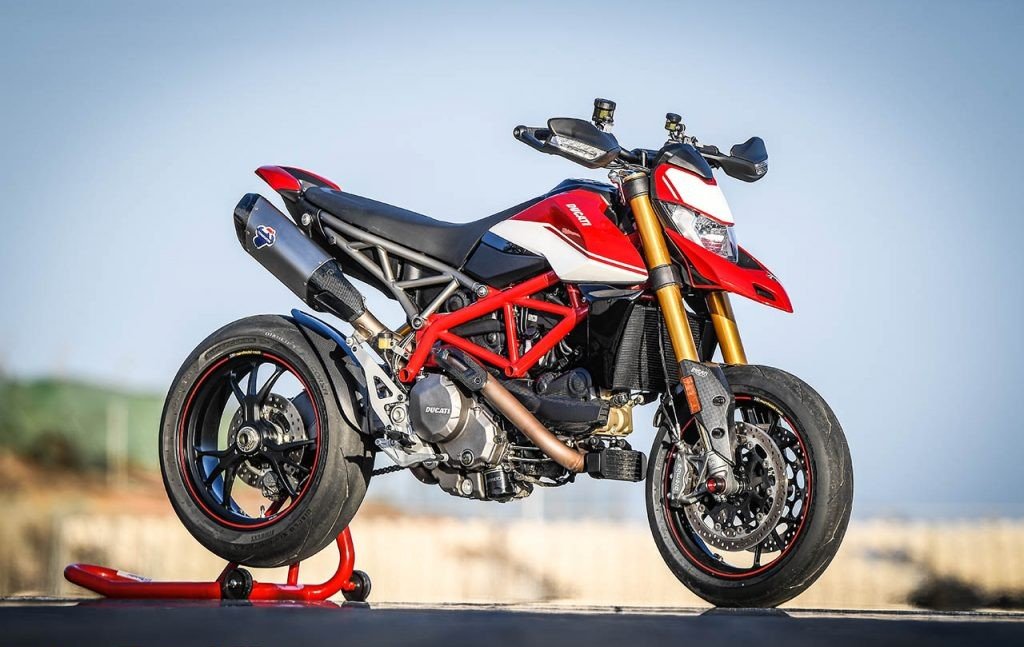
The Hypermotard 950 reaches approximately 148 mph (238 km/h) by odometer in closed-circuit testing (Motoplanete, 2024). BikeBound (2025) estimates the SP at roughly 150 mph. Neither figure is GPS-verified. Ducati publishes no official top speed.
No independently instrumented 0–60 test exists for the Hypermotard 950 specifically. BikeBound (2025) estimates about 3.1 seconds for the SP. MotoStatz instrumented the Ducati Monster 950 — same 937cc engine in a heavier chassis — at 3.44 seconds 0–60 (MotoStatz, 2023). A figure in the 3.0–3.3 second range for the lighter Hypermotard is plausible, but any tighter claim is an estimate.
At 114 hp in an upright, unfaired chassis, aerodynamic drag limits the bike above 120 mph. The Hypermotard pulls hard through four gears, then faces a wall of wind. Below triple digits, it’s one of the most urgent-feeling 114 hp bikes Ducati has built.
Full Specifications: Hypermotard 950 vs. 950 SP
| Specification | Hypermotard 950 | Hypermotard 950 SP |
|---|---|---|
| Engine | 937cc Testastretta 11° L-twin | 937cc Testastretta 11° L-twin |
| Power (claimed) | 114 hp @ 9,000 rpm | 114 hp @ 9,000 rpm |
| Torque (claimed) | 71 lb-ft @ 7,250 rpm | 71 lb-ft @ 7,250 rpm |
| Compression ratio | 13.3:1 | 13.3:1 |
| Transmission | 6-speed, wet multi-plate slipper clutch | 6-speed + bidirectional quickshifter (standard) |
| Front suspension | Marzocchi 45mm USD fork, 170mm travel | Öhlins 48mm USD fork, 185mm travel |
| Rear suspension | Sachs monoshock, 150mm travel | Öhlins monoshock, 175mm travel |
| Front brakes | Dual 320mm discs, Brembo M4.32 4-piston monobloc | Dual 320mm discs, Brembo M50 monobloc |
| Rear brake | 245mm disc, 2-piston caliper | 245mm disc, 2-piston caliper |
| ABS | Bosch Cornering ABS EVO | Bosch Cornering ABS EVO |
| Wheels | Cast aluminum 17-inch | Marchesini forged aluminum 17-inch |
| Seat height | 870mm (34.3 in) | 890mm (35.0 in) |
| Wet weight (no fuel) | 425 lb (193 kg) | — |
| Dry weight | — | 388 lb (176 kg) |
| Wheelbase | 59.0 in (1,498 mm) | 59.0 in (1,498 mm) |
| Fuel capacity | 3.8 gal (14.5 L) | 3.8 gal (14.5 L) |
| US MSRP (2024) | $15,995 | $19,795 |
Sources: Ducati USA tech specs (2024); Cycle World (2024)
Engine and Chassis: Why the 950 Feels More Aggressive Than Its Numbers Suggest
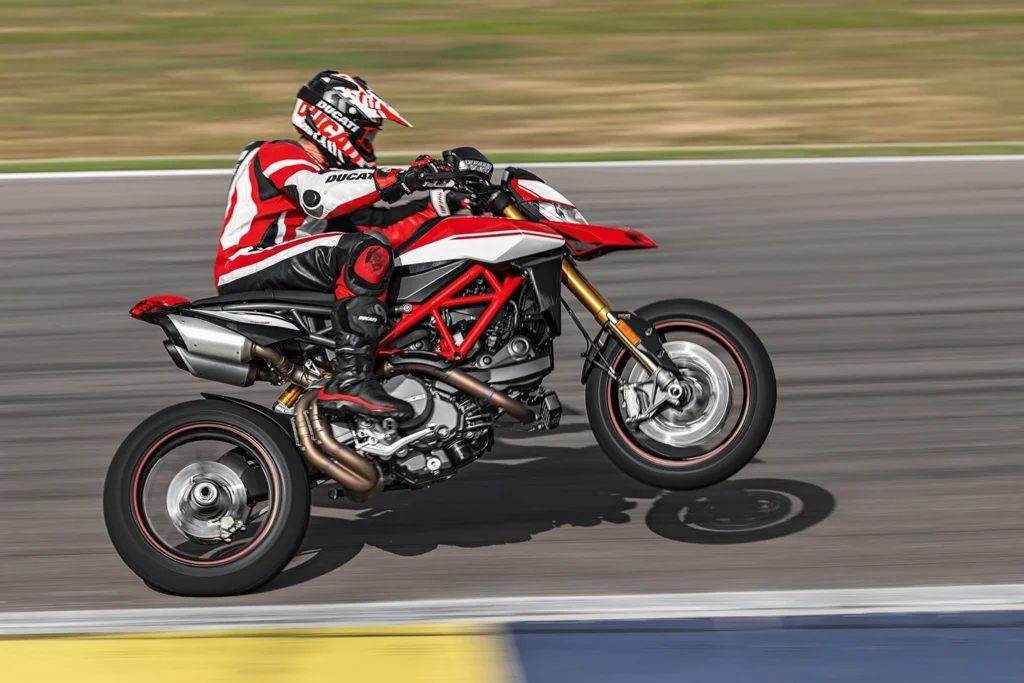
The Testastretta 11° designation refers to the angle between intake and exhaust valves. At 11 degrees, it allows straighter intake tracts and a more compact combustion chamber than older Ducati desmo designs. The same engine platform appears in the Monster 950, Multistrada V2, and DesertX, but the Hypermotard’s cam profiles, exhaust layout, and tuning are distinct.
What that produces is 80% of peak torque available at 3,000 rpm (Ducati, 2024). Third gear at city speeds and the bike responds immediately. The steel trellis frame was revised for the 950 generation, shaving approximately 1 kg over the 939 while maintaining rigidity (MCN, 2019). The 59-inch wheelbase, combined with the upright position over the front wheel, is why this bike changes direction faster than feels reasonable.
Maintenance note: the desmodromic valvetrain requires a major service every 18,000 miles or 30,000 km — 16 valve clearances plus timing belt inspection (Maintenanceschedule.com, 2023). Oil and filter changes are due every 9,000 miles or annually. This is dealer-level work; factor it into real ownership cost.
Electronics: Three Modes, One Purpose
Three riding modes — Sport, Touring, Urban — adjust power delivery, traction control aggressiveness, and throttle mapping. Urban caps output at 75 hp and maximizes electronic intervention. On a bike that will wheelie in second gear without effort, Urban mode on wet pavement is not optional for most riders.
The Bosch Cornering ABS EVO system uses a 6-axis IMU to modulate brake pressure by lean angle. It includes “Slide by Brake” — a setting permitting controlled rear-wheel slides under corner-entry braking. That feature says more about this bike’s intent than any paragraph of marketing copy. Ducati Traction Control EVO and Wheelie Control EVO are standard on both models. The SP adds a bidirectional quickshifter as standard; it’s optional on the base 950.
Strengths and Real Limitations
The Hypermotard 950 is exceptional on a twisty B-road. The upright ergonomics place weight over the front wheel, which means trail-braking produces real front-end feedback. The short wheelbase makes direction changes instantaneous. On the right road, this is one of the most satisfying sport-naked experiences under $20,000.
It falls short in predictable places. The seat is uniformly criticized — thin, flat, unforgiving beyond 50 miles. The 870mm seat height is a genuine problem for sub-5’8″ riders. Wind blast above 70 mph is fatiguing within minutes; this isn’t a highway machine. Fuel economy runs around 40–45 mpg in mixed riding, with roughly 130–140 miles of practical range.
The SP’s Öhlins setup is worth the price difference if you ride hard on variable surfaces. The improvement in mid-corner feedback is tangible, not just on paper.
Buyer Guidance: Who the 950 Is Right For
The Hypermotard 950 suits experienced riders who value feel and engagement over comfort. An intermediate sport-naked rider who runs B-roads will find it transforms their riding. A new rider will struggle with the seat height, throttle response, and aggressive chassis before getting to the good parts.
For 2025–2026 buyers: Ducati introduced the Hypermotard V2 for MY2026 at $16,995, with 120 hp, a non-desmodromic 890cc engine, and an 880mm seat height (Ducati, 2026). If lower seat height and simplified valve service matter, the V2 is the right direction. If you want the proven 937cc desmo character, new 950s remain available — and used examples will trade at a discount as the V2 establishes itself.
Frequently Asked Questions About the Ducati Hypermotard 950
What is the top speed of the Ducati Hypermotard 950?
The Hypermotard 950 reaches approximately 148 mph (238 km/h) based on odometer readings in closed-circuit testing (Motoplanete, 2024). Ducati publishes no official top speed. The SP is estimated at roughly 150 mph (BikeBound, 2025). Neither figure is GPS-verified — treat both as close approximations.
What engine is in the Ducati Hypermotard 950?
The Hypermotard 950 uses the 937cc Testastretta 11° L-twin — a liquid-cooled, 90-degree V-twin with desmodromic valve actuation and belt-driven cams. It produces a claimed 114 hp at 9,000 rpm and 71 lb-ft of torque at 7,250 rpm (Ducati, 2024). The same engine family also appears in the Monster 950, Multistrada V2, and DesertX, with cam profile and exhaust variations across models.
How tall is the Ducati Hypermotard 950 seat?
The standard 950 has a seat height of 870mm (34.3 inches). The SP, with longer Öhlins suspension, sits at 890mm (35.0 inches). Ducati and aftermarket suppliers offer lowered seat options. A lowered suspension kit can reduce the standard model’s height further, at the cost of suspension geometry and ground clearance.
How often does the Hypermotard 950 need a valve service?
Every 18,000 miles or 30,000 km (Maintenanceschedule.com, 2023). The desmodromic system requires checking 16 valve clearances — opener and closer for each of the eight valves — plus timing belt inspection. Standard oil and filter changes are due every 9,000 miles or annually. Budget for dealer labor; desmo service is not practical for most home garages.
Is the Ducati Hypermotard 950 good for beginners?
No. The 870mm seat height creates immediate challenges at stops. The short wheelbase and aggressive torque delivery reward trail-braking and weight-transfer technique that takes time to develop. Urban mode helps, but the chassis still demands respect. A year or more on a sport-naked bike is a reasonable baseline before stepping onto this one.
What replaced the Ducati Hypermotard 950?
The Hypermotard V2, introduced for MY2026, uses a new 890cc V-twin engine producing 120 hp at 10,750 rpm. The V2 engine uses spring-actuated valves with a variable intake timing system rather than the 950’s desmodromic actuation, which simplifies service intervals. The V2 also offers an 880mm seat height and starts at $16,995 in the US (Ducati, 2026).