Ducati Monster Top Speed, Specs & Review
TL;DR
- The Ducati Monster 937 (2024–2025) tops out at approximately 141 mph, per GPS-instrumented testing by MotoStatz (2026).
- It runs a 937cc Testastretta 11° L-twin making 111 hp at 9,250 rpm and reaches 60 mph in 3.44 seconds.
- The 2026 Monster gets a new 890cc V2 engine shared with the Panigale V2, dropping desmodromic valve actuation but adding variable valve timing.
- The 2024–2025 Monster Plus starts at $13,195 MSRP; the 2026 base model starts at $12,995 (Cycle World, 2024; Motorcycle.com, 2025).
- The Monster is a genuine all-rounder: manageable enough for a rider upgrading from a 600, fast enough to embarrass superbikes up to highway speeds.
Ducati Monster: Where It Sits in the Lineup
The Monster is Ducati’s entry point into the brand — the most accessible way to ride something Italian that was actually designed to go fast. Since the 2021 redesign, it runs a monocoque aluminum front frame lifted from the Panigale superbike, shedding roughly 40 pounds over the outgoing Monster 821 (Cycle World, 2024).
The current US lineup covers three real options: the Monster Plus (base trim, small front fairing, pillion seat cover), the Monster SP (fully adjustable Öhlins, Brembo Stylema calipers, Termignoni silencers), and for 2026, a re-engined fifth-generation model built around Ducati’s new 890cc V2 motor.
Ducati Monster Full Specs (2024–2026)
| Specification | 2024–2025 Monster (937) | 2026 Monster (890 V2) |
|---|---|---|
| Engine | 937cc Testastretta 11° L-twin | 890cc Ducati V2, 90° |
| Valve actuation | Desmodromic, 4 valves/cylinder | Spring + finger follower; IVT |
| Peak power | 111 hp @ 9,250 rpm | 110.7 hp @ 9,000 rpm |
| Peak torque | 69 lb-ft @ 6,500 rpm | 67 lb-ft @ 7,250 rpm |
| Compression ratio | 13.3:1 | Not published |
| Bore x stroke | 94 mm x 67.5 mm | Not published |
| Cooling | Liquid | Liquid |
| Gearbox | 6-speed | 6-speed |
| Quickshifter | Ducati Quick Shift (DQS) | DQS 2.0 |
| Clutch | Wet slipper/self-servo | Wet slipper/self-servo |
| Frame | Monocoque aluminum front frame | Monocoque + technopolymer rear subframe |
| Swingarm | Double-sided aluminum | Double-sided aluminum |
| Front suspension | 43 mm Showa inverted fork | 43 mm Showa inverted fork |
| Rear suspension | Sachs monoshock, preload-adj. | Showa monoshock, preload-adj. |
| Front brake | 2x 320 mm semi-floating discs, Brembo 4-piston radial | 2x 320 mm semi-floating discs, Brembo M4.32 Monobloc |
| Rear brake | 245 mm disc | 245 mm disc |
| Tires | Pirelli Diablo Rosso III, 120/70-17 / 180/55-17 | Pirelli Diablo Rosso IV, 120/70-17 / 180/55-17 |
| Wet weight | 414 lb (188 kg) | 386 lb (175 kg) |
| Seat height | 32.3 in (820 mm) standard | 32.1 in (815 mm) standard; 30.5 in with low seat kit |
| Fuel capacity | 3.7 gal (14 L) | 3.7 gal (14 L) |
| ABS | Cornering ABS (Bosch) | Cornering ABS (Bosch) |
| Traction control | DTC (lean-angle sensitive) | DTC (6-axis IMU) |
| Wheelie control | DWC | DWC |
| Display | 4.3-inch TFT color | 5-inch TFT 16:9 (800×400 res.) |
| US MSRP (base) | $13,195 (Monster Plus) | $12,995 (Monster base) / $13,995 (Monster+) |
Sources: Ducati.com, Motorcycle.com, TopSpeed (2024), Autoevolution (2025), SlashGear (2025)
Ducati Monster Top Speed: What the Numbers Actually Mean
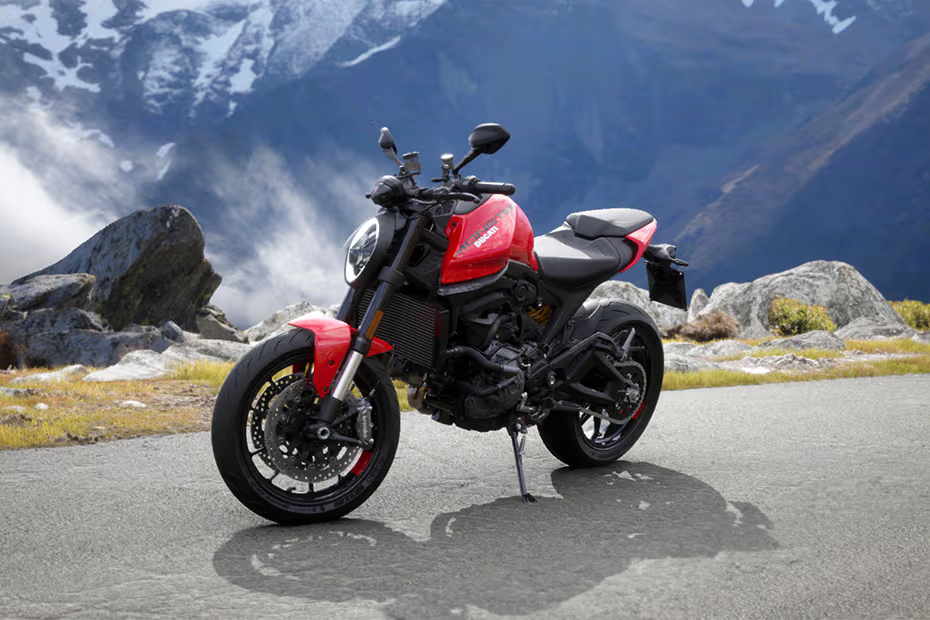
The Ducati Monster 937 has a tested top speed of 140.9 mph, recorded by MotoStatz using GPS instrumentation (MotoStatz, 2026). Ducati publishes no official top speed figure for the Monster, which is standard practice across the brand’s naked bike range.
That 140-mph ceiling is honest for a naked middleweight. The Monster’s upright riding position acts like a sail above 120 mph — aerodynamic drag chews through power quickly, and without a meaningful tuck, wind resistance becomes the real limiter before the engine is. One tested rider noted that at speeds above 130 mph, turbulence becomes more of the story than the speed itself.
For real-world riding, none of that matters. The engine pulls hard from 3,500 rpm and is in its sweet spot between 5,000 and 10,000 rpm — wide open on a canyon road, it doesn’t leave you wanting below 100 mph.
Ducati Monster Acceleration: 0–60, Quarter Mile, and Real-World Pull
The Monster 937 reaches 60 mph in 3.44 seconds and 100 mph in 7.46 seconds (MotoStatz, 2026). In the quarter mile, it runs 11.33 seconds with a terminal speed of 118 mph.
Those are strong numbers for a 111-hp naked bike. The Monster launches well and the quickshifter — significantly improved over older Ducati units — lets you drive through gears without interruption.
The 0–100 mph run at 7.46 seconds is competitive but can’t reach the 6-second territory that 150+ hp supernakeds manage. The Testastretta has strong mid-range pull but runs short of breath as you approach the rev ceiling in fourth. On real roads, you’ll never care.
Ducati Monster Acceleration Summary
| Benchmark | 2024–2025 Monster 937 | Source |
|---|---|---|
| 0–60 mph | 3.44 seconds | MotoStatz, 2026 |
| 0–100 km/h | 3.58 seconds | MotoStatz, 2026 |
| 0–100 mph | 7.46 seconds | MotoStatz, 2026 |
| Quarter mile | 11.33 sec @ 118 mph | MotoStatz, 2026 |
| Top speed (GPS tested) | 140.9 mph | MotoStatz, 2026 |
Engine Character: What the Testastretta 11° Actually Feels Like
The Testastretta 11° is a 937cc 90-degree L-twin with desmodromic valve actuation — two camshafts per cylinder head, one to open each valve and one to close it mechanically, eliminating the valve springs that can float at high rpm. The “11°” is the included angle between intake and exhaust valves; narrow enough for a compact combustion chamber and 13.3:1 compression.
On the street, it’s one of the smoother, more tractable L-twins Ducati has built. It pulls from under 3,000 rpm without drama, unlike older Ducati big twins that vibrated and protested below 3,500. You can lug it in fourth at 30 mph in city traffic — not ideal, but not a crisis.
The 2026 model’s 890cc V2 drops desmo actuation for conventional springs with finger-follower actuation and adds an Intake Variable Timing (IVT) system, holding peak torque across 4,000–10,000 rpm for a more linear delivery. It also sheds roughly 13 pounds versus the Testastretta, a meaningful reduction on a motorcycle already down to 386 pounds wet.
Handling and Chassis: Lighter Than You Expect
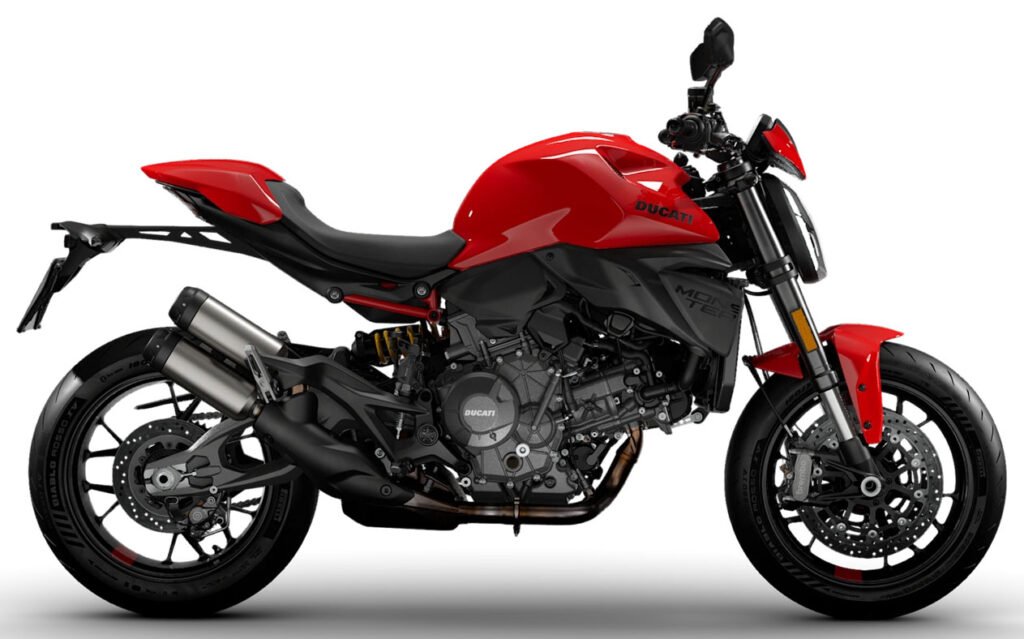
The Monster’s monocoque aluminum front frame is the biggest underappreciated story in this spec sheet. By using the engine as a stressed structural member — the same concept as the Panigale V4 superbike — Ducati cut the Monster’s wet weight to 386–414 pounds depending on year, which is 40 pounds lighter than the Monster 821 and comparable to several 600cc supersports.
That weight difference shows up everywhere corners exist. The Monster responds to body weight input and changes direction willingly — it doesn’t need to be muscled.
Suspension on the Monster Plus uses a 43 mm inverted Showa fork and a preload-adjustable monoshock: well-calibrated for road use, limited in adjustability. The Monster SP’s fully adjustable Öhlins NIX 30 fork and monoshock transform the bike’s behavior on uneven surfaces and are worth the premium if you ride aggressively. Braking is Brembo-sourced on both trims; the SP’s Stylema calipers add surgical precision at track pace but the standard hardware is already excellent.
Electronics Package: Sport-Class Features at a Mid-Range Price
The Monster’s suite — Cornering ABS, Ducati Traction Control (DTC), Ducati Wheelie Control (DWC), and Ducati Quick Shift (DQS) — uses a 6-axis Inertial Measurement Unit (IMU) that feeds lean-angle data to every system in real time. Lean-angle-sensitive ABS is not standard on every motorcycle at this price point; it prevents the ABS from over-braking mid-corner when the bike is leaned over.
Three riding modes (Sport, Urban, Wet) adjust throttle response, TC intervention, and ABS sensitivity simultaneously. Sport gives full power with minimal electronic intervention; Urban drops output to 75 hp with increased TC sensitivity; Wet dials in maximum protection across the board.
The 2026 model adds a fourth Power Mode, a new 5-inch 16:9 TFT display, Engine Brake Control (EBC), and the DQS 2.0 quickshifter carried over from the Panigale V4.
Who Should Buy the Ducati Monster
The Monster Plus ($13,195–$13,995) is for riders stepping up from a 600cc beginner bike who want real performance and electronics without a superbike seating position or a $20,000 price tag. The 32-inch seat height is manageable, the power is strong but not violent, and it commutes as well as it canyon-carves.
The Monster SP ($15,995 in 2024) is for the rider who’s done with stock suspension and wants a genuine performance tool. The Öhlins hardware, Stylema brakes, and Termignoni pipe change the bike’s character without requiring aftermarket work. If you ride aggressively on weekends or do track days, start here.
The Monster is not the best dollar-per-hp play in the class. A Yamaha MT-09 offers a 3-cylinder engine with more outright power and a full electronics suite at a lower MSRP. The Monster is for the rider who wants the Testastretta character and Ducati’s electronics integration specifically.
Ducati Monster Ownership Costs: The Desmo Service Reality
The Testastretta 11° requires a full Desmo service every 18,000 miles — checking and adjusting all 16 valve clearances plus replacing the timing belts (Maintenance Schedule, 2026). Oil and filter changes are due every 9,000 miles.
Dealer Desmo service runs $600–$1,200 depending on local labor rates and whether shims need replacing. It’s more expensive than a Japanese valve check, but the 18,000-mile interval is long enough that most street riders hit it infrequently. The 2026 Monster’s 890 V2 drops desmo actuation entirely, which will reduce major service complexity and cost.
For consumables: Pirelli Diablo Rosso III tires last 4,000–6,000 miles in normal street use. Chain life is almost entirely a function of lubrication habits — lube every 500 miles, check tension every 1,000, and you’ll get full life out of it.
Frequently Asked Questions About the Ducati Monster
What is the top speed of the Ducati Monster?
The 2024–2025 Ducati Monster 937 has a GPS-tested top speed of 140.9 mph, per MotoStatz (2026). Ducati does not publish an official top speed figure for the Monster. The 2026 Monster 890 V2 has not yet been independently GPS-tested as of mid-2026.
How fast is 0–60 mph on the Ducati Monster?
The Monster 937 hits 60 mph in 3.44 seconds, per GPS-instrumented testing by MotoStatz (2026). That time is competitive with other 111-hp naked bikes and faster than several more powerful machines that are harder to launch cleanly.
Is the Ducati Monster a good beginner bike?
The Monster is suitable for an intermediate rider upgrading from a smaller bike — not an absolute beginner. Its 111 hp and torque-rich Testastretta motor can get ahead of a new rider quickly. The 32-inch seat height and manageable ergonomics are accessible; the power is not trivial. A proper beginner is better served by something in the 400–650cc range first.
What is the difference between the Ducati Monster and the Monster SP?
The Monster SP adds a fully adjustable Öhlins NIX 30 front fork and Öhlins monoshock, Brembo Stylema calipers (versus standard 4-piston radials), factory Termignoni slip-on silencers, recalibrated electronics, and a MotoGP-inspired livery. The engine is identical. The SP starts at $15,995 in 2024; the Monster Plus starts at $13,195 (Cycle World, 2024).
What engine does the 2026 Ducati Monster have?
The 2026 Monster uses Ducati’s new 890cc V2 engine, a 90-degree twin with conventional spring-actuated valves plus an Intake Variable Timing (IVT) system. It produces 110.7 hp and 67 lb-ft of torque, and is shared with the 2026 Panigale V2 and Streetfighter V2. It is approximately 13 pounds lighter than the outgoing 937cc Testastretta (Autoevolution, 2025).
How often does the Ducati Monster need a valve service?
On the 2024–2025 Monster 937, the Desmo service — full valve clearance check and timing belt replacement — is due every 18,000 miles or 30,000 km (Maintenance Schedule, 2026). Oil and filter changes are every 9,000 miles. The 2026 Monster 890 V2 does not use a desmodromic valvetrain, so it will have simpler, lower-cost valve service intervals (not yet published as of mid-2026).
How much does the Ducati Monster cost in the US?
The 2024 Monster Plus starts at $13,195 MSRP. The 2024 Monster SP starts at $15,995. The 2026 base Monster starts at $12,995 and the 2026 Monster+ at $13,995, plus a $995 destination fee in both cases