Ducati Motorcycles: History, Manufacturer & Ownership
TL;DR
- Ducati was founded on July 4, 1926, in Bologna, Italy, as a radio components company — not a motorcycle maker.
- The company built its first motorcycle-related product, the Cucciolo, in 1946 after Allied bombing forced a business pivot.
- Ducati is headquartered in Borgo Panigale, Bologna, and is owned by the Volkswagen Group through its Audi AG subsidiary.
- The desmodromic valve system, introduced in competition in 1956 by engineer Fabio Taglioni, is the defining technical trait of every Ducati engine.
- Ducati sold 57,400 motorcycles in 2024 and has won MotoGP riders’ titles in 2022, 2023, and 2025.
From Radio Parts to Red Bikes: What Ducati Actually Is
Ducati Motor Holding S.p.A. is an Italian motorcycle manufacturer based in Borgo Panigale, a suburb of Bologna in northern Italy. The company is owned by the Volkswagen Group through Audi AG, and it sits alongside Lamborghini and Bentley in what VW calls its “Progressive Brand Group.” It makes one thing now: motorcycles. But for the first two decades of its existence, it had never built one.
The brand is best known for L-twin engines, desmodromic valve trains, Italian styling, and a racing record that most manufacturers would trade a kidney to have. It’s also known for complexity at service time and price tags that tend toward the upper end of any segment it enters. If you’re here to understand where the company came from and who’s running it today, you’re in the right place.
How a Radio Parts Company Became a Motorcycle Manufacturer
On July 4, 1926, Antonio Cavalieri Ducati and his three sons — Adriano, Bruno, and Marcello — registered a company in Bologna called Società Scientifica Radio Brevetti Ducati (SSR Ducati) (Volkswagen Group, 2023). The company made capacitors for radios, based on a patent held by eldest son Adriano, who had already built a short-wave radio device capable of reaching the United States — a legitimate engineering achievement in 1924 (RunMotoRun, 2025).
The business grew fast. By 1935, Ducati had established a 12-hectare manufacturing complex in Borgo Panigale and employed 3,500 people (Volkswagen Group, 2023). Before the war, the company was making radios, cameras, electric shavers, cash registers, and optical lenses — a broad consumer electronics portfolio for an Italian firm of that era. Sales offices ran from London to Sydney to New York. Nobody in the building was thinking about motorcycles.
Then Allied bombing raids during World War II hit the Borgo Panigale factory repeatedly. After liberation in 1944, the brothers found themselves in a different situation entirely. The delicate electronic components that had made them successful were harder to produce with a damaged factory and disrupted supply chains. They needed a simpler, more durable product.
The Cucciolo and the First Motorcycles (1946–1960s)
The pivot to motorcycles didn’t come from ambition — it came from necessity. SIATA (Società Italiana per Applicazioni Tecniche Auto-Aviatorie), a small Turinese firm, had developed a small 48cc four-stroke auxiliary engine called the “Cucciolo” — Italian for “puppy,” a nod to its distinctive exhaust note. SIATA couldn’t keep up with demand, so Ducati stepped in as the manufacturer (Wikipedia, 2026).
In 1946, full production of the Cucciolo began at Borgo Panigale. It was essentially a bicycle motor: 48cc displacement, 98 lbs total weight, a top speed of 40 mph, and fuel economy around 200 mpg (Wikipedia, 2026). It sold 100,000 units worldwide (MMR22, 2023). That commercial success bought the company time to develop its first complete motorcycle in 1949.
By 1953, the motorcycle business had grown large enough that management split the company into two separate entities: Ducati Meccanica SpA (motorcycles) and Ducati Elettronica (electronics). In the 1960s, Ducati Meccanica made a firm statement about what it was going to be — the Mach 1, introduced in that decade, was the fastest 250cc road bike available anywhere (Wikipedia, 2026).
Who Has Owned Ducati? A Complete Ownership History
Ducati has passed through more hands than most brands its size. Here’s the full timeline:
| Period | Owner | Notes |
|---|---|---|
| 1926–1948 | Cavalieri Ducati family | Founded as SSR Ducati; electronics focus |
| 1948–1954 | Italian government | Financial hardship post-WWII forced transfer |
| 1954–1985 | State-controlled IRI–EFIM–Finmeccanica | Split into Meccanica and Elettronica divisions; Fabio Taglioni era |
| 1985–1996 | Cagiva Group | Acquired with intent to rebrand; kept the Ducati name |
| 1996–2012 | Texas Pacific Group (TPG) / Investindustrial | TPG bought 51% in 1996; sold stake to Investindustrial in 2006 |
| 2012–present | Volkswagen Group (via Audi AG) | Acquired for €747 million on July 19, 2012 |
The 2012 acquisition is the one that matters most for understanding where the company sits today. Audi AG bought 100% of Ducati Motor Holding S.p.A. from Investindustrial for roughly €747 million (Wikipedia, 2026). Ducati then became part of Volkswagen’s “Progressive Brand Group” alongside Audi, Bentley, and Lamborghini. The connection is corporate and financial, not technical — Ducati designs and builds its motorcycles independently in Bologna with no shared platform from the car divisions.
There was genuine concern around 2015 that VW would sell Ducati to fund its diesel emissions scandal costs. Labor unions resisted, and the VW supervisory board confirmed Ducati would stay. As of 2026, it remains firmly inside the group.
The Desmodromic Valve System: What Sets Ducati Engines Apart
Every current Ducati engine uses a desmodromic valve system. This is the single most important technical trait that separates Ducati from every other production motorcycle manufacturer — and it goes back to 1956.
In a conventional engine, cam lobes push valves open and springs snap them shut. At high rpm, those springs can’t keep up, causing “valve float” — the valve doesn’t close in time, power drops, and in a worst case, the piston crown and valve meet each other. In 1956, Ducati’s chief engineer Fabio Taglioni solved this by eliminating the return springs entirely. His desmodromic system uses two sets of cam lobes and rocker arms — one to open the valve, one to positively close it (RevZilla, 2026). The word itself comes from the Greek desmos (controlled or linked) and dromos (track or course).
Taglioni first deployed the system in competition in the 125 Desmo Grand Prix racer in 1956. It trickled down to production road bikes in 1968, starting with the 450cc Scrambler’s “widecase” engine (Wikipedia, 2026). Every Ducati built since then has carried some version of it.
The practical tradeoff: desmo engines need periodic valve clearance checks that require removing rocker arms, not just shimming like most bikes. Servicing one properly is a longer job than a standard valve check. It’s not difficult, but it’s not a 45-minute task either — budget for it when buying used.
Racing: Why Ducati’s Track Record Actually Matters
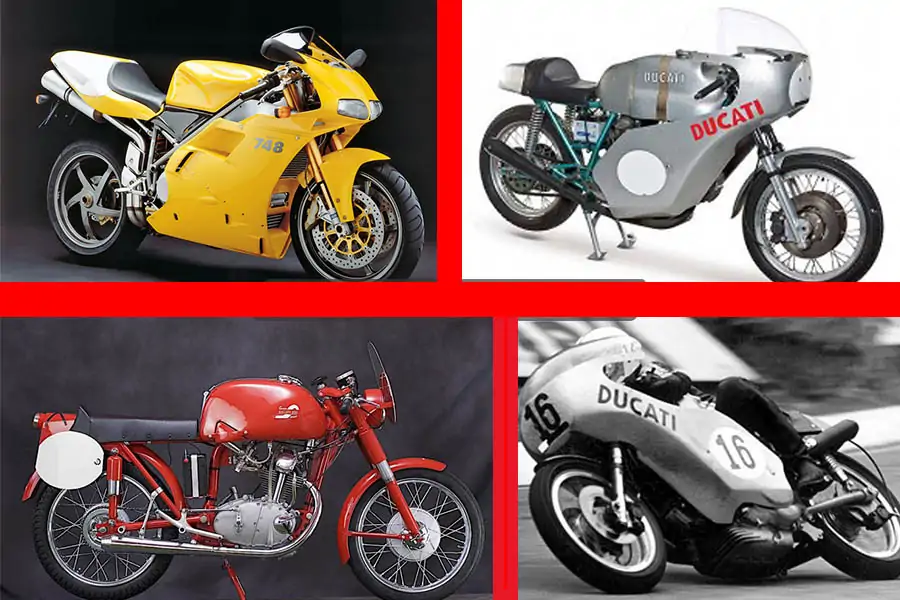
Ducati’s racing history isn’t just marketing backdrop — it directly shaped the bikes you can buy today. The Panigale V4’s electronics package, its traction control maps, and the geometry of its chassis all trace lines back to what Ducati Corse learned on track.
In the Superbike World Championship (WorldSBK), Ducati has more manufacturer titles than any other brand in the championship’s history, with 20 Manufacturers’ World Titles as of 2023 (Ducati, 2023). Carl Fogarty won four rider titles on Ducati V-twins in the 1990s. Troy Bayliss won three. Álvaro Bautista took back-to-back titles in 2022 and 2023 on the Panigale V4 R.
In MotoGP, Ducati spent years as the fast-but-fragile also-ran before Casey Stoner broke through in 2007. Francesco Bagnaia won consecutive rider championships in 2022 and 2023, becoming the first Ducati rider to defend a MotoGP title. In 2025, Marc Márquez won a ninth world championship on the factory Ducati, giving the brand its third MotoGP riders’ title in four years.
That run has made Ducati the team every other manufacturer on the grid is measuring itself against right now.
What Ducati Builds Today: The Model Families
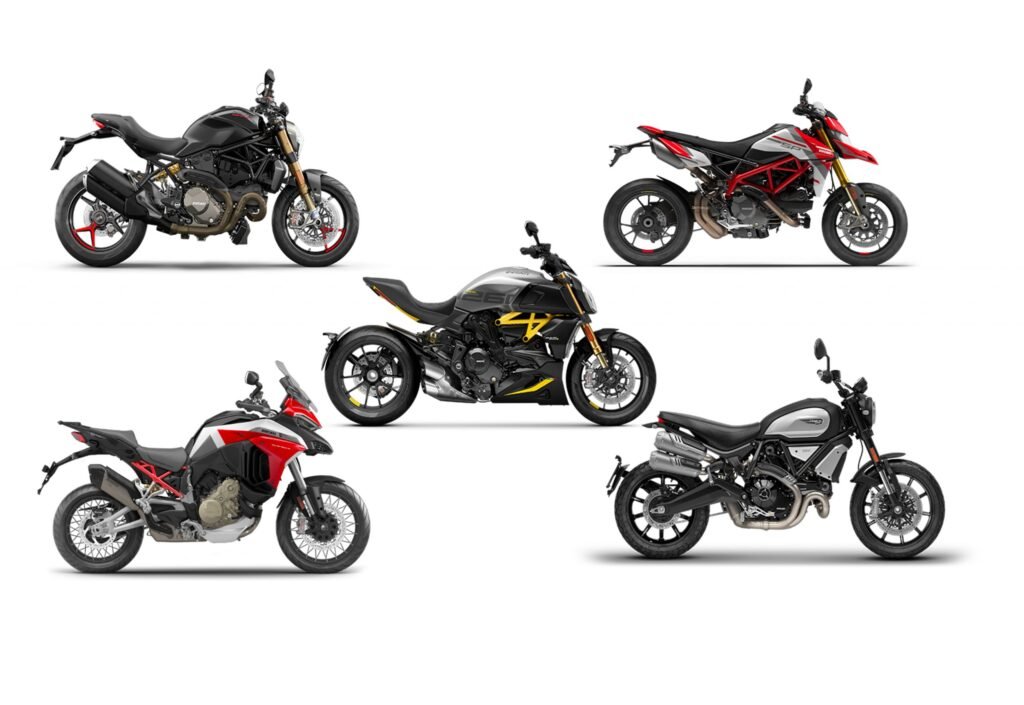
Ducati’s current lineup organizes into distinct families, each with a clear identity:
| Family | Character | Example Models |
|---|---|---|
| Panigale | Full track-focused sportbike | Panigale V4, V4 S, V4 R |
| Streetfighter | Naked sport | Streetfighter V4, V4 S |
| Monster | Accessible naked bike | Monster, Monster SP |
| Multistrada | Sport-touring, adventure | Multistrada V4, V4 S, V4 Rally |
| Scrambler | Retro-modern mid-weight | Scrambler Icon, Full Throttle, Desert Sled |
| DesertX | Adventure off-road | DesertX, DesertX Rally |
| Diavel | Power cruiser | Diavel V4 |
| Hypermotard | Supermoto-inspired | Hypermotard 698, 950 |
Every engine across the lineup uses the desmodromic system. All V-twins use a 90-degree L-twin layout — cylinders oriented in the direction of travel — which is the configuration Ducati locked into in the early 1960s. The V4 models, introduced in 2018, use a narrower 90-degree V-four derived from MotoGP development.
Ducati sold 57,400 motorcycles worldwide in 2024 (Volkswagen Group Annual Report, 2024). Italy remains the top national market; Europe takes the majority of global deliveries.
Frequently Asked Questions About Ducati
Who founded Ducati and when?
Ducati was founded on July 4, 1926, by Antonio Cavalieri Ducati and his three sons, Adriano, Bruno, and Marcello, in Bologna, Italy. The company started as a manufacturer of radio components called Società Scientifica Radio Brevetti Ducati — motorcycle production came two decades later.
Who owns Ducati now?
Ducati is owned by the Volkswagen Group through its Audi AG subsidiary. Audi acquired 100% of Ducati Motor Holding S.p.A. on July 19, 2012, for approximately €747 million. Ducati operates as an independent brand within VW’s Progressive Brand Group and designs and builds all its motorcycles in Bologna, Italy.
Where are Ducati motorcycles made?
Ducati motorcycles are designed and primarily manufactured at the Borgo Panigale factory in Bologna, Italy. The company also operates assembly facilities in Manaus, Brazil, and Amphur Pluakdaeng, Thailand, mainly to serve those regional markets.
What is the desmodromic valve system?
The desmodromic (or “desmo”) valve system is an engine valve control method where valves are both opened and closed mechanically by cam lobes and rocker arms, eliminating the need for valve return springs. Ducati engineer Fabio Taglioni introduced it in racing in 1956 and on road bikes in 1968. It allows the engine to rev higher without valve float, and it remains a defining feature of every Ducati engine in production today.
Has Ducati ever been close to going out of business?
Yes, twice. The first was after World War II, when Allied bombing damaged the factory and financial hardship forced the Ducati brothers to hand the company to the Italian government. The second was in the mid-1990s under Cagiva Group ownership, when production collapsed to 12,509 units in 1996, down from nearly 21,000 the previous year. Texas Pacific Group’s acquisition that same year stabilized the company and set the stage for the Monster and 916-led recovery that followed.