KTM Motorcycles: History, Manufacturer & Ownership
TL;DR
- KTM is an Austrian motorcycle brand founded in 1934 by Hans Trunkenpolz in Mattighofen, Austria; the name stands for Kronreif and Trunkenpolz Mattighofen.
- Indian manufacturer Bajaj Auto completed a majority acquisition of KTM’s parent company in November 2025, investing approximately €800 million and taking a 74.9% controlling stake. (Motorcycle.com, 2025)
- KTM has won the Dakar Rally 21 times, including an 18-consecutive-win streak from 2001 to 2019 — the longest winning run in Dakar history. (KTM.com, 2025)
- The brand produces motorcycles in three countries: Austria (flagship facility in Mattighofen), India (small-displacement models at Bajaj’s Chakan plant), and China (790 Duke and 790 Adventure, in partnership with CFMoto). (Wikipedia, 2025)
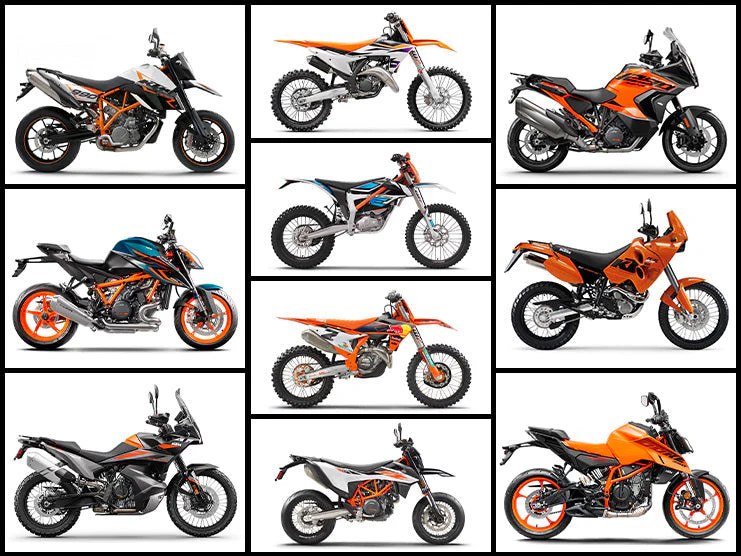
- KTM’s “Ready to Race” philosophy runs through every model it builds, from the 50cc youth bikes up to the 1290cc Super Duke R.
What KTM Stands For and Where It Comes From
KTM stands for Kronreif and Trunkenpolz Mattighofen. The name reflects the two men who built the company and the Austrian town where it all started. (Mallory Motorcycles, 2025) The brand is headquartered in Mattighofen, Upper Austria, where its main production facility and R&D center still operate today.
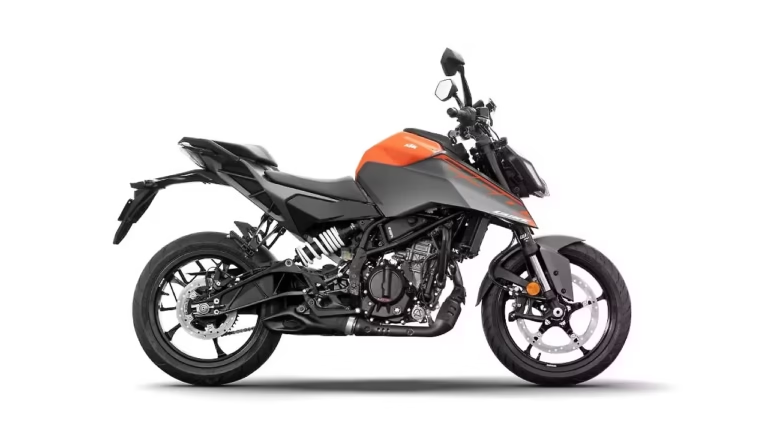
The company is Austrian through and through. Austrian engineering culture — precise, stubborn, and skeptical of compromise — shows up in how KTM designs motorcycles. The suspension geometry on a KTM street bike feels noticeably more aggressive than most competitors at the same price point, and that’s deliberate. The engineers who build the off-road bikes also shape the road bikes. A 390 Duke corners like it’s trying to prove something, because the people who engineered it have strong opinions about what a motorcycle should do when you tip it into a turn.
How a Car Repair Shop Became a Motorcycle Manufacturer (1934–1953)
In 1934, Hans Trunkenpolz opened a metalworking and vehicle repair shop in Mattighofen, Austria. He registered it as Kraftfahrzeug Trunkenpolz Mattighofen — “kraftfahrzeug” meaning motor vehicle in German. By 1937 he was selling DKW motorcycles; by 1938, Opel cars. (Wikipedia, 2025)
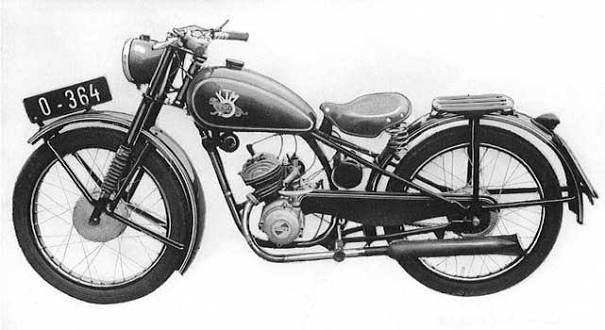
During World War II, his wife kept the business running while Hans worked on diesel engine repairs for the war effort. After the war, demand for affordable personal transportation grew sharply across Europe. Hans saw the opening. He built a prototype motorcycle in 1951 — the R100, a 98cc two-stroke using a Fichtel and Sachs engine — in his workshop. (MotoProWorks, 2024)
Ernst Kronreif joined as a business partner in 1953 and brought capital along with him. The company reorganized, swapped the “K” from Kraftfahrzeug to Kronreif, and began producing motorcycles at a rate of three per day with 20 employees. That first year also brought the brand’s first racing title: the Austrian 125cc national championship. (Wikipedia, 2025) A year later, Egon Dornauer won a gold medal at the International Six Days Trials on a KTM — the oldest off-road event sanctioned by the FIM. The direction was set early.
| Year | Milestone |
|---|---|
| 1934 | Hans Trunkenpolz opens repair shop in Mattighofen |
| 1951 | First KTM motorcycle prototype, the R100 |
| 1953 | Ernst Kronreif joins; production begins at 3 bikes per day |
| 1954 | First racing title: Austrian 125cc national championship |
| 1957 | First dedicated sport motorcycle, the Trophy 125cc |
| 1978 | US subsidiary founded in Lorain, Ohio |
| 1991 | Company splits into four entities after bankruptcy |
| 1992 | Stefan Pierer acquires motorcycle division |
| 1994 | Duke sport series launches |
| 2001 | First of 18 consecutive Dakar Rally wins begins |
| 2007 | Bajaj Auto takes initial 14.5% stake |
| 2025 | Bajaj completes majority acquisition for €800 million |
The Near-Death Years and How Stefan Pierer Saved the Brand (1989–1994)
By the 1980s, Japanese manufacturers had done to KTM what they did to most European motorcycle brands — buried them. Honda, Yamaha, Kawasaki, and Suzuki undercut the market on price and reliability, and KTM’s scooter and moped sales collapsed. Production halted in 1988. (RaceDriven, 2019)
Erich Trunkenpolz, son of founder Hans, died in 1989. An Austrian investment trust led by politician Josef Taus acquired 51% of the company and tried to turn it around. They couldn’t. By 1991, creditor banks took control, and KTM was split into four separate entities: motorcycles (KTM Sportmotorcycle GmbH), bicycles (KTM Fahrrad GmbH), radiators (KTM Kühler GmbH), and tooling (KTM Werkzeugbau GmbH). (Wikipedia, 2025)
Austrian entrepreneur Stefan Pierer acquired the motorcycle division in 1992. His bet paid off quickly. In 1994, KTM launched the Duke — a single-cylinder, trellis-framed street fighter that had no real equivalent at the time. In 1995, KTM bought Swedish off-road brand Husaberg. In 1996, KTM motocross machines got their now-iconic orange paint. In 1997, liquid-cooled twin-cylinder Adventure and Supermoto models arrived. (Wikipedia, 2025)
Within a decade, the company that had gone bankrupt was posting €1 billion in annual revenue and winning Dakar Rallies back to back. The turnaround is one of the cleaner stories in the motorcycle industry.
Who Manufactures KTM Motorcycles Today
KTM AG is the legal entity that manufactures KTM motorcycles. The company’s primary facility is in Mattighofen, Austria, which handles flagship model production, all R&D, racing development, and large-displacement motorcycle manufacturing. (Wikipedia, 2025)
Small- and mid-displacement KTMs — primarily the Duke and RC series — are built at Bajaj Auto’s Chakan plant in Pune, Maharashtra, India, and exported to over 80 countries. The 790 Duke and 790 Adventure are produced at a KTM-CFMoto joint facility in Hangzhou, China. (Wikipedia, 2025)
In total, KTM-branded motorcycle production reached approximately 290,000 units in 2023, with the broader group (including Husqvarna and GasGas) producing over 380,000 motorcycles. (Wikipedia, 2025)
Who Owns KTM Right Now
As of November 18, 2025, KTM is majority-owned by Bajaj Auto, India’s largest two-wheeler and three-wheeler exporter. The acquisition came in through Bajaj Auto International Holdings BV, a wholly owned Dutch subsidiary of Bajaj Auto Limited. Bajaj acquired 100% of Pierer Bajaj AG — which held approximately 74.9% of KTM’s parent holding company — for €800 million. (Motorcycle.com, 2025)
Following the transaction, Pierer Mobility AG was renamed Bajaj Mobility AG. KTM, Husqvarna, and GasGas all fall under this umbrella. The remaining ~25% of Bajaj Mobility AG shares are publicly traded on the SIX Swiss Exchange in Zurich and the Vienna Stock Exchange. (Autocar India, 2025)
Bajaj’s relationship with KTM goes back to 2007, when it first purchased a 14.5% stake. Over the years it built that stake to roughly 48% before completing the full takeover. The connection wasn’t just financial — Bajaj has manufactured KTM motorcycles in India since 2012 and helped build the brand’s presence across Asia and Africa.
KTM’s Racing Record: Dakar, MotoGP, and Motocross
KTM’s racing identity is the foundation the entire brand rests on. The “Ready to Race” motto isn’t marketing copy — it’s an engineering brief. Every road-going KTM is designed with a racing baseline in mind.
The headline achievement is the Dakar Rally. KTM won 18 consecutive Dakar titles from 2001 to 2019, a streak that no manufacturer in any motorsport category has matched over a comparable period. (KTM.com, 2025) The bike that did most of the heavy lifting was the KTM 450 Rally, which has 11 outright Dakar wins to its name. (Wikipedia, 2026) KTM has now won the Dakar a total of 21 times — adding victories in 2023 (Kevin Benavides), 2025 (Daniel Sanders), and 2026 (Luciano Benavides, by two seconds in the closest Dakar finish ever recorded). (Roadracing World, 2026)
In MotoGP, KTM entered the premier class in 2017. Three years in, Brad Binder won the 2020 Czech Grand Prix at Brno — KTM’s first MotoGP race win — on a steel trellis frame in a field that had long moved to aluminum. The bike also ran WP suspension developed in-house rather than sourced from the Swedish supplier most competitors used. It was the kind of result that defines the brand. KTM has since won multiple MotoGP races and runs two factory-affiliated teams.
In off-road and supercross, KTM and its sister brand Husqvarna have accumulated over 260 world championship titles across various disciplines since 1974. (Langston Motorsports, n.d.) The orange machines own more FIM World Motocross Championship titles than any other manufacturer.
Frequently Asked Questions About KTM Motorcycles
What does KTM stand for?
KTM stands for Kronreif and Trunkenpolz Mattighofen. The “K” originally stood for “Kraftfahrzeug” (motor vehicle in German), but was changed to Kronreif when Ernst Kronreif became a business partner in 1953. Mattighofen is the Austrian town where the company was founded and still operates today. (Mallory Motorcycles, 2025)
Where are KTM motorcycles made?
KTM motorcycles are made in three countries. The primary facility is in Mattighofen, Austria, where flagship and large-displacement models are built along with all R&D and racing development. Smaller-displacement KTMs — including the Duke and RC series — are manufactured at Bajaj Auto’s Chakan plant in Pune, India. The 790 Duke and 790 Adventure are assembled in Hangzhou, China, through a KTM-CFMoto joint venture. (Wikipedia, 2025)
Who owns KTM now?
Bajaj Auto, an Indian motorcycle manufacturer, completed a majority acquisition of KTM on November 18, 2025. Through its subsidiary Bajaj Auto International Holdings BV, Bajaj acquired a 74.9% controlling stake in KTM’s parent company (now called Bajaj Mobility AG) for approximately €800 million. The remaining ~25% of shares trade publicly on stock exchanges in Zurich and Vienna. (Motorcycle.com, 2025)
How many Dakar Rallies has KTM won?
KTM has won the Dakar Rally 21 times as of 2026. The brand holds the record for consecutive wins: 18 in a row from 2001 to 2019. KTM also won in 2023 (Kevin Benavides), 2025 (Daniel Sanders), and 2026 (Luciano Benavides). The KTM 450 Rally is the most successful model in Dakar history with 11 outright wins.
When did Bajaj Auto first invest in KTM?
Bajaj Auto first purchased a 14.5% stake in KTM Power Sports AG in 2007. It increased that stake over the following years, reaching approximately 48% before acquiring full majority control in November 2025. The partnership was operational long before the ownership change — Bajaj has manufactured KTM motorcycles in India since 2012 and exported them to over 80 countries.