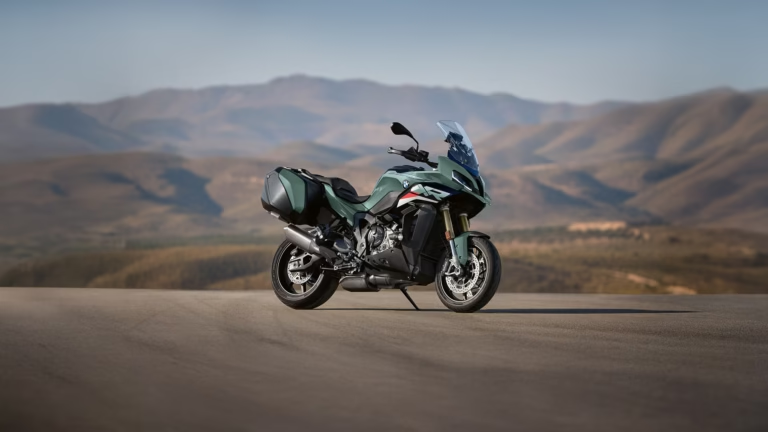
BMW Motorcycles: History, Manufacturer & Ownership
TL;DR
- BMW Motorrad is the motorcycle division of Bayerische Motoren Werke AG (BMW AG), headquartered in Munich, Germany, with primary motorcycle production in Berlin-Spandau.
- BMW built its first motorcycle, the R32, in 1923 — a flat-twin boxer design that still defines the R series today.
- The parent company BMW AG traces its founding to March 7, 1916, originally as an aircraft engine manufacturer.
- BMW sold 202,563 motorcycles globally in 2025, with the R1300GS and R1300GS Adventure accounting for over 66,000 units combined (BMW Motorrad, 2026).
- The current lineup spans six series — R, S, F, G, K, and C — covering everything from 313cc entry-level bikes to 1,802cc cruisers and a 1,649cc inline-six tourer.
Who Makes BMW Motorcycles and Where Are They Built
BMW motorcycles are made by BMW Motorrad, the dedicated motorcycle division of BMW AG, the German automotive conglomerate that also produces BMW cars, MINI, and Rolls-Royce vehicles. BMW Motorrad operates as a separate business unit within BMW AG, with its own CEO, product lines, and sales organization.
The primary production facility is the BMW plant in Berlin-Spandau, Germany, where motorcycle production has been based since 1969 (BMW Group, 2023). That plant handles the boxer-engined R series, the K series inline-six, and the S series superbikes. Not everything is built in Berlin, though. The G310 series — the entry-level single-cylinder models — is produced at TVS Motor Company’s plant in Hosur, Tamil Nadu, India, under a partnership arrangement. The C400 scooter series comes out of a Loncin facility in Chongqing, China.
Some engine components are manufactured in Austria and Taiwan. Final assembly, quality control, and brand identity remain firmly German regardless of where sub-assemblies originate.
| Production Site | Location | Models Produced |
|---|---|---|
| BMW Berlin-Spandau | Berlin, Germany | R series, S series, K series, R18, F series |
| TVS Motor Company | Hosur, India | G310R, G310GS, G310RR |
| Loncin | Chongqing, China | C400 GT, C400 X |
How BMW AG Was Founded: From Aircraft Engines to Motorcycles
BMW AG traces its official founding date to March 7, 1916, when Bayerische Flugzeugwerke AG (BFW) — Bavarian Airplane Works — was established in Munich. The company name BMW, short for Bayerische Motoren Werke (Bavarian Motor Works), came into use in 1917 when Karl Rapp’s engine company was renamed, and went fully public as BMW AG in 1918 (BMW Group, 2023).
The original business was building aircraft engines for the German military during World War I. The Treaty of Versailles ended that. Under its terms, BMW was banned from producing aircraft engines after the war. With no product and bills to pay, the company pivoted to whatever it could manufacture — railway brakes, farm equipment, and small industrial engines. It was not a glamorous period.
The flat-twin petrol engine BMW released in 1920, the M2B15, was designed as a portable industrial unit. Several motorcycle manufacturers picked it up and installed it in their own frames, which gave BMW its first indirect connection to two wheels. That connection became permanent three years later.
The R32 and the Boxer Twin: Where It All Started
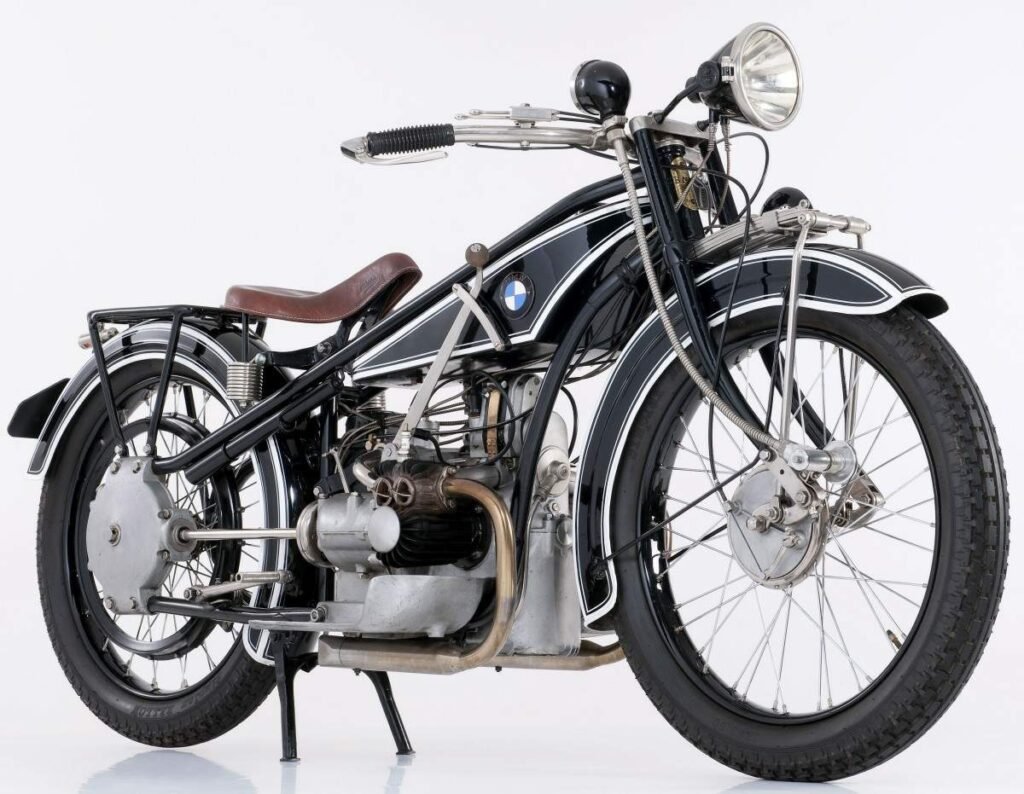
BMW built its first motorcycle in 1923: the R32, designed by engineer Max Friz. It used a 486cc flat-twin engine mounted longitudinally in the frame, with the cylinders sticking out horizontally on either side — the configuration now called the “boxer” or “boxer-twin” because the opposing pistons move in and out like a boxer’s fists (Wikipedia, 2026). The engine produced about 8.5 horsepower and pushed the R32 to a top speed of roughly 59–62 mph.
Two design choices from the R32 still echo across BMW’s lineup a century later. First, the shaft drive — instead of a chain connecting the engine to the rear wheel, BMW used a driveshaft enclosed in the swingarm. It requires less maintenance and handles desert grit and rain far better than a chain. Second, the boxer layout itself, which keeps the engine’s center of mass low, runs cool with exposed cylinders, and produces a distinctive riding feel unlike anything from a parallel-twin or inline-four.
BMW’s racing program validated the design quickly. Between 1924 and 1929, BMW won every German Championship in the 500cc class (BMW Motorrad, 2023). Works rider Ernst Henne broke the world land speed record in 1929 on a modified R37 at 216 km/h, then set a final record in 1937 at 279.5 km/h on a 500cc supercharged BMW that stood unchallenged for 14 years (Wikipedia, 2026).
The boxer engine has been in continuous production since 1923. That is not a marketing claim — it is a fact that puts BMW in a very short list of manufacturers who can trace a single architecture across a century.
From World War II to the Modern Era
BMW’s WWII role is worth knowing. The R75 military sidecar rig became one of the most capable off-road vehicles of the conflict, with shaft drive that thrived in North African desert conditions where chain-driven competitors failed. It influenced both Indian and Harley-Davidson to develop their own sidecar rigs for the US military.
Post-war recovery was slow. Allied occupation authorities initially banned BMW from manufacturing motorcycles. When permission came through in 1947, BMW had to reverse-engineer their own pre-war bikes from scratch — all the blueprints and tooling were in the Soviet-controlled Eisenach factory in East Germany. The first postwar BMW, the 1948 R24, was a 247cc single built from memory and borrowed knowledge (Wikipedia, 2026).
By 1969, car production pressure forced motorcycle manufacturing out of Munich entirely and into the dedicated Berlin-Spandau facility. The 1970s brought the /5 and /6 series twins that modernized the boxer platform. The 1980s added the K series inline-fours and inline-sixes, giving BMW a sport and touring option beyond the boxer. The 1990s produced the F650 Dakar and the R1100GS, which launched the adventure segment that BMW now dominates.
In 2000, BMW introduced ABS as standard equipment on its GS models, years before most competitors treated it as anything beyond an expensive option. That push toward electronics has continued — today’s R1300GS ships with radar-based adaptive cruise control and front collision warning.
The Current BMW Motorrad Model Families
BMW Motorrad organizes its lineup into six letter-designated families. Each letter signals the engine architecture and, loosely, the mission of the bike.
R series — the boxer twins. The R1300GS and R1300GS Adventure are the volume leaders, accounting for over 66,000 units sold globally in 2025 (BMW Motorrad, 2026). Displacement runs 1,254cc–1,300cc for the liquid-cooled modern boxers, plus the air/oil-cooled 1,802cc engine in the R18 cruiser. Shaft drive throughout.
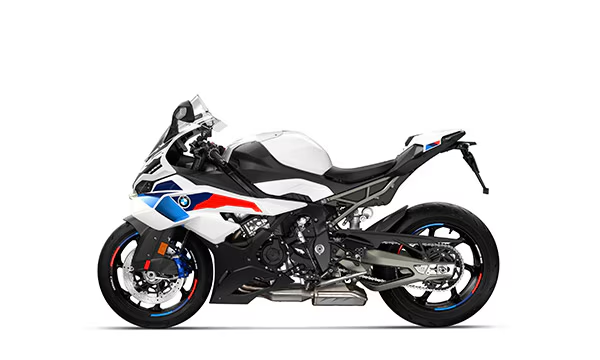
S series — inline-four superbikes and sport-tourers. The S1000RR is BMW’s track-focused superbike, generating 210 horsepower from a 999cc engine. The S1000R is the naked roadster version; the S1000XR is the adventure-sport crossover. The S series sold 20,859 units in 2025 (BMW Motorrad, 2026). Chain drive, as grip demands at the limit require it.
F series — parallel-twin mid-range bikes. The F900R, F900XR, F800GS, and F900GS sit in the 850–900cc range and handle most adventure and street riding without the weight or price premium of the R series.
G series — the entry-level single. The G310R and G310GS are 313cc bikes built in India by TVS. They are BMW’s answer to new riders and budget-conscious markets. Capable bikes, but do not expect boxer character.
K series — the inline-six tourers. The K1600GT, K1600GTL, K1600 Grand America, and K1600B are long-haul machines with 1,649cc six-cylinder engines producing about 160 horsepower and 129 lb-ft of torque. The K1600GTL weighs over 700 lbs wet — these are motorcycles for eating miles in comfort, not carving canyon roads.
C series — urban scooters and electric commuters, including the CE 04 electric scooter.
What BMW Motorcycle Ownership Actually Looks Like
BMW Motorrad sold 14,869 motorcycles in the United States in 2025, a drop from 17,272 in 2024 that reflects tariff-driven price increases rather than a loss of demand (BMW MOA, 2026). That context matters: a 25% US import tariff applied through parts of 2025 added real cost to bikes already priced at a premium.
The typical US BMW owner is buying into a specific experience. Service intervals on the boxer twins run to 6,000 miles for oil changes and 12,000 miles for major services — manageable, but more involved than a Japanese parallel-twin. The shaft drive eliminates chain maintenance entirely, which some riders find liberating and others find underwhelming when they miss the mechanical satisfaction of adjusting chain slack.
Parts availability is solid in metropolitan areas and reasonable in rural ones, though it does not match the density of Honda or Yamaha dealer networks. BMW Motorrad USA operates roughly 350 dealers nationally.
Resale holds reasonably well on R-series and S-series models. The GS platform, in particular, has consistent demand on the used market because the platform is proven and the Adventure Riding community around it is active. The R nineT and R18 attract a specific buyer who wants German heritage styling — for those riders, there is no comparable alternative.
Frequently Asked Questions About BMW Motorcycles
Who owns BMW Motorrad?
BMW Motorrad is a wholly owned division of BMW AG (Bayerische Motoren Werke Aktiengesellschaft), the publicly traded German multinational headquartered in Munich, Germany. BMW AG also owns the MINI and Rolls-Royce automobile brands. BMW Motorrad is not a separate company — it operates as a business unit within BMW AG with its own product leadership and CEO.
When did BMW start making motorcycles?
BMW produced its first motorcycle in 1923 — the R32, a 486cc flat-twin boxer. Before that, BMW manufactured aircraft engines starting in 1916, and sold flat-twin engines to other motorcycle manufacturers beginning around 1921. The R32 is the direct ancestor of every R-series motorcycle BMW makes today.
Where are BMW motorcycles made?
Most BMW motorcycles are produced at the company’s plant in Berlin-Spandau, Germany, where production moved in 1969. The G310 entry-level models are assembled at TVS Motor Company’s plant in Hosur, India. The C400 scooter series is built in China through a partnership with Loncin. Some engine components come from Austria and Taiwan.
What is the boxer engine and why does BMW use it?
The boxer engine places two cylinders horizontally opposed on either side of the frame, so the pistons move in and out rather than up and down. BMW has used this configuration since the 1923 R32 because it keeps the engine’s center of mass low, provides natural air cooling to the cylinder heads, and creates a distinctive low-rpm torque character that works well for touring and adventure riding. Over 100 years later, it remains the signature BMW Motorrad layout.
How many BMW motorcycles are sold per year?
BMW Motorrad sold 202,563 motorcycles globally in 2025, the fourth consecutive year above 200,000 units (BMW Motorrad, 2026). The R1300GS Adventure was the top-selling model, followed by the R1300GS. In the United States, 14,869 units were sold in 2025. Germany remains the single largest market with 25,516 units.