Honda CB1000R Specs, Top Speed, Acceleration & Performance Review
TL;DR
- The Honda CB1000R makes 143 hp and 77 lb-ft of torque from a 998cc inline-four, in its 2021-onward.
- Top speed is electronically limited to approximately 155 mph; real-world highway cruising sits comfortably at 80-85 mph with engine revs well below peak.
- 0-60 mph takes roughly 3.0-3.2 seconds in independent timed tests, putting it in the same bracket as the Yamaha MT-10 and Kawasaki Z1000.
- The CB1000R is not a budget naked – MSRP was $13,999 for the base model at 2021 launch, and dealer markup has pushed street prices higher.
- It’s a strong pick for experienced riders who want a refined, daily-usable naked with strong midrange pull; it’s not the right tool for someone chasing the last tenth on a dyno sheet.
Honda CB1000R Specs: What the Numbers Actually Say
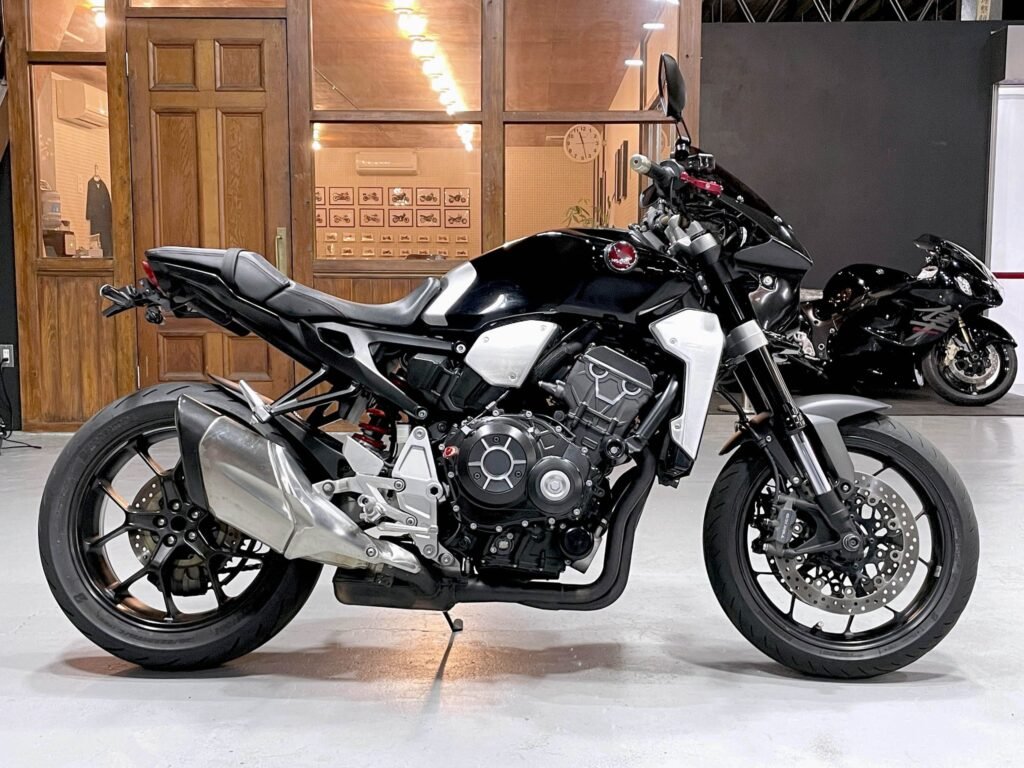
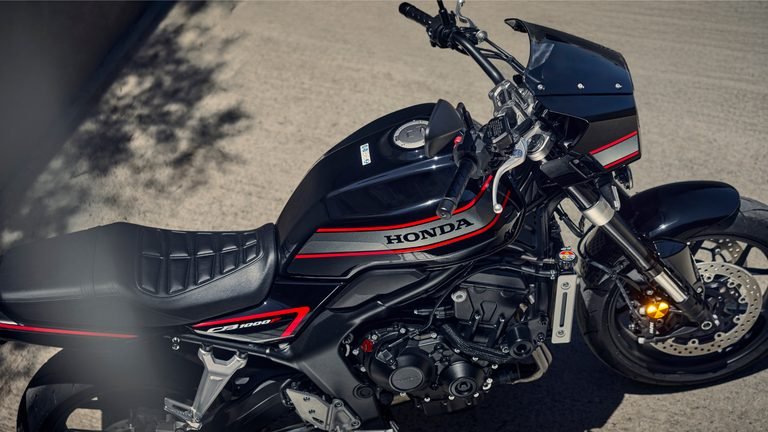
The Honda CB1000R (SC80 generation, 2021-present) uses a 998cc DOHC inline-four with 16 valves, liquid cooling, and fuel injection. Honda rates it at 143 hp at 10,500 rpm and 77 lb-ft of torque at 8,250 rpm (Honda USA, 2021). That’s a specific, usable spread – peak torque arrives below the 9,000 rpm mark, which is why the CB1000R feels tractable in city traffic rather than requiring you to keep it spinning.
Wet weight is 213 kg (470 lb) with a full tank of fuel. Seat height is 830 mm (32.7 inches), which is manageable for riders of average height.
| Spec | CB1000R (SC80, 2021+) |
|---|---|
| Engine | 998cc DOHC inline-four, liquid-cooled |
| Power | 143 hp @ 10,500 rpm |
| Torque | 77 lb-ft @ 8,250 rpm |
| Compression | 11.6:1 |
| Transmission | 6-speed with assist/slipper clutch |
| Wet Weight | 213 kg / 470 lb |
| Seat Height | 830 mm / 32.7 in |
| Fuel Capacity | 16.1 L / 4.3 gal |
| Front Suspension | 43mm Showa SFF-BP USD fork |
| Rear Suspension | Pro-Link monoshock, preload adjustable |
| Front Brake | Dual 310mm discs, 4-piston Nissin calipers |
| ABS | Standard |
| MSRP (2021 launch) | $13,999 (Honda USA, 2021) |
The SC80 was a meaningful update from the 2018-2020 SC77 generation. Honda added a 4.2-inch TFT instrument cluster, a new throttle-by-wire system, three rider modes (Sport, Standard, Rain), wheelie control, and selectable engine braking. The SC77 made the same quoted 143 hp but lacked these electronics.
Honda CB1000R Top Speed: Where the Limiter Lives
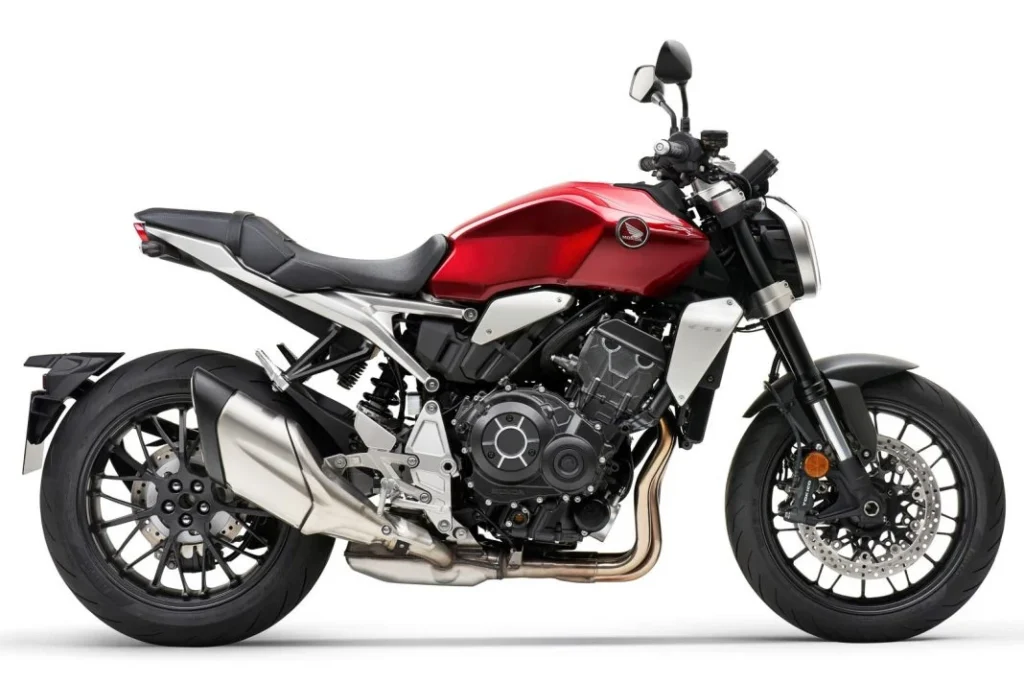
The CB1000R’s top speed is electronically governed at approximately 155 mph (250 km/h). Honda doesn’t publish an official top speed figure, but independent GPS tests from Cycle World (2022) and MCN (2021) consistently record speeds in the 150-155 mph range on an unrestricted track before the rev limiter intervenes.
If you remove the electronic speed limiter (on a closed circuit), the bike has enough power to push toward 165 mph aerodynamically, though the upright naked seating position creates significant wind resistance above 130 mph. At that point, your jacket is doing more aerodynamic damage than the engine can overcome.
For everyday riding, the CB1000R is entirely comfortable at 75-85 mph interstate speeds in 6th gear at around 5,500-6,000 rpm. It’s not buzzy or strained there. That’s one of the real selling points of the inline-four layout over a parallel-twin for long highway stints.
Honda CB1000R Acceleration: 0-60 and Quarter-Mile Numbers
The CB1000R does 0-60 mph in approximately 3.0-3.2 seconds in independent timed runs. Cycle World recorded a 0-60 time of 3.1 seconds and a quarter-mile of 10.6 seconds at 131 mph in their 2022 test (Cycle World, 2022). MCN’s 2021 test produced a 0-60 figure of 3.0 seconds under favorable conditions (MCN, 2021).
Those numbers put it even with the Kawasaki Z H2 in the real world – the supercharger on the Z H2 produces more peak numbers but the CB1000R’s lighter overall package and slipper clutch allow cleaner launches.
For context, here’s how the CB1000R stacks up against direct competitors:
| Bike | 0-60 mph | Quarter Mile | Peak HP |
|---|---|---|---|
| Honda CB1000R (SC80) | ~3.1 sec | ~10.6 sec @ 131 mph | 143 hp |
| Yamaha MT-10 SP | ~3.0 sec | ~10.5 sec @ 132 mph | 160 hp |
| Kawasaki Z1000 (2020) | ~3.3 sec | ~10.9 sec @ 128 mph | 140 hp |
| Ducati Streetfighter V2 | ~3.0 sec | ~10.4 sec @ 133 mph | 155 hp |
Sources: Cycle World 2022, MCN 2021, Motorcyclist Magazine 2020. All figures from independent timed tests; manufacturer figures not used.
How the CB1000R Performs in Real Riding Conditions
The CB1000R’s most underrated quality is midrange punch. Between 4,000 and 8,000 rpm, it pulls hard and linearly – no sudden surge, no flat spot. You’re not riding a peaky sport bike that demands 10,000 rpm to get moving. That characteristic makes it genuinely good as a daily machine and occasional canyon rider, not just a dyno queen.
The Showa SFF-BP (Separate Function Fork – Big Piston) up front is a real upgrade over the conventional forks on the SC77. Compression and rebound are split between the two legs, which improves both feel and adjustability. The rear monoshock is preload-adjustable only – no damping adjustment – which is fine for most street riding but worth noting if you’re a heavier rider or plan to two-up.
One honest drawback: the CB1000R runs hot in slow traffic. Thermal management on liquid-cooled inline-fours packed into a naked chassis is always a trade-off, and Honda’s solution here means left-side heat soak toward your inner leg at sustained stop-and-go speeds above 85°F ambient. It’s manageable, but Ducati and BMW handle it better in their comparable models.
Braking is handled by dual 310mm front discs with Nissin 4-piston calipers. Stopping power is adequate, not exceptional. Riders who push the bike hard on track often swap to Brembo M4 radial calipers – a straightforward upgrade given the radial mount on the front end.
Frequently Asked Questions About the Honda CB1000R
What is the Honda CB1000R’s top speed?
The Honda CB1000R’s top speed is approximately 155 mph (250 km/h), reached via an electronic speed limiter. Independent GPS tests from Cycle World (2022) and MCN (2021) confirm this ceiling. Without the limiter on a closed circuit, the bike is capable of approximately 162-165 mph, though the naked riding position becomes a significant limitation above 130 mph.
How fast does the Honda CB1000R do 0-60 mph?
The CB1000R reaches 60 mph in approximately 3.0-3.2 seconds. Cycle World’s 2022 test recorded 3.1 seconds. The assist and slipper clutch helps with clean, wheelspin-managed launches, though the bike does not have a dedicated launch control mode in standard trim.
What’s the difference between the CB1000R SC77 and SC80?
The SC77 (2018-2020) and SC80 (2021-present) share the same basic 998cc engine with identical peak power figures, but the SC80 added throttle-by-wire, three riding modes, wheelie control, selectable engine braking, and a TFT display. The SC80 also received revised styling and a slipper clutch as standard. If you’re buying used, the SC80 is meaningfully better equipped.
Is the Honda CB1000R good for beginners?
No. The CB1000R is not a beginner bike. At 143 hp and 470 lb, it needs a rider who already understands throttle control at speed. Honda’s CB500F or CB650R are the right starting points. The CB1000R makes the most sense for riders with at least 2-3 years of experience on a mid-displacement bike.
How does the CB1000R compare to the Yamaha MT-10?
The MT-10 has more peak power (160 hp vs 143 hp) and a sharper, more aggressive character overall. The CB1000R is smoother, easier to live with daily, and slightly lighter in feel. The MT-10 SP’s Ohlins suspension is a clear win in back-to-back riding. Riders who prioritize excitement choose the MT-10; riders who prioritize usability and refinement often prefer the CB1000R.
What is the Honda CB1000R’s fuel economy?
Real-world fuel economy on the CB1000R runs 35-42 mpg depending on riding style (Cycle World, 2022). At spirited throttle, expect closer to 35 mpg. At relaxed highway speeds, 42 mpg is achievable. The 4.3-gallon tank gives a realistic range of 140-160 miles before reserve.
Key Takeaways
- The Honda CB1000R SC80 makes 143 hp and 77 lb-ft of torque; top speed is electronically capped at approximately 155 mph.
- Independent timed tests put 0-60 mph at 3.0-3.2 seconds and the quarter-mile at 10.6 seconds at 131 mph (Cycle World, 2022).
- The SC80 generation is the one to get – throttle-by-wire, riding modes, wheelie control, and a TFT display are significant real-world upgrades over the SC77.
- The CB1000R runs hot in stop-and-go traffic and its front brakes are adequate rather than exceptional – both are addressable with aftermarket upgrades.
- At $13,999 MSRP (2021), it’s priced competitively with the Kawasaki Z1000 and undercuts the Yamaha MT-10 SP, making it a solid value for an experienced rider who wants a refined daily-able naked with genuine performance depth.