Honda CBR1000RR ABS Top Speed, 0-60 & Specs Review
TL;DR
- The Honda CBR1000RR ABS has a top speed around 186 mph and runs 0-60 mph in roughly 2.9 to 3.0 seconds, based on instrumented testing of the current-generation platform.
- Honda claims 189 hp at the crank; independent testers have measured 165-175 hp at the rear wheel.
- The 2026 CBR1000RR ABS has a base MSRP of $17,299 before the $775 destination charge.
- ABS has been standard equipment on this trim since the 2009 model year, not an optional add-on.
- This is the “base” liter-class Fireblade platform, not the flagship CBR1000RR-R Fireblade SP, which uses a different engine and costs over $10,000 more.
Honda CBR1000RR ABS Top Speed and 0-60 Time
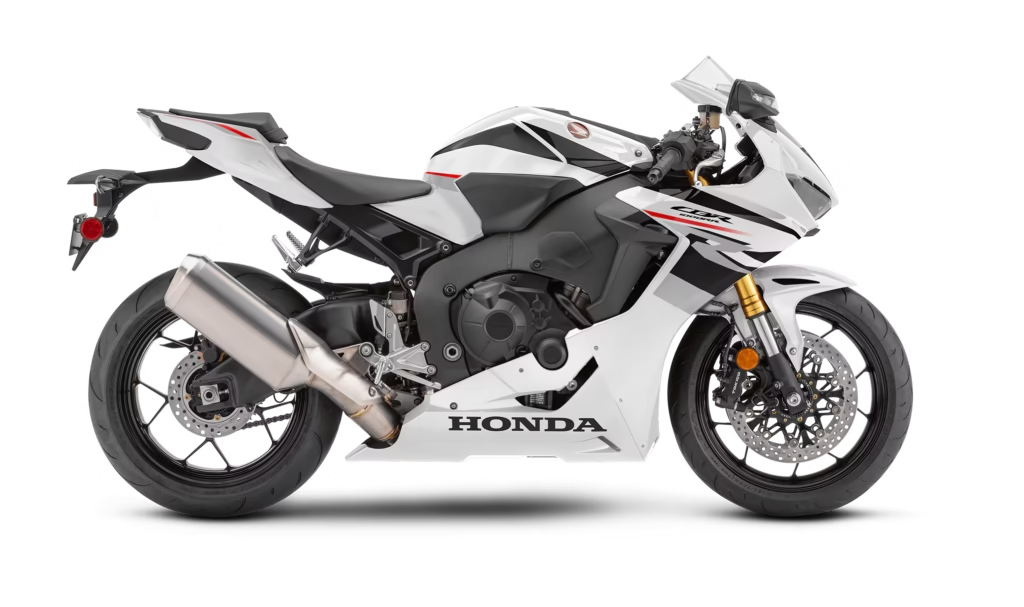
The CBR1000RR ABS has a top speed of roughly 186 mph and covers 0-60 mph in about 2.9 to 3.0 seconds. These figures come from GPS-instrumented testing of the 2017-2020 CBR1000RR, the generation that still forms the core of the current base and ABS trims (MotoStatz, 2022).
The CBR1000RR ABS is the antilock-brake trim of Honda’s non-SP liter-class superbike, sitting between the base CBR1000RR and the far pricier CBR1000RR-R Fireblade SP in Honda’s current lineup.
It runs a 999cc inline-four, paired with Showa suspension, Nissin-style radial brakes, and Honda’s gyro-assisted ABS system, and it is not the MotoGP-derived Fireblade SP platform you’ll see in World Superbike liveries.
Quarter-mile times land around 10.0 to 10.4 seconds at a trap speed near 146-151 mph, depending on rider skill and conditions. The bike gets to 100 mph in around 5.5 seconds. Gearing is long enough that a rider needs a shift into second gear before hitting triple digits, which softens the launch numbers slightly compared to shorter-geared rivals like the Yamaha R1.
Keep in mind these are generation-level figures from the 2017-2020 test bike, not a year-specific run for every single model year through 2026. Honda hasn’t substantially changed this engine’s output since the 2017 redesign, so the numbers hold reasonably steady across 2017-2026 model years, but no independently verified instrumented test of the 2026 model year specifically was found at time of writing.
Horsepower, Torque, and Engine Specs
Honda claims 189 hp at 13,000 rpm and 84 lb-ft of torque at 11,000 rpm for the current-generation 999cc engine. That’s the crank figure Honda publishes; it’s not what reaches the rear tire.
Independent dyno and track testing puts real-world rear-wheel output closer to 165-175 hp, which is normal. Drivetrain loss between crank and rear wheel typically runs 10-15% on a liter bike. A journalist who rode the 2017 launch bikes back-to-back with a BMW S 1000 RR estimated the CBR at around 165 rear-wheel hp, well short of the BMW’s near-190 hp at the time (Cycle News, 2025).
The engine is a 999cc liquid-cooled inline-four with dual-stage fuel injection (PGM-DSFI), 48mm throttle bodies, and a 13.0:1 compression ratio (Honda Powersports, 2026). Bore and stroke sit at 76.0mm x 55.1mm, and the six-speed gearbox runs a 530-chain final drive with 16T/43T sprockets.
2026 Honda CBR1000RR ABS Spec Table
| Spec | Detail |
|---|---|
| Engine | 999cc liquid-cooled inline-four, DOHC |
| Claimed horsepower | 189 hp @ 13,000 rpm |
| Claimed torque | 84 lb-ft @ 11,000 rpm |
| Compression ratio | 13.0:1 |
| Transmission | 6-speed manual, chain final drive |
| Front suspension | 43mm inverted Showa SFF-BP fork, 4.7 in travel |
| Rear suspension | Unit Pro-Link HMAS single shock, 5.4 in travel |
| Front brake | Dual 320mm discs, radial 4-piston calipers, ABS |
| Rear brake | Single 220mm disc, ABS |
| Seat height | 32.8 in |
| Curb weight | 434 lb |
| Fuel capacity | 4.3 gal |
| Base MSRP (2026) | $17,299 |
| Source: Honda Powersports, 2026 |
How the CBR1000RR ABS Compares to the Fireblade SP
The CBR1000RR ABS and the CBR1000RR-R Fireblade SP share a nameplate history but not much hardware anymore. The SP runs a completely different engine tuned to a claimed 214-218 hp, Öhlins electronic suspension, Brembo Stylema calipers, and an Akrapovic exhaust, and it costs roughly $28,999 before destination.
The ABS trim uses Showa suspension, Nissin-style radial calipers, and a steel exhaust, and it’s priced at $17,299, over $11,000 less than the SP. For street riders and most trackday regulars, the ABS trim delivers the vast majority of the experience at a fraction of the cost. The SP earns its premium on a closed track where the extra suspension adjustability and horsepower actually get used.
A Brief History of the CBR1000RR
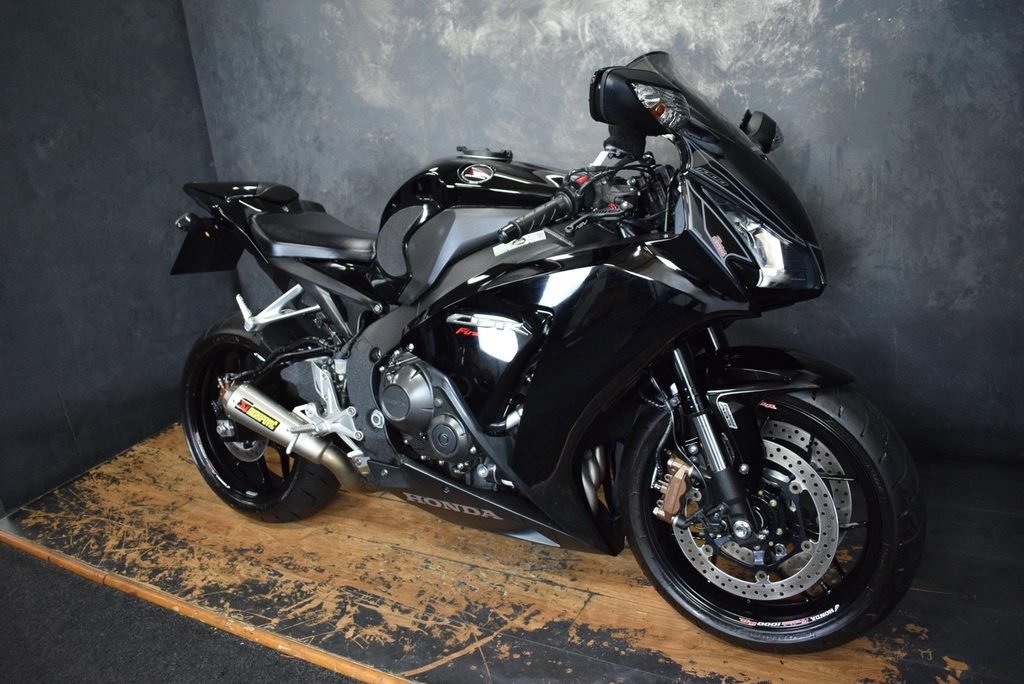
Honda launched the original CBR1000RR in 2004 as a full liter-class replacement for the CBR954RR, built with input from Honda’s MotoGP program and a claimed 170 hp (Honda UK, 2019). A 2008 redesign brought an all-new 999cc engine making a claimed 154 hp at the crank, and ABS arrived as an optional trim starting with the 2009 model year.
The 2017 model year brought the biggest jump: a retuned engine claiming 189 hp, the platform’s first ride-by-wire throttle, traction control, and selectable riding modes. That’s the core engine and electronics package still underpinning today’s CBR1000RR and CBR1000RR ABS trims.
The flagship Fireblade SP branched off into its own MotoGP-derived platform starting in 2020, which is why the ABS trim covered here and the SP no longer share an engine.
Frequently Asked Questions
What is the top speed of the Honda CBR1000RR ABS?
The CBR1000RR ABS tops out around 186 mph, based on instrumented testing of the current-generation platform, as detailed earlier in this article. Actual top speed varies with rider weight, aerodynamics, and elevation.
How fast does the CBR1000RR ABS go 0-60?
Instrumented testing puts 0-60 mph at roughly 2.9 to 3.0 seconds. A skilled rider with a fresh clutch can occasionally dip under 3 seconds, but 2.9-3.0 is the realistic range for most riders.
How much horsepower does the CBR1000RR ABS have?
Honda claims 189 hp at the crank; real-world rear-wheel output measures closer to 165-175 hp depending on the dyno and test conditions.
What is the difference between the CBR1000RR ABS and the CBR1000RR-R Fireblade SP?
The ABS trim is the more affordable, street-focused version with Showa suspension and a steel exhaust. The Fireblade SP is a separate, more powerful platform with Öhlins electronic suspension, Brembo Stylema brakes, and a price tag over $11,000 higher.
Does the CBR1000RR ABS come standard with ABS, or is it optional?
On this trim, ABS is standard equipment, not an add-on. Honda has offered ABS as a distinct trim level on the CBR1000RR since the 2009 model year.