Honda Hornet 750 Specs, Top Speed & Review
TL;DR
- The Honda Hornet 750 (sold in the US as the CB750 Hornet) is a 755cc liquid-cooled parallel-twin making 90 hp and 55 lb-ft of torque, redlined at 10,000 rpm.
- Honda rates the 2025 model’s 0-60 mph at approximately 3.3 seconds, with a quarter-mile time in the low 11-second range (ProfessCars, 2025).
- Top speed is not officially stated by Honda, but real-world testing consistently puts it in the 130-135 mph range for the unrestricted global version; US-spec output is reportedly closer to 83 hp due to emissions tuning.
- US MSRP is $7,999 (Honda Powersports, 2025), making it one of the least expensive middleweight naked bikes in its class.
- It’s a genuinely good motorcycle: sharp chassis, smooth engine, and a spec sheet that punches well above the asking price – though the suspension tuning is softer than riders who push hard in canyons will want.
What the Honda Hornet 750 Is and Why It Matters in 2025
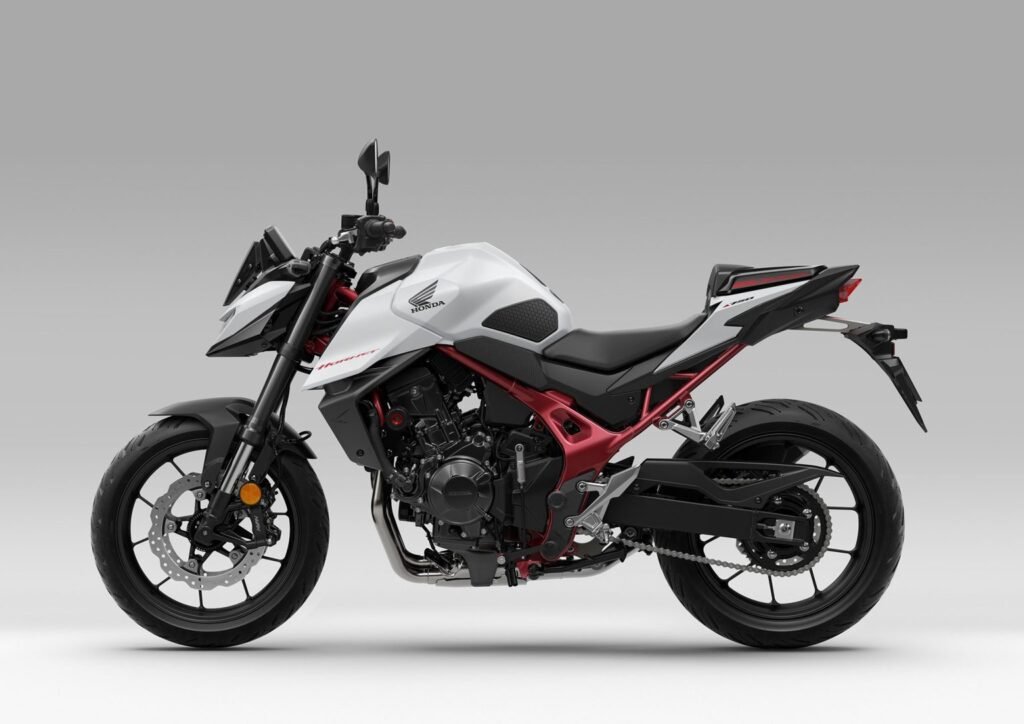
The Honda Hornet 750 is a middleweight naked streetfighter built on a 755cc Unicam parallel-twin engine with a 270-degree crank. It debuted in Europe as a 2023 model and arrived in the US as the CB750 Hornet for the 2025 model year. Honda designed it to slot between the CB500F and the CB650R in its standard lineup, targeting riders who want real performance at a real-world price.
The 270-degree crank firing order gives it a torque pulse that feels more like a V-twin than a flat-firing parallel – most riders describe the character as punchy and involving rather than buzzingly linear. That same 755cc twin powers Honda’s XL750 Transalp adventure bike, so it’s a known quantity with proven durability.
At $7,999 MSRP (Honda Powersports, 2025), the Hornet 750 sits at the budget end of its class. It’s a legitimate option for experienced sport riders who want a daily machine that’s fun without being terrifying, and for newer riders stepping up from a 500cc-class bike.
Honda Hornet 750 Full Specs
All specs are for the 2025 US-market CB750 Hornet as listed by Honda Powersports (Honda Newsroom, 2025).
| Specification | Detail |
|---|---|
| Engine | 755cc liquid-cooled 30° parallel-twin, SOHC Unicam |
| Bore x Stroke | 87.0mm x 63.5mm |
| Compression Ratio | 11.0:1 |
| Claimed Power | 90 hp (67 kW) at 9,500 rpm (global); ~83 hp US-spec |
| Claimed Torque | 55 lb-ft (75 Nm) |
| Redline | 10,000 rpm |
| Transmission | 6-speed manual with quickshifter |
| Clutch | Wet multiplate, slipper and assist |
| Final Drive | #520 chain; 16T/45T |
| Front Suspension | 41mm Showa SFF-BP inverted fork; 5.1 in. travel |
| Rear Suspension | Showa remote-reservoir shock, 7-stage preload; 5.1 in. travel |
| Front Brakes | Dual Nissin radial-mount 4-piston, 296mm petal discs; ABS |
| Rear Brake | Single-piston Nissin, 240mm disc; ABS |
| Front Tire | 120/70-17 (Michelin Road 6 or Dunlop Sportmax Roadsport 2) |
| Rear Tire | 160/60-17 |
| Wheelbase | 55.9 in. |
| Seat Height | 31.3 in. |
| Curb Weight | 422 lbs. |
| Fuel Capacity | 4.0 gal. (0.8 gal. reserve) |
| MSRP (US, 2025) | $7,999 |
Honda Hornet 750 Top Speed and Acceleration Numbers
The Honda Hornet 750 reaches 60 mph from a standstill in approximately 3.3 seconds and covers the quarter-mile in around 11.7-11.8 seconds (ProfessCars, 2025). Those are estimated performance figures based on the bike’s power-to-weight ratio, not officially dyno-timed results from Honda.
Top speed for the global 90 hp version is in the 130-135 mph range based on tested reports from European markets. The US-spec bike runs closer to 83 hp due to emissions tuning, which trims that ceiling modestly – expect low-to-mid 120s in real-world conditions with a rider in an upright naked-bike position.
To put those numbers in context: the Hornet’s 3.3-second 0-60 is on par with bikes that cost significantly more. The upright riding position is the main limiting factor on top speed; tuck down over the bars and the 755cc twin has more to give.
The engine revs cleanly from about 3,000 rpm all the way to the 10,000 rpm redline. Most of the torque – that 55 lb-ft figure – arrives between 5,000 and 8,000 rpm, which is exactly where you’re riding in the real world. You don’t have to wring it out to get things moving.
Fuel economy at an aggressive pace is around 46 mpg (Ultimate Motorcycling, 2025), which is genuinely impressive for a bike ridden hard through canyons. On a relaxed commute, expect 50+ mpg and around 180 miles from the 4-gallon tank before the low-fuel light appears.
How the Engine and Chassis Actually Perform
The 755cc Unicam engine is one of Honda’s better twin-cylinder designs. Unicam refers to Honda’s single-overhead-cam valve arrangement, where the intake valves are actuated directly by the cam and the exhaust valves operate through rocker arms. The setup keeps the engine shorter, lighter, and lower in the frame than a conventional DOHC layout – all of which helps mass centralization.
Honda also added Vortex Flow Ducts to the intake ports to swirl the incoming charge, improving fuel-air mixing in the low-to-mid rev range. The practical result is an engine that pulls cleanly from low rpm without the flat spot that plagues some parallel-twins below 5,000 rpm. Fueling from the PGM-FI system with 46mm throttle bodies is clean at all throttle openings (Ultimate Motorcycling, 2025).
The 6-speed gearbox is slick, and the quickshifter – included as standard equipment – has three sensitivity settings. It works cleanly at an aggressive pace. The slipper-assist clutch has Honda’s Friction Leveling System, which gives it an unusually light lever pull for this displacement class.
The frame is a steel diamond design that Honda says is 19% lighter than the CB650R’s unit (Ultimate Motorcycling, 2025). The result is a bike that flicks direction quickly for its weight and sits flat through mid-corner without drama. The 25-degree rake and 3.9 inches of trail are on the quick-steering side, which suits urban riding and tight canyon sections well.
Here’s the honest caveat: the Showa suspension is set up soft from the factory. The SFF-BP forks and preload-only rear shock are fine for commuting and smooth two-lane roads. But push hard through rough pavement or carry speed over mid-corner bumps and the chassis starts to feel unsettled. It’s not dangerous, but riders who spend serious time in the canyons will feel the limit of the damping long before the tire or frame runs out of capability.
The Michelin Road 6 tires fitted to tested units are a good match for the bike’s character – sport-touring rubber that handles wet roads, long commutes, and spirited weekend riding without demanding track conditions.
Electronics and Rider Aids on the 2025 Honda Hornet 750
The 2025 Hornet 750 comes with a useful suite of electronics for the price. There are three factory ride modes – Standard, Sport, and Rain – plus two rider-programmable User modes. Honda Selectable Torque Control (HSTC) handles traction control and is integrated with wheelie control. ABS is standard.
The 5-inch TFT display connects to a smartphone via Honda’s RoadSync Bluetooth system, supporting navigation and music controls. Display themes are selectable: bar-style tach, circle-style tach, or a simplified numeric readout.
One honest gripe: HSTC is reportedly aggressive in its default setting (Rider Magazine, 2025). Riders who enjoy light-front-end moments on corner exits will find it cuts in early. It’s easy enough to turn off, but it’s worth knowing before you head to your first twisty road.
Who Should Buy the Honda Hornet 750
The Hornet 750 is a good fit for riders who want a proper naked motorcycle at a price that doesn’t require financing a liter-bike payment. The 31.3-inch seat height and 422-pound curb weight are manageable for a wide range of rider heights; anyone over about 5’5″ should be able to flat-foot one side comfortably.
It’s a solid upgrade from a 300-500cc starter bike. The power delivery is linear and progressive – there’s no hit to ambush a newer rider, just a steady pull that builds confidence. The electronics package is better than anything available at this price point a few years ago.
It’s less ideal for tall riders who want touring range (the 4-gallon tank means frequent stops), or for track day regulars who’ll immediately want to replace the stock suspension with Öhlins cartridges or a piggyback shock.
Key Takeaways
- The Honda Hornet 750 is a 755cc parallel-twin producing 90 hp globally and approximately 83 hp in US trim.
- It reaches 60 mph in roughly 3.3 seconds and covers the quarter-mile in around 11.7 seconds (ProfessCars, 2025).
- Top speed in real-world naked-bike riding position is approximately 120-125 mph for the US-spec model.
- The chassis is a genuine highlight – quick-steering, well-balanced, and confidence-inspiring on technical roads.
- The stock suspension is the weakest link; it’s fine for street riding but undersized for the chassis’s actual capability.
- At $7,999 MSRP, it delivers a spec sheet that includes a quickshifter, slipper clutch, 5-inch TFT, Bluetooth, and five ride modes – equipment that costs significantly more on most competing platforms.
Frequently Asked Questions About the Honda Hornet 750
What is the top speed of the Honda Hornet 750?
Honda doesn’t publish an official top speed for the Hornet 750. The global 90 hp version tops out in the 130-135 mph range in real-world testing. The US-market CB750 Hornet runs approximately 83 hp due to emissions tuning, which places practical top speed in the low-to-mid 120 mph range from an upright naked-bike riding position.
How fast does the Honda Hornet 750 do 0-60 mph?
The Hornet 750 reaches 60 mph from rest in approximately 3.3 seconds, with a quarter-mile time of around 11.7-11.8 seconds, based on power-to-weight estimation (ProfessCars, 2025). Honda does not publish official factory acceleration times for the CB750 Hornet.
What engine does the Honda Hornet 750 use?
The Hornet 750 uses a 755cc liquid-cooled parallel-twin with a 270-degree crank and Honda’s Unicam SOHC valvetrain. The same engine powers the XL750 Transalp. Honda rates it at 90 hp and 55 lb-ft of torque, with a 10,000 rpm redline (Honda Newsroom, 2025).
Does the Honda Hornet 750 have a quickshifter?
Yes – the 2025 US-market CB750 Hornet includes an up-only quickshifter as standard equipment. It has three adjustable sensitivity levels. The bike also has a slipper-assist clutch with Honda’s Friction Leveling System for a notably light lever pull.
What is the price of the 2025 Honda Hornet 750 in the US?
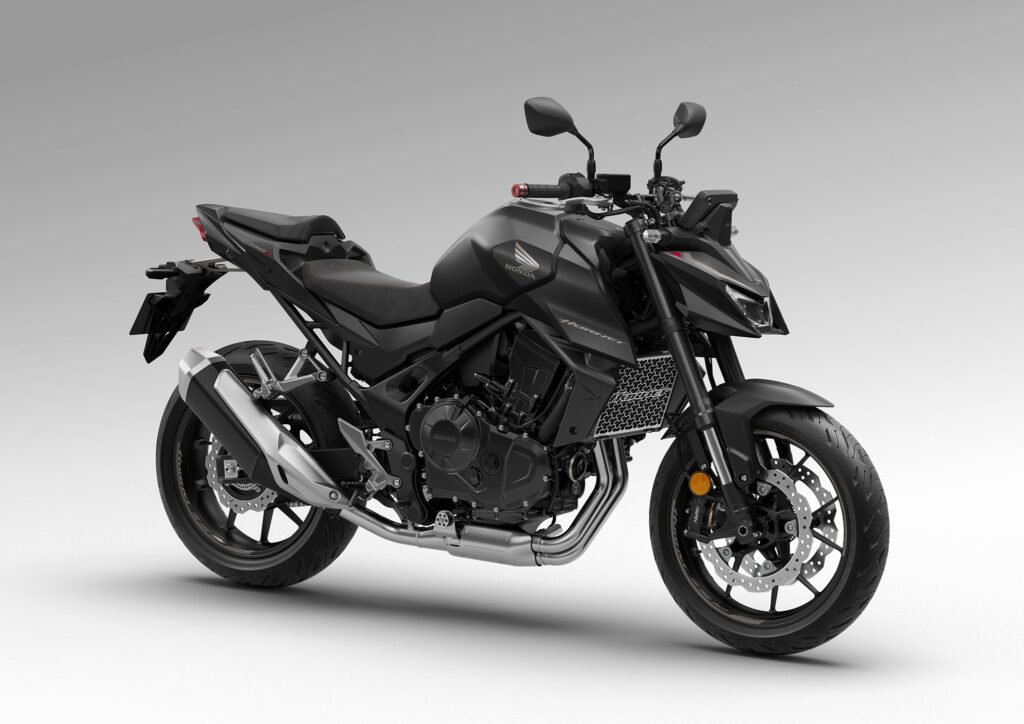
The 2025 Honda CB750 Hornet has a US MSRP of $7,999 (Honda Powersports, 2025). It’s available in Matte Black Metallic and Matte Pearl White. The price includes ABS, traction control, quickshifter, 5-inch TFT, Bluetooth connectivity, and five ride modes as standard equipment.
Is the Honda Hornet 750 a good beginner motorcycle?
The Hornet 750 is better described as a strong second motorcycle rather than a first bike. The power delivery is progressive and manageable, and the electronics package provides meaningful safety margins. For a true first bike, the CB500F is the better fit. Riders upgrading from a 300-500cc machine will find the Hornet 750 accessible without feeling limited by it.