Kawasaki Ninja ZX-10R Specs, Top Speed & Performance
TL;DR
- The 2026 Kawasaki Ninja ZX-10R makes 196 hp at 11,500 rpm from a 998cc inline-four, rising to 203 hp with RAM Air engaged.
- Top speed is approximately 186-189 mph; 0-60 mph takes around 2.91 seconds and the quarter mile falls in 9.98 seconds at 151 mph
- It starts at $16,999 (non-ABS) and $17,999 (ABS) in the USA for 2026.
- Seat height is 835 mm (32.9 in) with a curb weight of 207 kg (456 lb) — this is not a bike for new riders.
- The electronics package includes IMU-based traction control, cornering ABS, launch control, Showa Balance Free suspension, and Brembo radial brakes — all standard.
What Is the Kawasaki Ninja ZX-10R?
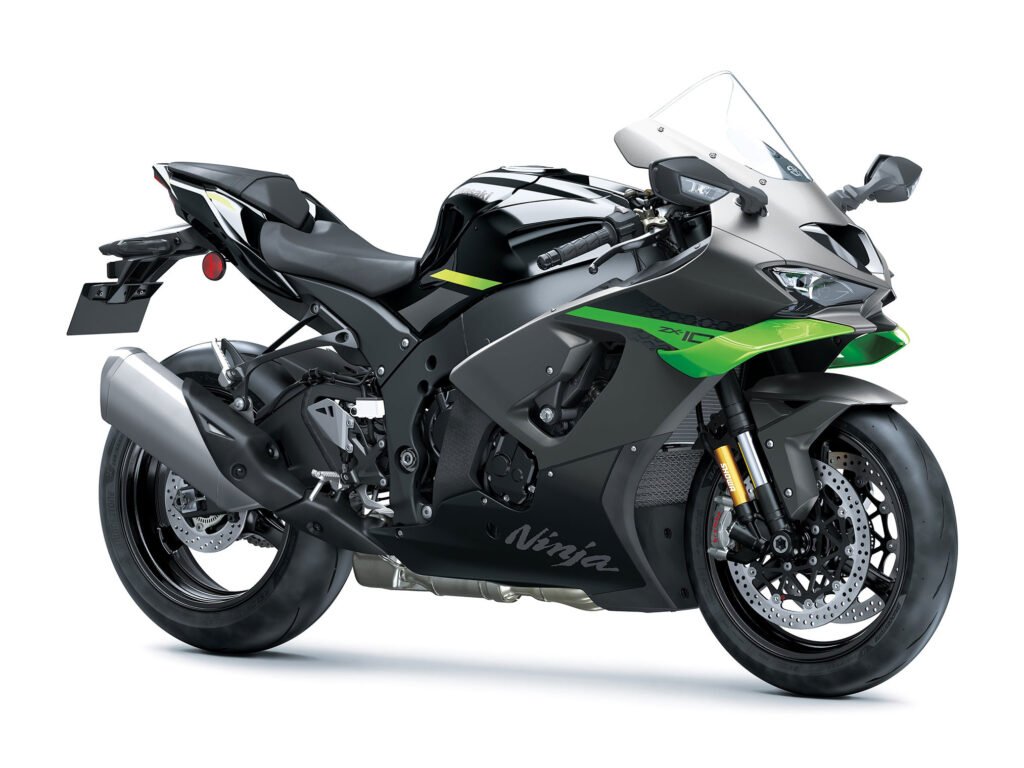
The Kawasaki Ninja ZX-10R is a 998cc, inline-four superbike built around Kawasaki’s World Superbike Championship (WorldSBK) racing program. It’s been in production since 2004 and the platform has contributed to seven WorldSBK titles (Autoevolution, 2025). The road bike and race bike share genuine DNA — the suspension architecture, electronic systems, and aerodynamic bodywork all trace back to the KRT (Kawasaki Racing Team) machines.
It’s aimed at experienced riders who want a track-capable machine that still passes emissions standards for the road. The 2026 update brings revised aerodynamic bodywork and an additional O2 sensor while carrying over the proven engine and chassis (Autoevolution, 2025).
2025/2026 Kawasaki Ninja ZX-10R Full Specs
| Spec | 2025/2026 Kawasaki Ninja ZX-10R |
|---|---|
| Engine | 998cc, liquid-cooled, inline-four, 16-valve DOHC |
| Horsepower | 196 hp @ 11,500 rpm (203 hp with RAM Air) |
| Torque | 84 lb-ft (114 Nm) @ 11,300 rpm |
| Redline | ~14,000 rpm |
| Transmission | 6-speed, bi-directional quickshifter (KQS) |
| Frame | Aluminum twin-spar perimeter |
| Front suspension | 43 mm Showa Balance Free Fork (BFF), adjustable, 119 mm travel |
| Rear suspension | Showa Balance Free Rear Cushion (BFRC), adjustable, 114 mm travel |
| Front brakes | Dual 330 mm discs, Brembo radial-mount, 4-piston monobloc calipers |
| Rear brake | Single 220 mm disc |
| Tires | Front 120/70-ZR17, Rear 190/55-ZR17 |
| Seat height | 835 mm (32.9 in) |
| Curb weight | 207 kg (456 lb) |
| Fuel capacity | 17 L (4.5 US gal) |
| MSRP (USA, non-ABS) | $16,999 |
| MSRP (USA, ABS) | $17,999 |
Sources: Kawasaki USA, 2025; Autoevolution, 2025; Torquepedia, 2025
Top Speed and Acceleration: Real-World Numbers
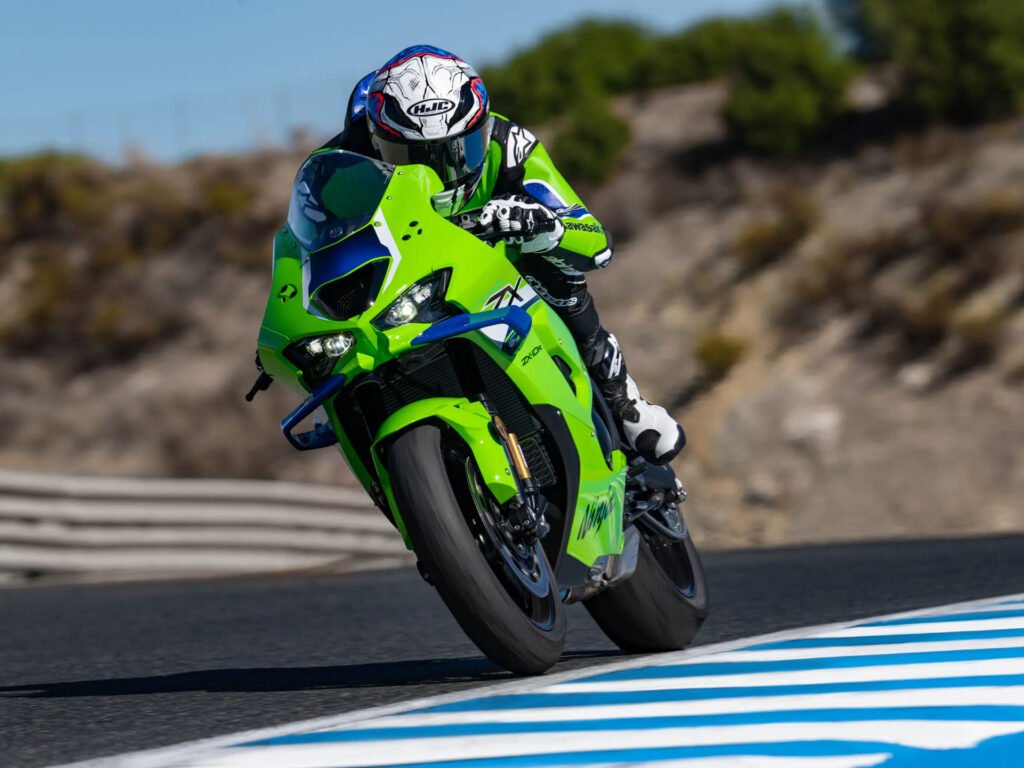
The ZX-10R runs 0-60 mph in approximately 2.91 seconds and covers the quarter mile in 9.98 seconds at 151 mph (MotoStatz, 2026). A sub-10-second quarter mile is genuinely rare — a car that runs those numbers is considered drag-strip serious. The ZX-10R does it on street tires, from a standing start.
Top speed is approximately 186-189 mph. MotoStatz recorded 188.9 mph in testing (MotoStatz, 2026). Like most modern superbikes, an electronic speed limiter is in place under an agreement among Japanese and European manufacturers, and that’s where most stock ZX-10Rs top out.
The claimed 196 hp is measured by the ISO 4106 standard, which reads slightly higher than SAE standards used for cars (Kawasaki, 2025). Rear-wheel dyno numbers typically land in the 165-175 hp range — that gap is normal and expected. RAM Air (the forced air intake system) adds pressurized charge density at speed, which is where Kawasaki’s claimed 203 hp figure comes from.
Electronics Package: WorldSBK Technology on a Road Bike
| System | Function |
|---|---|
| S-KTRC | IMU-based, cornering-aware traction control |
| KIBS | Cornering ABS (ABS model only) |
| KLCM | Launch control, optimizes power off the line |
| KQS | Bi-directional clutchless shifting |
| KCMF | Integrates braking, throttle, and lean angle |
| Öhlins Electronic Steering Damper | Reduces head shake at high speed |
Source: Autoevolution, 2025; Kawasaki, 2025
The IMU (Inertial Measurement Unit) reads lean angle, pitch, and yaw in real time, feeding data to the traction control and ABS. Cornering ABS means the bike can manage brake pressure mid-corner — a genuine functional advantage, not a checkbox feature.
Street and Track: How the ZX-10R Actually Rides
On the street, fueling is smooth in the lower power modes, and the quickshifter reduces clutch effort in traffic. The riding position is aggressive — you’re forward on the bars — and wrist fatigue sets in on longer urban rides. On track, the Showa suspension holds its line through direction changes, the Brembos shed speed with confidence, and the electronics provide a real safety net once dialed in. Slashgear tested the 2025 model at Buttonwillow Raceway and called the power delivery a “spine-sucking gut punch” (Slashgear, 2025).
One genuine drawback worth noting: with a 4.5-gallon tank and a high-revving inline-four, fuel range is shorter than you’d want on longer rides.
Who Should Buy the Kawasaki Ninja ZX-10R?
The ZX-10R suits experienced riders who want track capability without buying a dedicated race machine. If you’ve put miles on a mid-size supersport or a naked bike and you’re ready to move up, this is a serious option. The $16,999 starting price is competitive — comparable European hardware typically costs thousands more, and the Brembo/Showa/IMU package alone justifies a significant premium.
It’s the wrong bike if you’re new to motorcycles or primarily commuting in heavy traffic. The 456 lb curb weight, 32.9-inch seat height, and full-tuck ergonomics are all oriented toward confident, experienced riding.
Frequently Asked Questions About the Kawasaki Ninja ZX-10R
What is the top speed of the Kawasaki Ninja ZX-10R?
The ZX-10R reaches approximately 186-189 mph in real-world testing. MotoStatz recorded 188.9 mph in instrumented runs (MotoStatz, 2026). In stock form, it’s electronically limited under a manufacturer agreement shared by major Japanese and European brands.
How fast does the ZX-10R go from 0-60 mph?
Real-world 0-60 mph is approximately 2.91 seconds, with a quarter mile of 9.98 seconds at 151 mph (MotoStatz, 2026). These are instrumented results under controlled conditions with an experienced test rider — your numbers will vary with conditions and launch technique.
How much horsepower does the 2025/2026 ZX-10R make?
Kawasaki claims 196 hp at 11,500 rpm by ISO 4106 standards, rising to approximately 203 hp with RAM Air at speed (Kawasaki, 2025). On a rear-wheel dyno, expect 165-175 hp — crank-to-wheel loss is normal on any motorcycle.
What is the price of the 2026 Kawasaki Ninja ZX-10R?
The 2026 ZX-10R starts at $16,999 (non-ABS) and $17,999 (ABS) in the USA before $840 in destination charges (Kawasaki, 2025).
Is the ZX-10R a good beginner motorcycle?
No. The ZX-10R is not for beginners. The 196 hp, 32.9-inch seat height, 456 lb curb weight, and aggressive ergonomics demand prior experience on high-performance bikes. New riders should start with a smaller displacement machine.
What is the difference between the ZX-10R and ZX-10RR?
The ZX-10RR is a limited-production track version built on the ZX-10R chassis. It adds Pankl lightweight pistons, titanium connecting rods, Marchesini forged wheels, and Pirelli Diablo Supercorsa SP tires. It starts at $30,500 and produces 188 hp in a different state of tune optimized for circuit use (Autoevolution, 2025).
Key Takeaways
- The 2026 ZX-10R makes 196 hp (203 hp with RAM Air) from a 998cc inline-four and starts at $16,999 in the USA.
- Real-world 0-60 mph is approximately 2.91 seconds; quarter mile is 9.98 seconds at 151 mph.
- Top speed is approximately 186-189 mph in electronically limited stock form.
- The electronics — IMU traction control, cornering ABS, launch control, Showa BFF suspension, Brembo brakes — are genuine WorldSBK-derived hardware.
- This is a machine for experienced riders. Ergonomics, weight, and power are all oriented toward track days and skilled street use.