Kawasaki Ninja H2 Specs, Top Speed & Performance Review
TL;DR
- The Kawasaki Ninja H2 runs a 998cc supercharged inline-four producing 240 hp (claimed) at 11,500 rpm and 104.9 lb-ft of torque.
- Top speed is electronically limited to 186 mph (300 km/h) on the street-legal H2.
- Wet weight is 529 lb (240 kg); seat height is 32.5 inches; the 2025 base price is $32,100.
- Suspension is a 43mm Kayaba AOS-II inverted fork up front and a fully adjustable Öhlins TTX36 shock out back.
- The H2 is a limited-production, special-order-only machine — Kawasaki does not sell it off the showroom floor.
What Is the Kawasaki Ninja H2 and What Makes It Different?
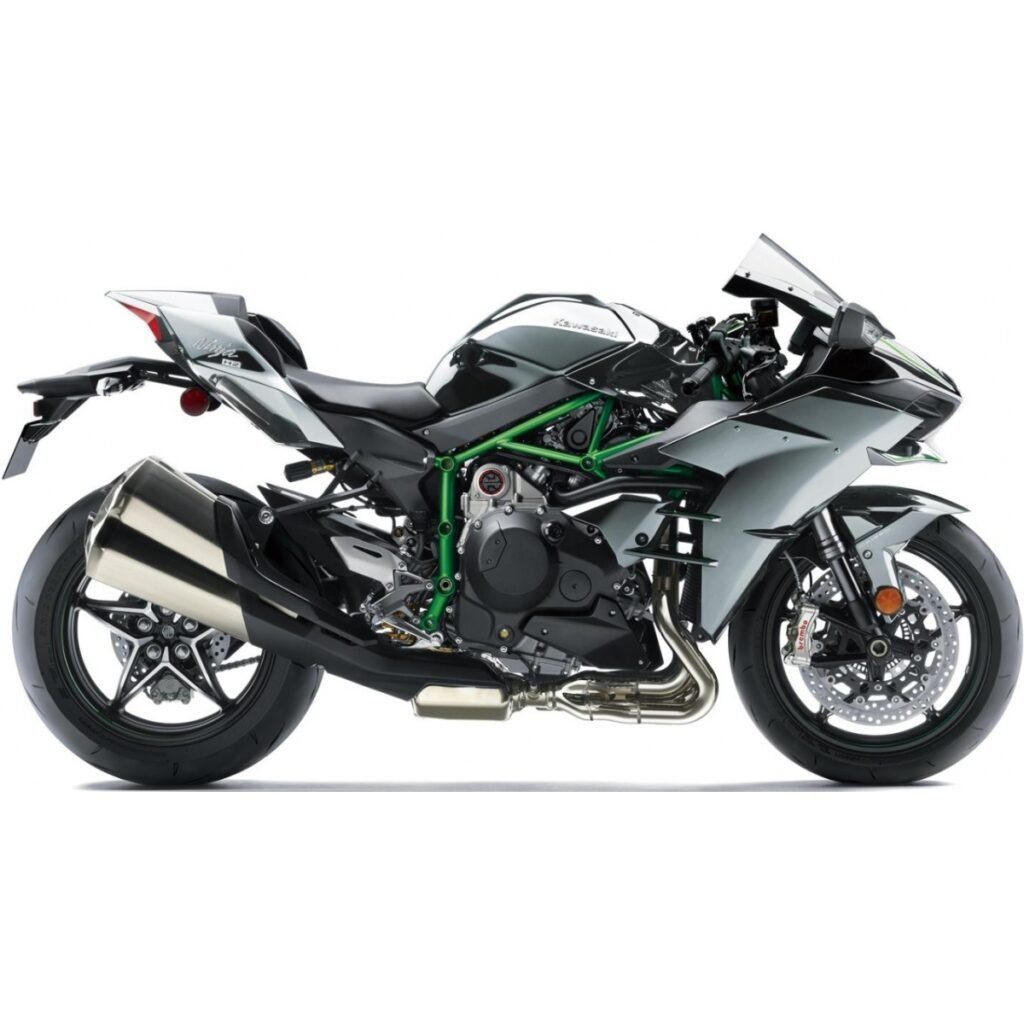
The Kawasaki Ninja H2 is a street-legal, supercharged hypersport motorcycle built around a 998cc inline-four that Kawasaki developed using aerospace engineering from its parent company, Kawasaki Heavy Industries. It entered production in 2015 as the first mass-production supercharged motorcycle from a major manufacturer.
The H2’s centrifugal supercharger is designed and built in-house — it spins to approximately 140,000 rpm, moves over 200 liters of air per second, and does all of this without an intercooler (Visordown, 2024). The compression ratio was dialed back to 8.5:1 to accommodate the pressurized intake charge. The result is an engine that pulls hard and consistently to its 11,500 rpm power peak, then hits the 186 mph limiter before the motor has said everything it has to say.
Full Kawasaki Ninja H2 Spec Sheet (2025/2026)
| Spec | Detail |
|---|---|
| Engine | 998cc DOHC liquid-cooled inline-four, supercharged |
| Bore x Stroke | 76.0mm x 55.0mm |
| Compression Ratio | 8.5:1 |
| Power (claimed) | 240 hp @ 11,500 rpm |
| Torque (claimed) | 104.9 lb-ft @ 11,000 rpm |
| Transmission | 6-speed, dog-ring design |
| Frame | Steel trellis |
| Front Suspension | 43mm Kayaba AOS-II inverted fork, fully adjustable |
| Rear Suspension | Öhlins TTX36 monoshock, fully adjustable |
| Front Brakes | 2x 330mm discs, Brembo M50 monoblock calipers |
| Rear Brake | 250mm disc, 2-piston Brembo caliper |
| Front Tire | 120/70ZR17 |
| Rear Tire | 200/55ZR17 |
| Wheelbase | 57.1 in (1,450mm) |
| Seat Height | 32.5 in (830mm) |
| Wet Weight | 529 lb (240 kg) |
| Fuel Capacity | 4.5 U.S. gallons |
| Top Speed | 186 mph (electronically limited) |
| MSRP (2025 H2 ABS) | $32,100 |
| MSRP (2025 H2 Carbon ABS) | $35,600 |
Sources: Kawasaki USA, 2025; Cycle World, 2024; Cycle News, 2025
Kawasaki Ninja H2 Top Speed: What the Limiter Is Hiding
The street-legal H2 is electronically limited to 186 mph (300 km/h) — not that you’d ever find legal space to use it.
The limiter exists partly for tire rating compliance and partly for legal liability. Derestricted H2s run in controlled conditions have reportedly exceeded 200 mph, though no manufacturer-sanctioned figure exists for this (SlashGear, 2025).
Where the H2 surprises people is not in the top speed number — it’s in how it gets there. Riders who’ve tested it on long straights describe the power delivery as surprisingly linear, almost turbine-smooth, with the supercharger providing consistent drive rather than the violent mid-range surge you’d expect from 240 claimed horsepower (Visordown, 2024).
Kawasaki Ninja H2 Acceleration: 0-60 and Quarter Mile
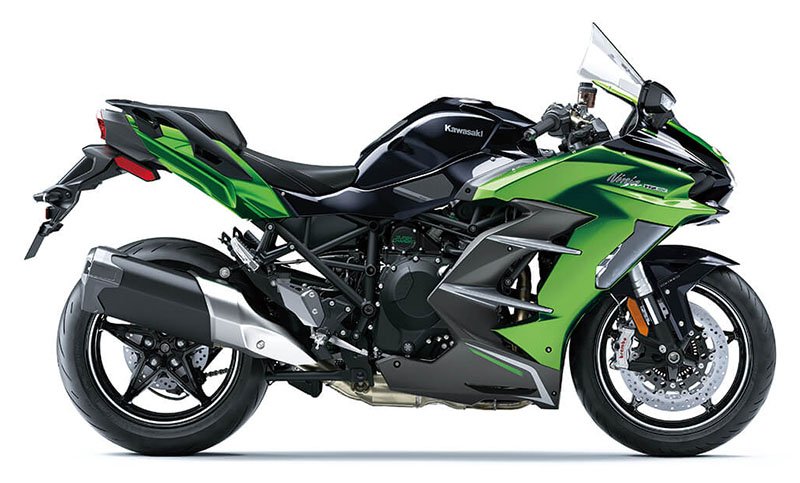
The H2 hits 0-60 mph in approximately 2.5 to 3 seconds in real-world testing, depending on launch technique and traction control settings. The 529 lb wet weight works against absolute launch numbers, and KLCM (Kawasaki Launch Control Mode) is tuned to manage wheelspin rather than maximize drag strip times.
Quarter-mile runs in the 9-second range are achievable with a skilled launch. That 240 hp through a 200mm street tire means traction control is doing real work off the line.
The H2 gets stronger as speeds climb. The supercharger’s efficiency improves at higher revs, so by 150 mph it’s still pulling hard — and that characteristic, power that doesn’t fall away, is what separates it from naturally aspirated bikes.
Chassis, Suspension, and Electronics
Kawasaki built the H2’s steel trellis frame to save weight and centralize mass. The single-sided swingarm — found on no other Kawasaki street bike — keeps rear wheel behavior predictable under serious power loads.
The Öhlins TTX36 rear shock and Kayaba AOS-II fork are both fully adjustable, and the factory baseline settings are well-sorted for street riding. The electronics package is one of the most complete on any production street bike: a six-axis IMU for lean-sensitive ABS and traction control, KIBS (Kawasaki Intelligent anti-lock Brake System) linking the ABS and engine ECU, KLCM launch control, cornering management, engine brake control, multiple riding modes, and a TFT display with smartphone connectivity. The Brembo M50 monoblock calipers on dual 330mm discs are the same hardware used on purpose-built track machines.
Kawasaki Ninja H2 Variants: H2, H2 Carbon, and H2R
| Variant | Power (claimed) | Key Difference | 2025 Price |
|---|---|---|---|
| Ninja H2 ABS | 240 hp | Street-legal, full electronics | $32,100 |
| Ninja H2 Carbon ABS | 240 hp | Carbon fiber upper fairing, Mirror Coated paint | $35,600 |
| Ninja H2R ABS | 322 hp | Track-only, aerowing, no street equipment | ~$59,100 |
Sources: Kawasaki USA, 2025; Cycle News, 2025
The H2 Carbon adds a dry carbon fiber upper cowl and Kawasaki’s mirror-coated paint — a finish created through a chemical silver reaction that produces a reflective surface unlike anything else on sale.
The H2R’s 322 hp figure uses a ram-air measurement at speed. Drag racing professional Rickey Gadson stated publicly he’d “never been so scared” riding it (HotCars, 2026). It’s available through the same annual order window as the street H2, at approximately $59,100 for 2025.
Who the Kawasaki Ninja H2 Is Actually For
The H2 is for experienced riders who want the most technically sophisticated street bike Kawasaki has built, and who accept they’ll use a fraction of its capability on public roads. At 529 lb wet and 32.5 inches of seat height, it’s not a small bike and it’s not a beginner machine.
Kawasaki opens the order window once a year with a fixed cutoff — October 31, 2025 for 2026 models (Cycle News, 2025) — which effectively filters out impulse buyers. If you want the supercharged platform with more all-day usability, the H2 SX is the sport-touring variant of the same engine family.
Frequently Asked Questions About the Kawasaki Ninja H2
What is the top speed of the Kawasaki Ninja H2?
The street-legal Ninja H2 ABS is electronically limited to 186 mph (300 km/h). Derestricted versions tested in controlled conditions have reportedly exceeded 200 mph, but Kawasaki publishes no unrestricted speed figure (SlashGear, 2025).
How much horsepower does the Kawasaki Ninja H2 make?
Kawasaki claims 240 hp at 11,500 rpm, measured using the ISO 4106 standard, which reads higher than SAE measurements. The 2015-2018 models were rated at 200 hp claimed; Kawasaki increased this to 240 hp for 2019 and later models after updates to the intake, ECU, air filter, and spark plugs (Wikipedia, 2025).
How fast is the Kawasaki Ninja H2 from 0-60 mph?
Real-world 0-60 mph times fall in the 2.5-to-3-second range depending on launch conditions and traction control settings. The 529 lb wet weight and street tire traction are the main variables.
What does the Kawasaki Ninja H2 weigh?
The Ninja H2 ABS has a wet weight of 529 lb (240 kg), including fluids and a full tank. It’s heavier than most naturally aspirated liter-class sport bikes due to the supercharger assembly and steel trellis frame.
What is the difference between the Kawasaki Ninja H2 and the H2R?
The Ninja H2 is street-legal with 240 hp claimed, full lighting, mirrors, and road electronics. The H2R is a track-only machine at 322 hp claimed (with ram air), no street equipment, and a 2025 price of approximately $59,100.
Is the Kawasaki Ninja H2 available at dealerships?
No. The H2, H2 Carbon, and H2R are limited-production special-order machines. Kawasaki opens a customer order window annually with a fixed cutoff date (Cycle News, 2025).
Key Takeaways
- The Ninja H2 produces 240 hp (claimed, ISO 4106) from a 998cc in-house supercharged inline-four.
- Street top speed is electronically limited to 186 mph; the engine has more in it at that point.
- Wet weight is 529 lb due to the supercharger and steel trellis frame; seat height is 32.5 inches.
- Suspension is fully adjustable Kayaba AOS-II fork and Öhlins TTX36 shock; brakes are Brembo M50 monoblocks.
- The H2 is special-order only with an annual order window; 2025 base price starts at $32,100.