KTM 1290 Super Duke R Specs, Top Speed & Review
TL;DR
- The KTM 1290 Super Duke R is a 1,301 cc liquid-cooled 75° V-twin producing a claimed 177 hp and 106 lb-ft of torque, making it one of the most powerful naked bikes on the market.
- Independent testing by MotoStatz puts the 0–60 mph time at 2.75 seconds and the quarter mile at 10.21 seconds at 144.8 mph — figures that land in 1,000 cc superbike territory.
- Top speed is a genuine 170 mph, verified through independent testing; KTM does not publish an official top speed figure.
- The Evo variant (2022–2023) adds second-generation WP semi-active suspension (SAT) with three damping modes: Comfort, Street, and Sport — a meaningful real-world improvement over the standard bike.
- US MSRP for the 2022–2023 model year ranged from $19,599 to $20,399; the 1290 has since been replaced in KTM’s lineup by the 1390 Super Duke R for 2024.
KTM 1290 Super Duke R Full Specs
The KTM 1290 Super Duke R is built around KTM’s LC8 (Liquid Cooled 8-valve) V-twin engine, displacing 1,301 cc from a 108 × 71 mm bore and stroke. It runs a 13.6:1 compression ratio and uses Keihin electronic fuel injection with ride-by-wire (RBW) throttle control. The chromoly steel trellis frame treats the engine as a stressed member on third-generation models.
| Spec | Detail |
|---|---|
| Engine | 1,301 cc, 75° V-twin, DOHC, 8-valve, liquid-cooled |
| Bore × Stroke | 108 mm × 71 mm |
| Compression Ratio | 13.6:1 |
| Claimed Power | 177 hp (132 kW) |
| Rear-Wheel Power | 157.3 hp @ 9,500 rpm (Cycle World dyno, 2023) |
| Claimed Torque | 106 lb-ft (144 Nm) |
| Rear-Wheel Torque | 92.8 lb-ft @ 8,300 rpm (Cycle World dyno, 2023) |
| Transmission | 6-speed, hydraulic wet clutch (PASC slipper) |
| Fuel System | Keihin EMS, ride-by-wire, 56 mm throttle bodies |
| Frame | Chromoly steel trellis |
| Front Suspension | 48 mm WP inverted fork, fully adjustable |
| Rear Suspension | WP monoshock, linked, fully adjustable |
| Front Brakes | Dual 320 mm discs, Brembo M50 4-piston (std) / Stylema Monoblock (Evo) |
| Rear Brake | 267 mm disc, 2-piston caliper |
| Front Tire | 120/70-17 |
| Rear Tire | 190/55-17 |
| Wheelbase | 58.3 in (1,482 mm) |
| Seat Height | 32.9 in (835 mm) |
| Dry Weight | 189 kg (417 lb) |
| Wet Weight | 471 lb (Cycle World scales, 2023) |
| Fuel Capacity | 4.8 US gal (18 L) |
| MSRP (2022 base R) | $19,599 (Rider Magazine, 2022) |
| MSRP (2023 Evo) | $20,399 (Cycle News, 2022) |
KTM 1290 Super Duke R Top Speed: What Independent Tests Show
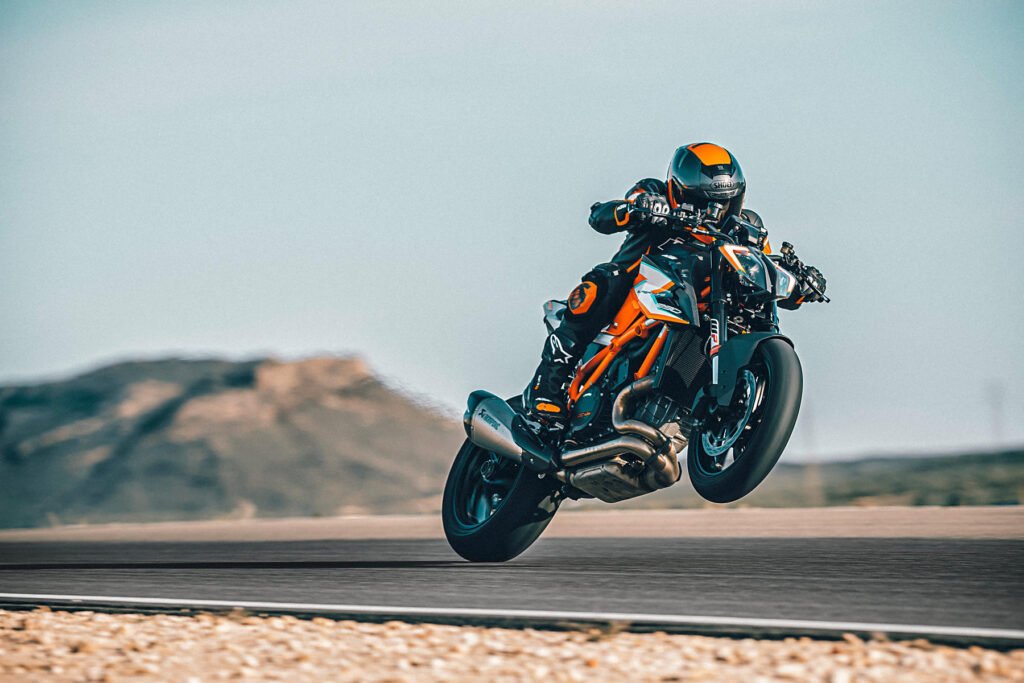
The KTM 1290 Super Duke R has a real-world top speed of approximately 170 mph (274 km/h). KTM does not publish an official top speed figure. The 170 mph number comes from MotoStatz independent testing using fifth and sixth gear with the throttle held open on a measured stretch. Some Autobahn-based GPS recordings have shown speeds approaching 180 mph, though these depend on conditions and rider weight.
What’s worth understanding here: as a naked bike with no fairing, the rider’s torso takes the full force of the wind at high speed. Getting to 170 mph requires a genuine tuck, and the experience at that point is described by testers as “insane” rather than controlled. The real-world fast riding happens well below that ceiling, and that’s where the 1290 excels most.
The Wikipedia-cited top speed of 180 mph (289 km/h) appears to be an extrapolated theoretical figure rather than a confirmed instrument-tested result. The independently measured 170 mph is the figure worth trusting.
KTM 1290 Super Duke R Acceleration: 0–60, Quarter Mile, and In-Gear Performance
The 1290 Super Duke R is one of the fastest-accelerating naked motorcycles ever tested. Per MotoStatz independent instrumented testing:
| Performance Metric | Time / Speed |
|---|---|
| 0–60 mph | 2.75 seconds |
| 0–100 km/h | 2.92 seconds |
| 0–100 mph | 5.36 seconds |
| 0–200 km/h | 7.36 seconds |
| Quarter mile | 10.21 seconds @ 144.8 mph |
| Top speed | ~170 mph |
These numbers put the 1290 on par with many fully faired 1,000 cc superbikes. The quarter-mile time of 10.21 seconds is firm superbike territory for a naked street machine.
A huge factor in these numbers is the low-end torque. MotoStatz data shows the engine delivering more than 80 lb-ft of torque from as low as 3,500 rpm. That means the bike doesn’t need high revs to accelerate hard — you can short-shift your way through traffic and still run away from almost anything on the road.
The limiting factor off the line is wheelie control. The 1290’s combination of 177 hp and sub-420 lb wet weight wants to rotate the front wheel the moment you open the throttle aggressively. With wheelie control active, the electronics keep launches manageable. With it off, the bike will pull the front wheel in any of the first three gears on demand — experts only.
Rider Knox documented a 0–60 mph run of 3.6 seconds in a side-by-side test against the Kawasaki Z H2 (Knox, 2021), which is slightly slower than the MotoStatz instrumented figure — the difference is likely down to launch technique and rider weight. Both sources confirm the 1290 is in a very short list of street-legal naked bikes capable of sub-3.7 second 0–60 runs.
How the LC8 Engine Actually Feels on the Road
The LC8 V-twin is the center of everything this bike does well. Cycle News called it “one of the very best V-twin motors ever created,” and after spending time on the 1290, it’s hard to argue the point.
The character is different from a Japanese inline-four. The LC8 gives you a wall of torque from the moment you crack the throttle at 3,000 rpm. It doesn’t need to rev to deliver — it pulls hard from anywhere in the powerband. Ask for more revs past 6,000 rpm and it responds with a second surge that carries hard to the 10,000 rpm redline.
Cycle World’s 2023 dyno run confirmed 157.3 hp at the rear wheel with a flat torque curve — 80 lb-ft available at just 4,000 rpm. A flat torque curve on a V-twin this size means in-gear roll-on acceleration that will outpace most bikes on the road below 120 mph, in any of the first four gears, from almost any speed.
The throaty V-twin sound through the standard exhaust is aggressive without being obnoxious. Fit an Akrapovic slip-on and that changes considerably.
Suspension, Chassis, and How the Evo Differs from the Standard R
The standard KTM 1290 Super Duke R runs a 48 mm WP inverted fork and a WP monoshock, both fully adjustable. On the 2022 Evo model, KTM added second-generation WP APEX Semi Active Technology (SAT) — electronic damping that adjusts in real time based on speed, lean angle, throttle position, and road surface inputs.
The SAT system offers three modes: Comfort, Street, and Sport. The Evo variant also allows rear spring preload adjustment through the TFT menu over a 20 mm range in 2 mm increments, without touching a spanner.
Rider Magazine tested both settings extensively and found Street mode the most practical for everyday riding — firm enough for canyon work but compliant enough on broken pavement. Sport mode is genuinely very stiff and works best when you’re pushing hard on smooth roads or a track.
The optional Suspension Pro pack adds an anti-dive function: the fork stiffens under heavy braking to prevent excessive compression. It’s a useful addition if you’re running the bike on a track day.
The chromoly steel trellis frame, reworked for 2020 with the engine as a stressed member, gives the 1290 a planted feel in corners despite the short 58.3-inch wheelbase. The 24.9° rake and 4.2-inch trail are aggressive numbers for a street bike — this thing changes direction quickly.
Electronics and Rider Aids on the 1290 Super Duke R
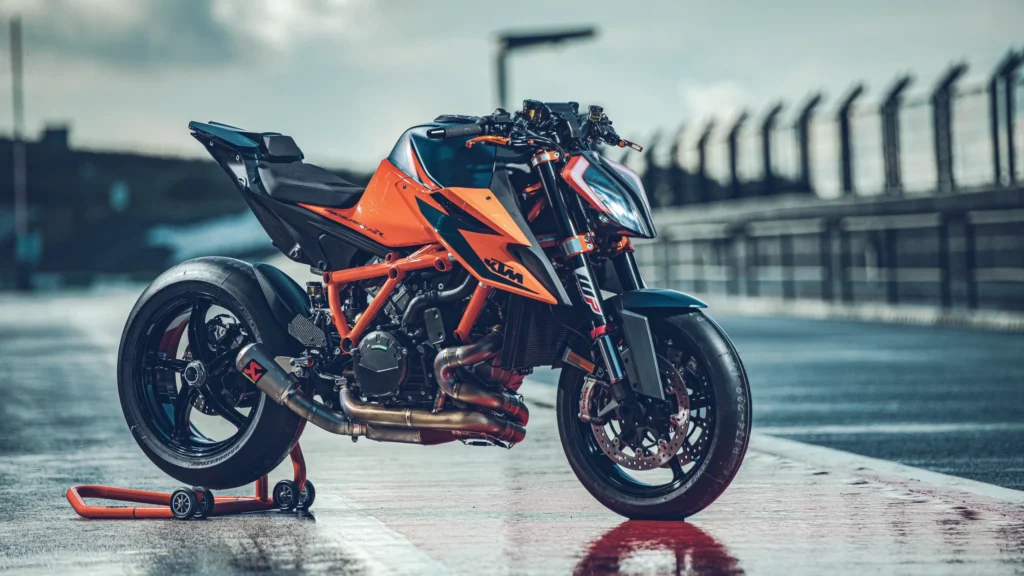
The 1290 Super Duke R runs one of the more complete electronics packages in the naked-bike segment. The system centers on a Bosch IMU (Inertial Measurement Unit) that reads the bike’s lean angle and feeds data to multiple safety and performance systems simultaneously.
Standard on the Evo:
- Cornering ABS (Bosch MSC — Motorcycle Stability Control) with Supermoto ABS mode
- Multi-stage lean-angle-sensitive traction control (MTC), with a 6-axis lean sensor
- Wheelie control
- Cruise control
- Ride modes: Rain, Street, Sport (standard); Track and Performance available as paid options
- 4.8-inch color TFT display
The optional Tech Pack ($899.99 in 2022, per Rider Magazine) adds an up/down quickshifter, Motor Slip Regulation (MSR), Suspension Pro, and the Track Pack. The quickshifter notably is not standard — which reviewers criticized given the price point.
Track mode, once activated, lets the rider dial in nine stages of traction control and disable MSC and anti-wheelie entirely. Performance mode gives similar control while keeping street-legal functions like cruise control active.
Who Should Ride the KTM 1290 Super Duke R
The 1290 Super Duke R is not a beginner bike. It’s not even a “I’ve been riding for three years” bike. With 177 claimed horsepower, a wet weight just under 480 lb, and a chassis tuned for aggression, the 1290 rewards riders who already know how to manage power and read corner entry.
The rider who gets the most from this bike is an experienced street rider or occasional track day participant who wants a machine that can commute Monday through Friday and still embarrass sport bikes on a Sunday morning canyon run. The 32.9-inch seat height is manageable for most riders — shorter than many adventure bikes — and the ergonomics are upright enough for all-day riding despite the aggressive character.
The 2022–2023 Evo is the version to target on the used market if you want the semi-active suspension; it changes the real-world rideability significantly. The base R without SAT is still a supremely capable machine, but the Evo’s Comfort mode opens the bike up to longer days and imperfect roads without compromise.
Honest Pros and Cons of the KTM 1290 Super Duke R
What it does exceptionally well:
- The LC8 engine’s torque delivery is as satisfying as motorcycle engines get — usable, brutal, and endlessly flexible.
- In-gear acceleration in any of the first four gears is near-unbeatable at street speeds.
- The Brembo brakes (M50 or Stylema depending on year) are excellent, with strong feel and consistent stopping power.
- Electronics suite is genuinely useful, not just spec-sheet padding — the cornering ABS and traction control are well-calibrated.
- Ergonomics are surprisingly comfortable for all-day riding despite the bike’s performance focus.
Real drawbacks:
- The quickshifter is not standard — it’s part of a $899.99 optional pack, which stings at $19,000+.
- High-speed wind blast is substantial. The upright position makes 150+ mph uncomfortable to sustain, unlike a sport bike where you’re tucked behind a screen.
- Service intervals (valve checks) are 9,000 miles — not unusually short, but the service cost at a KTM dealer adds up.
- Reliability reputation is mixed. Older-generation 1290s had some reported engine and electronics issues; the 2020-onward generation is generally regarded as more sorted, but it still can’t match Japanese big-twin ownership cost expectations.
- The 2024 model year saw the 1290 replaced by the 1390 Super Duke R, which means factory support and parts availability for the 1290 will shift to an older-model timeline.
Frequently Asked Questions About the KTM 1290 Super Duke R
What is the KTM 1290 Super Duke R top speed?
Independent testing by MotoStatz puts the genuine top speed at approximately 170 mph (274 km/h) achieved in fifth and sixth gear on a measured course. KTM does not publish an official top speed figure. Some GPS-recorded Autobahn runs have shown speeds near 180 mph, but these are uncontrolled conditions and heavily rider/weather dependent.
How fast is the 0–60 mph on the KTM 1290 Super Duke R?
Per MotoStatz instrumented testing, the 1290 Super Duke R covers 0–60 mph in 2.75 seconds and 0–100 km/h in 2.92 seconds. The bike’s tendency to wheelie means those figures can be slightly slower in practice without launch control or optimal wheelie-control settings. Rider Knox achieved a 3.6-second 0–60 mph time in a separate real-world test (Knox, 2021), illustrating the range of outcomes depending on launch conditions.
What is the difference between the KTM 1290 Super Duke R and the 1290 Super Duke R Evo?
The Evo designation, introduced for the 2022 model year, refers specifically to the addition of WP second-generation semi-active suspension (SAT). The Evo runs three electronic damping modes — Comfort, Street, and Sport — that adjust in real time. Both models share the same 1,301 cc LC8 engine producing 177–180 claimed hp (figures varied slightly by model year and market). The standard R uses manually adjusted WP suspension with the same spec forks and shock.
What is the KTM 1290 Super Duke R’s engine displacement and power output?
The 1290 Super Duke R uses a 1,301 cc (not 1,290 cc — the name is a brand designation) liquid-cooled 75° V-twin with DOHC 8-valve heads. KTM’s claimed output is 177 hp (132 kW) and 106 lb-ft (144 Nm) of torque. Cycle World’s 2023 dyno test of the Evo measured 157.3 rear-wheel horsepower at 9,500 rpm and 92.8 lb-ft at 8,300 rpm — typical drivetrain loss of around 12% from crank to wheel.
Is the KTM 1290 Super Duke R still in production?
No. KTM replaced the 1290 Super Duke R with the 1390 Super Duke R starting with the 2024 model year. The 1390 uses a new 1,350 cc V-twin (110 mm bore, same 71 mm stroke) with variable cam timing, a 60 mm throttle body upgrade, and a 4.6-gallon tank. The 1290 is still widely available used; the 2022–2023 Evo models are the most recent and most capable versions of the 1290 platform.
How much does the KTM 1290 Super Duke R weigh?
The 1290 Super Duke R has a dry weight of 189 kg (417 lb). With fuel and fluids, Cycle World’s 2023 scales put the Evo’s wet weight at 471 lb. The EVO variant adds approximately 4.4 lb (2 kg) over the standard R due to the semi-active suspension components (KTM, 2022).
What tires does the KTM 1290 Super Duke R use?
The 1290 Super Duke R runs 120/70-17 front and 190/55-17 rear on 17-inch wheels. From the factory the Evo came on forged 5-spoke wheels finished in orange. Replacement tire choices from the aftermarket include the Michelin Power GP2, Pirelli Diablo Rosso IV Corsa, and Bridgestone Battlax S23 — all suitable for the power and weight of the platform.
Key Takeaways
- The 1290 Super Duke R’s 1,301 cc LC8 V-twin produces 157.3 rear-wheel horsepower and 92.8 lb-ft of rear-wheel torque per Cycle World’s 2023 dyno test — strong figures matched by an exceptionally flat torque curve starting at 3,500 rpm.
- 0–60 mph in 2.75 seconds and a 10.21-second quarter mile at 144.8 mph (MotoStatz) place it in superbike acceleration territory despite the naked-bike format.
- The 2022–2023 Evo is the recommended version for a used buy — WP semi-active suspension changes everyday rideability in a meaningful way.
- Top speed of approximately 170 mph is independently verified; treat figures above this with caution.
- The 1290 has now been replaced by the 1390 Super Duke R (2024+), but the 1290 platform remains one of the most capable and driver-focused naked bikes ever produced.