Triumph Bonneville Bobber Top Speed, Specs & Review
TL;DR
- The 2025 Triumph Bonneville Bobber hits an estimated top speed of around 111 mph, though Triumph publishes no official figure.
- Power comes from a 1,200cc liquid-cooled parallel twin making 77 hp at 6,100 rpm and 78 lb-ft of torque at 4,000 rpm.
- The 2017-generation Bobber ran 0-60 mph in 3.6 seconds and the quarter mile in 12.5 seconds; no independently instrumented 2025 test data is available as of this writing.
- The 2025 update added lean-sensitive cornering ABS and traction control via an IMU, cruise control, USB-C charging, and a larger 3.7-gallon fuel tank.
- At $13,995, the Bobber is a factory-built custom that actually rides as well as it looks – and it looks very good.
2025 Triumph Bonneville Bobber Specs
| Spec | Detail |
|---|---|
| Engine | 1,200cc liquid-cooled SOHC parallel twin, 270° firing interval |
| Bore x Stroke | 97.6 mm x 80.0 mm |
| Power | 77 hp (76.9 bhp) @ 6,100 rpm |
| Torque | 78 lb-ft (106 Nm) @ 4,000 rpm |
| Transmission | 6-speed, chain final drive |
| Estimated Top Speed | ~111 mph (not officially stated by Triumph) |
| 0-60 mph | ~3.6 sec (2017 gen; no current instrumented figure published) |
| Wet Weight | 251 kg (553 lbs) |
| Seat Height | 690-700 mm (27.2-27.6 in), adjustable |
| Fuel Tank | 3.7 gal (14L) |
| Front Suspension | 47mm Showa cartridge forks, 90mm travel |
| Rear Suspension | Hidden monoshock with linkage, preload adjustable |
| Front Brakes | Twin 310mm discs, Brembo 2-piston axial calipers |
| Rear Brake | 255mm disc, Nissin caliper |
| ABS / TC | Standard; lean-sensitive cornering ABS via IMU |
| Front Tire | 130/90 B16 Avon Cobra AV71 |
| Rear Tire | 150/80 R16 Avon Cobra AV72 |
| Fuel Economy | ~52 mpg combined (Motorcycle.com, 2025) |
| MSRP (2025, USA) | $13,995 (base); $14,295 (Red Hopper); $14,495 (Jet Black/Ash Gray); $14,795 (Icon Edition) |
Sources: Triumph Motorcycles (2025), Motorcycle.com (2025), Autoevolution (2025)
Triumph Bonneville Bobber Top Speed: What the Data Actually Says
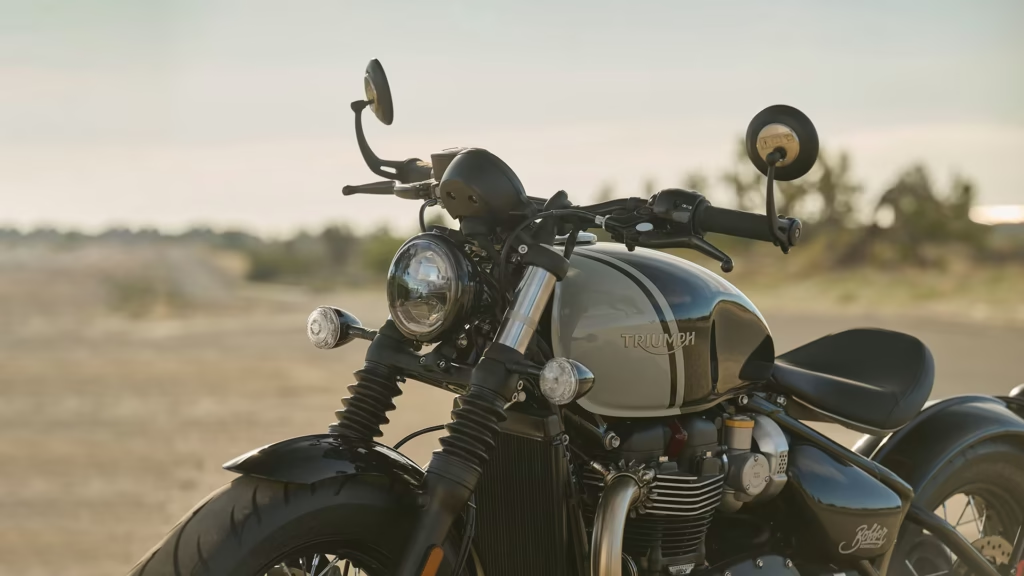
The Triumph Bonneville Bobber’s top speed is approximately 111 mph (180 km/h), according to motoplanete.us’s modeling of the 2025 model. Triumph does not publish an official top speed figure for the Bobber, which is standard practice for cruiser-segment machines.
That number lines up with what the powertrain suggests. With 77 hp driving 553 pounds, there’s enough grunt to get there on a long straight, but the upright riding position and wind resistance put a realistic ceiling on sustained high-speed work. This bike was not built to eat miles at triple-digit speeds. It was built to look sinister at 60 mph and feel alive doing it.
For 0-60 and quarter-mile data, the most widely cited figures come from ZeroTo60Times.com based on the original 2017 Bobber: 0-60 mph in 3.6 seconds, quarter mile in 12.5 seconds at around 105 mph trap speed. No independently instrumented test using the current post-2025 specification has been published, so these numbers should be treated as directional estimates.
Engine & Power Delivery: Why the 270° Firing Interval Matters
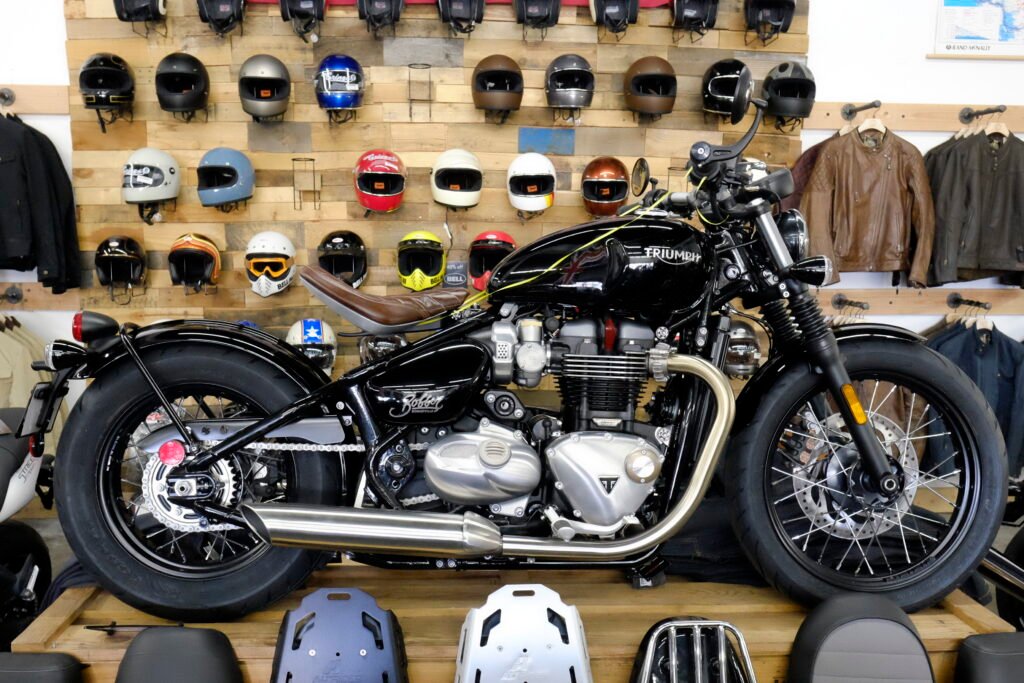
The 1,200cc High Torque engine is the best part of this motorcycle. Triumph tuned the Bobber with a specific engine map that front-loads torque delivery, so the power comes in thick and early – right where you want it on a cruiser. The 78 lb-ft peak arrives at just 4,000 rpm, which means you’re into the meat of the power band before you’ve even cleared the end of your street.
The 270° firing interval gives the engine a V-twin-like pulse without the V-configuration. At low revs there’s a lumpy, syncopated beat; roll the throttle past 4,000 rpm and it turns more urgent, with a distinctive growl that carries through the standard twin stainless steel silencers.
The engine doesn’t rev like a sportbike. Peak power is done by 6,100 rpm and the redline isn’t far beyond that. Riding the Bobber is about exploiting the torque band between 2,500 and 5,500 rpm, not chasing peak numbers. In practice, the engine pulls cleanly from low speed in any gear, which makes it easy to manage in city traffic without constant gearchanges.
Chassis, Suspension & Braking
The Bobber’s chassis setup is a study in managed compromises. The 47mm Showa cartridge forks offer 90mm of travel at the front, and the hidden monoshock at the rear runs through a linkage that allows preload adjustment. Total rear travel is limited – real-world owners have noted the bike can feel firm over sharp urban bumps (BikerKaz, 2025). That’s the trade-off: the short-travel suspension looks right and handles well on smooth roads, but it transmits more road surface than a touring machine would.
The braking setup is genuinely good for the segment. Twin 310mm discs up front with Brembo 2-piston axial calipers give strong, progressive stopping power. The single Nissin caliper on the 255mm rear disc handles its end without drama. Standard cornering ABS – managed through a high-performance IMU – makes a real difference in mixed-surface or wet conditions. This is not a safety gimmick; lean-sensitive ABS works in directions a simple wheel-speed sensor cannot.
The 16-inch wheels front and rear are fitted with Avon Cobra tires (AV71 front, AV72 rear), which are well-matched to the bike’s character. They provide adequate grip for the Bobber’s power output and prioritize the visual proportions that define the look.
Riding Experience and Ergonomics
The 2025 Bonneville Bobber’s ergonomics are more comfortable than the hardtail looks suggest. Seat height is adjustable between 690mm and 700mm (27.2 to 27.6 inches), which puts it within reach for shorter riders. The floating aluminum seat – a Bobber design signature – has been widened and reshaped for 2025, which is a real improvement over earlier generations.
The riding position is upright and relaxed with mid-mounted foot controls. There’s none of the forward-stretch that makes some cruisers fatiguing, and the handlebar height is natural. What you give up is long-distance comfort: with no wind protection, speeds above 75 mph get tiring quickly, and the 3.7-gallon tank offers an estimated 190-200 mile range in mixed riding based on the 52 mpg combined figure (Motorcycle.com, 2025). That’s adequate for a day ride but will limit longer touring runs.
Ride-by-wire throttle, two riding modes (Road and Rain), cruise control, and USB-C charging come standard on the 2025 model. The single analog speedometer with LCD display reads cleanly and is easy to navigate on the move.
Strengths and Limitations
The Bobber does several things well. The engine has genuine character, not just numbers on a spec sheet. The factory build quality exceeds what most custom builders produce at this price. The cornering ABS and traction control system is well-integrated and unobtrusive. At $13,995, the base model delivers solid value in hardware.
There are legitimate drawbacks. The suspension is on the firm side for rough urban roads; riders who spend a lot of time on broken pavement will feel it. Range is modest – plan on stopping every 150-180 miles in spirited riding. The single-seat setup limits two-up capability almost entirely. At 553 pounds wet, it’s not the lightest machine to manage in parking lots; new riders should get comfortable with the weight before committing.
The 2025 TFC version (750 units, $18,495) addresses some of this with Ohlins suspension front and rear, Brembo M50 radially-mounted four-piston calipers, clip-on bars, and a 19-inch front wheel – a different machine for a different buyer (Cycle World, 2025).
Who Should Buy the 2025 Triumph Bonneville Bobber
The Bobber is the right bike for an experienced rider who wants a factory-quality custom without the build cost and the reliability questions that come with custom work. It suits city riding and weekend canyon runs equally well. It doesn’t excel at sustained highway miles or carrying a passenger, so touring riders or those who regularly ride two-up should look elsewhere in the Bonneville lineup.
Riders moving up from a middleweight will find the 1,200cc engine immediately accessible without being overwhelming. The low seat height and manageable power band also make it approachable for riders returning to motorcycling after a break. The weight requires deliberate low-speed handling, so it’s better suited to riders with at least a season of experience than to someone on their first bike.
Frequently Asked Questions
What is the top speed of the Triumph Bonneville Bobber?
The Triumph Bonneville Bobber’s top speed is estimated at approximately 111 mph (180 km/h), based on third-party computational modeling of the 2025 model (Motoplanete.us, 2025). Triumph does not publish an official top speed figure for this model. Real-world top speed will vary depending on rider weight, road conditions, and riding position.
How fast is the Triumph Bonneville Bobber 0 to 60?
The most frequently cited 0-60 figure for the Bonneville Bobber is 3.6 seconds, with a quarter-mile time of 12.5 seconds (ZeroTo60Times.com; BikeBound, 2021). These figures were established using the original 2017 specification, which shares the same 1,200cc engine architecture as the 2025 model. No independently instrumented 0-60 test on the current 2025 specification has been published.
How much does the 2025 Triumph Bonneville Bobber cost?
The 2025 Triumph Bonneville Bobber starts at $13,995 in the US for the base model. The Icon Edition adds $800 to reach $14,795. The limited-edition Bobber TFC (750 units worldwide) is priced at $18,495 (Triumph USA, 2025). All prices are MSRP before dealer fees, destination charges, or taxes.
What engine does the Triumph Bonneville Bobber use?
The Bonneville Bobber uses a 1,200cc liquid-cooled SOHC parallel twin with a 270° crankshaft offset. It produces 77 hp at 6,100 rpm and 78 lb-ft of torque at 4,000 rpm. The 270° firing interval gives the engine a V-twin-like pulse and sound character. The engine pairs with a 6-speed gearbox and chain final drive.
Is the Triumph Bonneville Bobber good for beginners?
The Bobber is not ideal as a first motorcycle. At 553 pounds wet and with a 1,200cc engine, it requires confident low-speed handling and some familiarity with motorcycle dynamics. Riders coming from a 650-900cc machine will find the step up manageable. The seat height of 690-700mm is accessible for a wide range of heights, and the engine’s strong low-end torque is easy to manage once moving. One season of riding experience before stepping onto the Bobber is a reasonable baseline.