Moto Guzzi Motorcycles: History, Manufacturer & Ownership
TL;DR
- Moto Guzzi is an Italian motorcycle manufacturer founded on March 15, 1921, in Mandello del Lario on the shores of Lake Como.
- The company is the oldest European motorcycle manufacturer in continuous production — over 100 years without stopping.
- Moto Guzzi has been wholly owned by Piaggio Group since December 30, 2004; Piaggio is currently Europe’s largest motorcycle manufacturer.
- Every Moto Guzzi motorcycle is still assembled by hand at the original Mandello del Lario factory.
- The brand’s signature design — an air-cooled 90° transverse V-twin with a longitudinal crankshaft — dates to 1967 and remains in production today.
Moto Guzzi is an Italian motorcycle manufacturer based in Mandello del Lario, in the Lecco province of northern Italy. Founded in 1921, it holds the distinction of being the oldest European motorcycle manufacturer in unbroken continuous production. Every model the company has ever sold — from the original 8 hp Normale to the current V100 Mandello — came out of the same lakeside factory.
That kind of continuity is rare in any industry. Triumph went through receivership. Royal Enfield did the same. Moto Guzzi kept the lights on through the Great Depression, World War II, several ownership changes, and at least two near-bankruptcies. The eagle on the tank has never stopped flying.
Who Founded Moto Guzzi and Why the Eagle Is on the Badge
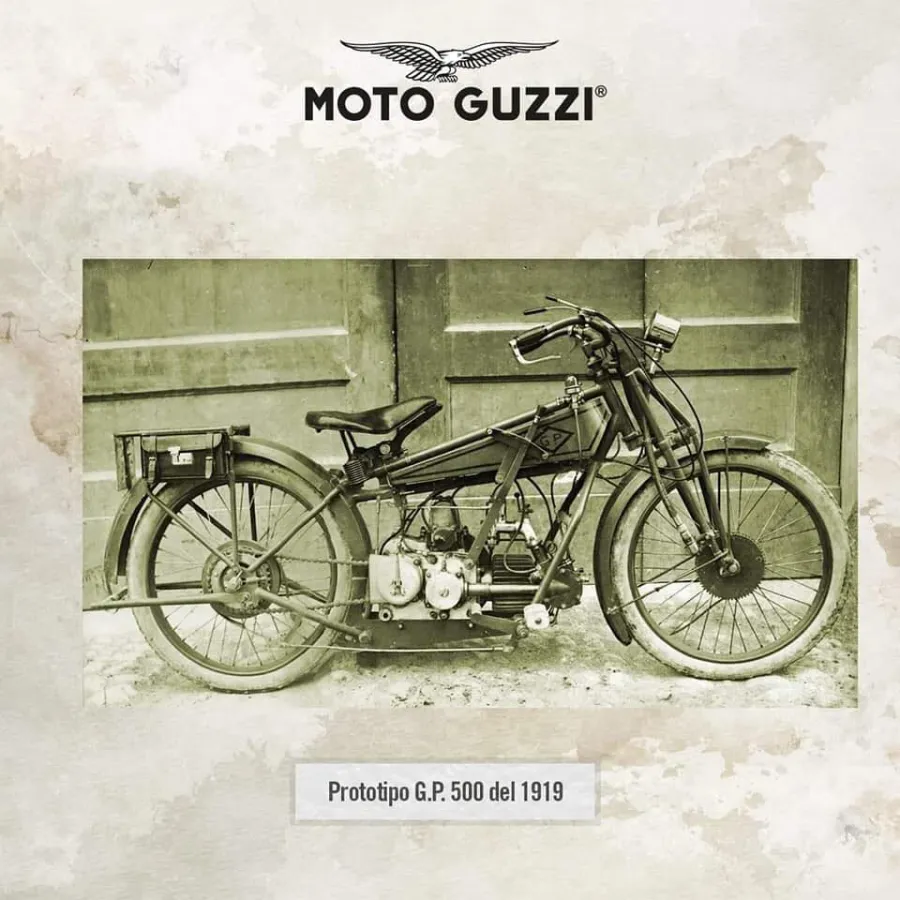
Moto Guzzi was founded by three men who met during World War I while serving in the Italian Air Corps: engineer Carlo Guzzi, aviator Giorgio Parodi, and pilot Giovanni Ravelli. Their plan was to build motorcycles together after the war.
Ravelli never made it. He died in a test flight on August 11, 1919. When Guzzi and Giorgio Parodi formally established the company on March 15, 1921 — with financial backing from Giorgio’s father, shipowner Emanuele Vittorio Parodi — they put a spread-winged eagle on the badge as a tribute to their dead friend. The eagle comes directly from the symbol of the Italian Royal Navy’s Naval Aviation arm. It has stayed on every Moto Guzzi gas tank ever since (Wikipedia, 2024).
The first production motorcycle, called the Normale, had a 500cc horizontal single-cylinder engine producing 8.5 hp with a top speed of about 52 mph. Seventeen were built in the first year (Run Moto Run, 2022). The horizontally mounted single became the backbone of the company’s lineup for 45 years.
Racing success came fast. Moto Guzzi won the prestigious Targa Florio in 1921, the same year the company was founded. By the time the factory pulled out of Grand Prix competition in 1957, the tally stood at 14 world speed titles, 11 Tourist Trophy wins, and more than 3,300 victories in official competition (Wide Piaggio Group, 2021).
Moto Guzzi Ownership: Who Has Owned the Brand and When
The company has changed hands several times since the founders stepped back. Here is the ownership timeline:
| Period | Owner | Key Development |
|---|---|---|
| 1921–1966 | Parodi & Guzzi family | Founded, grew to Italy’s largest motorcycle maker by 1934 |
| 1967–1973 | SEIMM (state-controlled receiver) | Nationalized after financial crisis; 90° V-twin engine developed |
| 1973–2000 | Alejandro de Tomaso / De Tomaso Industries | Returned to profitability; 850 Le Mans launched 1975 |
| 2000–2004 | Aprilia S.p.A. | Acquired for $65 million; factory renovated; Aprilia itself then failed |
| 2004–present | Piaggio Group (IMMSI S.p.A.) | Acquired December 30, 2004; brand revived and expanded |
The first crisis hit in the early 1960s. Carlo Guzzi retired in 1961 at age 72. Giorgio Parodi had died in 1955. Emanuele Parodi was gone too. By 1964 the company was in full financial crisis, and by 1966 it entered liquidation. SEIMM — Società Esercizio Industrie Moto Meccaniche — a new subsidiary of a large Italian building society (IMI), bought the company outright in February 1967 (Moto Guzzi Club GB, 2021).
The SEIMM years were actually productive on the engineering side. That era produced the 90° V-twin engine, originally designed by Giulio Cesare Carcano, which would define Moto Guzzi from that point forward.
In 1973, Argentinian industrialist Alejandro de Tomaso — who already owned Benelli and Maserati — purchased SEIMM and thereby Moto Guzzi. The De Tomaso years brought the company back to profitability. The 850 Le Mans, launched in 1975, became one of the most iconic Italian café racers ever built. De Tomaso ownership lasted until 2000, though the final years saw underinvestment and the company sliding toward bankruptcy again.
In April 2000, Aprilia CEO Ivano Beggio — who described himself as a lifelong Guzzista — bought Moto Guzzi for $65 million. Aprilia renovated the Mandello factory and launched the V11 Sport. But Aprilia ran into its own serious financial trouble, and on December 30, 2004, Piaggio Group acquired Aprilia and Moto Guzzi along with it (Wikipedia, 2024).
Piaggio has owned Moto Guzzi ever since. As of 2026, the brand operates as a wholly owned subsidiary within the Piaggio portfolio alongside Vespa, Aprilia, and Scarabeo.
The Engine That Made Moto Guzzi What It Is
Every Moto Guzzi built since 1967 has centered on a variation of the same fundamental engine architecture: an air-cooled 90° V-twin with a longitudinal crankshaft and transverse cylinder heads that stick out prominently on either side of the bike. This layout is unique in the industry.
The longitudinal crankshaft — running front-to-back rather than side-to-side — creates a slight gyroscopic effect and a characteristic handling feel that Guzzi riders describe as alive in corners. It also allowed for a shaft final drive rather than a chain, which simplifies maintenance considerably. No chain to adjust, no chain lube to schedule.
The original 700cc Carcano engine grew through 750cc, 850cc, 1000cc, 1100cc, and 1200cc displacements across decades of development. The modern V7 runs an 853cc air-cooled version producing 67.3 hp (Roadrunner, 2025). The V100 Mandello introduced a 1042cc liquid-cooled version of the V-twin producing 115 hp — a significant technology step while keeping the same transverse cylinder layout (Total Motorcycle, 2024).
What Moto Guzzi Makes Today
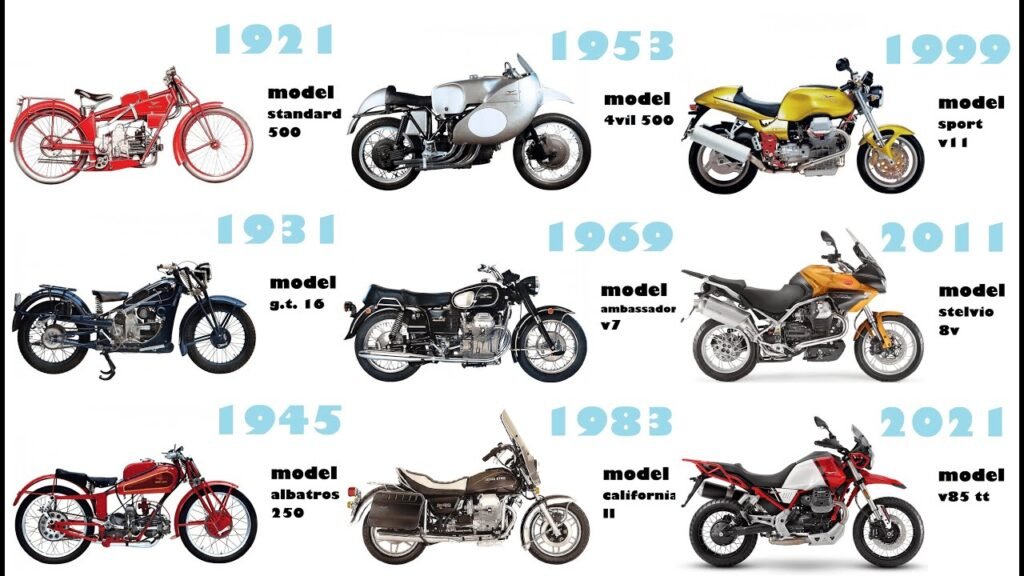
As of 2026, the full lineup runs across four families:
| Model | Engine | Power | Type |
|---|---|---|---|
| V7 Stone / Special / Sport | 853cc air-cooled V-twin | 67.3 hp | Retro roadster |
| V9 Bobber / Roamer | 853cc air-cooled V-twin (V9 tune) | ~55 hp | Urban cruiser |
| V85 TT / TT Travel / Strada | 853cc with variable valve timing | ~80 hp | Mid-adventure |
| Stelvio | 1042cc liquid-cooled V-twin | 115 hp | Adventure tourer |
| V100 Mandello / Mandello S | 1042cc liquid-cooled V-twin | 115 hp | Sport tourer |
Annual production is approximately 6,000 units, with the majority exported outside Italy (Grokipedia, 2026). That’s a small-batch operation by any modern standard — closer to a specialty manufacturer than a mass-market producer. It explains both the pricing and the cult following.
The V100 Mandello is the most technologically forward machine the brand has ever sold. It runs Öhlins semi-active suspension, active aerodynamic winglets that adjust at speed, forward collision warning, blind spot monitoring, and a bidirectional quickshifter. A decade ago that list would have read like a BMW R1250RT spec sheet.
Frequently Asked Questions About Moto Guzzi
Who manufactures Moto Guzzi motorcycles?
Moto Guzzi motorcycles are manufactured by Moto Guzzi S.p.A., a wholly owned subsidiary of Piaggio Group. All production takes place at the original factory in Mandello del Lario, Italy, where every motorcycle is assembled by hand.
Who owns Moto Guzzi today?
Piaggio Group has owned Moto Guzzi since December 30, 2004. Piaggio is itself controlled by IMMSI S.p.A., the financial holding company of the Colaninno family. Piaggio also owns Vespa, Aprilia, Scarabeo, and Derbi, making it Europe’s largest motorcycle and scooter manufacturer.
When was Moto Guzzi founded?
Moto Guzzi was officially founded on March 15, 1921. The three founders were engineer Carlo Guzzi and brothers-in-arms Giorgio Parodi and (posthumously honored) Giovanni Ravelli, all veterans of the Italian Air Corps during World War I.
Where are Moto Guzzi motorcycles made?
Every Moto Guzzi motorcycle is made in Mandello del Lario, a small town on Lake Como in the Lecco province of northern Italy. The factory has operated continuously on the same site since 1921. The town itself is informally known as “La Città della Moto Guzzi” — the city of Moto Guzzi.
What is Moto Guzzi known for?
Moto Guzzi is known for its air-cooled 90° transverse V-twin engine with a longitudinal crankshaft — an engine architecture found on no other production motorcycle. The brand is also known for being Europe’s oldest motorcycle manufacturer in continuous production, its factory-based museum and historic wind tunnel, and a devoted global owner community called Guzzisti.
Is Moto Guzzi a reliable motorcycle?
Moto Guzzi’s reputation for reliability is generally solid, particularly on older air-cooled V-twin models. The shaft drive eliminates chain maintenance entirely. Common weak points on earlier models include the bevel-drive and older carbureted engines requiring attention to valve clearances, but the platform is well-understood after decades of production. Modern Piaggio-era bikes benefit from fuel injection and tighter production quality control.