MV Agusta Motorcycles: History, Manufacturer & Ownership
TL;DR
- MV Agusta was founded on January 19, 1945 by Count Domenico Agusta in Cascina Costa, near Milan, Italy — “MV” stands for Meccanica Verghera, the hamlet where the first factory sat.
- The brand’s roots go back further, to an Agusta family aeronautics business started by Count Giovanni Agusta in 1907.
- MV Agusta dominated Grand Prix racing in the 1950s and ’60s, winning 38 World Riders’ Championships, 37 World Constructors’ Championships, and 270 Grand Prix races.
- The brand went dormant from 1980 to 1997, was revived by Claudio Castiglioni and Cagiva, and has changed hands multiple times since.
- As of January 2025, MV Agusta is fully owned by Art of Mobility S.A., controlled by the Sardarov family, and all production stays in Varese, Italy.
Who Makes MV Agusta Motorcycles

MV Agusta motorcycles are made by MV Agusta Motor S.p.A., an Italian company headquartered in Varese, at a plant in the Schiranna district on the shore of Lake Varese. That factory address hasn’t changed in decades. Despite a revolving door of corporate owners over the years, every MV Agusta has been hand-assembled in northern Italy since the brand’s revival in the late 1990s.
The full name, Meccanica Verghera Agusta, nods to Verghera — a small hamlet near the original Cascina Costa factory where Count Domenico Agusta set up shop in 1945. The “MV” initials stuck even after the brand was restructured, revived, sold, and restructured again.
Production volume is deliberately small. In 2024, MV Agusta sold 4,000 motorcycles globally — a number that represents 116% growth over the prior year, but still places the brand firmly in the hand-finished, low-volume category alongside Ducati’s most exclusive offerings and well above Bimota’s output (SportBikes Inc Magazine, 2025).
The Founding: From Aircraft to Motorcycles (1907-1945)
MV Agusta’s origin isn’t a motorcycle story — it’s an aviation story first. Count Giovanni Agusta founded an aeronautics company in 1907, initially near Palermo, Sicily, then relocated to Cascina Costa in northern Italy. He produced aircraft for the Italian military during World War I, and the company grew steadily until his death in 1927, when control passed to his widow Giuseppina and their four sons: Domenico, Vincenzo, Mario, and Corrado (Wikipedia, MV Agusta).
The peace treaty ending World War II brought the aviation business to a halt. Italy was barred from producing aircraft, and the Agustas needed a new revenue source fast. Domenico Agusta, who had already been sketching out a motorcycle concept during the war, acted on it immediately. On January 19, 1945, Meccanica Verghera S.r.l. was registered as a private company in Cascina Costa.
The first MV Agusta — a 98 cc two-stroke — was unveiled in autumn 1945. The company had briefly considered naming it “Vespa,” but that name was already claimed by Piaggio, so the bike simply went out as the MV 98. First deliveries started in 1946, and MV Agusta entered endurance racing in the same year, winning its first event almost immediately.
The Racing Years: 1950s-1977
The 1950s and ’60s were MV Agusta’s golden era, and the numbers are hard to argue with. The brand won 38 World Riders’ Championships and 37 World Constructors’ Championships across 125 cc, 250 cc, 350 cc, and 500 cc Grand Prix classes (MV Agusta historical records). Riders like Carlo Ubbiali, Mike Hailwood, and Giacomo Agostini — who holds more Grand Prix wins than any rider in history at 122 victories — won those titles aboard factory MV Agustas.
Domenico Agusta died in 1971. Without his leadership, the company began to struggle financially. Italy’s industrial financing agency, EFIM, stepped in as a financial partner but pushed MV Agusta out of motorcycles entirely to focus on its helicopter division. The last motorcycle left the Cascina Costa factory in 1980. By that point, the brand had produced approximately 260,000 motorcycles over its first 35 years (Run Moto Run, historical records).
The Ownership Timeline at a Glance
| Years | Owner | Key Event |
|---|---|---|
| 1945-1980 | Agusta family | Founded; racing dominance; production ends |
| 1991 | Cagiva / Castiglioni family | Bought MV Agusta trademark |
| 1997 | Cagiva / Castiglioni family | F4 750 Serie Oro unveiled at EICMA |
| 1999 | Cagiva / Castiglioni family | F4 enters production |
| 2004 | Proton (Malaysia) | Bought 65% stake for €70 million |
| 2005 | GEVI S.p.A. (Italian) | Bought Proton’s stake for €1 |
| 2008 | Harley-Davidson | Acquired brand for €70 million |
| 2010 | Castiglioni family | Harley-Davidson sells back for €20 million |
| 2019 | ComSar Invest / Sardarov family | Full acquisition completed |
| 2022 | KTM / Pierer Mobility | 25.1% stake, strategic partnership |
| Jan 2025 | Art of Mobility S.A. / Sardarov family | Full ownership restored; split from KTM |
The Castiglioni Revival and the F4 (1991-2010)
The MV Agusta name sat dormant through most of the 1980s until Claudio Castiglioni — the man behind Cagiva, who had also previously rescued Ducati — purchased the trademark in 1991. What followed was one of the more dramatic brand resurrections in motorcycle history.
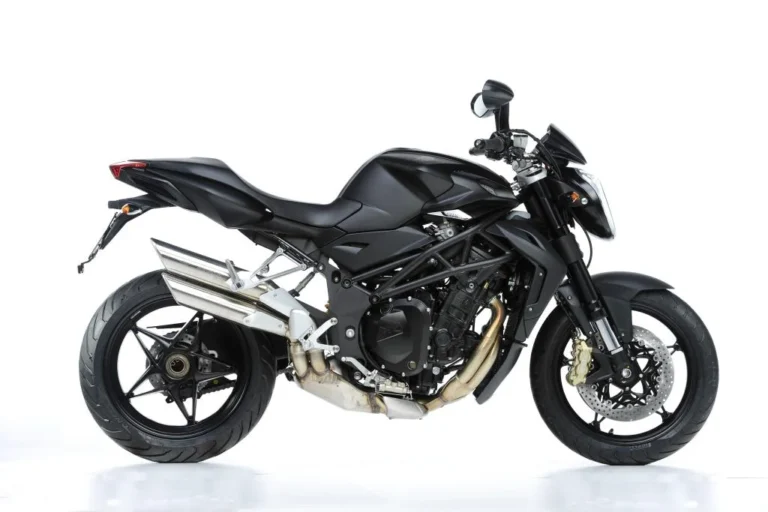
Designer Massimo Tamburini, who had just finished the Ducati 916 at Cagiva’s research center in San Marino, turned his attention to a new four-cylinder MV. The result was the F4 750 Serie Oro, unveiled at EICMA in autumn 1997. The press called it the most beautiful motorcycle in the world. It entered production in 1999, featuring a single-sided swingarm, trellis frame, reverse-rotating crankshaft, and an inline-four making around 126 horsepower — numbers that matched its visual drama.
The years between 1997 and 2010 were financially turbulent despite the critical acclaim. Proton, the Malaysian automaker, bought a 65% stake for €70 million in 2004, then sold it a year later for €1 when new leadership walked in the door. Harley-Davidson acquired the brand in 2008 for €70 million, invested €40 million into debt payoffs and new model development — including work on a three-cylinder F3 — then sold it back to Claudio Castiglioni in 2010 for €20 million and wrote off $162.7 million in total losses (RideApart, 2010). Claudio Castiglioni died in August 2011, and his son Giovanni took over leadership of the brand.
Who Owns MV Agusta in 2025-2026
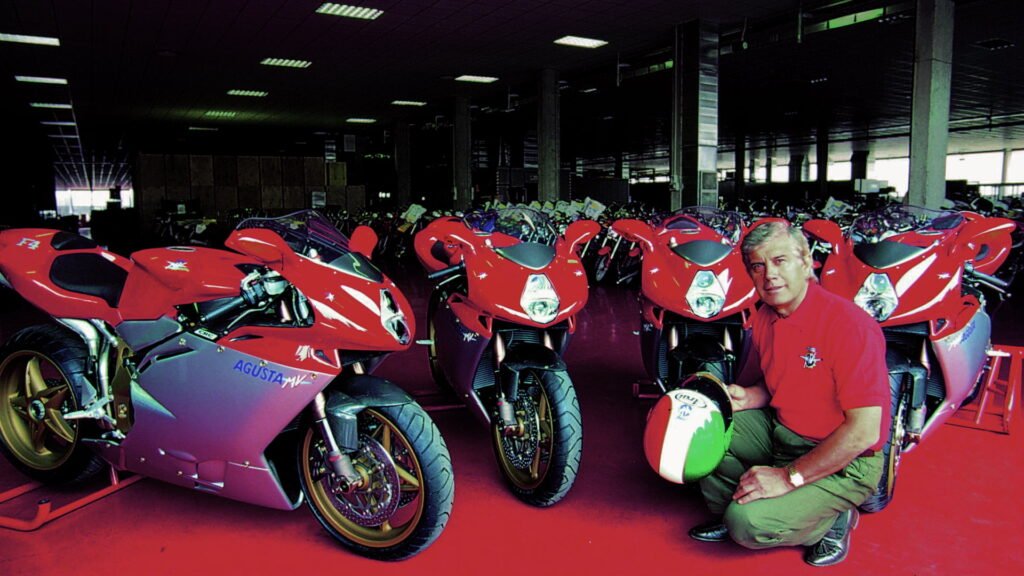
As of January 2025, MV Agusta is fully owned by Art of Mobility S.A., a Luxembourg-based holding company controlled by the Sardarov family. Timur Sardarov — Moscow-born, London-raised, now based in Italy — first got involved with MV Agusta in 2016 through his capital venture business, and his family completed full acquisition in September 2019.
In late 2022, KTM’s parent company Pierer Mobility acquired a 25.1% stake and a strategic distribution and supply-chain partnership was announced. When Pierer Mobility ran into financial trouble in early 2025, that stake reverted to the Sardarov family, and MV Agusta formally separated from KTM. The separation was complete by mid-2025 (Grokipedia, 2026).
Sardarov relocated from London to Varese in 2019 as a signal of commitment. Under his ownership, the brand has added an adventure segment with the LXP Orioli and Enduro Veloce, launched e-mobility products, and posted its best sales growth in decades. Manufacturing remains in Varese — the same Lake Varese location it has occupied since the Castiglioni era.
Frequently Asked Questions About MV Agusta
Where are MV Agusta motorcycles made?
All MV Agusta motorcycles are manufactured at the Schiranna plant in Varese, Italy, near Lake Varese. Production has remained in Italy since the brand’s 1999 revival, regardless of who has held corporate ownership at any given time.
Who founded MV Agusta?
Count Domenico Agusta founded Meccanica Verghera S.r.l. on January 19, 1945 in Cascina Costa, near Milan. The Agusta family’s business roots go back to 1907, when his father Count Giovanni Agusta established an aeronautics company in Sicily.
What does MV stand for in MV Agusta?
MV stands for Meccanica Verghera. Verghera is the hamlet near Cascina Costa where the Agusta family built their original factory. The “Agusta” part comes from the founding family name.
Who owns MV Agusta today?
As of January 2025, MV Agusta is owned by Art of Mobility S.A., a Luxembourg-based company controlled by Timur Sardarov and the Sardarov family. This completed a full separation from KTM following Pierer Mobility’s financial difficulties earlier that year.
Did Harley-Davidson own MV Agusta?
Yes. Harley-Davidson purchased MV Agusta in 2008 for €70 million. The acquisition proved costly — Harley sold the brand back to the Castiglioni family in 2010 for €20 million, recording over $162 million in losses on the deal.