Husqvarna Motorcycles: History, Manufacturer & Ownership
TL;DR
- Husqvarna Motorcycles traces its roots to a Swedish weapons factory founded in 1689 by royal decree, and began producing motorcycles in 1903.
- The brand changed hands five times across four countries: Sweden, Italy, Germany, Austria, and now India.
- As of November 2025, Husqvarna Motorcycles is owned by Bajaj Mobility AG (formerly PIERER Mobility AG), an Austrian holding company majority-controlled by Indian manufacturer Bajaj Auto.
- Husqvarna holds 15 FIM Motocross World Championship titles and has won more than 100 world championships across all disciplines since 1960.
- The current street lineup includes the Vitpilen 401, Vitpilen 801, Svartpilen 401, Svartpilen 801, and the Norden 901 adventure bike.
Where Is Husqvarna Motorcycles From and Who Makes It?
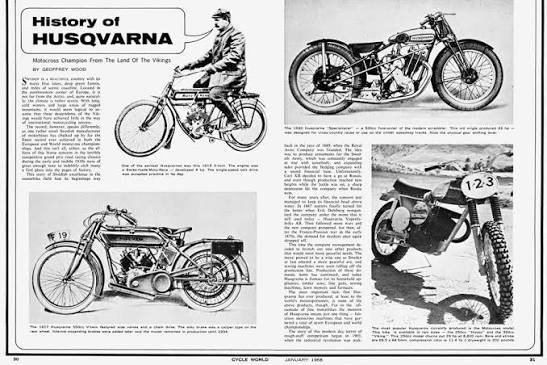
Husqvarna Motorcycles is a Swedish-origin motorcycle brand that is currently designed, engineered, and manufactured in Mattighofen, Austria, by Bajaj Mobility AG through its subsidiary KTM AG. The company began as a weapons factory in the Swedish town of Huskvarna in 1689 and entered motorcycle production in 1903, making it one of the longest continuously operating motorcycle manufacturers in the world (Husqvarna Motorcycles, 2024).
The motorcycle brand operates separately from Husqvarna Group, the Swedish outdoor power equipment company known for chainsaws and lawnmowers. Both trace their roots to the same 1689 factory, but the motorcycle division split off in 1987 and has been under different ownership ever since.
Husqvarna Ownership Timeline: Every Company That Has Owned the Brand
| Year | Owner | Country |
|---|---|---|
| 1903 | Husqvarna Armament (subsidiary) | Sweden |
| 1977 | Electrolux Group | Sweden |
| 1987 | Cagiva / MV Agusta Group | Italy |
| 2007 | BMW Motorrad | Germany |
| 2013 | PIERER Industrie / KTM Group | Austria |
| 2025 | Bajaj Mobility AG (via KTM AG) | Austria / India |
How Husqvarna Went From Muskets to Motorcycles (1689-1920)
Husqvarna started as a rifle factory, not a motorcycle company. In 1689, the Swedish crown established a weapons works beside the waterfalls in Huskvarna, southern Sweden, to bore and grind musket barrels for the national army (Husqvarna Group, 2022). That gun-sight logo on every Husky tank? It is not a styling choice – it is literally a view down a rifle barrel, carried over from the factory’s original product.
By the 1870s, demand for rifles had declined and Husqvarna pivoted to sewing machines, stoves, and bicycles, applying the same precision metalworking skills to each new category. In 1903, the board of directors agreed to add motorized bicycles to the lineup after watching multi-million-kronor imports from the US and UK flow into Sweden (Adventure Rider, 2021). That first machine was a “Motor-velocipede” powered by a Belgian-made FN 225cc single-cylinder engine making 1.25 horsepower, with a leather belt driving the rear wheel – top speed around 30 mph (RideApart, 2017).
By 1916, Husqvarna was building engines entirely in-house. The first all-Swedish Husky used a 550cc four-stroke V-twin that echoed the Harley-Davidson and Indian engines of the era. A contract with the Swedish Army followed, and the brand began entering cross-country races that would define its identity for the next century.
The Racing Golden Age That Made Husqvarna Famous (1930s-1980s)
Husqvarna’s reputation as a serious racing brand did not start with motocross. During the 1930s, the company ran factory bikes in the Isle of Man TT and Grand Prix events in the 350cc and 500cc classes, with rider Stanley Woods winning the Swedish Grand Prix four consecutive years on Husqvarna machinery (Wikipedia, 2024).
The real explosion came when motocross began drawing mass audiences. Swedish rider Bill Nilsson won Husqvarna’s first Motocross World Championship in the 500cc class in 1960. What followed was one of the most dominant decades any manufacturer has had in off-road racing. Torsten Hallman won the 250cc title four times between 1962 and 1967. Heikki Mikkola added the 500cc title in 1974 and the 250cc in 1976. By the end of the 1970s, Husqvarna had claimed 14 Motocross World Championship titles, 24 Enduro European Championships, and 11 Baja 1000 victories (Husqvarna Motorcycles, 2024).
The brand’s secret was weight. While British four-stroke machines were heavy and plodding, Husqvarna’s two-stroke singles were light enough that a factory-backed 250 weighed barely 200 pounds ready to race. Riders like Malcolm Smith and Hollywood actor Steve McQueen became closely associated with the brand during this era, putting Husky motorcycles in American living rooms through films and magazine coverage.
In 1983, a 500cc four-stroke Husky enduro model set a new standard for off-road performance with air cooling, full lubrication, and a weight low enough to embarrass most two-strokes. That machine became the spiritual ancestor of every serious four-stroke enduro bike that followed.
Every Owner Since 1977: Italy, Germany, Austria, India
In 1977, the entire Husqvarna business, including the motorcycle division, became part of Sweden’s Electrolux Group. Ten years later, Electrolux sold the motorcycle division to Italian manufacturer Cagiva (later MV Agusta Group) for an undisclosed sum, and production shifted to Varese, Italy in 1987. A core group of Husqvarna’s Swedish engineers refused to make the move and instead founded a new brand, Husaberg, which built competition enduro bikes independently in Sweden before KTM acquired Husaberg in 1995.
BMW Motorrad purchased Husqvarna Motorcycles from Cagiva in July 2007 for a reported €93 million, positioning the brand as a two-wheel equivalent to what MINI is to BMW’s car division (BMW Group press release, 2007). Development and production stayed in Varese. BMW struggled to define a clear product direction for Husqvarna, and on January 31, 2013, announced it had sold the brand to PIERER Industrie AG.
Stefan Pierer, who was simultaneously CEO of KTM, absorbed Husqvarna into the KTM Group in late 2013. Production moved to Mattighofen, Austria – KTM’s home base – and the separated Husaberg brand was folded back into Husqvarna, reuniting the two branches of the original team. The first modern street bikes, the Vitpilen 401 and Svartpilen 401, reached customers in 2018.
The most recent ownership change came in November 2025. Bajaj Auto, through its subsidiary Bajaj Auto International Holdings BV, completed the acquisition of Pierer Bajaj AG, giving it a controlling 74.9% stake in Bajaj Mobility AG (formerly PIERER Mobility AG), the holding company for KTM, Husqvarna, and GasGas (Motorcycle.com, 2025). The name change from PIERER Mobility AG to Bajaj Mobility AG took effect January 13, 2026.
Who Owns Husqvarna Motorcycles Right Now?
As of 2026, Husqvarna Motorcycles is owned by Bajaj Mobility AG, an Austrian holding company that is 74.9% controlled by Bajaj Auto International Holdings BV, itself a wholly owned subsidiary of Bajaj Auto of India. Bajaj Mobility AG is headquartered in Mattighofen, Austria and also owns KTM and GasGas (Bajaj Mobility AG, 2026).
Bajaj Auto is one of the five largest motorcycle manufacturers in the world. Its connection to KTM and Husqvarna predates the acquisition by nearly two decades – Bajaj has manufactured smaller-displacement KTM models like the Duke 125 and RC 200 in India since the 2000s and distributed them globally. The full takeover formalized what had been a deepening partnership, with Bajaj injecting €800 million into KTM in May 2025 to prevent bankruptcy before acquiring full control in November (iMotorbike, 2025).
Despite the Indian majority ownership, Husqvarna Motorcycles continues to be designed and assembled in Austria, and the brand’s identity as a Swedish-heritage performance label remains unchanged.
What Motorcycles Does Husqvarna Make Today?
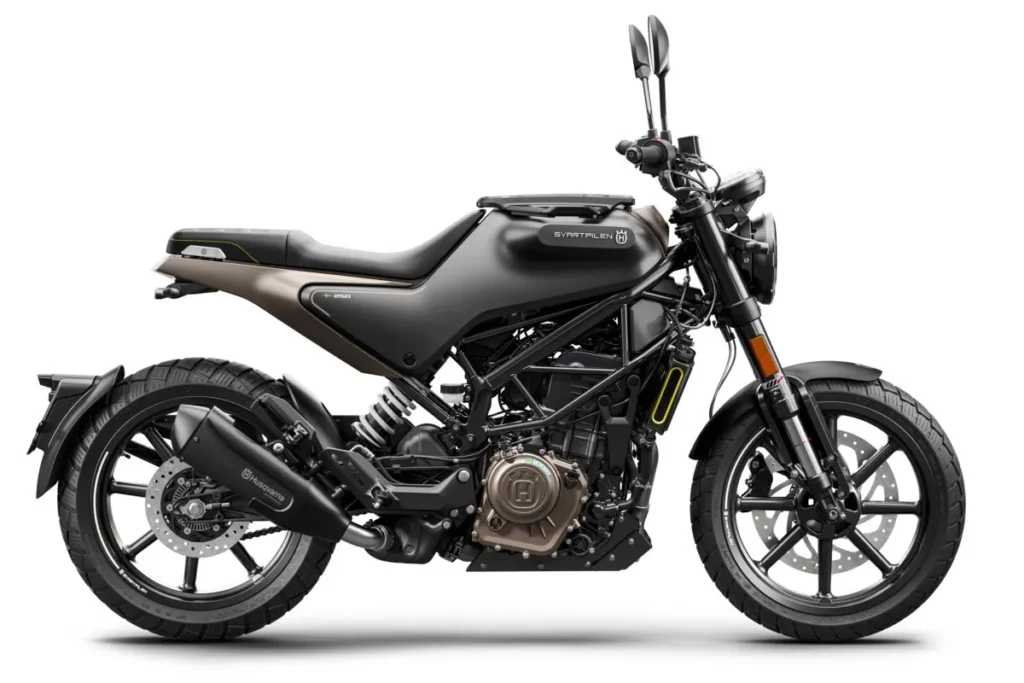
Husqvarna’s current lineup covers street, adventure, motocross, enduro, and supermoto categories. The street range centers on four bikes organized around two names from Swedish: Vitpilen (“white arrow”) for the cafe racer-style roadster, and Svartpilen (“black arrow”) for the scrambler.
| Model | Engine | Power | MSRP (USD, approx.) |
|---|---|---|---|
| Vitpilen 401 | 373cc single | ~44 hp | ~$6,999 |
| Svartpilen 401 | 373cc single | ~44 hp | ~$6,999 |
| Vitpilen 801 | 799cc parallel-twin | 105 hp | ~$10,499 |
| Svartpilen 801 | 799cc parallel-twin | 105 hp | ~$10,499 |
| Norden 901 | 889cc parallel-twin | 105 hp | ~$13,499 |
The 401 models use a 373cc liquid-cooled single shared with the KTM 390 Duke, fitted with WP suspension, cornering ABS, and a quickshifter. The 801s step up to the 799cc parallel-twin from the KTM 790 Duke, with a 75-degree crankpin offset that gives the engine V-twin character in a more compact package (Rider Magazine, 2025). The Norden 901 uses the 889cc version of the same engine and targets adventure touring with a 21-inch front wheel and longer-travel suspension.
Off-road, Husqvarna continues to field factory motocross, enduro, and hard enduro programs under the Rockstar Energy Husqvarna Factory Racing banner. Billy Bolt, riding for Husqvarna, became the first FIM Hard Enduro World Champion in 2021 and has since added multiple SuperEnduro titles, standing at eight world championships as of 2026 (Husqvarna Motorcycles, 2026).
Frequently Asked Questions About Husqvarna Motorcycles
Who owns Husqvarna Motorcycles in 2026?
Husqvarna Motorcycles is owned by Bajaj Mobility AG, an Austrian holding company with a 74.9% controlling stake held by Bajaj Auto International Holdings BV, a subsidiary of Bajaj Auto of India. The ownership was completed in November 2025, when Bajaj acquired full control of what was then PIERER Mobility AG. The holding company was officially renamed Bajaj Mobility AG on January 13, 2026.
Is Husqvarna Motorcycles the same as Husqvarna chainsaws?
No. Both companies trace their origins to the same 1689 Swedish weapons factory, but the motorcycle division split from the broader Husqvarna group in 1987 when it was sold to Cagiva of Italy. The outdoor power equipment business, which makes chainsaws, lawnmowers, and robotic mowers, remained as the independent Husqvarna Group and is now based in Stockholm. The two are separate companies with no current shared ownership.
Where are Husqvarna Motorcycles made?
Husqvarna Motorcycles are designed, engineered, and assembled at KTM’s facility in Mattighofen, Austria. Some smaller-displacement models are also produced by Bajaj Auto’s manufacturing operations in India and distributed globally. The brand’s headquarters moved from Varese, Italy to Mattighofen following KTM’s 2013 acquisition.
How many world championships has Husqvarna won?
Husqvarna has won more than 100 FIM World Championship titles since 1960 across motocross, enduro, supermoto, and rally-raid disciplines. That total includes 15 FIM Motocross World Championship titles, with the first coming when Bill Nilsson won the 500cc class in 1960 (Racer X, 2022). The brand’s current factory enduro racer, Billy Bolt, holds eight world championship titles as of 2026.
What is the difference between Husqvarna and KTM motorcycles?
Husqvarna and KTM are sister brands under the same parent company, Bajaj Mobility AG, and share platforms, engines, and suspension components. The primary differences are styling and brand positioning: Husqvarna targets riders who want premium Scandinavian aesthetics and a quieter identity, while KTM leans into its “Ready to Race” competition focus. On the street, a Vitpilen 801 and a KTM 890 Duke share the same engine and suspension but look and feel distinctly different. Husqvarna typically prices slightly higher and offers a more refined finish.