Triumph Bonneville T120 Top Speed, Specs & Review
TL;DR
- The 2026 Triumph Bonneville T120 is powered by a 1,200cc liquid-cooled parallel twin producing 79 hp at 6,550 rpm and 77 lb-ft of torque at 3,500 rpm
- Top speed is approximately 120 mph based on GPS data logged by riders on unrestricted roads; Triumph publishes no official figure.
- The 2026 model adds a six-axis IMU with lean-sensitive cornering ABS and traction control as standard, plus standard cruise control – the most significant tech update since the 2021 refresh.
- At $13,995 base price (2026), it’s a strong pick for riders who want genuine 1960s Bonneville character without giving up modern safety electronics.
- Best suited for commuters, weekend canyon riders, and touring riders who cover moderate distances – not the right tool for aggressive track days or cross-country slabbing.
2026 Triumph Bonneville T120 Specs
| Specification | Detail |
|---|---|
| Engine | 1,200cc liquid-cooled parallel twin, SOHC, 8-valve |
| Firing order | 270° crank angle |
| Bore x Stroke | 97.6 mm x 80 mm |
| Compression ratio | 10.0:1 |
| Peak power | 79 hp @ 6,550 rpm (claimed) |
| Peak torque | 105 Nm (77 lb-ft) @ 3,500 rpm (claimed) |
| Transmission | 6-speed, chain final drive |
| Frame | Tubular steel twin-cradle |
| Front suspension | 41 mm Kayaba cartridge forks |
| Rear suspension | Twin RSU shocks, 5-way preload adjustment |
| Front brake | Dual 310 mm discs, 2-piston Brembo floating calipers |
| Rear brake | 255 mm disc, 2-piston Nissin floating caliper |
| Front tyre | 100/90-R18 |
| Rear tyre | 150/70-R17 |
| Wheelbase | 1,450 mm (57.1 in) |
| Seat height | 790 mm (31.1 in) |
| Wet weight | 236 kg (520 lb) |
| Fuel capacity | 14.5 L (3.8 US gal) |
| Fuel economy | ~60 mpg combined (Motorcycle.com, 2025) |
| MSRP (base, US) | $13,995 (2026) |
| Service interval | 10,000 miles / 12 months |
Sources: Triumph Motorcycles, 2026; Motorcycle.com, 2025
Triumph Bonneville T120 Top Speed: What the Numbers Actually Show
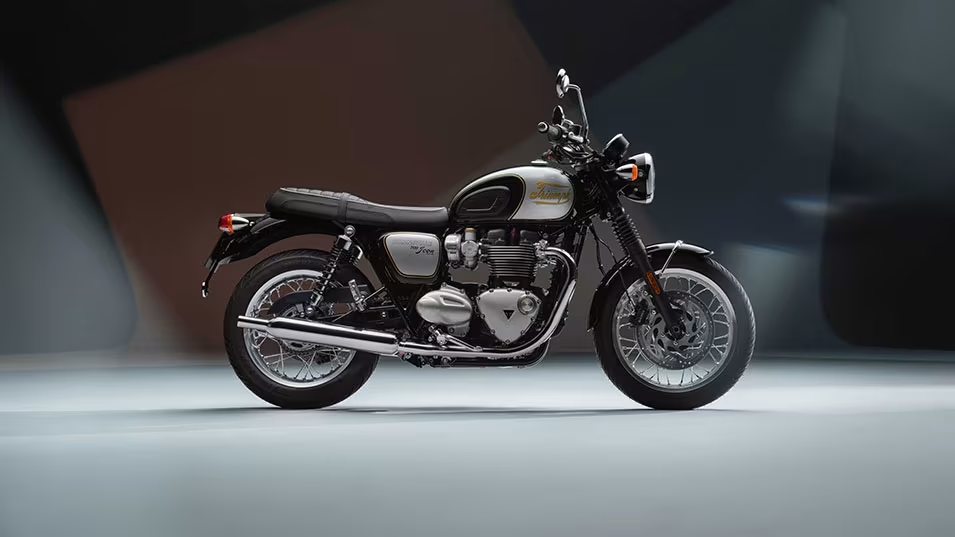
Triumph publishes no top speed figure for the T120 – standard practice for a bike positioned as a modern classic. GPS data from riders on the Autobahn puts real-world top speed at approximately 193 km/h / 120.6 mph (Triumph Rat Forum, 2016). That figure has been consistent across owner reports since the current-generation engine arrived.
The engine isn’t tuned for top-end pull. Triumph’s “High Torque” tune prioritizes a fat, usable mid-range – 90% of peak torque arrives at low rpm, making the T120 feel faster than its numbers suggest in everyday traffic. Slot it into third at 40 mph and crack the throttle; the response is immediate and satisfying in a way that a peak-power-obsessed sportbike rarely delivers at real-world speeds.
No major publication has published an instrumented 0-60 mph figure for the current 1,200cc T120. The 4.9-second 0-60 and 13.24-second quarter-mile figures sometimes cited online are from a Cycle World test of the older air-cooled 865cc Bonneville (Cycle World, 2009) – a fundamentally different engine. Direct performance comparisons to that data are not valid for the 1,200cc model.
Engine and Character: What the 270° Twin Actually Feels Like
The T120’s 1,200cc parallel twin uses a 270° firing order, giving it an uneven firing pulse that sounds and feels closer to a V-twin than a traditional 360° parallel twin. Stagger the firing events and the engine picks up a character that a perfectly balanced twin can’t fake.
At low speeds, it thumps with enough personality to make you grin in city traffic. The burble carries through the peashooter exhausts and into the seat. Mid-range pull between 3,000 and 5,500 rpm is the engine’s sweet spot – this is where the 77 lb-ft does its best work, covering most real-world riding situations without a downshift.
Above 6,000 rpm, the engine gets grainier and less rewarding. It revs willingly to the 7,000 rpm redline, but there’s no payoff up there. The T120 is built to be ridden lazily and confidently, not screamed – torque does the work, the top of the rev range is just a formality.
Service intervals are set at 10,000 miles or 12 months, whichever comes first (Total Motorcycle, 2025). Valve clearance checks are part of the major service schedule.
Chassis, Suspension, and How the T120 Handles
The T120 rides on a tubular steel twin-cradle frame with 41 mm Kayaba cartridge forks up front and twin shocks with five-way preload adjustment at the rear. Neither end is adjustable for damping from the factory.
The setup works well for the bike’s intended use. Around town and on sweeping two-lane roads, it steers easily and holds a line without drama. The 18-inch front and 17-inch rear spoke wheels – shod with Pirelli Phantom Sportscomp tyres from the factory – keep handling neutral and predictable. Ground clearance is 140 mm; aggressive lean angles will scrape the footpegs before the chassis runs out of ability.
One real-world caution: some owners report that the stock Pirellis track road imperfections and lane markings more than expected at speed. Swapping to Avon Roadmasters or Michelin Road 5s is a common and worthwhile upgrade for riders doing regular highway miles.
At 520 lb wet, the T120 parks and maneuvers like a real motorcycle. The 790 mm seat height is accessible for most riders of average height, and the upright riding position makes multi-hour stints comfortable without creating fatigue.
2026 Electronics Update: IMU, Cornering ABS, and What Changes
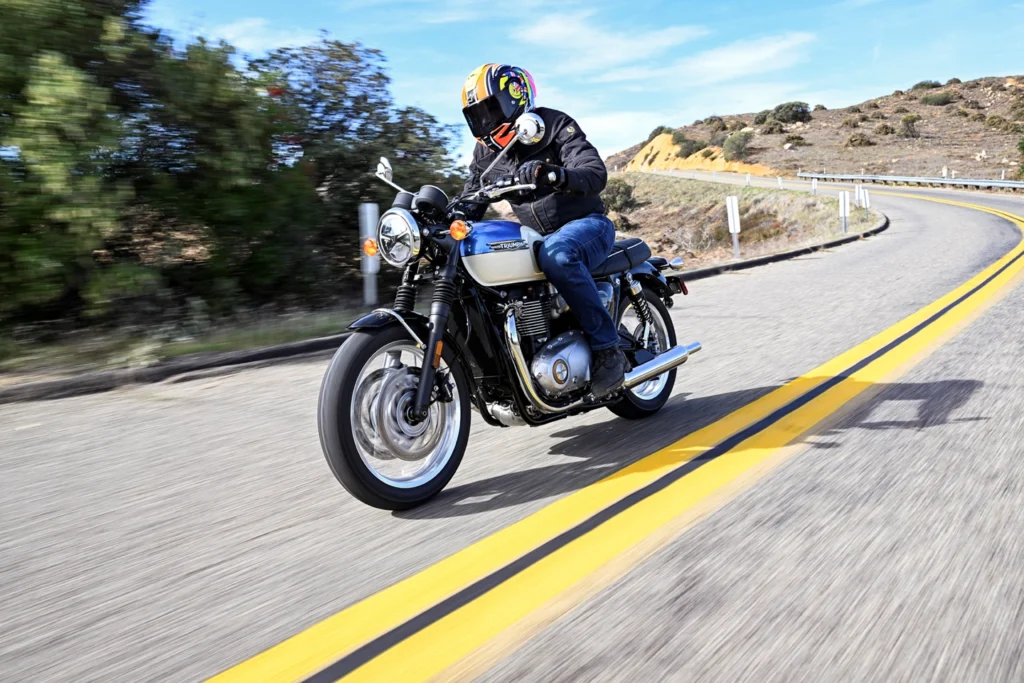
The 2026 model year brought the most significant technology upgrade to the Bonneville range since the 2021 refresh. All T120 variants now carry a six-axis IMU enabling lean-sensitive Optimized Cornering ABS and traction control (Triumph, 2026).
In practice, the electronics operate as a background safety net. RevZilla’s first-ride review noted that neither system triggered during normal spirited road riding – you’d need to be genuinely out of shape in a corner before they step in (RevZilla, 2026). That’s the right calibration. Heavy-handed intervention would kill the T120’s character; stepping in only when you actually need it preserves it.
Two ride modes – Road and Rain – adjust throttle response and traction control thresholds. Cruise control is standard on the T120 and T120 Black. A USB-C charging port and revised LED headlight with a daytime running light round out the update.
The 2026 package comes at a cost: the T120 starts at $13,995, up $1,100 from the 2025 base price of $12,895 (RevZilla, 2026; Motorcycle.com, 2025). Riders indifferent to cornering electronics can find a leftover 2025 example and save that money without surrendering anything mechanical.
What the T120 Does Well and Where It Falls Short
The T120’s strengths are real. The engine character is genuinely enjoyable – not artificially retro, but actually good. Fit and finish is high: hand-painted coach lines on two-color scheme options, chrome details that hold up to scrutiny. The 10,000-mile service interval keeps running costs down. And 60 mpg from a 1,200cc engine is genuinely impressive.
The limitations are equally clear. There’s no wind protection. Highway cruising above 70 mph is tiring, especially for taller riders. A flyscreen from Triumph’s accessory catalog is worth adding if highway miles are part of the plan.
Storage is zero. Panniers and a tank bag are the starting point for any touring. The 3.8-gallon tank delivers roughly 200-220 miles of range in mixed riding – plan fuel stops accordingly.
The Brembo front brakes and Nissin rear provide adequate stopping power for the bike’s envelope. They’re not race-spec, but the T120 doesn’t need them to be.
Who Should Buy the Triumph Bonneville T120
The T120 suits a specific rider: someone whose week includes city commuting, weekend canyon roads, and the occasional two-day trip. The torquey engine forgives lazy gearbox work in traffic. The upright position doesn’t punish your back on a 200-mile day.
It’s not right for riders chasing sportbikes through mountain roads – soft suspension and tall gearing are tuned for relaxed pace. Serious long-haulers will also find the 3.8-gallon tank and zero wind protection limiting.
The main alternatives are BMW’s R nineT (sharper handling, higher price) and the Yamaha XSR900 (lighter, more aggressive). At $13,995, the T120 is the most accessible entry point in the premium modern-classic segment.
Frequently Asked Questions
What is the top speed of the Triumph Bonneville T120?
Triumph publishes no official top speed. GPS data from owners on unrestricted roads puts real-world top speed at approximately 120 mph / 193 km/h (Triumph Rat Forum, 2016). The engine is tuned for mid-range torque rather than peak velocity – the T120 reaches its comfortable cruising pace well below that ceiling.
How fast is the Triumph Bonneville T120 from 0-60 mph?
No major publication has instrumented the current 1,200cc T120 for a 0-60 mph time. The 4.9-second figure sometimes cited in forums applies to the older 865cc air-cooled Bonneville (Cycle World, 2009) – a different engine. The 1,200cc motor is more powerful and more torque-forward; real-world acceleration is noticeably stronger, particularly in the 20-60 mph range.
What engine does the Triumph Bonneville T120 use?
The T120 uses a 1,200cc liquid-cooled parallel twin with a 270° firing order, SOHC valvetrain, and 8 valves. It produces 79 hp at 6,550 rpm and 77 lb-ft of torque at 3,500 rpm (Triumph, 2026). The 270° crank creates an uneven firing pulse that gives the engine a V-twin-like character.
What is new on the 2026 Triumph Bonneville T120?
The 2026 T120 gains a six-axis IMU with lean-sensitive Optimized Cornering ABS and traction control, standard cruise control, a USB-C charging port, and a revised LED headlight. The engine and frame are unchanged. Base price is $13,995, up $1,100 from 2025 (RevZilla, 2026).
Is the Triumph Bonneville T120 good for beginners?
Approachable but not ideal for complete beginners. The 790 mm seat height and manageable power delivery help; the 236 kg wet weight makes low-speed maneuvering demanding. A2 restrictor kits are available for 2026 European models. In the US, a lighter middleweight is a better starting point – the T120 works best as a second or third motorcycle.
How often does the Triumph Bonneville T120 need servicing?
The T120 runs on a 10,000-mile or 12-month service interval (Total Motorcycle, 2025). Oil and filter, chain adjustment, and brake fluid are the main recurring tasks, with valve clearance inspection at major services. That interval is a clear improvement over the older 865cc Bonneville’s 6,000-mile schedule.