What Is a Stator on a Motorcycle? (2026 Guide)
TL;DR
- A stator is the stationary coil assembly inside your motorcycle’s charging system that generates alternating current (AC) as the engine runs.
- Without a working stator, your battery drains while riding and eventually your bike dies, even with a fully charged battery.
- Common failure signs include a battery that won’t hold a charge, dim headlights at idle, and a voltmeter reading below 13.5 volts at 3,000 RPM.
- Testing a stator takes about 20 minutes with a basic multimeter and costs nothing if you do it yourself.
- Replacement stators run $40-$300 depending on the brand, with labor adding $100-$200 at most shops.
What Is a Stator on a Motorcycle and What Does It Do?
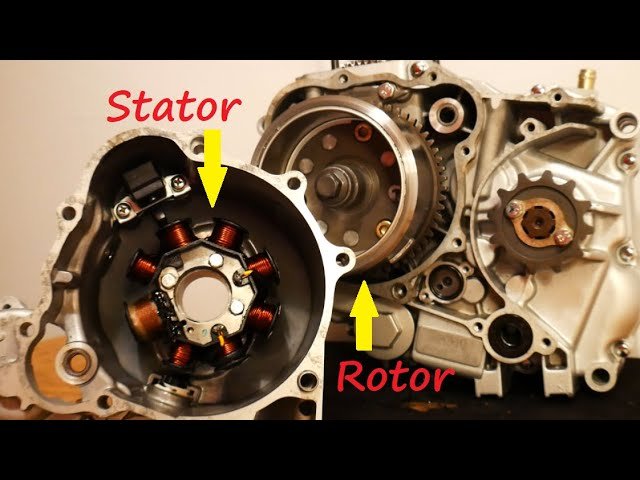
A stator on a motorcycle is a set of copper wire coils wound around an iron core that sits stationary inside the engine’s crankcase cover. As the engine runs, a magnetized rotor (also called a flywheel) spins around the outside of the stator. That spinning magnetic field induces an alternating electrical current in the stator coils – the same basic physics behind any generator.
That AC power feeds into a regulator/rectifier, which converts it to the direct current (DC) your battery and electrical systems need. The stator is, in plain terms, your motorcycle’s onboard power plant. It’s what keeps the battery charged while you ride and what powers your headlights, instrument cluster, ignition system, and fuel pump at the same time.
Most modern street motorcycles run a three-phase stator, meaning three separate coil windings that produce three AC sine waves offset by 120 degrees. Three-phase output is smoother and more efficient than single-phase, which is why you’ll find it on everything from a Honda CB500F to a Harley-Davidson Road Glide.
How a Motorcycle Stator Generates Power: The Full System
The stator doesn’t work alone. It’s one piece of a three-part charging system, and understanding all three makes troubleshooting a lot easier.
The rotor (flywheel) mounts directly to the crankshaft and spins with the engine. Permanent magnets on the inside of the rotor pass over the stator coils as the crank turns. The faster the engine spins, the more electrical output the stator produces. At idle, most stators put out between 20-40 volts AC; at highway RPM, that can climb above 60 volts AC.
The stator converts that rotational energy into raw AC electricity. The coil windings are fixed and don’t move – “stator” comes from the Latin stare, meaning “to stand.” The output is proportional to engine speed, which is why your lights may flicker at a low idle but stabilize once you rev past 2,000 RPM.
The regulator/rectifier does two jobs: it rectifies the AC into DC, and it regulates voltage to a stable 13.8-14.5 volts so your battery doesn’t overcharge. A bad regulator/rectifier can look exactly like a bad stator on a voltmeter, so test both when you’re diagnosing charging problems.
Motorcycle Stator vs. Car Alternator: What’s the Difference?

A motorcycle stator and a car alternator do the same job but work differently. In a car, the alternator has both a spinning rotor and a stationary stator inside a self-contained housing driven by a serpentine belt. On most motorcycles, the rotor is the flywheel itself, and the stator sits inside the engine cover – no belt, no separate housing, just a compact assembly built into the motor.
The trade-off is simplicity versus serviceability. Motorcycle stators are lighter and have fewer moving parts, but they run hotter because they’re surrounded by engine oil and heat. That’s part of why stator failures are more common on high-mileage bikes or machines that spend a lot of time in stop-and-go traffic with the engine running hot.
| Feature | Motorcycle Stator | Car Alternator |
|---|---|---|
| Location | Inside engine crankcase cover | External, belt-driven |
| Cooling | Oil-cooled (wet) or air-cooled (dry) | Air-cooled, externally mounted |
| Output type | AC (converted by separate rectifier) | AC (rectified internally) |
| Typical output | 200-500 watts | 700-2,000 watts |
| Replacement difficulty | Moderate (requires cover removal) | Easy (external access) |
| Average replacement cost | $100-$500 installed | $200-$600 installed |
Some motorcycles, particularly older British bikes and certain off-road machines, use a separate alternator-style charging system. But the vast majority of Japanese, European, and American street bikes built since the 1980s use the stator-inside-the-flywheel design.
Signs Your Motorcycle Stator Is Failing
A failing stator usually doesn’t quit all at once. It degrades over time, and the symptoms show up gradually before the bike leaves you stranded.
Battery that won’t stay charged is the most common sign. If you’re charging the battery overnight and it’s dead again after a 45-minute ride, the charging system isn’t keeping up. A healthy charging system should read 13.5-14.5 volts DC at the battery terminals with the engine at 3,000 RPM (Cycle World, 2023). Below 13.5 volts means the battery is draining faster than the stator can replenish it.
Dim or flickering lights at low RPM point to low AC output at idle. The stator may still work at higher RPM, which is why the symptom often disappears once you get moving. Don’t ignore it – a partially failed stator will typically go the rest of the way at the worst possible moment.
The bike runs fine but dies after 30-60 minutes is a classic stator failure pattern. The bike starts on a full battery, runs normally until the battery drains below the threshold the ignition needs, then cuts out. It may restart after a rest and a fresh charge, which fools a lot of riders into thinking it’s a battery problem.
Burning smell from the left engine cover indicates the stator windings are overheating, often from a shorted coil. On most bikes, the stator lives behind the left-side cover. If you smell something electrical burning after a ride, pull that cover and inspect the coils for discoloration or melted insulation.
How to Test a Motorcycle Stator with a Multimeter
Testing a stator takes two measurements: a resistance test (static, engine off) and an AC output test (dynamic, engine running). You need a basic multimeter – a $20 Cen-Tech from Harbor Freight works fine for this.
Static Resistance Test (Engine Off)
- Locate the stator connector, usually a 3-wire plug coming from the left engine cover. Unplug it.
- Set your multimeter to the Ohms (resistance) setting.
- Test resistance between each pair of stator wires: pins 1-2, pins 2-3, and pins 1-3.
- All three readings should be equal and within the spec listed in your service manual – typically 0.2 to 1.5 ohms for most street bikes.
- Then test each pin to ground (bare metal on the engine). You should read infinite resistance (OL). Any reading other than OL means the stator is shorted to ground – that coil is done.
Uneven resistance between the three pairs points to a partially shorted winding. The stator may still charge the battery at some RPM ranges, but it’s on its way out.
AC Output Test (Engine Running)
- Reconnect the stator connector.
- Switch your multimeter to AC voltage.
- Backprobe the stator wires at the connector while the engine runs – or use the AC terminals on the regulator/rectifier side if backprobing isn’t practical.
- At 3,000 RPM, a healthy stator should produce 20-50 volts AC between each pair of wires, with all three pairs reading roughly the same.
- Low output on all three phases points to the stator. Low output on one phase only points to a single shorted winding.
If the static test passes but the AC output is low, the rotor magnets may be weak. Rotor failure is less common than stator failure but does happen on high-mileage machines.
What Does Stator Replacement Cost in 2026?
Stator replacement cost depends on the brand, the bike, and whether you do it yourself. Parts alone range from about $40 for an aftermarket stator on a common Japanese bike (such as a Honda CBR600RR or Yamaha R6) to $200-$300 for OEM units on touring machines like the Harley-Davidson Electra Glide, which have higher electrical demands and larger stator assemblies.
| Bike Type | Aftermarket Stator | OEM Stator | Shop Labor | Total Installed |
|---|---|---|---|---|
| Sport bike (600cc class) | $40-$80 | $120-$180 | $100-$150 | $140-$330 |
| Standard/naked (650-900cc) | $60-$120 | $150-$250 | $100-$150 | $160-$400 |
| Adventure tourer (1000cc+) | $100-$200 | $200-$400 | $150-$200 | $250-$600 |
| Harley-Davidson V-Twin | $80-$150 | $200-$350 | $150-$250 | $230-$600 |
Labor is mostly driven by access. Some bikes, like the Honda CB series, have a straightforward left-side cover that takes 30 minutes. Others require draining the oil, removing exhaust pipes, or pulling the engine partially. If you’re replacing the stator yourself on a common bike, block out 2-4 hours and buy a new gasket for the cover while you’re at it – they’re cheap and you don’t want to pull the cover twice.
One important note: always replace the regulator/rectifier when you replace the stator if the old one ran hot. A failing regulator can overheat and burn out a new stator in as little as a few thousand miles (Cycle World, 2023).
Frequently Asked Questions About Motorcycle Stators
How long does a motorcycle stator last?
Most stators last 20,000-60,000 miles under normal use, but that range varies widely. Bikes that run extensive low-speed, high-heat riding (think heavy traffic in summer) tend to kill stators faster. High-output accessories like heated grips, auxiliary lights, and aftermarket sound systems also shorten stator life by pushing the charging system closer to its limits continuously.
Can I ride with a bad stator?
You can ride short distances on battery power alone – some riders do it to limp home. But the window is short. A fully charged motorcycle battery typically powers the ignition, fuel injection, and basic electronics for 20-40 minutes before voltage drops too low to keep things running. Riding on a dead stator is not a long-term plan, and doing it repeatedly will damage the battery.
Will a bad stator throw a fault code?
On modern fuel-injected bikes with a CAN-bus system, a charging fault will often trigger a warning light and may log a fault code you can read with a scan tool or diagnostic app. Older carbureted bikes have no such warning – you find out when the lights go dim. Either way, a voltmeter at the battery terminals is the most direct check, regardless of what the dashboard says.
Is a stator the same as a magneto?
No, though they’re related. A magneto is a self-contained ignition power source found on small engines and older bikes – it generates a high-voltage spark directly without a battery or separate charging system. A stator is part of a battery-dependent charging system. Some older off-road bikes and small displacement engines use magneto-based ignition alongside a separate charging stator, but they serve different functions.
Can I replace a motorcycle stator myself?
Yes, for most bikes this is a solid intermediate DIY job. You need a multimeter, a torque wrench, a set of metric sockets, and your service manual for the specific torque specs and wire routing. The actual repair is straightforward: drain the oil if needed, pull the cover, unplug the old stator, bolt in the new one, and reassemble. The harder part is accurate diagnosis beforehand – confirm the stator is actually the problem before you start wrenching.