Ducati Panigale V4 Top Speed, Specs & Review
TL;DR
- The 2025 Ducati Panigale V4 starts at $25,995 and the V4 S at $33,895
- The 1,103cc Desmosedici Stradale V4 makes 209 hp in US trim and 91 lb-ft of torque.
- Top speed is 186 mph; 0–60 mph runs approximately 3.0–3.2 seconds based on independent testing
- The 2025 model ditched the iconic single-sided swingarm for a lighter double-sided unit, reducing lateral stiffness by 37% and cutting weight versus the outgoing model.
- This is a track-first superbike on street-legal plates — not a beginner bike, not a commuter, not a weekend tourer unless the weekend involves a track day.
2025 Ducati Panigale V4 Specs at a Glance
| Spec | Panigale V4 | Panigale V4 S |
|---|---|---|
| Engine | 1,103cc 90° V4, desmodromic | Same |
| Power (US market) | 209 hp @ 12,750 rpm | 209 hp @ 12,750 rpm |
| Torque | ~89.5 lb-ft @ 11,250 rpm | ~89.5 lb-ft @ 11,250 rpm |
| Wet weight (no fuel) | 421 lb (191 kg) | 412 lb (187 kg) |
| Seat height | 32.3 in (820 mm) | ~33.5 in (850 mm) |
| Fuel capacity | 4.5 gal (17 L) | 4.5 gal (17 L) |
| Front brakes | Brembo Hypure, dual 330 mm | Brembo Hypure, dual 330 mm |
| Front suspension | Showa 43mm BPF, fully adj. | Öhlins NPX-30 electronic |
| Rear suspension | Sachs monoshock, fully adj. | Öhlins TTX36 electronic |
| Front tire | 120/70 ZR17 | 120/70 ZR17 |
| Rear tire | 200/60 ZR17 | 200/60 ZR17 |
| MSRP (US) | $25,995 | $33,895 |
Sources: Ducati USA (2024), Motorcycle.com (2024), Cycle News (2024).
Ducati Panigale V4 Top Speed: What the Data Actually Shows
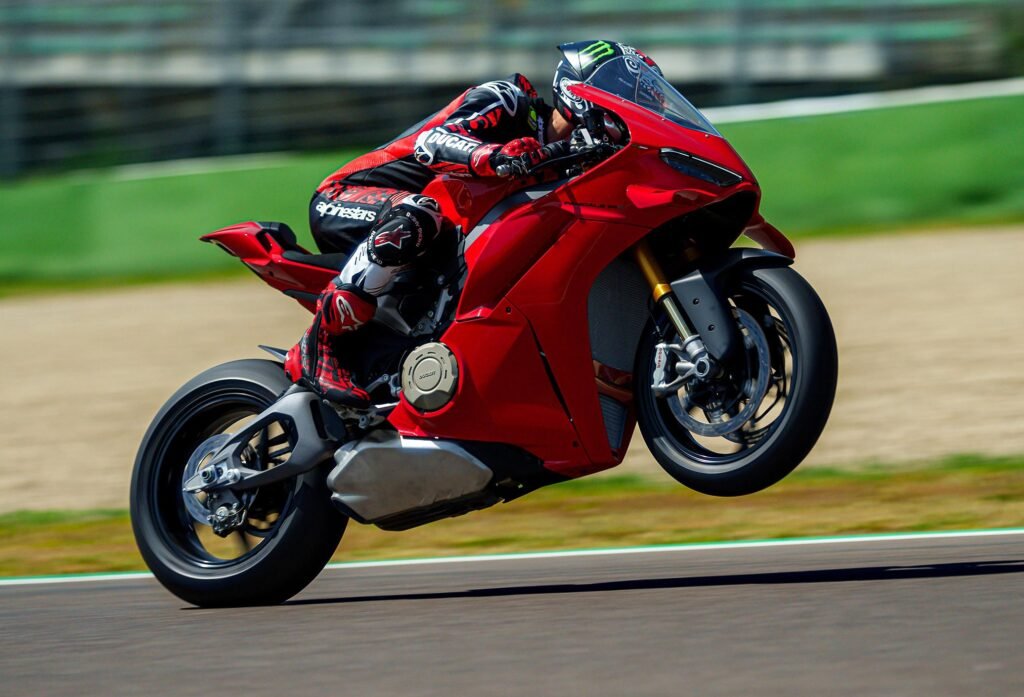
The 2025 Ducati Panigale V4 has a tested top speed of approximately 186 mph (299 km/h), per TopSpeed (2024). Ducati does not publish an official top speed figure — like most manufacturers, they leave that to independent testers. The 186 mph figure comes from multiple independent sources and is consistent across the 2022–2025 generation.
The V4 R, Ducati’s 998cc homologation-spec variant built to WorldSBK rules, is a different animal entirely. With the factory racing exhaust fitted, Ducati claims it exceeds 205 mph — a figure the company attributes to its closed-course configuration only (Ducati USA press release, 2025).
For the standard V4 and V4 S, 186 mph is the number to use. It’s the electronically managed ceiling in road trim, shaped by aerodynamics, gearing, and the 209 hp available in US-market tune.
Ducati Panigale V4 0–60 mph and Acceleration
Ducati publishes no official 0–60 mph time. Based on multiple independent tests and modeling data, the 2025 Panigale V4 reaches 60 mph from a standstill in approximately 3.0–3.2 seconds (TopSpeed, 2024; MotoStatz, 2024). Those figures are representative of the class — comparable to other 1,000cc four-cylinder superbikes running similar power figures.
Where the Panigale pulls away from the pack is in mid-range and top-end pulls. Once the V4 hooks third gear and the revs climb past 9,000 rpm, the Desmosedici Stradale’s counter-rotating crankshaft and desmodromic valve actuation deliver an acceleration arc that most 1,000cc bikes simply can’t match through the upper gears (MotoStatz, 2024).
The quarter mile comes in at roughly 9.9 seconds with a terminal speed around 155–159 mph — elite numbers for a road-legal motorcycle.
The 1,103cc Desmosedici Stradale Engine: How It Works
The Panigale V4’s engine is a 1,103cc 90-degree V4 with a counterrotating crankshaft and Ducati’s signature desmodromic valve actuation. “Desmodromic” means the valves are both opened and closed mechanically by dedicated cam lobes and rockers, rather than relying on return springs. This system lets Ducati rev the engine harder, higher, and with less valve float risk than a conventional spring-return design.
The counterrotating crank spins opposite to the wheels. That cancels out some of the gyroscopic effect you’d normally feel from the drivetrain, making the bike feel lighter on its steering — a real benefit when changing direction at pace on a track.
In US-market tune, the V4 makes 209 hp at 12,750 rpm and approximately 89.5 lb-ft of torque. Full Power mode delivers the whole package. Low mode cuts output to 160 hp with a noticeably softer throttle response — which sounds like a lot but turns the bike into something a less-experienced rider can actually manage on the street without white-knuckling every traffic light.
Valve clearance service is due every 15,000 miles (24,000 km). That’s a meaningful interval improvement over earlier generations. Budget for it when you buy used — labor on a desmo service is not cheap.
2025 Chassis and Suspension Changes: Why the Swingarm Matters
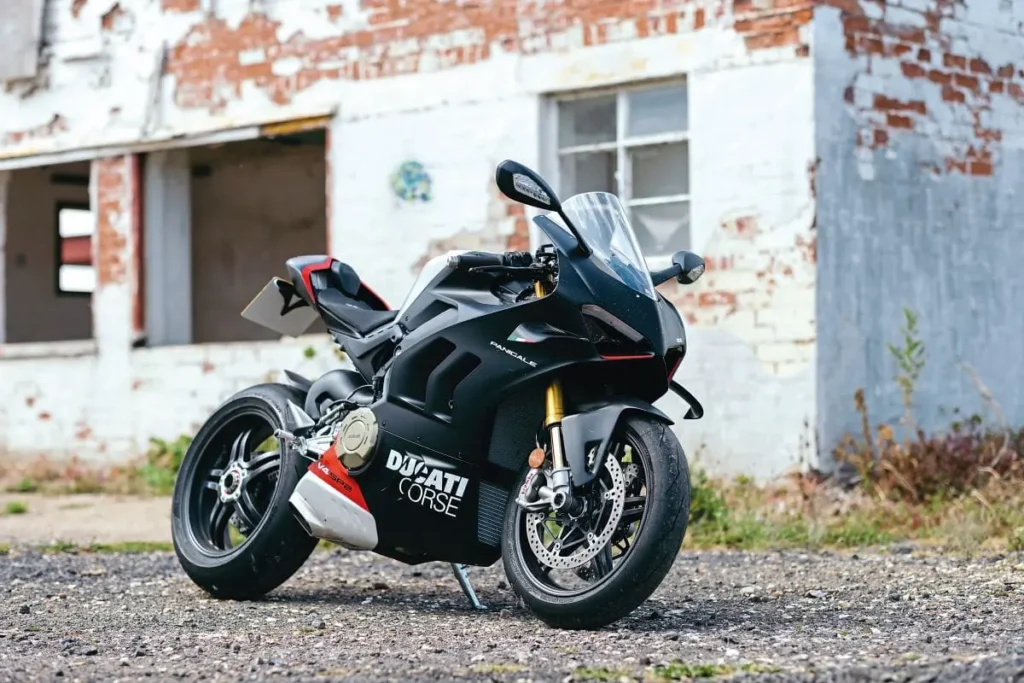
The biggest news for 2025 is the double-sided swingarm. For the first time in the V4’s history, Ducati replaced the signature single-sided unit with a hollow, symmetrical double-sided design. The swap reduces lateral stiffness by 37% versus the outgoing arm, which translates to more chassis flex feedback at corner exit — exactly what track riders want to feel when they feed the power on mid-corner (Cycle News, 2024).
The whole rear assembly — swingarm, wheel, and caliper — came in 6 lbs lighter than before. For a bike already trimmed to 421 lbs wet (no fuel), that matters.
Suspension breakdown by variant:
- Panigale V4: 43mm Showa Big Piston Fork up front, fully adjustable Sachs monoshock at the rear. Sachs steering damper included.
- Panigale V4 S: Öhlins NPX-30 semi-active electronic fork, Öhlins TTX36 electronic shock, Öhlins steering damper. The S adjusts suspension electronically on the fly across ride modes.
Both run Pirelli Diablo Supercorsa SP-V4 rubber — 120/70 ZR17 front, 200/60 ZR17 rear. That’s a road-legal tire with race compound DNA. On a warm summer day, it’s sticky enough for spirited sport riding. On a cold wet morning, treat it with appropriate respect.
Braking on both variants uses Brembo’s new Hypure monobloc 4-piston radial calipers biting 330mm semi-floating discs. The Hypure calipers are 30g lighter per side than the previous Stylema units (Cycle News, 2024). Cornering ABS and the new Race eCBS combined braking system are standard — the latter modulates front-to-rear brake pressure distribution during hard deceleration, borrowed directly from WorldSBK development.
Electronics Package: What’s on Board
The 2025 Panigale V4 runs a six-axis IMU feeding a full suite of Ducati Safety Pack electronics:
- Cornering ABS (Bosch, 8-level)
- Ducati Traction Control (DTC)
- Ducati Wheelie Control (DWC)
- Ducati Slide Control (DSC)
- Ducati Power Launch (DPL)
- Engine Brake Control (EBC)
- Ducati Quick Shift (DQS) up/down quickshifter
- Race eCBS combined braking
Ride modes are Race A, Race B, Sport, Road, and Wet. Power modes — Full, High, Medium, Low — give you 209, 209 (softer map), ~180, and 160 hp respectively.
The V4 S ships with a 6.5-inch TFT display. The base V4 uses a 4.3-inch unit. Both show lean angle, G-force, lap timer data, and full setup menus. The S gets Bluetooth connectivity for the Ducati Connect app.
Who the Panigale V4 Is Actually For
This bike is for experienced riders who want the closest thing to a WorldSBK machine that can be titled and plated. It’s not for beginners. It’s not a practical commuter. It’s not forgiving of sloppy inputs at 150 mph.
On a track, the 2025 V4 is objectively easier to ride fast than any previous Panigale, thanks to the updated chassis, electronics refinements, and the improved swingarm feedback. Cycle News (2025) called it “monstrous” even in Road mode — which gives you 209 hp — but noted Ducati has made real gains in making that power approachable.
On the street, you’ll spend most of your time between 3,000 and 7,000 rpm, where the torque curve is flat and manageable. The 820mm seat height (32.3 in) on the base V4 is low enough that average-height riders can get a foot down comfortably. The V4 S sits a bit taller at approximately 850mm due to the Öhlins suspension geometry.
The drawback, and it’s real: the seating position is aggressive. Wrists on the clip-ons, weight forward, very little back support. An hour at highway speeds is uncomfortable. Two hours is a commitment. The Panigale was designed for lap times, not interstate miles — and it shows.
Ducati Panigale V4 Pros and Cons
Pros:
- One of the most capable track-focused superbikes available on street plates in the US.
- Desmosedici Stradale engine character is unlike any other production four-cylinder — the desmo top end and counter-rotating crank give it a sensation you don’t get from a conventional literbike.
- 2025 chassis updates genuinely improved front-end feedback and swingarm feel versus the 2022–2024 generation.
- Electronics package is class-leading in depth and configurability.
- New Brembo Hypure brakes are among the best production motorcycle brakes available.
Cons:
- $25,995 base MSRP before destination, taxes, and gear — dealer premiums are common.
- Desmo valve service is expensive. Budget $500–$1,000+ at a Ducati dealer every 15,000 miles.
- Ergonomics are track-specific. Street touring is uncomfortable past an hour.
- 820mm seat height and narrow V4 chassis help, but the bike’s power demands serious experience.
- The base V4 ships without the quick-access electronics or display quality of the S — the $7,900 price gap to the V4 S is worth it for serious track riders.
Frequently Asked Questions About the Ducati Panigale V4
What is the top speed of the Ducati Panigale V4?
The 2025 Ducati Panigale V4 and V4 S have an independently tested top speed of approximately 186 mph (299 km/h) in stock road configuration. Ducati does not publish an official top speed figure. The V4 R variant, with its full racing exhaust system fitted, exceeds 205 mph per Ducati’s own closed-course claims.
How fast is the Ducati Panigale V4 from 0–60 mph?
Independent tests and performance modeling place the 0–60 mph time at approximately 3.0–3.2 seconds (TopSpeed, 2024). Ducati publishes no official figure. Quarter-mile time is in the 9.9-second range with a terminal speed near 155–159 mph.
What engine is in the Ducati Panigale V4?
The Panigale V4 and V4 S use a 1,103cc 90-degree V4 engine called the Desmosedici Stradale. It features desmodromic valve actuation, a counterrotating crankshaft, and liquid cooling. US-market output is 209 hp at 12,750 rpm and approximately 89.5 lb-ft of torque.
What is the difference between the Panigale V4 and V4 S?
The V4 S adds Öhlins semi-active electronic suspension (NPX-30 fork, TTX36 shock, steering damper), forged aluminum wheels, a lithium-ion battery, and a larger 6.5-inch TFT display. It weighs about 9 lbs less than the base V4. The V4 S starts at $33,895 versus $25,995 for the base model (Ducati USA, 2024).
Is the Ducati Panigale V4 a good beginner bike?
No. The Panigale V4 is a track-focused superbike producing 209 hp with aggressive ergonomics. It demands significant riding experience and focused throttle control. New riders should build skills on a middleweight machine before considering it. The electronics package helps manage power delivery, but they don’t replace seat time.
How often does the Ducati Panigale V4 need a valve service?
Valve clearance should be checked every 15,000 miles (24,000 km). Desmodromic valve service at a Ducati dealer typically costs $500–$1,000 or more depending on labor rates and whether any clearances are out of spec. This is the primary ownership cost to factor into your budget.
What year did Ducati switch the Panigale V4 to a double-sided swingarm?
- The 2025 model year was the first Panigale V4 — and the first Panigale of any generation, V-twin or V4 — to use a double-sided swingarm. Prior models used a single-sided unit. Ducati’s testing showed the new hollow symmetrical design reduced lateral stiffness by 37% and saved weight compared to a single-sided unit that met the same flex targets.
Key Takeaways
- The 2025 Ducati Panigale V4 makes 209 hp in US trim and hits approximately 186 mph.
- Base price is $25,995; the V4 S with Öhlins semi-active suspension is $33,895.
- The 2025 generation introduced a double-sided swingarm for the first time in the model’s history, improving chassis feedback and reducing weight.
- Desmodromic valve service every 15,000 miles is the main ongoing ownership cost to plan for.
- This is a track-first machine. It rewards experienced riders and punishes inattentive ones.