
Yamaha XMAX Top Speed, Specs & Review
TL;DR
- The Yamaha XMAX 300 top speed is approximately 87–90 mph based on owner GPS data and third-party road tests; Yamaha does not publish an official figure.
- It runs a 292cc liquid-cooled SOHC single with CVT transmission and a manufacturer-estimated 73 mpg fuel economy.
- The 2025 model introduced an electronically adjustable windscreen, a dual-screen TFT/LCD dash, and Y-Connect Bluetooth smartphone integration.
- Wet weight is 403 lb and seat height is 31.3 inches, making it manageable for average-height riders but notable for short ones.
- The XMAX is best for urban commuters who occasionally want to stretch out on the highway — it handles 70–75 mph cruise speeds with confidence.
2025/2026 Yamaha XMAX Full Spec Sheet
All figures below are from the official Yamaha Motorsports USA specification page (2026).
| Specification | Detail |
|---|---|
| Engine | 292cc liquid-cooled 4-stroke SOHC, 4-valve single |
| Bore x Stroke | 70.0 mm x 75.9 mm |
| Compression Ratio | 10.9:1 |
| Fuel Delivery | Fuel injection, 12-hole injector |
| Transmission | Automatic CVT / V-belt final drive |
| Front Suspension | 33mm telescopic fork; 4.3 in travel |
| Rear Suspension | Dual shocks; 3.1 in travel |
| Front Brake | 267mm hydraulic disc with ABS |
| Rear Brake | 245mm hydraulic disc with ABS |
| Tires | Front: 120/70-15 Dunlop Scoot Smart / Rear: 140/70-14 |
| Seat Height | 31.3 in |
| Wheelbase | 60.6 in |
| Wet Weight | 403 lb |
| Fuel Capacity | 3.4 gal |
| Fuel Economy | 73 mpg (manufacturer estimate) |
| US MSRP (2025) | $6,299 |
| US MSRP (2026) | $6,399 |
Engine and Real-World Performance
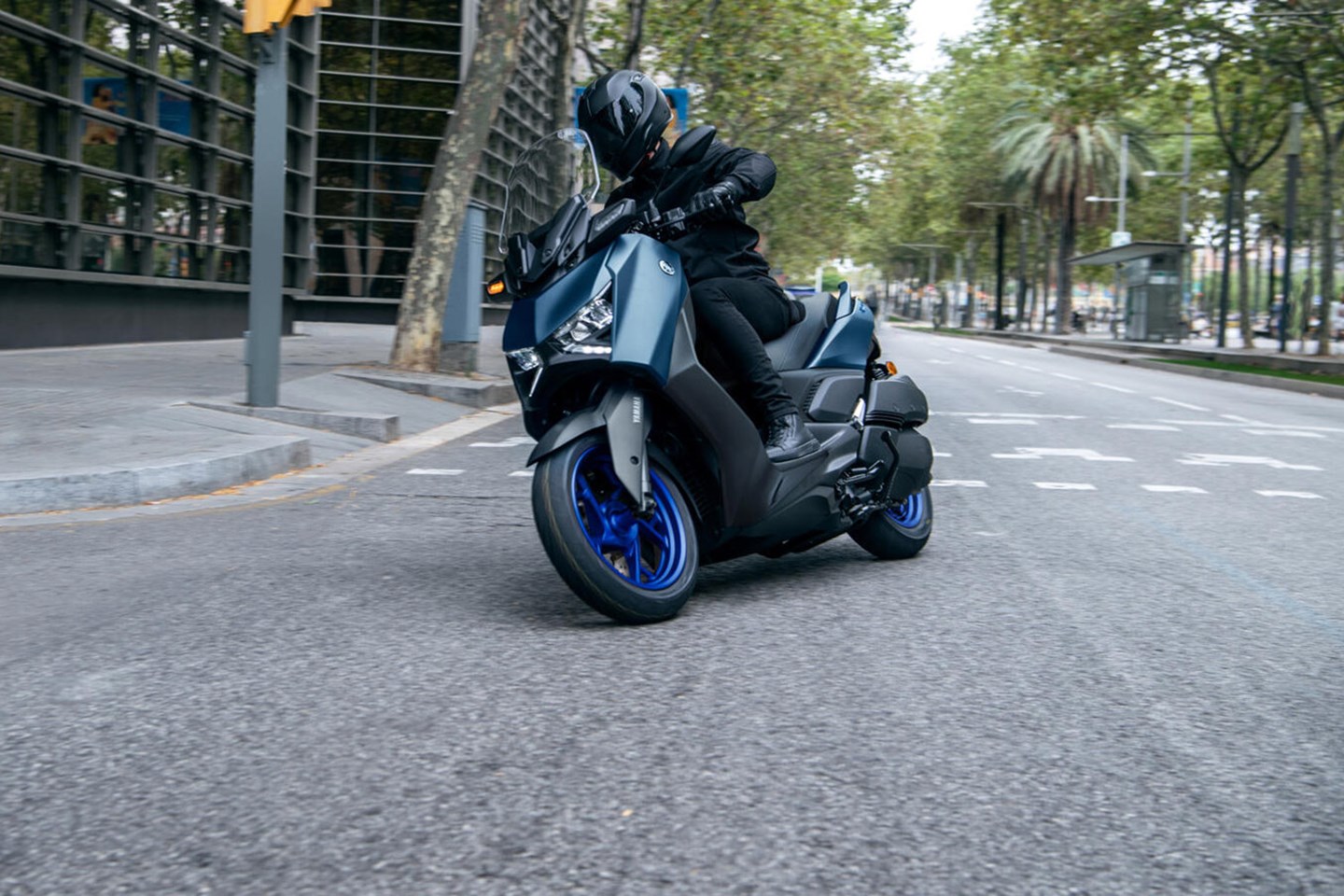
The XMAX runs a 292cc single-cylinder, liquid-cooled four-stroke with single overhead cam and four valves. That engine traces back to Yamaha’s Blue Core platform, which prioritizes combustion efficiency and friction reduction over outright power. The result is an engine that makes approximately 27–28 horsepower and 21 lb-ft of torque at the crank, figures consistent with third-party road test data from publications including Ultimate Motorcycling (2025).
Power delivery is deliberately smooth. The CVT holds revs in the midrange when you’re moving through traffic, and there’s no hunting or jerking when you roll on hard from a stop. It’s a well-tuned setup. Full throttle from a standstill gets you to 60 mph in the 7–8 second range, which is adequate for merging and matches what you’d expect from a scooter this size and weight.
Yamaha uses an offset cylinder layout to reduce piston side-load, which cuts internal friction and contributes to the 73 mpg estimate. In mixed city and suburban riding, owners typically report 68–72 mpg in real conditions. Drop it to straight highway at 75 mph and economy falls a bit, but the 3.4-gallon tank still gives you a realistic cruising range well past 200 miles between fill-ups — a genuine advantage over smaller scooters with 1.5-gallon tanks.
Yamaha XMAX Top Speed: What You Can Actually Expect

Yamaha does not publish an official top speed for the XMAX 300. Based on GPS-logged owner data and road test reports, the real-world maximum sits in the 87–90 mph range on flat ground with a solo rider in a tuck. Biketopspeed.com lists 87 mph as a representative figure consistent with this data.
That number matters less than it sounds. The XMAX is not a vehicle you’d ever run flat-out for any distance — at that speed, the wind is working against the fairing’s limits and the CVT is spinning hard. The bike’s comfortable highway territory is 65–80 mph, where the chassis feels settled, the wind protection is effective with the screen raised, and the fuel economy holds up.
For most US riding, including urban freeways and two-lane state routes, 80 mph is the practical ceiling you’ll ever approach. The XMAX handles that speed with confidence. It doesn’t feel strained at 75 mph the way a 125cc or 150cc scooter does, and that’s the real performance story here: you get enough reserve that you’re not riding at 100% throttle to keep up with traffic.
One caveat: the 2025 revision added six pounds over the previous generation (Ultimate Motorcycling, 2025), which slightly affects acceleration at the margins, though most riders won’t notice a difference in day-to-day riding.
Ride Quality and Handling

The XMAX uses a 33mm telescopic fork up front with 4.3 inches of travel and dual rear shocks with 3.1 inches of travel. It’s a conventional setup for a maxi-scooter, and it works well on smooth to mildly rough pavement. Expansion joints and coarse city asphalt come through more than you’d want, particularly at the rear — some owners add a slightly stiffer spring preload setting to reduce pitch under hard braking with a passenger.
The 60.6-inch wheelbase gives the XMAX predictable straight-line stability. It tracks well at highway speeds and doesn’t get nervous in crosswinds the way shorter-wheelbase scooters do. Corner carving isn’t really the point of this machine, but lean angles are usable and the Dunlop Scoot Smart tires maintain good grip in dry conditions. In wet weather, take it easy — no tire on a 403-pound machine with this geometry is going to feel inspiring on wet pavement.
At low speed, 403 lb is real. U-turns in tight parking lots require commitment, especially for riders under 5’6″. The 31.3-inch seat height isn’t extreme, but combined with the weight, shorter riders will want to evaluate whether they can flat-foot or at least get a solid ball-of-foot contact before committing to a purchase.
Dual-channel ABS is standard, and it works well — the front brake setup with the 267mm disc gives good feel and stopping power.
Tech, Electronics, and the 2025 Updates
The 2025 model year brought the most significant XMAX changes in several years. The biggest is the electronically adjustable windscreen, which moves vertically through nearly four inches of stepless travel via a switch on the left bar. For a daily commuter, this is genuinely useful — lower for visibility in slow traffic, raised for wind protection on the freeway. It replaces the old manually adjustable screen and is controlled without taking your hands off the bars.
The new instrument cluster pairs a 4.2-inch full-color TFT screen with a 2.8-inch (2025) or 3.2-inch (2026 spec per Yamaha) LCD panel. Readouts include a large speedometer, tachometer arc, fuel level, clock, ambient temperature, and Bluetooth connectivity status. The display is readable in direct sunlight, though it’s not the brightest TFT on the market.
Y-Connect is Yamaha’s Bluetooth smartphone integration system. It gives you incoming call and text notification, music control, and the ability to log ride data. The Garmin StreetCross app, which is free for iOS and Android, adds turn-by-turn navigation to the TFT display — no phone mount required. This is a solid feature set at this price point; you won’t find it on a Honda Forza 350 or Suzuki Burgman 400 at anywhere near this cost.
Standard equipment also includes dual-LED headlights, a USB charging port, and a proximity key system for keyless starting.
Storage, Practicality, and Daily Use
Under the seat, the XMAX fits two full-face helmets — a legitimate claim, not marketing fiction. The underseat storage is one of the roomiest in this segment, and it’s dry enough for daily use with a rain-covered lid. There’s also a small front storage cubby near the left knee, and Yamaha’s optional OEM top case system bolts directly to the integrated rear rack.
The riding position is upright with wide, flat floorboards that accommodate most rider sizes. There are aluminum footplates on the 2026 model, which feel premium underfoot. The seat is wide enough for two riders, and a grab rail is standard.
A genuine real-world limitation: the XMAX is heavy for its displacement class. Pushing it out of a tight parking space or loading it onto a center stand (sold separately; there’s no standard center stand in the US spec) takes effort. For a scooter many buyers will use daily in urban environments, that matters.
Frequently Asked Questions About the Yamaha XMAX 300
What is the Yamaha XMAX 300 top speed?
The XMAX 300 top speed is approximately 87–90 mph based on GPS-logged road tests and owner-reported data. Yamaha does not publish an official top speed figure. Sustained comfortable cruise speed is 70–80 mph, where the scooter feels stable and power is not being pushed to the limit.
How does the Yamaha XMAX compare to the Honda Forza 350?
The XMAX 300 uses a 292cc engine versus the Forza 350’s 350cc unit, so the Honda has a small power and top speed advantage. However, the XMAX’s Y-Connect smartphone integration, electronically adjustable windscreen, and dual-screen TFT dash give it a technology edge over comparable Forza configurations. Fuel economy on both is similar in real-world riding.
Is the Yamaha XMAX good for highway riding?
Yes, with the caveat that it’s most comfortable between 65 and 80 mph. It has enough power to merge and hold speed confidently, and the adjustable windscreen handles wind protection at those speeds well. At 85+ mph, the CVT and wind become noticeable, so it’s better suited to commuter-length highway stints than extended high-speed touring.
How much does the 2025/2026 Yamaha XMAX cost in the US?
The 2025 US MSRP is $6,299 (Ultimate Motorcycling, 2025). The 2026 model lists at $6,399 per Yamaha Motorsports USA. Neither price includes destination charges, taxes, or dealer prep — add roughly $500–$700 in typical US markets for those costs.
What are the most common complaints about the Yamaha XMAX 300?
The most consistently reported issues from owners are wind buffeting around the neck area even with the screen at max height (a helmet and riding jacket help substantially), the weight making low-speed maneuvering demanding, and the stock seat becoming firm on rides longer than two hours. None of these are reliability complaints — the engine and drivetrain are well-regarded.


