Triumph Speed Twin 1200 Top Speed, Specs & Review
TL;DR
- The 2025 Triumph Speed Twin 1200 produces 103.5 hp at 7,750 rpm and 82.6 lb-ft of torque at 4,250 rpm from a 1,197cc liquid-cooled parallel twin.
- Triumph publishes no official top speed; third-party estimates put the ceiling around 130 mph (210 km/h), with the 2019 model independently timed at a 12.1-second quarter mile at 111.6 mph.
- The 2025 update added a six-axis IMU, cornering ABS, lean-sensitive traction control, and 5 more horsepower over the 2024 model.
- US MSRP starts at $13,595 for the standard and $15,995 for the Sport RS variant.
- It’s the right machine for experienced riders who want genuinely involving real-world performance wrapped in a convincing period-correct design.
2025 Triumph Speed Twin 1200 Full Specs
| Spec | Detail |
|---|---|
| Engine | 1,197cc liquid-cooled SOHC parallel twin, 270° crank |
| Bore x Stroke | 97.6 mm x 80.0 mm |
| Compression Ratio | 12.1:1 |
| Peak Power | 103.5 hp (77.2 kW) at 7,750 rpm |
| Peak Torque | 82.6 lb-ft (112 Nm) at 4,250 rpm |
| Transmission | 6-speed, wet multi-plate slip-assist clutch |
| Frame | Tubular steel cradle |
| Front Suspension | 43 mm Marzocchi inverted fork, 120 mm travel (non-adjustable) |
| Rear Suspension | Twin Marzocchi shocks, 116 mm travel (preload only) |
| Front Brakes | Dual 320 mm discs, Triumph 4-piston radial calipers, OCABS |
| Rear Brake | 220 mm disc, Nissin 2-piston caliper |
| Tires | Metzeler Sportec M9RR, 120/70 ZR17 front / 160/60 ZR17 rear |
| Wheelbase | 55.7 in (1,414 mm) |
| Seat Height | 31.7 in (805 mm) — standard / 31.9 in (810 mm) — RS |
| Wet Weight | 476 lb (216 kg) |
| Fuel Capacity | 3.8 US gal (14.5 L) |
| US MSRP | $13,595 (standard) / $15,995 (RS) |
Sources: Triumph Motorcycles, 2024; Rider Magazine, 2025
Triumph Speed Twin 1200 Top Speed: What the Data Actually Shows
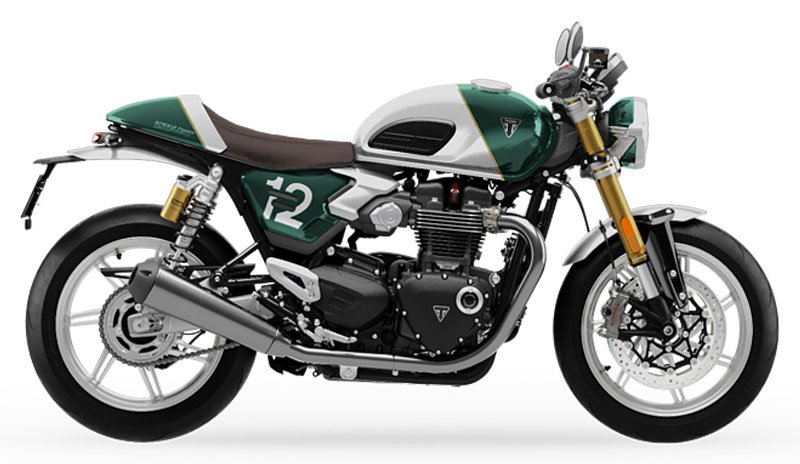
Triumph publishes no top speed figure for the Speed Twin 1200. Third-party estimates (Motoplanete, 2025) put the practical ceiling at approximately 130 mph (210 km/h).
The most reliable instrumented data comes from the pre-update generation. Motorcycle Consumer News recorded a 0-60 mph time of 3.37 seconds and a quarter mile in 12.1 seconds at 111.6 mph on the 2019 Speed Twin 1200 — tuned to 99 hp at the time. That’s a useful floor for the 2025 model’s 103.5 hp tune, but it can’t be attributed directly to the current generation. No major outlet has published drag-strip numbers for the 2025 bike as of this writing.
In street terms, none of this matters much. The Speed Twin pulls hard from 2,500 rpm, torque peaks before 5,000 rpm, and you’ll run out of road confidence before you run out of motorcycle.
Engine Character: The 270° Crank Parallel Twin
The 1,197cc parallel twin is what makes the Speed Twin 1200 worth discussing at all. Its 270° firing interval — the same offset Triumph uses across the Bonneville family — gives it a loping, asymmetric beat that sounds and feels more like a V-twin than a conventional parallel twin. That crank angle genuinely changes how the bike communicates through the seat.
For 2025, Triumph revised cam profiles, ignition timing, and fuel map to extract five additional horsepower while clearing Euro 5+ emissions standards. The rev ceiling moved up 500 rpm to 8,000, and Rider Magazine (2025) noted the engine pulls cleanly all the way to the limiter — a change from the previous generation, which ran out of breath around 7,000 rpm. Torque peaks early at 4,250 rpm, so the power delivery is democratic: it doesn’t demand aggressive riding to feel rewarding.
The six-speed gearbox is precise with a short throw. Cycle News (2025) flagged it as slightly notchy cold but slick once up to temperature. The slip-assist clutch is well-calibrated — light at the lever without feeling numb.
Chassis and Handling: Where This Bike Earns Its Keep
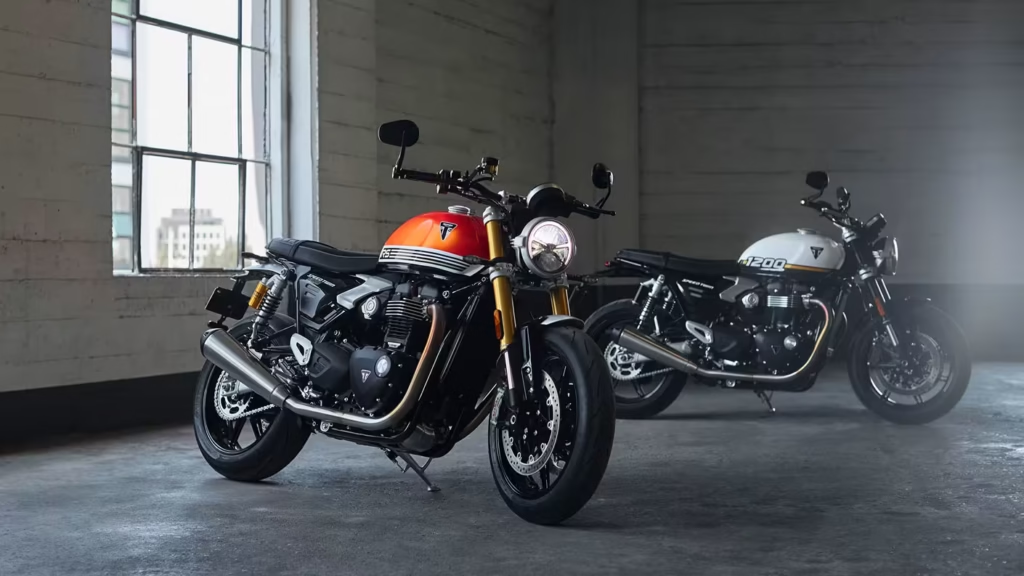
At 476 lb wet with a 55.7-inch wheelbase and 22.6° rake, the Speed Twin 1200 is not a lightweight. Once moving, it’s genuinely agile. The geometry is set up for direction changes rather than straight-line stability, and the bike responds to lean inputs quickly and without drama.
The standard model’s 43 mm Marzocchi inverted forks are non-adjustable beyond rear preload on the shocks. Rider Magazine (2025) noted the spring rates and damping are better calibrated for 2025, delivering a controlled ride on broken asphalt without being brittle on smooth roads. The Metzeler Sportec M9RR rubber suits the bike’s real-world brief well — reasonable mileage, competent wet-weather grip, no need to warm them up for 20 minutes before trusting a corner.
Braking is handled by Triumph’s four-piston radial calipers on twin 320 mm discs. They stop the bike with conviction, though several reviewers noted they’re on/off rather than progressive — expect a short learning curve to modulate them smoothly (Motofomo, 2026).
Electronics: IMU and OCABS Are the Real 2025 Story
The headline addition for 2025 is the six-axis IMU, which enables Optimised Cornering ABS (OCABS) and lean-sensitive traction control. These are features the Speed Twin didn’t have before, and they’re a meaningful safety upgrade.
The standard model ships with two riding modes: Road and Rain. Road delivers full power with moderate electronic intervention; Rain tightens throttle response and lowers traction control thresholds. Neither is intrusive at sane road speeds. A new TFT display integrated into the round instrument cluster is cleaner to read than the old twin-clock setup, with a USB-C charge port added alongside it (Rider Magazine, 2025).
The RS adds Sport mode, which sharpens throttle response and raises the intervention threshold for lean-sensitive ABS and traction control. It also gets an ambidextrous quickshifter — the first on any Triumph Modern Classic.
Standard vs. Speed Twin 1200 RS: What the $2,400 Buys
The RS and the standard Speed Twin 1200 share the same engine, frame, and fuel tank. The differences — suspension, brakes, ergonomics, and electronics — add up to a meaningfully different riding experience.
| Feature | Standard | RS |
|---|---|---|
| Forks | Marzocchi non-adjustable | Marzocchi fully adjustable |
| Rear shocks | Marzocchi preload only | Öhlins fully adjustable piggyback |
| Front brakes | Triumph 4-piston radial | Brembo Stylema 4-piston |
| Tires | Metzeler M9RR | Metzeler RaceTec RR K3 |
| Riding modes | Road, Rain | Road, Rain, Sport |
| Quickshifter | No | Yes (up/down) |
| Handlebar position | Higher, more upright | Lower, further forward |
| US MSRP | $13,595 | $15,995 |
The standard is the better daily rider. Its upright ergonomics are comfortable over distance, and the non-adjustable suspension is well-tuned for mixed road conditions. The RS is for riders who actually use the extra grip from the RaceTec K3s and who want the Brembo Stylemas’ sharper feedback — a real step up over the standard calipers in precise trail braking.
Honest Strengths and Real Limitations
Where the Speed Twin 1200 delivers:
The midrange torque is addictive. Between 3,000 and 6,000 rpm this bike pulls with urgency that makes urban riding entertaining. The 270° crank character gives it a personality that smooth, peaky sportbike engines don’t have. Fit and finish is excellent — the brushed aluminum finishes, twin megaphone silencers, and chiseled tank look like a bike that costs more than $13,595. At 31.7 inches, the seat height is accessible for a wide range of riders.
Where it falls short:
The 3.8-gallon tank is a genuine constraint. At 45-50 mpg mixed, you’re looking at a 170-190 mile range before reserve — not great if you’re planning distance work (Rider Magazine, 2025). There’s no wind protection, which makes sustained highway speeds fatiguing. ABS can’t be disabled on the standard model. The gearbox can feel agricultural when cold.
Who Should Buy the Speed Twin 1200
The Speed Twin 1200 suits a rider with some seat time who wants something they’ll look at in the garage as much as ride. It’s not a beginner’s machine — 103 hp and 476 lb reward experience — but it’s far from intimidating once moving. Commuters will find the light clutch and tractable midrange useful in traffic; weekend riders will find the chassis capable on twisty B-roads.
If most of your miles are highway or long-haul, look elsewhere. The Speed Twin is built for the roads you choose, not the miles you have to cover.
Frequently Asked Questions
What is the top speed of the Triumph Speed Twin 1200?
Triumph does not publish an official top speed. Third-party estimates (Motoplanete, 2025) put the practical ceiling around 130 mph (210 km/h). The 2019 model — at 99 hp — ran a quarter mile at 111.6 mph per Motorcycle Consumer News (2019). No independent drag-strip test of the 2025 bike has been published as of this writing.
How much horsepower does the 2025 Speed Twin 1200 make?
Triumph claims 103.5 hp (77.2 kW) at 7,750 rpm and 82.6 lb-ft (112 Nm) of torque at 4,250 rpm. That’s a 5 hp increase over the 2024 model, achieved through revised cam profiles, updated ignition timing, and a reworked fuel map (Triumph Motorcycles, 2024). The rev limit was also raised by 500 rpm to 8,000 rpm.
Is the Speed Twin 1200 good for beginners?
The Speed Twin 1200 is not ideal as a first motorcycle. At 476 lb wet with 103 hp and a strong torque curve that starts pulling at 2,500 rpm, it rewards familiarity with throttle management. Riders moving up from a 400-650cc machine will adapt quickly; true beginners should spend time on something smaller first.
What is the difference between the Speed Twin 1200 and the Speed Twin 1200 RS?
The RS adds fully adjustable Marzocchi forks, Öhlins piggyback rear shocks, Brembo Stylema front calipers, Metzeler RaceTec RR K3 tires, a Sport riding mode, an ambidextrous quickshifter, and a sportier ergonomic setup with lower bars and higher pegs. It retails for $2,400 more than the standard model at $15,995 US MSRP.
How many miles per gallon does the Speed Twin 1200 get?
Real-world fuel economy typically falls in the 45-50 mpg range for mixed riding. With a 3.8-gallon tank, that translates to a practical range of roughly 170-190 miles before the reserve light appears. The WMTC estimated consumption figure is approximately 46 mpg (5.10 L/100 km) per Motoplanete (2025).