Indian Springfield Top Speed, Specs & Review
TL;DR
- The Indian Springfield tops out at approximately 110–115 mph (177–185 km/h) based on owner GPS data; Indian publishes no official top speed figure.
- The 2026 model runs the Thunderstroke 116, a 1,890 cc air-cooled V-twin producing 126 ft-lb of torque at 2,900 rpm and a claimed 92 hp at the crank.
- Cycle World’s dyno test of the Thunderstroke 116 in the Chieftain (a direct sibling engine) recorded approximately 84–85 rear-wheel horsepower
- Wet weight is around 827 lbs; seat height is a low 26 inches — both manageable for most adult riders.
- At $23,999 US MSRP, the Springfield sits below the Chieftain and Roadmaster while giving up little in daily usability.
2026 Indian Springfield Full Specs
| Specification | Detail |
|---|---|
| Engine | Thunderstroke 116, air-cooled 49° V-twin |
| Displacement | 116 cu in (1,890 cc) |
| Bore x Stroke | 4.063 in x 4.449 in (103.2 mm x 113.1 mm) |
| Compression Ratio | 11:1 |
| Claimed Horsepower | 92 hp (crank) |
| Peak Torque | 126 ft-lb (171 Nm) at 2,900 rpm |
| Transmission | 6-speed, constant mesh, foot-shift |
| Final Drive | Belt |
| Fuel System | Closed-loop EFI, 54 mm bore |
| Seat Height | 26.0 in (660 mm) |
| Wheelbase | 67.0 in (1,701 mm) |
| Wet Weight | ~827 lbs (~375 kg) |
| Fuel Capacity | 5.5 gal (20.8 L) |
| Front Suspension | Telescopic fork, 4.7 in (119 mm) travel |
| Rear Suspension | Single air-adjustable shock, 4.5 in (114 mm) travel |
| Front Brakes | Dual 300 mm floating rotors, 4-piston caliper, ABS |
| Rear Brake | Single 300 mm floating rotor, 2-piston caliper, ABS |
| Front Tire | 130/90B16 |
| Rear Tire | 180/60R16 |
| US MSRP (2026) | $23,999 |
Source: Indian Motorcycle (2026), Motorcycle.com (2026), Indian Motorcycle EMEA press release (2016, chassis architecture)
Indian Springfield Top Speed: What the Data Actually Shows
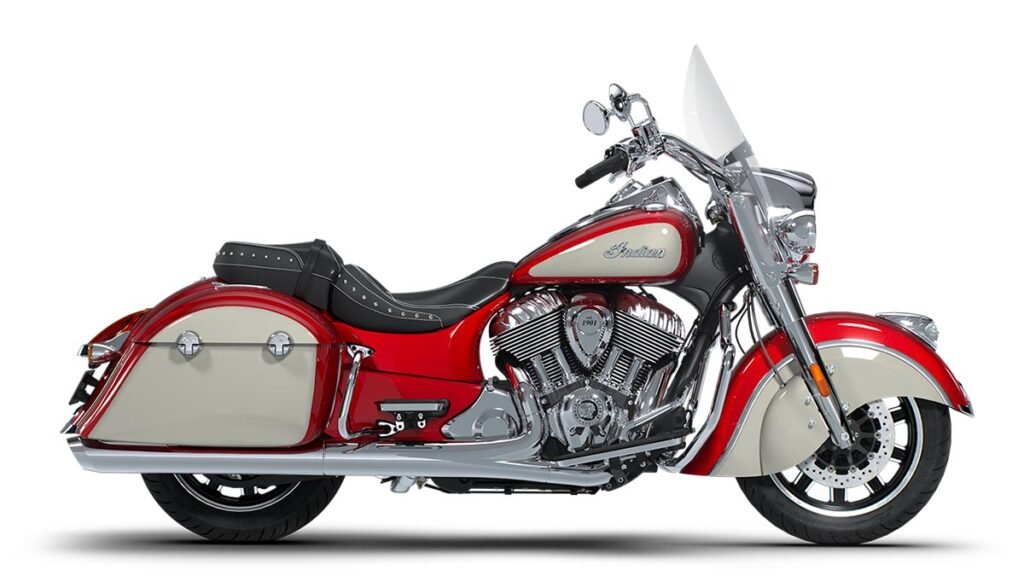
The Indian Springfield has a top speed of approximately 110–115 mph (177–185 km/h). Indian does not publish an official top speed figure for any Springfield variant. The 110–115 mph range comes from GPS-verified owner reports on the Indian Motorcycle forums, where multiple riders with stock bikes recorded speeds between 105 and 115 mph before aerodynamic drag from the upright riding position and windshield made further acceleration impractical (indianmotorcycles.net forum data, 2017–2024).
One forum member confirmed a GPS reading of 112 mph on a stock Stage 1-equipped bike, with the speedo showing around 120 mph — a discrepancy consistent with Indian’s known speedo optimism at high speed. A separate thread noted the VCM (Vehicle Control Module) records a speed limit in the range of 193 km/h (approximately 120 mph), though real-world aerodynamics on a loaded bagger with a windshield up typically keep riders well below that figure.
The honest reality: the Springfield’s 827-lb wet weight and wide, upright seating position mean the wind becomes a wall past 90 mph. You can do highway miles all day at 80 mph without a second thought, but chasing the top end becomes uncomfortable long before you run out of engine.
Top Speed Summary
| Condition | Estimated Top Speed |
|---|---|
| Stock, windshield up, rider only | ~105–110 mph (GPS) |
| Stock, windshield removed | ~110–115 mph |
| VCM-reported limit | ~120 mph (193 km/h) |
No manufacturer-published top speed exists. All figures above are owner-reported GPS data or VCM readings (indianmotorcycles.net, 2017–2024).
Acceleration: How Fast Does the Indian Springfield Pull?
Indian publishes no 0–60 mph or quarter-mile figures for the Springfield. Based on the Thunderstroke 116’s power characteristics — 126 ft-lb arriving at just 2,900 rpm — the engine delivers strong, linear low-end pull rather than a high-revving rush.
Cycle World ran the Thunderstroke 116 (in the mechanically similar Chieftain Limited) on their in-house dyno and recorded 84.78 rear-wheel horsepower at 4,240 rpm and 116.23 ft-lb rear-wheel torque at 2,730 rpm (Cycle World, 2022). That torque curve means the bike feels strong from about 2,000 rpm and pulls cleanly through all six gears without chasing the redline.
In practice, the 60–90 mph roll-on is immediate — you’re at highway passing speed before you’ve thought much about it. Owners consistently describe fifth- and sixth-gear roll-on as a strong, effortless shove.
Estimated 0–60 mph: 4.5–5.5 seconds (owner-estimated; no independent instrumented figure available).
Thunderstroke 116 Engine: Where the Springfield Gets Its Character
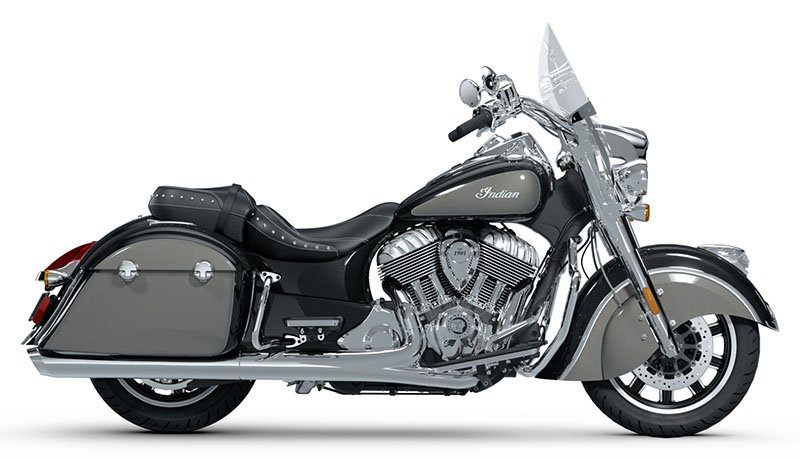
The Thunderstroke 116 is a 1,890 cc, 49-degree air-cooled V-twin with OHV pushrod valve actuation. Bore is 4.063 inches, stroke is 4.449 inches — a long-stroke, torque-first design that doesn’t need to rev. The 11:1 compression ratio keeps it in premium-fuel territory.
Fueling runs through closed-loop EFI with a 54 mm throttle body and throttle-by-wire (TBW) for the three selectable ride modes. The rear cylinder deactivation system shuts off the rear cylinder at stops in ambient temperatures above 60°F, cutting heat onto the rider’s right leg in traffic. It’s a practical feature, and the cylinder comes back online without any noticeable jolt.
The 6-speed gearbox uses a gear-drive primary — not a chain primary — which is worth knowing for long-term maintenance planning. Final drive is a Gates carbon fiber belt: quiet, low-maintenance, and typically good for 100,000+ miles with proper tension checks.
Chassis and Suspension: 827 lbs That Doesn’t Feel Like 827 lbs
The Springfield’s frame is a cast aluminum backbone unit. The telescopic front fork offers 4.7 inches of travel, and the rear single air-adjustable shock provides 4.5 inches — enough to dial in preload for solo riding or two-up with luggage. At 25-degree rake and 5.2 inches of trail, the geometry is stable at highway speeds without being heavy to steer. The 26-inch seat height and the long-stroke engine’s low center of gravity help mask the 827-lb wet weight better than you’d expect.
Braking is handled by dual 300 mm floating rotors up front with four-piston calipers, a single 300 mm rotor at the rear with a two-piston caliper, and standard ABS. Indian’s semi-floating rotor design reduces thermal distortion on long descents — useful on mountain passes where a loaded bagger carries real momentum downhill.
Electronics and Rider Aids
The 2026 Springfield ships with ABS standard, three selectable ride modes (Tour, Standard, Sport) via throttle-by-wire, rear cylinder deactivation at stops, keyless ignition, cruise control, TPMS with real-time display, a 12V charging port, and an analog/digital cluster showing fuel range, fuel economy, gear position, ambient temperature, and battery voltage.
What you don’t get on the base Springfield is Ride Command — Indian’s 7-inch touchscreen navigation system is reserved for the Chieftain, Roadmaster, and Pursuit. If integrated GPS is a must-have for your touring setup, the Springfield isn’t your bike. If you’re happy running a RAM mount with your phone, the rest of the electronics package is genuinely complete for the price.
Strengths and Limitations
The Springfield’s strongest card is its convertibility. The quick-release windshield comes off in seconds with no tools, and the remote-locking hard saddlebags are trunk-compatible for anyone who wants to add a top case. In five minutes you can go from fully loaded tourer to clean bagger. That flexibility is genuinely rare at this price point.
The Thunderstroke 116’s torque delivery is the other advantage. The 116 adds pull in the 2,000–3,500 rpm band that matters most in real riding — freeway on-ramps, two-up passing, loaded climbs.
The real drawbacks: 827 lbs is 827 lbs. Parking lot maneuvers demand respect. Fuel economy around 32–33 mpg (VikingBags, 2025) means roughly 175–180 miles between fill-ups on the 5.5-gallon tank — workable, but shorter-legged than some touring platforms. Riders who want heated grips, heated seats, or Ride Command GPS will need to spend more on the Dark Horse+ or step up to the Chieftain.
Early Thunderstroke owners (2016–2019) sometimes reported low-speed throttle hesitation — a fueling map issue Indian addressed through software updates. The current 2026 platform is not widely associated with this complaint.
Who Should Buy the Indian Springfield?
The Springfield is built for the rider who wants American bagger style without paying Chieftain money and plans to use it for weekend day rides as often as multi-day touring. The 26-inch seat height makes it accessible to shorter and average-height riders who’d struggle with taller bikes. The quick-detach windshield means you’re not locked into one configuration.
Skip it if you want tight city maneuverability, regularly park in cramped urban spots, or need sub-$20,000 pricing. If serious touring is the primary use and you want Ride Command GPS, budget for the Chieftain instead.
Frequently Asked Questions
What is the top speed of the Indian Springfield?
The Indian Springfield reaches approximately 110–115 mph (177–185 km/h) under real-world conditions with the windshield in place. Indian does not publish an official top speed. GPS-verified owner reports from the Indian Motorcycle forums consistently place the stock bike in the 105–115 mph range, with aerodynamic drag — not engine limitation — as the primary constraint (indianmotorcycles.net, 2017–2024).
How much horsepower does the Indian Springfield make?
Indian claims 92 hp at the crank for the Thunderstroke 116. Cycle World’s dyno test of the same engine in the Chieftain Limited recorded approximately 85 rear-wheel horsepower, accounting for typical 10–15% drivetrain losses (Cycle World, 2022). Peak torque is 126 ft-lb at 2,900 rpm — that’s where the engine’s real character lives.
What is the 0–60 mph time for the Indian Springfield?
Indian publishes no acceleration figures. Based on the Thunderstroke 116’s torque characteristics and owner accounts, an estimated 0–60 mph time is in the 4.5–5.5 second range. No independently instrumented figure is currently available.
What’s the difference between the Springfield and Springfield Dark Horse?
The Dark Horse runs the same Thunderstroke 116 engine but swaps the chrome details for blacked-out finishes — matte paint, black engine cases, gunfighter-style seat, open front fender with a 19-inch wheel. It weighs approximately 50 lbs less (776 lbs vs. 827 lbs) by dropping the valanced front fender and chrome trim, and it starts at a slightly higher MSRP.
Is the Indian Springfield good for two-up riding?
Yes. The 126 ft-lb torque figure means carrying a passenger and luggage doesn’t blunt the engine’s pull. The air-adjustable rear shock handles the extra load, and the 2026’s 2-Up Studded Seat and passenger floorboards make it genuinely comfortable for passengers. GVWR is 630 kg (1,385 lbs).
What fuel mileage does the Indian Springfield get?
Real-world fuel economy is approximately 32–33 mpg (VikingBags, 2025). With a 5.5-gallon tank, expect around 175–180 miles between fill-ups at highway speeds. City riding with more stop-and-go drops the figure toward 28–30 mpg.
What to Remember About the Indian Springfield
- Top speed is approximately 110–115 mph based on GPS-verified owner data; Indian publishes no official figure.
- The Thunderstroke 116 makes 92 claimed crank hp and 126 ft-lb of torque at 2,900 rpm; rear-wheel output is approximately 85 hp (Cycle World dyno, 2022).
- Wet weight is 827 lbs with a 26-inch seat height — heavy but accessible.
- The quick-release windshield and trunk-compatible saddlebags give the Springfield a touring-to-cruiser conversion that most bikes at this price can’t match.
- At $23,999 MSRP, it’s the entry point into Indian’s bagger lineup — and a good one for riders who don’t need the Chieftain’s Ride Command screen.