Harley-Davidson Motorcycles: History, Manufacturer & Ownership
TL;DR
- Harley-Davidson was founded in 1903 in Milwaukee, Wisconsin by William S. Harley and brothers Arthur, Walter, and William A. Davidson, starting in a 10×15-foot backyard shed.
- The company is headquartered at 3700 W. Juneau Avenue in Milwaukee – the same Chestnut Street block where they built their first factory in 1906.
- American Machine and Foundry (AMF) owned Harley-Davidson from 1969 to 1981 before a group of 13 executives bought it back for approximately $80 million.
- Harley-Davidson went public in 1986 on the New York Stock Exchange under the ticker HOG; today’s largest shareholders are institutional funds including Vanguard Group and BlackRock (Harley-Davidson Inc., 2025).
- Artie Starrs became Harley-Davidson’s President and CEO on October 1, 2025, succeeding Jochen Zeitz.
Who Founded Harley-Davidson and When

Harley-Davidson was founded in 1903 by four Milwaukee-born men: William S. Harley, Arthur Davidson, Walter Davidson, and William A. Davidson. The company was officially incorporated in September 1907, with Walter Davidson serving as the first president, Arthur as general sales manager, William A. as works manager, and William Harley as chief engineer and treasurer (Harley-Davidson USA, 2025).
The origin story is genuinely humble. In 1901, 20-year-old William Harley drew up plans for a small displacement engine – roughly 7 cubic inches – intended to assist a standard bicycle frame (Wikipedia, 2025). He and childhood friend Arthur Davidson spent the next two years tinkering in a Milwaukee machine shop before calling in Arthur’s brother Walter, who was working as a machinist in Kansas at the time.
Arthur’s father eventually shooed the project out of the basement and into the backyard, where they built a 10×15-foot wooden shed. That shed is Harley-Davidson’s original factory. Their first completed motorcycle was sold to a local friend, Henry Meyer. By 1905, the company had built three official motorcycles (EagleLights, 2025).
The four founders divided responsibilities by skill and stayed in those roles for decades:
| Founder | Role | Years Active |
|---|---|---|
| William S. Harley | Chief Engineer & Treasurer | 1903 – 1943 |
| Arthur Davidson | General Sales Manager & Secretary | 1907 – 1950 |
| Walter Davidson | President | 1907 – 1942 |
| William A. Davidson | Works Manager (Operations) | 1907 – 1937 |
William Harley earned a mechanical engineering degree from the University of Wisconsin-Madison in 1907, the same year the company incorporated. He remained in the chief engineer seat and test-rode new prototypes personally until his death in 1943 (Harley-Davidson USA, 2025). Arthur Davidson was the last of the four founders to die, killed in an automobile accident in Milwaukee on December 30, 1950.
How Harley-Davidson Grew From a Shed to a National Brand
Harley-Davidson built its first permanent factory on Chestnut Street in Milwaukee in 1906, producing roughly 50 motorcycles that year. By 1907, production hit 150 units. The company started selling to police departments around the same time, a market that has stayed important to the brand ever since (Wikipedia, 2025).
The factory that started at 40×60 feet kept growing until the Juneau Avenue building reached seven stories by 1920 – and that building still exists today as H-D’s corporate office.
Three milestones in the early years defined what Harley-Davidson would become:
The V-Twin Engine (1909): William Harley had been working on a two-cylinder design almost from day one. The first V-twin went into production in 1909, and that 45-degree configuration has defined Harley’s sound and character for the 115 years since.
Military contracts in World War I: By 1917, roughly 50% of Harley’s sales went to U.S. armed forces (Universal Technical Institute, 2025). Wartime contracts pushed quality and volume simultaneously, and the brand’s reputation for durability followed.
The “Wrecking Crew” racing team: Harley went from publicly opposing racing to fielding a factory-supported team that routinely swept the top finishing spots at major events (Harley-Davidson USA, 2025). The wins built credibility at a time when dozens of American manufacturers competed for the same buyers.
By 1920, Harley-Davidson was the world’s largest motorcycle manufacturer. An estimated 88,000 motorcycles were built for the military during World War II (Universal Technical Institute, 2025).
The AMF Years: How Corporate Ownership Nearly Killed the Brand
In 1969, American Machine and Foundry (AMF) – a company primarily known for bowling equipment and industrial machinery – acquired Harley-Davidson, ending the family’s direct control overnight (CycleVisions, 2025).
AMF’s goal was simple: push production up and costs down. What followed was 12 years that H-D riders still reference with visible irritation. Production roughly doubled, but without equivalent quality control investment. Oil leaks, electrical failures, and inconsistent assembly became common enough that AMF-era Harleys earned nicknames like “Hardly Ableson” and “Hogly Ferguson” (Wikipedia, 2025). At the same time, Honda’s CB750 – introduced the same year AMF took over – was smoother, faster, and more reliable than anything Harley was selling. Kawasaki, Yamaha, and Suzuki followed. Harley’s market position eroded fast.
By 1981, AMF put Harley-Davidson up for sale. A group of 13 executives, led by Vaughn Beals and Willie G. Davidson (grandson of co-founder William A. Davidson), completed a leveraged buyout for approximately $80 million (Washington Post, 1993). The new management rode from the York, Pennsylvania plant to Milwaukee on June 16, 1981 to mark the occasion.
The first year post-buyout was the company’s worst by most financial measures. But the team scrapped the volume-first mentality, adopted Total Quality Management practices borrowed from Japanese manufacturing, and rebuilt dealer relationships. In 1983, Reagan-era tariffs on imported heavyweight motorcycles over 700cc bought H-D time to execute. In 1984, the Evolution (Evo) engine arrived – the first modern V-twin that actually addressed the Shovelhead’s oil leak and reliability problems. In 1986, one year before the tariffs expired, Harley asked Reagan to remove them early. Reagan visited the York plant and called the company “an American success story” (Washington Post, 1993). Harley’s U.S. market share rose 97% between 1980 and 1992, and the company crossed $1 billion in annual sales for the first time that year.
Where Harley-Davidson Is Manufactured Today
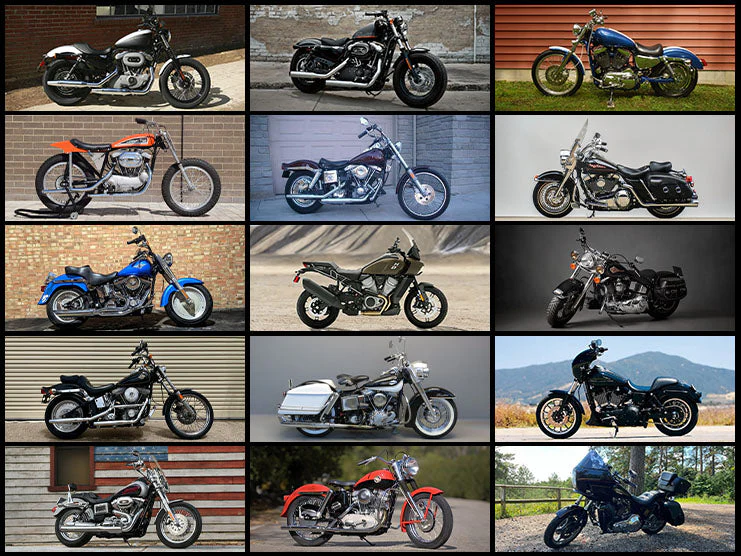
Harley-Davidson motorcycles are assembled at two primary U.S. facilities. The York, Pennsylvania plant at 1.5 million square feet handles Sportster, Cruiser, Touring, and CVO families, along with LiveWire electric models. The Menomonee Falls, Wisconsin facility – just outside Milwaukee – assembles the V-twin engines that power the Big Twin lineup (Universal Technical Institute, 2025).
The company also has international production footprints. A factory in Manaus, Brazil opened in 1998. Additional assembly operations exist in India and Thailand, the latter of which drew criticism from H-D loyalists and complicated the company’s relationship with U.S. trade policy during the tariff environment of the 2020s.
The corporate headquarters remains at 3700 W. Juneau Avenue in Milwaukee – the same block where the first real Harley-Davidson factory went up in 1906.
The Harley-Davidson Museum, which opened in 2008 in Milwaukee’s Menomonee Valley, covers roughly 130,000 square feet and houses the company’s historic motorcycle collection and corporate archives (Wikipedia, 2025).
Who Owns Harley-Davidson Now
Harley-Davidson went public on the New York Stock Exchange in 1986 under the ticker HOG. It has been a publicly traded company since then. As of 2024-2025, the largest shareholders are institutional funds – Vanguard Group, BlackRock, and State Street typically hold mid-to-high single-digit percentage stakes each, while insider and legacy family economic stakes are modest relative to those institutional positions (PortersFiveForce.com, 2025).
The company operates as Harley-Davidson, Inc., which includes Harley-Davidson Motor Company and Harley-Davidson Financial Services (HDFS). In 2022, Harley spun off its electric motorcycle brand as LiveWire Group, Inc. (NYSE: LVWR), retaining a controlling stake.
On October 1, 2025, Artie Starrs became Harley-Davidson’s President and CEO. He came from Topgolf Callaway Brands, where he served as CEO of Topgolf International. Jochen Zeitz, who had led the company since 2020 and executed the Hardwire five-year strategic plan, remained as a senior advisor through February 2026 to support the transition. Troy Alstead became Chairman of the Board effective October 1, 2025 (Rider Magazine, 2025).
Harley-Davidson reported 2024 earnings of $278 million on the sale of 148,862 motorcycles – a 17% unit volume decrease compared to 2023 – with the high-interest-rate environment putting pressure on discretionary purchases across the category (Northwest Harley Blog, 2025). The U.S. Touring segment remained a relative bright spot, with Harley holding a 74.5% share of the U.S. touring market in 2024 (Harley-Davidson Inc., 2025).
Harley-Davidson Model Families in 2026
Harley-Davidson organizes its current lineup into distinct families:
| Family | Character | Example Models |
|---|---|---|
| Touring | Long-distance, loaded, wind protection | Street Glide, Road Glide, Electra Glide Ultra |
| Cruiser | Mid-weight, relaxed ergonomics | Fat Boy, Heritage Classic, Softail Standard |
| Sportster | Lighter, more accessible entry point | Nightster, Nightster Special |
| CVO | Custom Vehicle Operations, top-spec | CVO Road Glide, CVO Street Glide |
| Adventure Touring | Pan America platform | Pan America 1250 Special |
| LiveWire (EV) | Separate brand, electric | LiveWire ONE, LiveWire S2 Del Mar |
The company’s most profitable segment remains Touring, where it controls roughly three-quarters of the U.S. market. The Pan America 1250 marked H-D’s first serious entry into the adventure touring segment, and it competes directly with BMW’s GS lineup and the KTM 1290 Super Adventure.
Frequently Asked Questions About Harley-Davidson
Who founded Harley-Davidson?
Harley-Davidson was founded by four men: William S. Harley and brothers Arthur, Walter, and William A. Davidson. All four were from Milwaukee, Wisconsin. The company started in 1903 and was officially incorporated in 1907, with Walter Davidson as first president and William Harley as chief engineer.
Where is Harley-Davidson headquartered?
Harley-Davidson is headquartered at 3700 W. Juneau Avenue in Milwaukee, Wisconsin – the same location as the company’s first major factory built in 1906. The corporate offices remain there today.
Is Harley-Davidson still American-owned?
Harley-Davidson is a publicly traded American company listed on the New York Stock Exchange under the ticker HOG. Its largest shareholders are institutional investment firms including Vanguard Group and BlackRock. The company is American-domiciled and Milwaukee-headquartered, though shares are held by investors globally.
Did AMF own Harley-Davidson?
Yes. American Machine and Foundry (AMF) acquired Harley-Davidson in 1969 and owned it through 1981. A group of 13 Harley-Davidson executives, led by Vaughn Beals and Willie G. Davidson, purchased the company back in a leveraged buyout for approximately $80 million (Washington Post, 1993). The AMF period is widely regarded as a low point for build quality and brand reputation.
Who is the current CEO of Harley-Davidson?
Artie Starrs became Harley-Davidson’s President and CEO on October 1, 2025. He replaced Jochen Zeitz, who had led the company since 2020. Starrs came from Topgolf Callaway Brands, where he was CEO of Topgolf International (Rider Magazine, 2025).
When did Harley-Davidson go public?
Harley-Davidson went public on the New York Stock Exchange in 1986, one year after requesting early removal of the Reagan-era import tariffs on heavyweight motorcycles. The stock was first offered at $11 per share (Washington Post, 1993).
What is LiveWire?
LiveWire is Harley-Davidson’s electric motorcycle brand, spun off as a separate publicly traded company in 2022 under the ticker LVWR on the New York Stock Exchange. Harley-Davidson retains a controlling stake. LiveWire sells the LiveWire ONE and the S2 Del Mar, targeting urban and performance-focused riders.