Top 10 Fastest Can-Am Motorcycles Ranked by Top Speed
TL;DR
- The fastest Can-Am three-wheeler you can buy new is the Spyder F3-S, which GPS-confirmed owner testing places at approximately 115 mph stock.
- All 1330cc Spyder models share the same engine; top speed differences come down to sprocket size and the ECU throttle map BRP programs for each trim.
- The Ryker 900 is electronically limited to roughly 105-106 mph, while the Ryker 600 tops out near 90-95 mph in real-world conditions.
- None of these figures come from professional GPS-instrumented dyno or track testing; they are owner-reported and ECU tuner-derived estimates — treat them as close approximations.
- Can-Am licenses its on-road lineup as three-wheeled motorcycles in most US states; an M endorsement may be required depending on your state.
How the Can-Am Lineup Is Organized
Can-Am’s on-road vehicles split into two families: the Spyder (larger, more powerful, sport or touring oriented) and the Ryker (lighter, more affordable, CVT automatic). Both sit on a reverse-trike layout — two wheels up front, one in the rear — and both require a motorcycle endorsement in many US states.
Every current Spyder runs the Rotax 1330 ACE inline-triple producing 115 hp and 96-98 lb-ft of torque (BRP spec, 2024). What separates fast trims from slower ones is the rear sprocket size and the ECU throttle map, not engine displacement. The Ryker uses either the Rotax 600 ACE two-cylinder (50 hp) or the Rotax 900 ACE three-cylinder (82 hp) with a CVT automatic.
Top 10 Can-Am Three-Wheelers Ranked by Top Speed
| Rank | Model | Engine | Est. Top Speed | ECU Restriction Starts |
|---|---|---|---|---|
| 1 | Spyder F3-S | 1330cc triple | ~115 mph | 105 mph |
| 2 | Spyder F3-T / F3 Limited | 1330cc triple | ~115 mph | 105 mph |
| 3 | Spyder RS / RS-S (2007-2016) | 998cc V-twin | ~115 mph | N/A |
| 4 | Spyder ST / ST-S (2012-2016) | 998cc V-twin | ~112 mph | N/A |
| 5 | Spyder F3 base / F3L | 1330cc triple | ~108 mph | 95 mph |
| 6 | Spyder RT / RT Limited / Sea-to-Sky | 1330cc triple | ~112 mph | 95 mph |
| 7 | Ryker 900 / Ryker Sport | 900cc triple | ~105 mph | ~105 mph |
| 8 | Ryker Rally | 900cc triple | ~103 mph | ~105 mph |
| 9 | Ryker 600 | 600cc twin | ~90-95 mph | ~95 mph |
| 10 | Ryker 600 (two-up or loaded) | 600cc twin | ~75-80 mph | ~95 mph |
All speed figures are estimated from owner GPS reports and ECU tuner data. No independent instrumented test data exists for these models. See the data note at the end of this article.
#1 Can-Am Spyder F3-S — Fastest Can-Am You Can Buy New
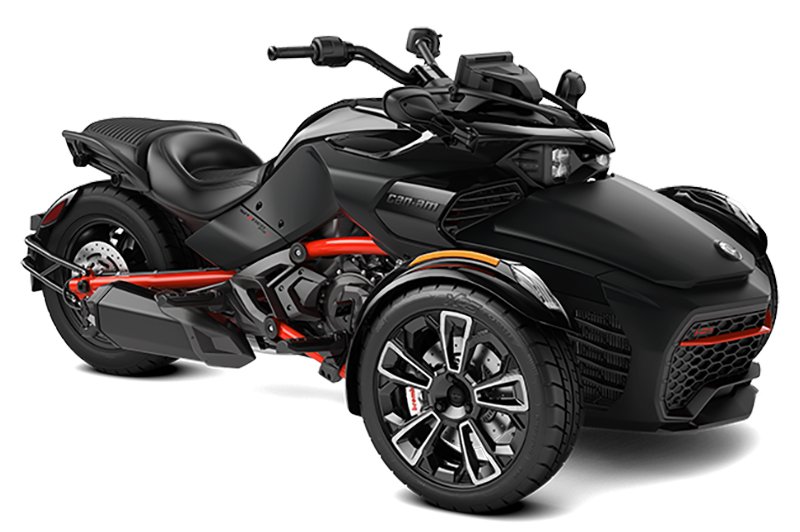
The Spyder F3-S is the top performer in Can-Am’s current lineup. BRP fits the F3-S with a larger 89-tooth rear sprocket and a sport-tuned ECU map that keeps the throttle butterflies fully open to 105 mph — 10 mph longer than the RT or base F3. Owner testing on SpyderLovers confirmed a GPS-corrected top speed of approximately 115 mph stock, with the speedo reading around 118 mph (SpyderLovers ECU testing thread, 2023). The F3-S also weighs in at 899 lb, making it the lightest Spyder in the current lineup.
It hits 0-60 mph in just under 4.5 seconds in Sport mode, which TopSpeed confirmed in a 2024 three-week press evaluation. At $27,599 MSRP for the 2025 model, it’s the stripped-out sport option in a lineup that skews toward touring.
#2 Can-Am Spyder F3-T and F3 Limited — Sport Touring Speed with Added Weight
The F3-T and F3 Limited share the same 1330cc engine and 89-tooth sprocket as the F3-S, so the ECU restriction point and theoretical ceiling are identical. The difference is weight. The F3-T adds a windshield and saddlebags; the F3 Limited layers on a top case, audio system, and heated grips. That extra mass keeps real-world top speed at approximately 115 mph — the same ceiling as the F3-S — but the heavier body makes that ceiling harder to reach and less stable at sustained speed. Both start north of $30,000 (BRP US, 2025). If you need the speed and plan to ride two-up or long distance, this is the practical version of the F3-S.
#3 Can-Am Spyder RS and RS-S (2007-2016) — The 998cc V-Twin Era
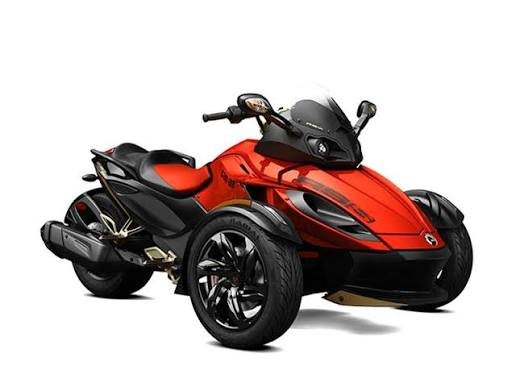
The original Spyder ran a 998cc Rotax V-twin producing 100 hp (BRP spec, 2014). ECU mapping on these older models was less aggressive than what BRP uses today, and the lighter chassis — the RS weighed 798 lb — helped it stay competitive with the 1330cc machines that replaced it. Owner GPS reports from the SpyderLovers and SpyderTalk forums consistently placed the RS and RS-S in the 115-117 mph range on the speedo, with GPS-corrected figures closer to 113-115 mph. The RS-S added Fox Podium shocks and cosmetic upgrades but used the same drivetrain. Both were discontinued after 2016 when BRP transitioned the sport line to the F3 platform and the 1330cc engine.
#4 Can-Am Spyder ST and ST-S (2012-2016) — Sports Touring on the 998cc Platform
The ST and ST-S used the same 998cc V-twin as the RS but mounted it in a more upright, touring-friendly chassis with removable saddlebags. Real-world top speed was reported slightly below the RS — consistently in the 110-112 mph range from owner forum data — due to the heavier frame and taller, more wind-catching bodywork. The ST-S added LED fenders, carbon-black wheels, and a front spoiler. Can-Am dropped the entire ST line in 2016 alongside the RS. Used examples now regularly appear in the $8,000-$12,000 range, making the ST a decent value if you can find one with good service history.
#5 Can-Am Spyder F3 Base and F3L — The 79-Tooth Sprocket Changes Everything
The base F3 and the F3L run the same 1330cc Rotax triple as the F3-S, but BRP fits them with a 79-tooth rear sprocket instead of the 89-tooth unit. That smaller sprocket shifts the ECU’s throttle-butterfly restriction down to 95 mph — 10 mph earlier than the F3-S — and caps GPS-corrected top speed at approximately 108 mph stock (SpyderLovers ECU testing, 2023). The performance difference between the F3 base and F3-S is entirely software and gearing, not engine hardware. An ECU flash from a tuner like Monster Fuel can remap the 79-tooth models to run the F3-S restriction profile, bumping top speed to roughly 115 mph, though that voids the warranty.
#6 Can-Am Spyder RT, RT Limited, and RT Sea-to-Sky — Touring Weight vs. Top Speed
The RT family runs the 79-tooth sprocket and the same ECU restriction profile as the base F3, with the butterfly closure starting at 95 mph. Owner GPS testing places the RT’s actual top speed at approximately 112 mph — slightly higher than the base F3 despite the shared sprocket, likely due to the RT’s larger fairing reducing turbulent drag at high speed (TimeForWheels, 2025). The RT Limited and the RT Sea-to-Sky add chrome accents, upgraded audio, and self-leveling suspension, but none of that changes the drivetrain. The RT Sea-to-Sky is the most expensive Can-Am on the market at around $32,999-$38,000 depending on trim (BRP US, 2025), and it’s the slowest Spyder in a straight line.
#7 Can-Am Ryker 900 and Ryker Sport — CVT Limits Performance at the Top
The Ryker 900 uses the Rotax 900 ACE three-cylinder producing 82 hp (BRP spec, 2025). Its CVT automatic transmission is the main restriction on top speed. The ECU-governed ceiling sits at approximately 105-106 mph, and multiple owner GPS confirmations on SpyderLovers and the Ryker forums placed real-world results between 103 and 106 mph in Sport mode under ideal conditions (SpyderLovers top speed thread, 2020). The Ryker Sport adds KYB suspension and sportier ergonomics but uses the same drivetrain. 0-60 mph acceleration is slower than the Spyder family, with the CVT adding a slight lag off the line.
#8 Can-Am Ryker Rally — Lifted Suspension Costs You a Few MPH
The Ryker Rally shares the 900cc engine with the Ryker 900 but adds raised, adjustable KYB suspension, a skid plate, handguards, and rally-spec tires designed for mixed surfaces. The taller suspension and heavier tires add rolling resistance and shift the aerodynamic profile slightly upward. Owner reports place its practical top speed 2-3 mph below the Ryker 900 base, around 102-103 mph, though the ECU ceiling is the same (SpyderLovers, 2020). If you need to gravel-road a Can-Am, the Rally is the obvious choice. If you’re chasing top-end numbers, the base 900 does it fractionally better.
#9 Can-Am Ryker 600 — City Runner That Runs Out of Road on the Highway
The Ryker 600 uses the Rotax 600 ACE two-cylinder producing 50 hp (BRP spec, 2025). Its ECU-governed ceiling lands around 90-95 mph under ideal conditions — solo rider, flat road, Sport mode, no headwind. In real-world highway conditions, most owners report 85-90 mph as the practical cruise limit before the throttle starts to soften. A forum member on Ryker Forums confirmed 75 mph two-up with a combined rider weight of 320 lb, which tells you how much headroom disappears with a passenger. The Ryker 600 starts at $9,599 and is the entry point into the Can-Am lineup. It’s fine for city riding and 60 mph county roads. It’s not a long-haul Interstate machine.
#10 Can-Am Ryker 600 Under Load — Why Payload Matters More Than Engine Size
A Ryker 600 carrying a passenger or loaded with gear sees its effective top speed drop to the 75-80 mph range — fast enough for state highway speeds but with almost no reserve. It’s the same Ryker 600 that sits at #9 under different conditions. It earns its own entry because the payload drop is severe enough to matter for buyers choosing between the 600 and 900. The 900 handles a passenger or luggage without the same top-speed penalty. If you’re buying a Ryker and you ever plan to ride two-up or load gear, the 600 is the wrong choice unless you stay off the Interstate entirely.
What Actually Determines Top Speed on a Can-Am
Every current Spyder uses the same 1330cc engine. The variables separating fast trims from slower ones are sprocket size and the ECU throttle map. BRP programs the ECU to begin closing the throttle butterflies at 95 mph on 79-tooth models (RT, F3 base, F3L) and at 105 mph on 89-tooth models (F3-S, F3-T, F3 Limited). The butterflies don’t snap shut; they gradually reduce throttle response until the trike hits a soft wall.
For the Ryker, the CVT transmission is the limiting factor. CVT ratios are tuned for low-speed response and efficiency, not top-end pull. That’s why 82 hp in a Ryker 900 only reaches 105 mph while 115 hp in a Spyder F3-S reaches 115 mph.
Rider weight and wind matter too. At 100+ mph on a three-wheeler’s large frontal area, aerodynamic drag from a heavier rider or taller windshield can cost 3-5 mph of top speed (SpyderLovers testing, ongoing).
A Note on Can-Am Speed Data
No independent GPS-instrumented test data from professional publications exists for Can-Am Spyder or Ryker top speed figures. The numbers in this article come from three sources: ECU tuner testing documented in the SpyderLovers community (specifically the ECU butterfly-restriction thread), owner GPS reports across SpyderLovers, SpyderTalk, and Ryker Forums, and PowerSportsGuide’s model reviews (2024). BRP does not publish official top speed figures for any of its on-road models. All figures here should be treated as best-available estimates, not independently verified specifications. Your actual results will vary based on rider weight, wind, altitude, and tire condition.
Frequently Asked Questions About Can-Am Top Speed
What is the fastest Can-Am three-wheeler available today?
The 2025 Can-Am Spyder F3-S is the fastest current model, with GPS-confirmed owner testing placing its stock top speed at approximately 115 mph. It hits 60 mph in just under 4.5 seconds in Sport mode and starts at $27,599 (BRP US, 2025).
Why is the Spyder F3-S faster than the RT if both use the same engine?
Both run the 1330cc Rotax ACE triple at 115 hp, but the F3-S gets a larger 89-tooth rear sprocket and an ECU map that keeps the throttle fully open to 105 mph. The RT’s 79-tooth sprocket setup starts closing the butterflies at 95 mph, costing 7-10 mph of top speed (SpyderLovers ECU testing, 2023).
Can I increase my Can-Am’s top speed?
Yes, through an ECU flash. A Stage 1 flash on a 79-tooth model (RT, F3 base) remaps it to run the F3-S restriction profile, pushing top speed from ~108 mph to approximately 115 mph for roughly $180-$400. This voids the BRP factory warranty. Inspect tires, brakes, and suspension before any ECU tune.
Is a motorcycle license required to ride a Can-Am Spyder or Ryker?
In most US states, yes. Can-Am classifies both as three-wheeled motorcycles, and most states require a standard motorcycle endorsement (M endorsement). Some states issue a separate three-wheel endorsement; a handful allow a standard driver’s license. Check your state DMV before purchasing.
How does the Ryker 600 compare to the Ryker 900 for highway use?
The Ryker 600 tops out near 90-95 mph solo and drops to roughly 75-80 mph two-up, leaving almost no margin on 75-80 mph Interstates. The Ryker 900 reaches 105 mph and carries a passenger with far less penalty. For highway riding or two-up use, the 900 is the minimum practical choice.