Indian Super Chief Top Speed, Specs & Review
TL;DR
- The Indian Super Chief’s top speed is approximately 120 mph based on real-world road tests, though it’s not a bike you’ll be chasing the horizon on — it’s built for rolling torque and long-mile comfort.
- Power comes from an air-cooled Thunder Stroke 116 V-twin producing 120 lb-ft of torque at 2,900 rpm.
- The 2026 Super Chief Limited starts at $22,499 MSRP with ABS, Ride Command, cruise control, and Metzeler CruiseTec tires standard.
- Seat height is a low 26.2 inches, wet weight is 739 lbs (Super Chief Limited), and the 4-gallon tank caps its practical range at roughly 150-160 miles between stops.
- Best suited for riders who want old-school American styling with enough touring kit to actually use it day to day.
Indian Super Chief Specs at a Glance
| Spec | Super Chief (Base) | Super Chief Limited |
|---|---|---|
| Engine | Thunder Stroke 111 (111 ci / 1,811 cc) | Thunder Stroke 116 (116 ci / 1,890 cc) |
| Peak Torque | 108 lb-ft @ 3,200 rpm | 120 lb-ft @ 2,900 rpm |
| Horsepower (claimed) | ~79 hp | ~91 hp (est.) |
| Bore x Stroke | 3.976 in x 4.449 in | 4.063 in x 4.449 in |
| Compression | 9.5:1 | 11.0:1 |
| Transmission | 6-speed wet multi-plate clutch | 6-speed wet multi-plate clutch |
| Final Drive | Carbon-reinforced belt | Carbon-reinforced belt |
| Front Suspension | 46mm telescopic fork, 5.2 in travel | 46mm telescopic fork, 5.2 in travel |
| Rear Suspension | Dual shocks, preload-adjustable, 3.0 in travel | Dual shocks, preload-adjustable, 3.0 in travel |
| Front Brake | 300mm semi-floating rotor, 4-piston caliper | 300mm semi-floating rotor, 4-piston caliper |
| Rear Brake | 300mm floating rotor, 2-piston caliper | 300mm floating rotor, 2-piston caliper |
| Front Tire | Pirelli Night Dragon 130/90B16 | Metzeler CruiseTec 130/90B16 |
| Rear Tire | Pirelli Night Dragon 180/65B16 | Metzeler CruiseTec 180/65B16 |
| Wheelbase | 64.0 in | 64.0 in |
| Rake / Trail | 29° / 5.2 in | 29° / 5.2 in |
| Seat Height | 26.2 in (665 mm) | 26.2 in (665 mm) |
| Wet Weight | 714 lbs | 739 lbs |
| Fuel Capacity | 4.0 gal | 4.0 gal |
| ABS | Optional (+$950) | Standard |
| Display | Analog/digital combo gauge | 4-inch Ride Command TFT touchscreen |
| MSRP (2026) | ~$19,999 | $22,499 |
Sources: Indian Motorcycle (2026 specs), Rider Magazine (2022 SCL road test), Total Motorcycle (2024 spec guide)
Indian Super Chief Top Speed: What to Actually Expect
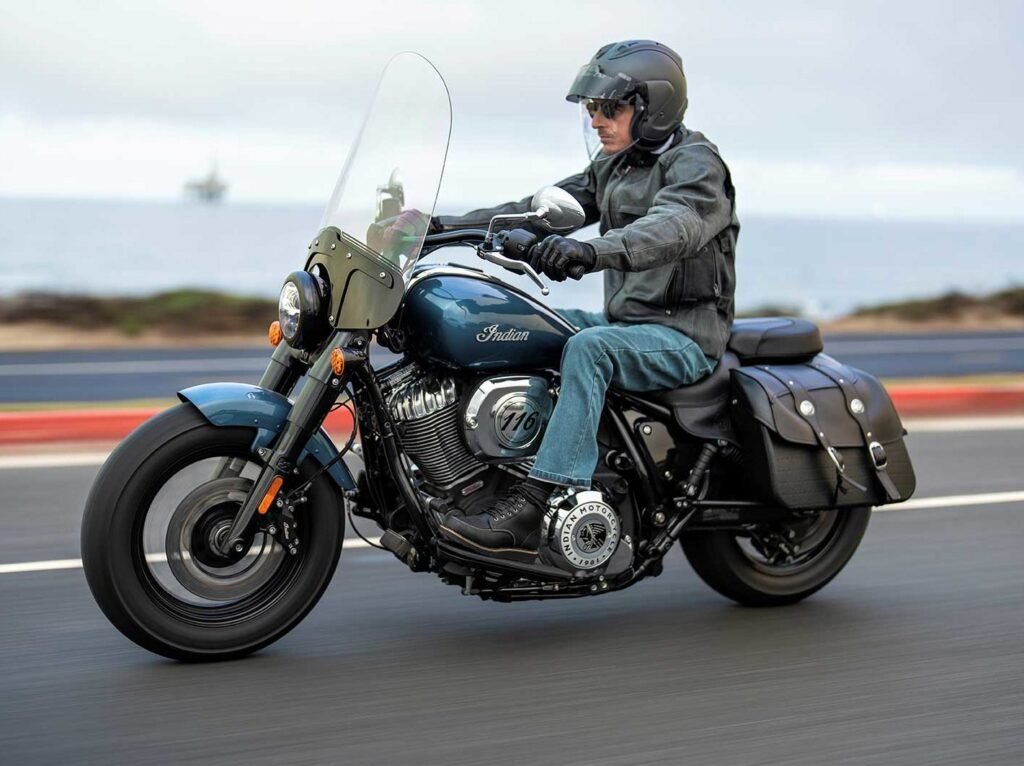
The Super Chief’s top speed is approximately 120 mph. That figure comes from road test observations (TopSpeed, 2024) and aligns with what the Thunder Stroke V-twin’s power delivery and the bike’s geometry are set up to do. At 114 mph in sixth gear you’re turning about 4,000 rpm and the engine’s still pulling — there’s nothing frantic about how it gets there.
To put the number in context: a Rider Magazine dyno run on the Indian Roadmaster Limited, which shares the same Thunder Stroke 116, pulled 76 hp and 106 lb-ft at the rear wheel on a Jett Tuning dyno (Rider Magazine, 2022). That’s honest American V-twin output once the EPA-mandated fueling restrictions take their cut. The base Super Chief with the 111ci engine lands a few mph lower, closer to 110-115 mph in similar conditions.
Neither figure is the point of this bike. The Super Chief’s engine is designed for roll-on torque between 2,000 and 4,000 rpm, not top-end screaming. Drop it two gears at 60 mph and you’ll feel exactly what 120 lb-ft means in a hurry. Passing power on a US highway is never in question.
Thunder Stroke Engine: Old School Look, Modern Manners
The Thunder Stroke 116 in the Super Chief Limited is Indian’s 49-degree, air-cooled OHV V-twin — the same family of engine they’ve been developing since the Chief’s relaunch in 2014. The 116ci version has a larger bore (4.063 inches) and an 11.0:1 compression ratio versus the base 111’s 9.5:1, which accounts for the jump from 108 to 120 lb-ft claimed torque.
The motor runs a 54mm throttle body with closed-loop fuel injection and a Bosch ECU. Rear cylinder deactivation kicks in at idle and low speeds to cut down on heat — something you’ll appreciate at summer red lights when the big air-cooled twin starts cooking the inside of your right leg. One real-world note: the engine prefers premium fuel, and you’ll hear audible pinging under hard acceleration on regular 87 octane (American Rider, 2022 road test).
Throttle response in Standard and Tour ride modes is smooth and manageable. Sport mode sharpens the initial throttle hit considerably — enough that a few testers found it slightly abrupt (American Rider, 2022). For day-to-day cruising and highway runs, Standard mode is where most riders leave it.
How It Rides: Torque-First and Highway-Happy
The Super Chief rides like a bike that was designed around an 800-mile week, not a twisty canyon afternoon. The 29-degree rake and 5.2-inch trail give it outstanding straight-line tracking at interstate speeds — point it and it holds course with very little input needed. Turn it into sweeping two-lane curves and it responds with more confidence than its 739-lb wet weight suggests.
The wide, swept-back beach-style handlebars put riders in a naturally upright position with good leverage for directional changes. Footboards let you shift foot position on long hauls — something you genuinely miss on any bike without them after four or five hours in the saddle. A 6-foot rider fits well; the floorboard-to-bar relationship works better for a wider range of body types than the Chief Bobber’s mini-apes do (Ultimate Motorcycling, 2022).
Where the Super Chief shows its limits is rear suspension travel. At 3.0 inches of rear shock travel — down from 4.5 inches on the previous-generation Chief — sharp road imperfections read more clearly through the seat than on competing bikes like the Harley-Davidson Heritage Classic, which offers 4.4 inches of rear travel. It’s not brutal, but it’s worth knowing before a long day on chip-seal pavement.
The single front rotor setup (300mm disc with a 4-piston caliper) is adequate, but a dual-rotor front end would suit a 739-lb bike better at aggressive deceleration. The Super Chief Limited’s brakes work fine for normal riding; just don’t expect them to feel like Brembo hardware.
Ergonomics and Touring Reach
The Super Chief’s 26.2-inch seat height makes it accessible to a wide range of riders, including shorter-inseam riders who’d normally avoid a full-size American cruiser. With fuel on board, the bike doesn’t feel as heavy as it weighs at low parking lot speeds, and the wide bars give you enough leverage to manage the mass.
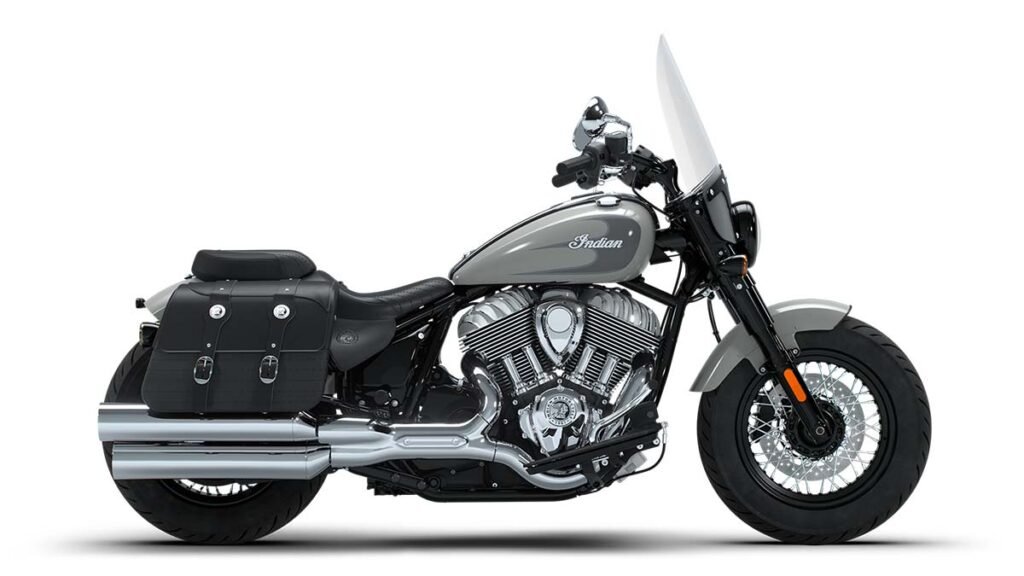
The quick-release windshield is the right call for this bike. It sits above eye level and provides genuine protection from the elements at highway pace without creating the fairing-tunnel effect you get on a full dresser. Pop it off for town riding and the cockpit opens up considerably. The saddlebags add 9.7 gallons of combined storage capacity — functional, though notably less than the 18.2 gallons on Indian’s Chieftain (American Rider, 2022).
The four-gallon tank is the Super Chief’s most limiting touring spec. At typical cruiser fuel economy of 40-45 mpg, you’re stopping every 150-160 miles. That’s not unusual for a cruiser in this class, but it’s something to plan around on a big ride.
Electronics and Ride Command
The Super Chief Limited’s 4-inch Ride Command TFT touchscreen is genuinely useful hardware for a bike in this category. The display is round to keep the retro aesthetic, but packed: speedometer, tachometer, fuel gauge, compass, gear indicator, ambient temp, and turn-by-turn navigation all live in one screen you can read in direct sunlight.
Bluetooth connectivity lets you manage music and phone calls without stopping. The system pairs reliably with Android and iOS. Three ride modes — Sport, Standard, and Tour — adjust power delivery and throttle response. Cruise control and keyless ignition are standard across both trims. ABS is standard on the Limited; an $800-950 add-on for the base Super Chief.
One usability note: the touchscreen controls share space with the Ride Command toggle switch on the left bar, and it’s possible to accidentally swipe to a different screen while adjusting grip — a quirk that a few early reviewers flagged (Rider Magazine, 2022). It’s a minor annoyance, not a deal-breaker.
Pros and Cons
Strengths:
- 120 lb-ft of torque makes real-world passing effortless at any legal highway speed.
- Low 26.2-inch seat height with wide handlebars makes it accessible for a broad rider demographic.
- Retro flathead-inspired styling is the real deal, not a costume job.
- Ride Command touchscreen punches above its weight for a non-dresser bike.
- Rear cylinder deactivation reduces heat soak at stops.
Weaknesses:
- Only 3.0 inches of rear suspension travel makes broken pavement noticeable.
- Four-gallon tank limits range to roughly 150-160 miles between stops.
- Single front disc on a 739-lb bike; dual rotors would be better.
- The base model’s ABS is an add-on, not standard.
- Premium fuel required to avoid pinging under load.
Who the Indian Super Chief Is For
The Super Chief is for the rider who wants a big American V-twin with enough touring capability to actually commit to it. You get saddlebags, a windshield, floorboards, and a genuine torque motor — without the full-dresser weight, size, or price of a Chieftain or Roadmaster.
It’s a strong fit for riders who log 500-1,000 miles on weekend runs and want to show up looking like they mean it. If you’re mostly on canyon roads chasing lean angles, or you want a stripped-down solo cruiser for city riding, other bikes in the Chief lineup serve those purposes better. For two-up touring on US highways with a nod to mid-century American motorcycle aesthetics, the Super Chief Limited does the job cleanly.
Frequently Asked Questions About the Indian Super Chief
What is the top speed of the Indian Super Chief?
The Indian Super Chief’s top speed is approximately 120 mph in real-world conditions (TopSpeed, 2024). The base model with the 111ci Thunder Stroke engine runs slightly less, in the 110-115 mph range. Neither figure is the bike’s selling point — it’s built for long-range torque, not top-end speed.
What engine is in the Indian Super Chief?
The base Super Chief runs the air-cooled Thunder Stroke 111 (1,811cc), producing 108 lb-ft of torque at 3,200 rpm. The Super Chief Limited uses the larger Thunder Stroke 116 (1,890cc), rated at 120 lb-ft at 2,900 rpm. Both are 49-degree OHV V-twins with closed-loop fuel injection and a 6-speed transmission with belt final drive.
How does the Indian Super Chief compare to the Harley-Davidson Heritage Classic?
The Super Chief and Heritage Classic target similar buyers: relaxed-seating American V-twins with touring capability. The Heritage Classic offers slightly more rear suspension travel (4.4 inches vs. 3.0 inches) and roomier saddlebags. The Super Chief Limited counters with a more modern tech package including navigation, Bluetooth, and a cleaner cockpit without the bulky fender valances. Pricing is comparable, both landing in the $20,000-23,000 range.
How heavy is the Indian Super Chief?
The base Super Chief weighs 714 lbs wet. The Super Chief Limited, which adds the larger engine, touchscreen, and premium trim, comes in at 739 lbs wet (Indian Motorcycle, claimed). Both figures are with a full fuel load. Despite the weight, the low seat height and wide handlebars keep low-speed maneuverability more manageable than the numbers suggest.
Does the Indian Super Chief have ABS?
Standard ABS is included on the Super Chief Limited. On the base Super Chief, ABS is optional and adds approximately $800-950 to the MSRP. The Limited also includes cruise control, keyless ignition, Ride Command navigation, and Metzeler CruiseTec tires as part of the standard package.