GasGas Motorcycles: History, Manufacturer & Ownership
TL;DR
- GasGas was founded in 1985 in Girona, Spain, by Narcís Casas and Josep Pibernat after Bultaco’s original factory shut down.
- The brand went bankrupt in 2015, changed hands twice, and was acquired by KTM’s parent company in 2019.
- As of November 2025, GasGas is controlled by India’s Bajaj Auto, which now holds a 74.9% stake in KTM AG and its parent, soon renamed Bajaj Mobility AG.
- KTM shut down GasGas motorcycle production at the Girona plant in October 2025 and moved it to Mattighofen, Austria.
- GasGas still sells enduro, motocross, cross-country, and electric bicycle models through KTM’s US dealer network, but pulled its factory trials racing team for 2026.
Who Founded GasGas and When?
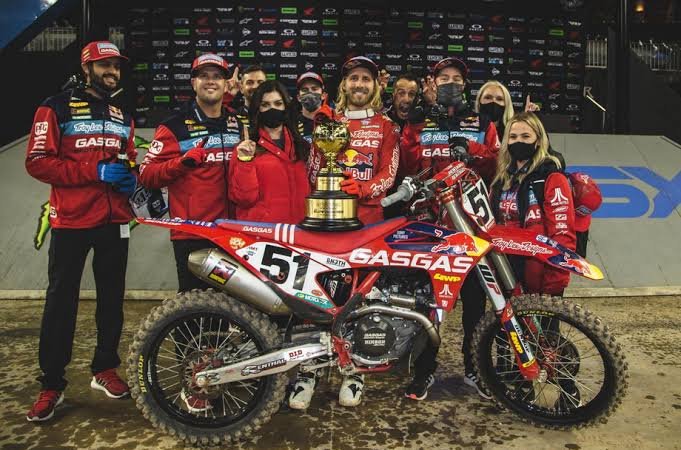
GasGas was founded in 1985 in Salt, a small town near Girona in Catalonia, Spain. Narcís Casas and Josep Pibernat started the company after the original Bultaco factory, where both men had worked, closed its doors in 1983.
The name translates to “Go! Go!” in Catalan, and that fits the mission. Casas and Pibernat wanted to fill the gap Bultaco left in the trials scene, and they built the brand around one thing: light, agile bikes that could climb over rocks and logs without breaking a rider’s back doing it.
Trials riding is a niche sport even by dirt bike standards. It’s slow-speed, technical, and rewards balance over horsepower. GasGas leaned into that identity from day one, and it paid off. The brand’s early models, like the Halley, earned a reputation fast among Spanish trials riders who already had strong opinions about what a trials bike should feel like underneath them.
What Made GasGas a Big Name in Off-Road Racing?
GasGas built its reputation on trials world championships, not showroom sales volume. The brand poached Jordi Tarrés from Beta in 1993, and he responded by winning three straight world trials titles in 1993, 1994, and 1995 (Wikipedia, 2026).
That kind of factory-rider success is how a small Spanish manufacturer punches above its weight. Adam Raga kept the streak alive later, winning the Trial Outdoor World Championship in 2005 and 2006, plus four straight Trial Indoor titles from 2003 through 2006 (Wikipedia, 2026). By the late 1990s and early 2000s, GasGas had also expanded past pure trials into enduro and motocross, chasing the same woods-and-track crowd that Beta and Sherco were courting.
Here’s the thing about being a specialist brand: it works great until the market shifts or the balance sheet doesn’t. GasGas built serious credibility in a small pond. Keeping the lights on in a bigger one turned out to be the harder problem.
Why Did GasGas Go Bankrupt?
GasGas filed for bankruptcy in 2015 after years of declining sales and mounting debt. Reports at the time point to a sales drop of more than 50% in prior years and roughly 23 million euros in outstanding debt at the Girona operation (Cycle News, 2019).
The Torrot Group, backed by Black Toro Capital, stepped in to keep the brand alive after the bankruptcy filing. It wasn’t a smooth handoff. When KTM representatives visited the Girona factory in 2015 to scout a possible purchase, workers greeted them with a burning pile of tires and an effigy dressed in KTM gear hanging outside a window (Cycle News, 2019). Employees feared the same fate that befell KTM’s Husqvarna plant in Varese, Italy, which had been shut down after a prior acquisition.
Torrot-GasGas struggled anyway, and by 2019 the company was back in trouble. That’s when KTM, through its parent company at the time (then called KTM Industries AG, soon renamed Pierer Mobility AG), returned with a formal deal instead of a scouting visit.
When Did KTM Acquire GasGas?
KTM acquired a 60% stake in GasGas in September 2019, then bought the remaining 40% in July 2020 to take full ownership (Motorcycle.com, 2021). The deal folded GasGas into the same corporate family as KTM and Husqvarna under Pierer Mobility AG.
Unlike the 2015 visit, this acquisition landed with union support rather than burning tires. KTM assured Girona plant workers it would keep production running locally, and Ramon Betolaza of Black Toro Capital called the joint venture a guarantee of a “bright future” for the brand and the plant (Cycle News, 2019). For a few years, that held up. GasGas got access to KTM engineering, a fuel-injected four-stroke enduro lineup, and eventually a spot in factory motocross and Moto3 racing programs.
GasGas sold 8,648 motorcycles in 2020, its first full year under Pierer Mobility, even as KTM’s own sales dropped by more than 21,000 units that year due to the pandemic (Motorcycle.com, 2021). The three-brand structure of KTM, Husqvarna, and GasGas let Pierer spread its manufacturing and R&D costs across a wider product range while keeping each badge distinct.
Who Owns GasGas Now?
GasGas is currently owned by Bajaj Auto of India, which completed a full takeover of KTM’s parent company on November 18, 2025 (Motorcycle.com, 2025). Bajaj now holds roughly 74.9% of the renamed holding company, with the rest publicly traded on the Swiss and Austrian stock exchanges.
Bajaj wasn’t new to this relationship. The Indian manufacturer had held a minority stake in KTM since 2007 and built KTM-branded bikes in India for export. But KTM’s parent company, then still controlled by the Pierer family, hit a genuine financial crisis in late 2024, filing for court-led restructuring and replacing its longtime CEO (Ultimate Motorcycling, 2025). Bajaj injected 800 million euros in May 2025 to keep the group solvent, then exercised call options through the rest of the year to buy out the Pierer family entirely.
As part of that restructuring, the parent company is being renamed Bajaj Mobility AG, and the joint venture that held the controlling stake is becoming Bajaj Auto International Holdings AG. GasGas, KTM, and Husqvarna all remain distinct brands under that single ownership structure, alongside the WP suspension brand (Bajaj Mobility AG, 2026).
Where Are GasGas Motorcycles Built Today?
GasGas motorcycles are now built at KTM’s main plant in Mattighofen, Austria, after KTM shut down GasGas motorcycle production at its Girona, Spain, factory in October 2025 (RideApart, 2025). The Girona facility isn’t closing outright. Electric bicycle production and other GasGas operations remain in Spain, but the motorcycle assembly line moved.
KTM’s stated reasons were consolidating expertise and cutting costs under one roof, and about 20 of the roughly 300 Girona employees lost their jobs in the transition (Visordown, 2025). No additional staff are being hired at Mattighofen to absorb the extra workload, which several outlets have flagged as a sign of just how tight the group’s finances still are.
This matters if you’re shopping for a GasGas: the bikes themselves haven’t changed platforms, since GasGas models already share engines and frames closely with KTM and Husqvarna equivalents. What’s changed is the factory stamp, and it puts an end to GasGas motorcycles being built on Spanish soil for the first time in the brand’s 40-year history.
Does GasGas Still Race Trials and Motocross?
GasGas still competes in motocross and offers technical support to trials privateers, but it pulled its factory trials team out of the World and Spanish Trial Championships starting in 2026. Fabian Simmer, GasGas Managing Director, cited a financially unsustainable racing budget alongside a broader slowdown in trial motorcycle sales (Visordown, 2025).
That’s a notable retreat for a brand whose entire identity was built on trials championships in the 1990s and 2000s. Riders can still buy GasGas TXT GP and TXT Racing trials bikes, and GasGas continues fielding factory riders in motocross, where Jorge Prado won the premier-class Motocross World Championship for the brand in both 2023 and 2024 (Wikipedia, 2026).
For 2026, the US off-road lineup includes the MC 125 and MC 250 two-stroke motocross bikes, MC 250F and MC 450F four-strokes, youth MC 50/65/85 minis, the EC 300 two-stroke enduro, and the EX 300 cross-country model, alongside four-stroke EC 350F and EC 500F enduro variants in some markets (Cycle News, 2025; Enduro21, 2025). Pricing for the 2026 range hadn’t been announced as of this writing, so check with a dealer before budgeting for one.
Frequently Asked Questions About GasGas Ownership
Who owns GasGas motorcycles?
GasGas is owned by KTM AG’s parent company, which as of November 2025 is majority-controlled by India’s Bajaj Auto at roughly a 74.9% stake. GasGas, KTM, and Husqvarna operate as separate brands under that single ownership umbrella.
Is GasGas the same as KTM?
No, GasGas is a distinct Spanish brand with its own model lineup and racing history, but it shares engines, frames, and suspension technology with KTM and Husqvarna since all three fall under the same parent company.
Where are GasGas motorcycles made?
As of October 2025, GasGas motorcycles are assembled at KTM’s Mattighofen, Austria, plant. Production previously took place at the Girona, Spain, facility where the brand was founded in 1985.
Did GasGas go bankrupt?
Yes, GasGas filed for bankruptcy in 2015 after a steep sales decline and heavy debt. It changed hands through the Torrot Group and Black Toro Capital before KTM acquired a controlling stake in 2019.
Is GasGas a good brand to buy in 2026?
GasGas bikes share core engineering with KTM and Husqvarna, which gives them a solid technical foundation, but the brand has scaled back its racing programs and moved production amid its parent company’s financial restructuring. Buyers should confirm current dealer support and parts availability before purchasing.