Suzuki Motorcycles: History, Manufacturer & Ownership
TL;DR
- Suzuki Motor Corporation manufactures Suzuki motorcycles, headquartered in Hamamatsu, Japan.
- The company was founded in 1909 by Michio Suzuki as a weaving loom manufacturer — not a motorcycle maker.
- Suzuki built its first motorized vehicle in 1952 and officially renamed itself Suzuki Motor Co., Ltd. in 1954.
- Suzuki is a publicly traded company on the Tokyo Stock Exchange; institutional investors hold roughly 51% of shares as of 2025, with Toyota holding a 4.94% strategic stake.
- Its most famous motorcycles include the GSX-R750, the Hayabusa, and the V-Strom adventure series.
Who Makes Suzuki Motorcycles and Where Are They Built?
Suzuki motorcycles are made by Suzuki Motor Corporation, a Japanese multinational manufacturer headquartered in Hamamatsu, Shizuoka Prefecture. The company produces motorcycles, automobiles, ATVs, and outboard marine engines across 35 production facilities in 23 countries (Suzuki Motor Corporation, 2024). In the United States, Suzuki motorcycles and ATVs are sold through American Suzuki Motor Corporation, a wholly owned subsidiary based in Brea, California.
The motorcycle division operates separately from the automaking side of the business. Suzuki’s domestic motorcycle sales volume ranks third in Japan behind Honda and Yamaha, though its global reach covers 192 countries through 133 distributors.
How a Loom Factory Became a Motorcycle Manufacturer: Suzuki’s Origins (1909–1954)
Suzuki has nothing to do with motorcycles in its earliest chapter. In 1909, Michio Suzuki founded the Suzuki Loom Works in Hamamatsu, Japan, supplying weaving equipment to small fabric manufacturers across the Tokyo-Yokohama-Nagoya corridor. Japan’s textile industry was booming, and Suzuki’s loom designs were well-regarded enough that the company went public in 1920, officially becoming the Suzuki Loom Manufacturing Company (Suzuki Motor Corporation, 2024).
The company spent the next two decades making looms exclusively. World War II interrupted Michio Suzuki’s experiments with small car prototypes he had begun in 1937. Wartime industrial demands redirected the factory, and post-war Japan left Suzuki rebuilding in a shattered economy where textile demand had collapsed.
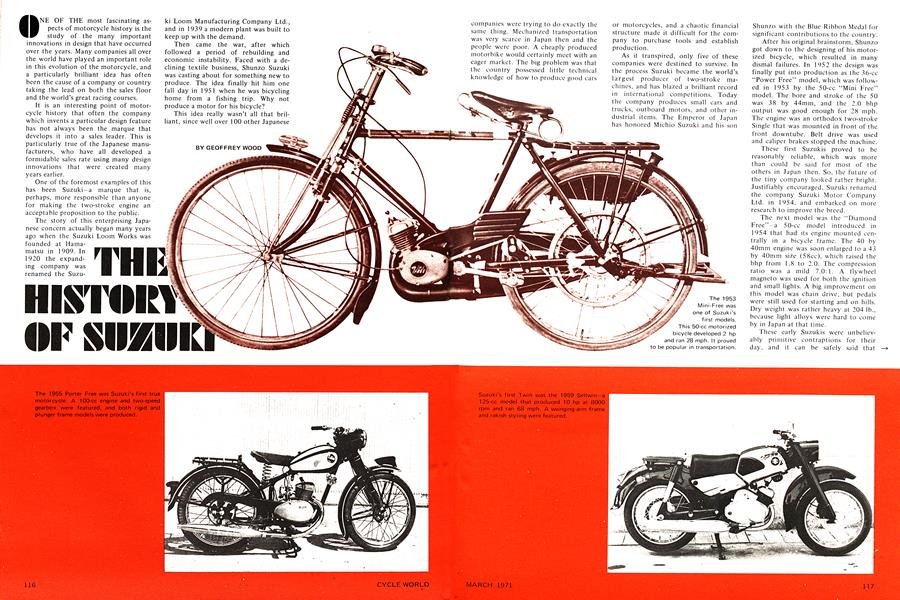
That collapse forced the pivot. In 1952, Suzuki launched the Power Free — a motorized bicycle with a 36cc two-stroke engine that could be pedaled when the engine was off. Practical, cheap, and well-suited to a country still recovering from wartime devastation, it sold well. Two years later, in 1954, the company officially renamed itself Suzuki Motor Co., Ltd., closing the loom chapter for good.
Suzuki’s Motorcycle Milestones: From the Colleda to the Hayabusa
Suzuki’s first true motorcycle was the Colleda, launched in 1955 alongside the Suzulight, the company’s first passenger car. The two-wheeled side of the business grew faster. Through the 1960s and 1970s, Suzuki built a global reputation by winning in motocross — Roger De Coster rode Suzuki machines to multiple FIM Motocross World Championship titles during that era, and from 1975 to 1984 Suzuki dominated the 125cc Motocross World Championship for ten consecutive years.
The GS750 in the late 1970s signaled Suzuki’s ambition in four-stroke street bikes, but the model that changed the sportbike category entirely was the GSX-R750. Introduced at the 1984 Cologne Motor Show as a 1985 model, it was the first production motorcycle to put genuine race-bike engineering — alloy frame, oil-cooled engine, radical weight reduction — in a bike anyone could buy and ride to work on Monday. Every modern sportbike owes something to it.
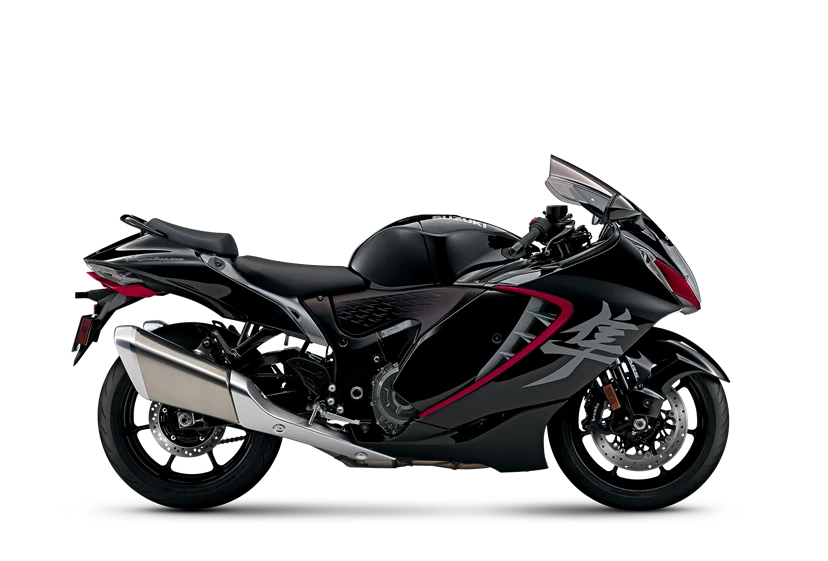
The Hayabusa arrived in 1999 and reset expectations for production bike performance. Its 1,299cc inline-four engine produced 173 horsepower and pushed the bike to a verified top speed of 188–194 mph (303–312 km/h), making it the fastest production motorcycle in the world at launch (Wikipedia, 2024). Nothing had broken the production top-speed record by that margin in a single jump before. The Hayabusa remains in production today in its third generation, launched in 2021 with 190 hp and a full electronics package including launch control, traction control, and hill hold.
Suzuki Motorcycle Milestone Timeline
| Year | Model / Event | Significance |
|---|---|---|
| 1952 | Power Free | First Suzuki motorized vehicle, 36cc two-stroke |
| 1955 | Colleda | First true Suzuki motorcycle |
| 1975–1984 | 125cc Motocross dominance | 10 consecutive world championships |
| 1985 | GSX-R750 | Defined the modern sportbike category |
| 1999 | GSX-1300R Hayabusa | World’s fastest production motorcycle at launch |
| 2001 | GSX-R1000 | “Ultimate sports bike” based on GSX-R750 platform |
| 2008 | RM-Z450 | World’s first production fuel-injected motocross bike |
| 2014 | V-Strom 1000 ABS | First Suzuki motorcycle with traction control |
| 2021 | Hayabusa Gen 3 | Full redesign after 13 years; Euro 5 compliant |
Who Owns Suzuki Motor Corporation?
Suzuki Motor Corporation is a publicly traded company listed on the Tokyo Stock Exchange (ticker: 7269). No single entity holds majority ownership. As of April 2025, institutional investors collectively own approximately 51% of shares, spread across trust banks, global custodians, and domestic financial institutions (PortersFiveForce.com, 2025).
The most strategically significant ownership stake belongs to Toyota Motor Corporation, which acquired a 4.94% stake in Suzuki in August 2019 as part of a capital alliance focused on hybrid technology, advanced safety systems, and cooperation on carbon neutrality (Toyota Motor Corporation, 2019). Suzuki made a parallel investment in Toyota. The two companies are not merged — Suzuki runs independently — but the Toyota partnership shapes R&D direction, particularly on electrification.
The Suzuki family retains board-level influence. Toshihiro Suzuki, son of the late Osamu Suzuki, serves as Representative Director and President as of 2025 (PortersFiveForce.com, 2025). Osamu Suzuki, who led the company from 1978 and built it from a regional automaker into a global operation, retired as chairman in June 2021 and passed away in December 2024 at age 94.
Suzuki has had major corporate partnerships before. General Motors held up to 20% of Suzuki shares from 1981 until it sold its remaining stake in 2008. Volkswagen Group held a cross-shareholding from 2009 until a bitter dispute ended the arrangement in 2015. The Toyota alliance, which focuses on technology sharing rather than equity control, has proven more stable.
Suzuki Motor Corporation Ownership Snapshot (2025)
| Shareholder Type | Approximate Stake |
|---|---|
| Institutional investors (total) | ~51% |
| Toyota Motor Corporation | ~4.94% |
| MUFG Bank (Investment Banking) | ~3.32% |
| Tokio Marine Asset Management | ~3.35% |
| Suzuki family / strategic influence | Board-level, exact % varies by filing |
Sources: PortersFiveForce.com, 2025; Toyota Motor Corporation, 2019
What Suzuki Motorcycles Are Available in the US Today?
Suzuki’s current US motorcycle lineup covers several categories. The GSX-R series — GSX-R600, GSX-R750, GSX-R1000, and GSX-R1000R — handles the sport and supersport segments. The Hayabusa anchors the hypersport category. The GSX-S naked bikes (GSX-S750, GSX-S1000) offer a more upright streetfighter position on the same performance-oriented engines. The SV650 remains one of the most recommended entry-level and intermediate motorcycles on the market, praised by instructors and experienced riders alike for its forgiving V-twin power delivery and light weight.
The V-Strom adventure-touring line covers a wide displacement range — the V-Strom 650 and V-Strom 1050 — for riders who want dual-sport capability without the full off-road commitment of a KTM or BMW GS.
Suzuki no longer sells passenger cars in the United States. The company exited the US auto market in 2012, but the motorcycle and ATV divisions continued operating without interruption. For US riders, Suzuki remains a full-line motorcycle manufacturer.
The SV650 deserves a specific mention here because it’s one of the few bikes that gets recommended to beginners, intermediates, and experienced riders who’ve simplified their garage. The 645cc 90-degree V-twin produces around 75 horsepower in stock form — enough to be genuinely fast without being punishing — and the bike weighs just under 450 lbs wet. It’s the kind of machine you can still hustle through a canyon on after ten years of riding without feeling like you’ve outgrown it. That’s a harder thing to build than a 200 hp superbike.
The V-Strom lineup has also matured significantly. The V-Strom 1050 added a 6-axis IMU with lean-angle-sensitive traction control and ABS starting in 2020, bringing it closer to the electronics package on rival adventure bikes from BMW and KTM at a noticeably lower price point. For riders who want to cover ground comfortably but aren’t planning serious off-road use, it’s one of the more honest value propositions in the adventure-touring segment.
Frequently Asked Questions About Suzuki Motorcycles
Who founded Suzuki Motor Corporation?
Michio Suzuki founded the company in 1909 in Hamamatsu, Japan, originally as a manufacturer of weaving looms. He was born in 1887 in a farming village in Shizuoka Prefecture. The company didn’t build its first motorized vehicle until 1952 — 43 years after its founding.
Is Suzuki owned by Toyota?
Toyota owns approximately 4.94% of Suzuki Motor Corporation as part of a capital alliance formed in August 2019. That stake makes Toyota a significant shareholder, but it does not give Toyota ownership or control of Suzuki. Suzuki operates independently. No single entity holds majority ownership; institutional investors collectively control about 51% of shares (PortersFiveForce.com, 2025).
Where are Suzuki motorcycles manufactured?
Suzuki has production facilities in 23 countries. Japan remains the primary manufacturing base for higher-displacement models like the Hayabusa and GSX-R series. Suzuki also produces motorcycles in India through its Indian subsidiary, Suzuki Motorcycle India Private Limited, which has a plant in Gurgaon, Haryana with annual capacity of 540,000 units.
What is the fastest Suzuki motorcycle ever made?
The original 1999 Suzuki GSX-1300R Hayabusa reached a verified top speed of 188–194 mph (303–312 km/h), making it the world’s fastest production motorcycle at launch (Wikipedia, 2024). No production motorcycle had broken the previous speed record by that margin in a single model. The current third-generation Hayabusa (2021–present) is electronically limited to 186 mph (299 km/h) per an informal gentleman’s agreement among Japanese manufacturers.
Did Suzuki ever partner with General Motors?
Yes. GM began purchasing Suzuki shares in 1981 and eventually held a 20% stake by 1988. The partnership gave Suzuki access to GM’s North American distribution network and produced joint projects like the Geo Metro, based on Suzuki’s Cultus platform and built at the CAMI Automotive plant in Ontario, Canada. GM sold its remaining Suzuki shares in 2008, ending the equity relationship entirely.