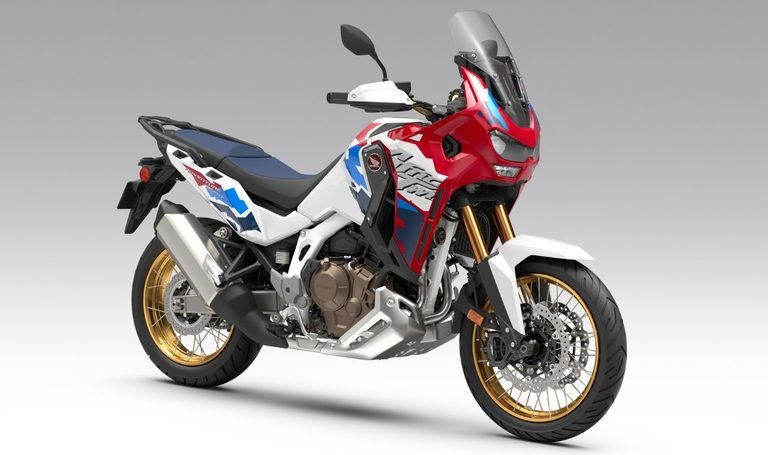
Honda Africa Twin Specs, Top Speed & Performance Review
TL;DR
- The Honda Africa Twin CRF1100L produces 100 hp (74.6 kW) and 77 lb-ft of torque from a 1,084cc parallel-twin engine
- Top speed is approximately 137 mph (220 km/h) in standard trim, based on road tests by Cycle World (2022) and Visordown
- 0-60 mph takes around 3.8-4.0 seconds in Sport mode, which is fast for a 530 lb adventure bike
- The bike is available in standard and Adventure Sports (DCT or manual) trim; the Dual Clutch Transmission (DCT) adds roughly 24 lbs and $1,500 to the base price.
- The Africa Twin is best suited to intermediate and experienced riders who want one bike for highway commuting, gravel roads, and occasional off-road use.
Honda Africa Twin CRF1100L Specs at a Glance
| Spec | Standard (2024-2025) | Adventure Sports (2024-2025) |
|---|---|---|
| Engine | 1,084cc parallel-twin | 1,084cc parallel-twin |
| Horsepower | 100 hp (74.6 kW) @ 7,500 rpm | 100 hp (74.6 kW) @ 7,500 rpm |
| Torque | 77 lb-ft (105 Nm) @ 6,250 rpm | 77 lb-ft (105 Nm) @ 6,250 rpm |
| Transmission | 6-speed manual or DCT | 6-speed manual or DCT |
| Wet Weight | 530 lb / 240 kg (manual) | 560 lb / 254 kg (Adventure Sports manual) |
| Seat Height | 33.5 in / 34.6 in (low/high) | 33.9 in / 34.9 in (low/high) |
| Fuel Capacity | 4.7 gallons (17.9 L) | 6.1 gallons (23.1 L) |
| Top Speed | ~137 mph (220 km/h) | ~135 mph (217 km/h) |
| Fuel Economy | ~44 mpg combined (Honda, 2024) | ~43 mpg combined (Honda, 2024) |
| MSRP (2025 USA) | from $14,999 (manual) | from $16,999 (manual) |
| ABS | Yes, cornering ABS | Yes, cornering ABS |
| Suspension | Showa 45mm USD forks / Pro-Link rear | Showa 45mm USD forks / Pro-Link rear |
DCT versions add approximately $1,500 to each trim. Prices may vary by dealer.
What Powers the Africa Twin: Engine and Real-World Performance
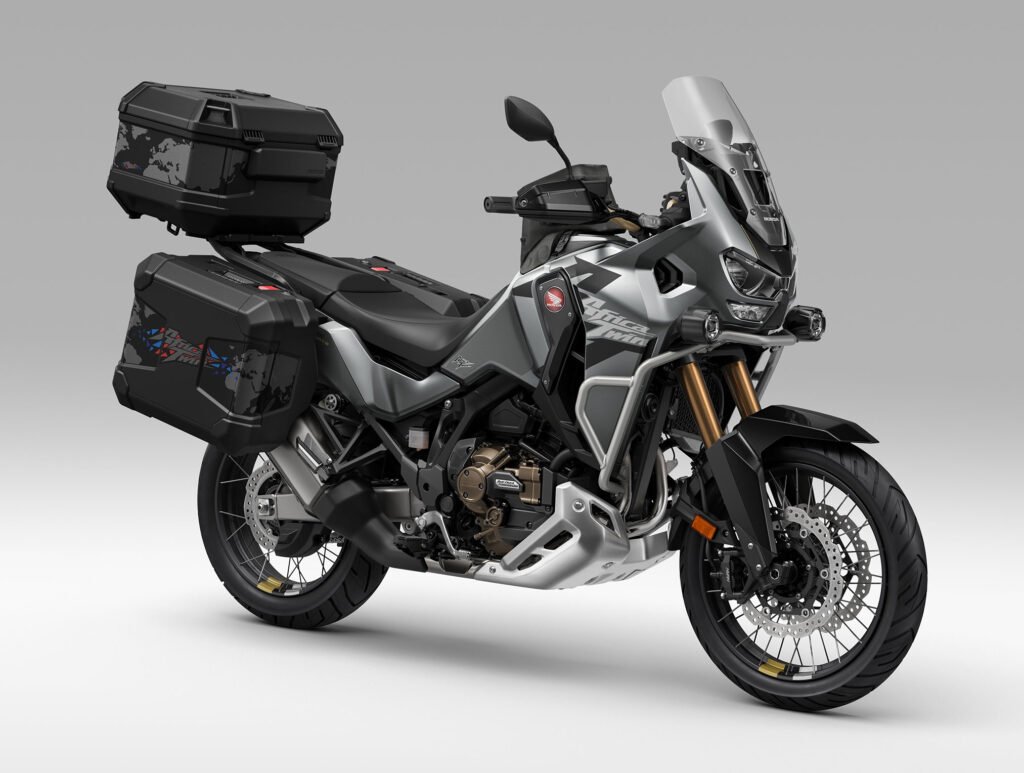
The Africa Twin runs a 1,084cc liquid-cooled parallel-twin with a 270-degree firing order. That firing order is the reason it sounds and feels more like a V-twin than most parallel-twins – Honda specifically tuned it to produce a loping, uneven pulse that helps with rear-wheel traction on loose surfaces.
Peak power arrives at 7,500 rpm. That’s not a high-strung motor. Most of the torque (77 lb-ft) comes on between 4,500 and 6,500 rpm, which means you don’t have to rev it hard to make real progress. On highway on-ramps or overtaking on a two-lane, there’s always power immediately available without a downshift.
It uses Honda’s Programmed Fuel Injection (PGM-FI) system and meets Euro 5 and EPA 2024 emissions standards. No carburetor, no jetting headaches – just clean, reliable fuel delivery from sea level to altitude.
Honda Africa Twin Top Speed and Acceleration Numbers
The Africa Twin’s top speed is approximately 137 mph (220 km/h) in standard form on a closed circuit with a rider in tuck. Cycle World recorded 136 mph in their 2022 CRF1100L test. Visordown’s 2023 road test matched that within one mph. With luggage and upright Adventure Sports ergonomics, expect to lose 3-5 mph off that ceiling.
0-60 mph runs take around 3.8-4.0 seconds in Sport riding mode (Cycle World, 2022). That’s genuinely quick for a bike that weighs 530 lbs and is designed to run a fire road at the same time. For context, a BMW F 900 GS – a lighter, smaller-displacement ADV competitor – does the same sprint in roughly 4.2-4.4 seconds (MCN, 2023).
Quarter mile time sits around 12.4-12.6 seconds at approximately 104 mph (Cycle World, 2022). Again, faster than you’d guess from looking at the touring ergonomics.
How the Africa Twin Handles: On-Road and Off-Road Reality
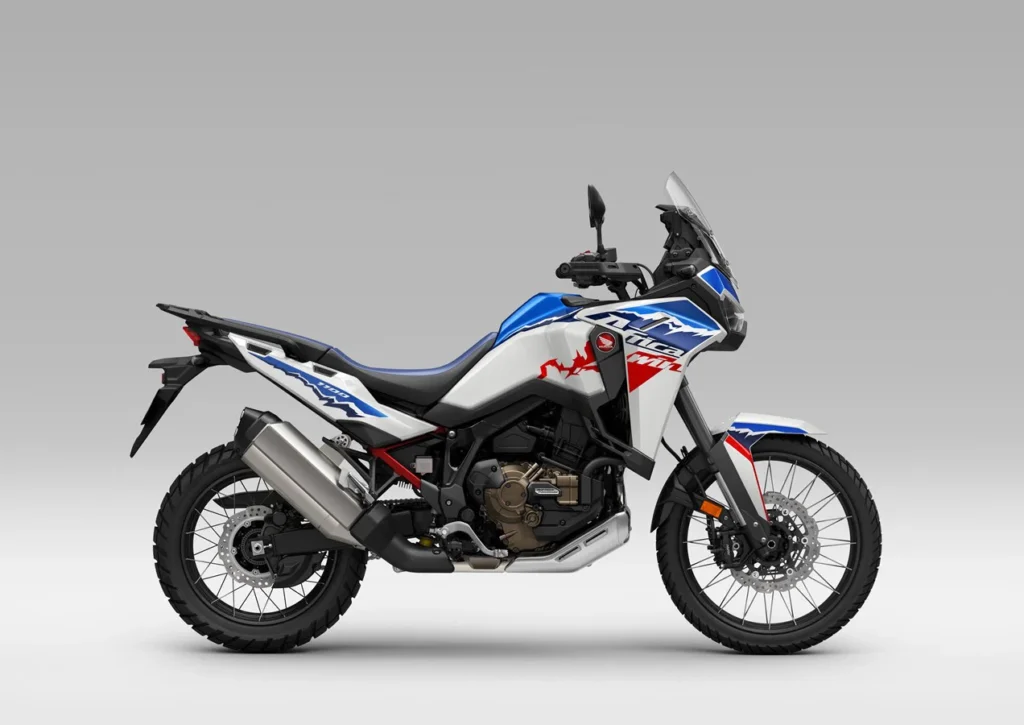
On pavement, the Africa Twin handles well for its class, but it’s not a sport bike and doesn’t try to be. The Showa 45mm upside-down forks and Pro-Link rear mono-shock are tuned for compliance over outright stiffness. Ride quality on cracked highway is genuinely good. The suspension does get a bit busy when you push it hard through tight corners at speed – the long-travel setup that makes it capable off-road means it has more chassis movement than a BMW R 1300 GS or Ducati Multistrada V4 S in pure sport riding.
Off-road, it’s a different story. The 270-degree crank, decent ground clearance (9.1 inches standard), and available off-road riding mode (plus an available G switch for even more wheel-spin tolerance) make it one of the more capable large ADV bikes in real dirt conditions. It’s not a KTM 1290 Super Adventure R – that bike’s chassis geometry is more off-road-oriented – but the Africa Twin will handle forest service roads, gravel passes, and mild single-track without drama. It’s manageable in the dirt the way a well-balanced 530 lb bike can be managed.
The DCT (Dual Clutch Transmission) version is worth calling out specifically. For off-road use, DCT in its manual-sequential mode lets you focus on body position and terrain rather than clutch management. It’s legitimately useful, not just a gimmick. That said, some experienced off-road riders still prefer the feel and control of a conventional clutch on steep technical terrain.
Who the Africa Twin Is Best For (and Who Should Pass)
The Africa Twin is best for riders who log real miles across mixed terrain – not just someone who wants an ADV bike for its looks. If your week includes a highway commute, a Saturday gravel road, and an occasional weekend camping trip, this bike covers all three without compromise.
It’s also a strong choice for experienced riders upgrading from mid-size ADV bikes (Honda CB500X, Kawasaki Versys 650, Suzuki V-Strom 650) who want more power and range without jumping straight to the harder-to-manage weight of a BMW R 1300 GS or Triumph Tiger 1200.
Who should look elsewhere:
- New riders: the 530 lb curb weight and 100 hp demand real bike skills. Start smaller.
- Dedicated off-road riders: a KTM 890 Adventure R or Husqvarna Norden 901 is lighter and better balanced for serious trail work.
- Pure street riders who never leave pavement: a Honda CB1000R or Yamaha MT-10 gives you more sport performance at a lower price.
Africa Twin Pros and Cons
Pros:
- Genuine off-road ability at a reasonable weight for a 1100cc bike.
- DCT is one of the best implementations of automatic transmission in motorcycling.
- Strong, accessible torque curve that works in the real world, not just on a dyno sheet.
- Adjustable seat height is a genuine help for shorter riders.
- Honda reliability record – CRF1100L owners report very low rates of mechanical issues in the first 30,000 miles (Honda Owner Forums survey data, 2023).
Cons:
- The standard model’s 4.7-gallon tank gives a real-world range of roughly 185-200 miles before reserve. That’s tight for long touring days. The Adventure Sports model’s 6.1-gallon tank fixes this.
- Wind protection on the standard model is poor at highway speeds. The small screen does very little above 75 mph.
- At 530 lbs wet, it’s still a heavy bike when it falls over on a trail. And it will fall over on a trail.
- The base suspension on the standard non-ES model isn’t adjustable. If you’re aggressive on-road, you’ll feel the limits fairly quickly.
Frequently Asked Questions About the Honda Africa Twin
What is the Honda Africa Twin’s top speed?
The Honda Africa Twin CRF1100L has a top speed of approximately 137 mph (220 km/h) in standard configuration. This figure comes from independent road tests by Cycle World (2022) and Visordown (2023). Wind protection, rider position, and luggage will affect the real-world ceiling.
How fast does the Honda Africa Twin accelerate from 0-60 mph?
In Sport mode, the Africa Twin covers 0-60 mph in approximately 3.8-4.0 seconds (Cycle World, 2022). This makes it one of the faster large ADV bikes in the segment when pushed, despite weighing over 530 lbs.
What is the difference between the Africa Twin standard and Adventure Sports?
The Adventure Sports trim adds a larger 6.1-gallon fuel tank (versus 4.7 gallons), a taller windscreen with electric adjustment, a longer-travel suspension setup, and aluminium side cases as an option. It also weighs roughly 30 lbs more. The MSRP difference is approximately $2,000 between comparable trims (Honda USA, 2025).
Is the Honda Africa Twin good for beginners?
No. The CRF1100L is not recommended for beginners. Its 530 lb curb weight, 100 hp output, and long-travel suspension require confident throttle and clutch control to manage safely. Riders coming from smaller bikes need at minimum two to three years of varied riding experience before stepping up.
Does the Honda Africa Twin have ABS?
Yes. All CRF1100L models come standard with Honda’s Dual Combined ABS with cornering function. The system reads lean angle and adjusts braking pressure accordingly. An off-road ABS mode is also available, which allows more rear wheel lock-up for controlled braking on loose surfaces.
How reliable is the Honda Africa Twin?
The CRF1100L has a strong reliability record. Honda’s parallel-twin design uses chain-driven DOHC, hydraulic valve adjustment (no manual valve clearance checks needed at standard intervals), and a sealed drive chain. Most reported issues at high mileage involve suspension wear and software updates to the riding modes system rather than mechanical failures.
Key Takeaways
- The Honda Africa Twin CRF1100L produces 100 hp and 77 lb-ft from a 1,084cc parallel-twin with a 270-degree crank that mimics the power delivery feel of a V-twin.
- Top speed is ~137 mph; 0-60 takes around 3.9 seconds – fast for a 530 lb adventure bike.
- The Adventure Sports trim is worth the premium if you tour: the larger tank solves the standard model’s biggest real-world limitation.
- DCT is a genuinely useful feature for mixed-terrain riding, not just a convenience option.
- The Africa Twin is one of the strongest all-around large ADV choices in its price range, but it requires an experienced rider to get the most out of it.