Honda CB750 Hornet Top Speed, 0-60 Time & Specs Review
TL;DR
- The Honda CB750 Hornet’s 0-60 mph time is approximately 3.3 seconds, with a quarter-mile in the 11.7-11.8 second range, based on formula-derived estimates rather than a Honda-published figure.
- European type-approval filings list a calculated top speed of 127 mph, based on the bike’s final drive ratio; some spec aggregators round this up to 133 mph.
- The engine is a 755cc liquid-cooled Unicam parallel-twin making 90.5 hp at 9,500 rpm and 55 lb-ft at 7,250 rpm.
- 2026 US MSRP is $7,999 ($8,599 out the door with destination), and Honda’s E-Clutch semi-automatic system is now standard equipment at no extra cost.
- It’s a genuinely strong middleweight naked: torquey engine, sharp handling, real value, but the non-adjustable front fork will limit hard canyon riders.
What the Honda CB750 Hornet’s Top Speed Actually Is
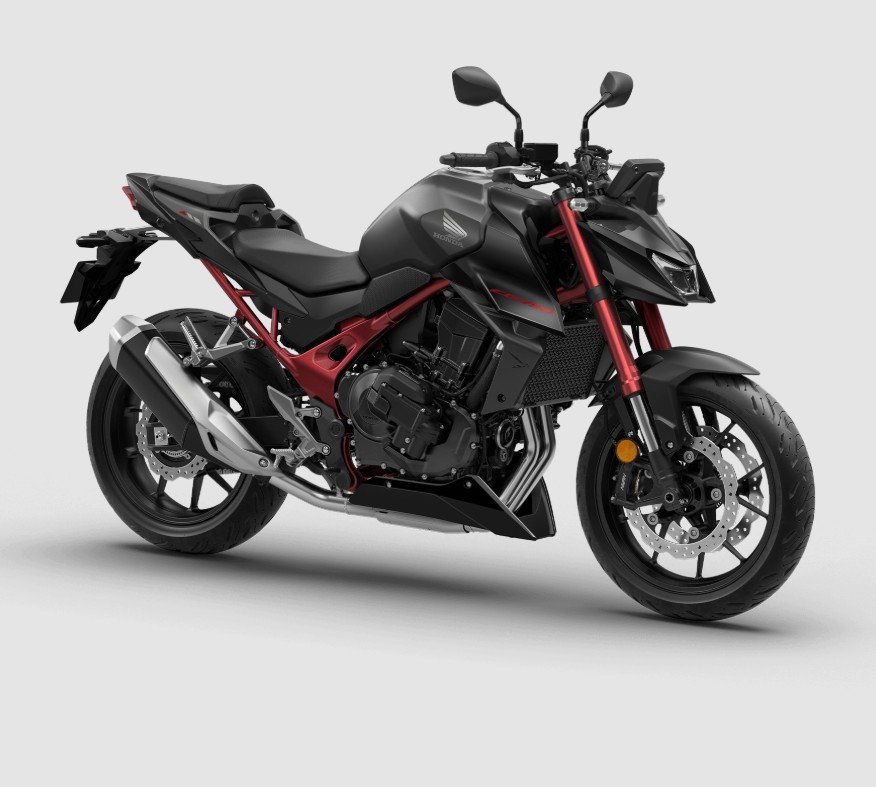
Honda has never published an official top speed for the CB750 Hornet, so the most credible number comes from regulatory type-approval paperwork filed for the model in Europe. Those documents list a 2.81 final drive ratio that works out to 127 mph (205 km/h) at redline in top gear, a figure derived from gearing math rather than a magazine’s radar-gun run.
That number applies to the full-power global version making around 90 hp. Several spec-aggregator sites round the figure up to 133 mph, but that’s a separate calculated projection, not a measured test, and the gap between the two shows how much top speed numbers can shift depending on the source’s methodology. Riding position matters here too.
A naked bike with wide bars and an upright seating posture hits an aerodynamic wall well before a fully-faired sportbike would, so real-world top speed on an unfaired Hornet will typically land a few mph under any theoretical number regardless of source.
For context, the US-spec 2026 Hornet ships with the full 90.5 hp global tune, unlike some past US Honda models that arrived detuned for emissions compliance.
That matters for top speed specifically, because a detuned engine loses top-end power first, which is exactly where a bike needs it most to reach an unrestricted top speed. So the type-approval figure is a reasonable ceiling to expect from a US-spec bike, not an optimistic European-market number that doesn’t apply here.
How Fast Is 0-60 on the CB750 Hornet
The CB750 Hornet’s 0-60 mph time comes in around 3.3 seconds, with the quarter-mile in roughly 11.7 to 11.8 seconds at close to 115 mph, according to formula-derived estimates from performance data aggregator ProfessCars (ProfessCars, 2026).
These figures come from the bike’s power-to-weight ratio, not a stopwatch run from a magazine test, so treat them as a close approximation rather than a lab-verified number.
At 432 pounds curb weight and 90.5 hp, the Hornet’s power-to-weight ratio sits right around 0.21 hp per pound, which is what makes that low-3-second 0-60 believable. The 270-degree crank gives the twin a lopsided firing order that mimics a V-twin’s torque pulse, so the bike pulls hard off the line without the top-end rush of an inline-four.
Motorcycle.com ran the Hornet on a dyno alongside the Yamaha MT-07 and Suzuki GSX-8S and found the Honda’s midrange power delivery stronger than the Yamaha’s from roughly 4,000 rpm up, which lines up with how the Hornet actually launches (Motorcycle.com, 2025). That midrange grunt, more than outright horsepower, is what makes the Hornet feel quick in the real world.
Full Specs: Engine, Chassis, and Dimensions
The numbers below are Honda’s official 2026 US-market specifications, confirmed directly from the factory spec sheet (Honda Powersports, 2026).
| Spec | 2026 CB750 Hornet |
|---|---|
| Engine | 755cc liquid-cooled Unicam parallel-twin |
| Bore x stroke | 87.0mm x 63.5mm |
| Compression ratio | 11.0:1 |
| Horsepower | 90.5 hp @ 9,500 rpm |
| Torque | 55 lb-ft @ 7,250 rpm |
| Transmission | 6-speed manual, standard Honda E-Clutch |
| Front suspension | 41mm Showa SFF-BP inverted fork, 4.7 in travel (non-adjustable) |
| Rear suspension | Pro-Link single shock, 5.1 in travel, 7-stage preload |
| Front brake | Dual 296mm discs, radial 4-piston Nissin calipers, ABS |
| Rear brake | Single 240mm disc, ABS |
| Seat height | 31.3 in |
| Wheelbase | 55.9 in |
| Curb weight | 432 lb |
| Fuel capacity | 4.0 gal |
| MSRP | $7,999 ($8,599 with destination) |
Source: Honda Powersports, 2026
Is the E-Clutch Worth Having on the Hornet
Yes, for most riders the E-Clutch is a genuine upgrade rather than a gimmick, and Honda now includes it standard at no added cost over last year’s manual-only model. It lets you shift up and down without touching the clutch lever, while still leaving the lever fully functional if you want to ride it the old-fashioned way.
Cycle News tested the system on canyon roads and reported crisp, precise shifts with the quickshifter’s most aggressive sensitivity setting engaged all day (Cycle News, 2025).
For new riders, E-Clutch removes the stall-and-lurch learning curve entirely. For experienced riders, it works as a bidirectional quickshifter during hard acceleration and braking, which is the setup a track-day rider actually wants.
The trade-off is minor: the system adds a small amount of complexity to the drivetrain versus a pure cable clutch, and if it were to fail you’d fall back to a fully manual clutch anyway, so there’s no real downside risk.
Where the Suspension and Brakes Fall Short
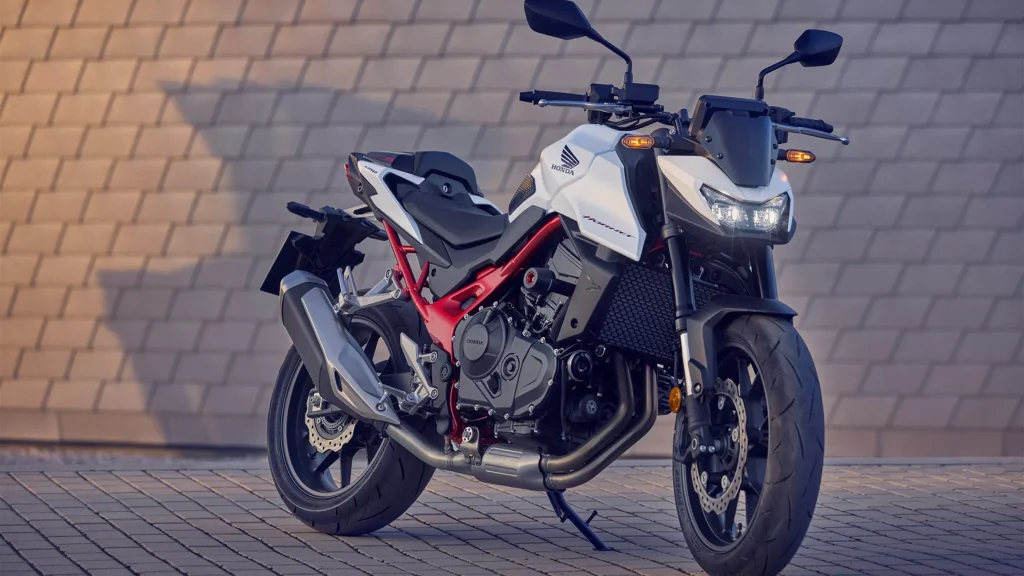
credit: https://www.1000ps.com/
The Hornet’s suspension is tuned for comfort over cornering precision, and the non-adjustable 41mm Showa fork is the bike’s clearest weak point for aggressive riders. It soaks up potholes and broken pavement well, but it doesn’t offer the compression or rebound adjustment a rider pushing hard through switchbacks would want to dial in.
The rear shock at least offers 7-stage preload adjustment, so you can compensate for a passenger or loaded panniers. Braking hardware is a genuine strength: dual 296mm front discs with radial-mounted 4-piston Nissin calipers give strong, progressive stopping power.
The one upgrade worth considering for sustained hard use is swapping the stock rubber brake lines for steel-braided ones, which firms up lever feel under repeated heavy braking.
For commuting, weekend backroad riding, and most street use, the suspension tuning is the right call. Riders planning regular track days or aggressive canyon carving will want to budget for aftermarket fork internals or a shock upgrade down the line.
Frequently Asked Questions
What is the top speed of the Honda CB750 Hornet?
Honda hasn’t published an official figure, but European type-approval documents calculate a top speed of 127 mph (205 km/h) based on the bike’s final drive ratio. Some spec sites list 133 mph, though that number is a projection rather than a tested result.
How fast does the CB750 Hornet go from 0 to 60?
The 0-60 mph time is estimated at approximately 3.3 seconds, with the quarter-mile falling in the 11.7 to 11.8 second range. These are power-to-weight-based calculations, not officially timed runs, as noted in the performance section above.
How much horsepower does the CB750 Hornet make?
The 755cc parallel-twin makes 90.5 hp at 9,500 rpm and 55 lb-ft of torque at 7,250 rpm, as covered in the specs table above. US-spec bikes get the full global power output rather than a detuned version.
What is the price of the 2026 Honda CB750 Hornet?
The 2026 CB750 Hornet has a US MSRP of $7,999, or $8,599 out the door with the $600 destination charge, matching the spec table above. E-Clutch is now standard equipment at that same price point.
Is the Honda CB750 Hornet a good first motorcycle?
The Hornet works better as a second bike than a true first motorcycle. The power delivery is strong enough that a brand-new rider can get overwhelmed, and the standard E-Clutch does flatten the learning curve, but riders coming from a 300-500cc bike will find the step up manageable without feeling limited.