Honda CB1000F Top Speed & Specs Review (2026)
TL;DR
- The 2026 Honda CB1000F makes 122 hp at 9,000 rpm and 76 lb-ft of torque at 8,000 rpm from a detuned Fireblade-based inline-four.
- Manufacturer-configuration top speed is 143 mph (230 km/h); no independently timed 0-60 figure exists yet for this newly launched model.
- Base MSRP is $10,599, undercutting its Hornet SP sibling by $400.
- Curb weight is 472 pounds with a 31.3-inch seat height, both slightly different from the Hornet SP it’s based on.
- It’s a retro-styled naked bike built for midrange grunt and all-day comfort, not outright top-end speed.
Meet the Retro Naked Bike Built on the Hornet Platform
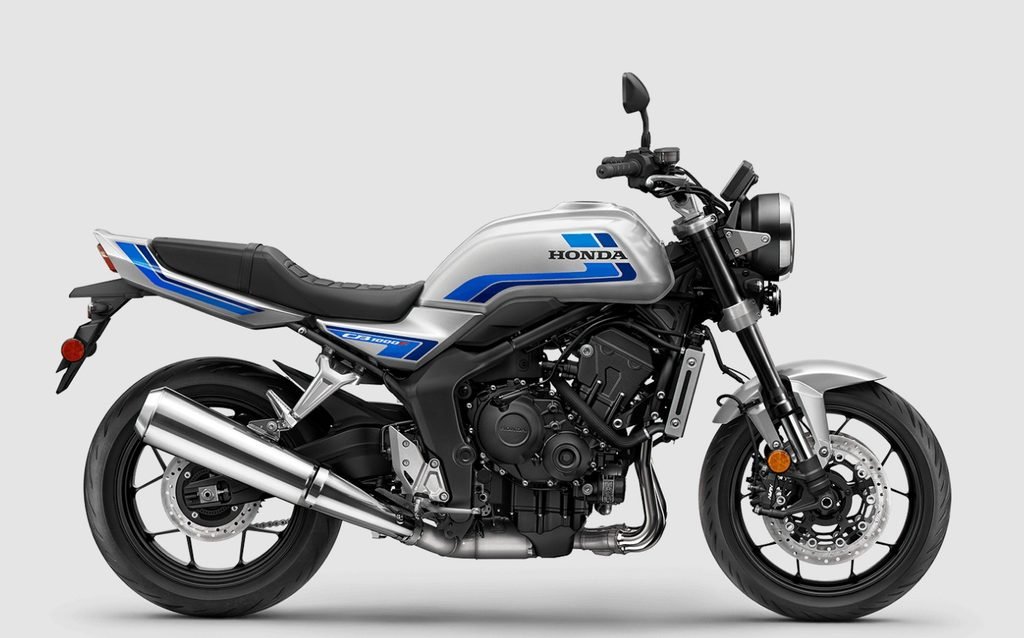
The CB1000F is Honda’s 2026 retro-styled naked bike, built on the same 1000cc platform as the CB1000 Hornet SP but tuned for low-end and midrange power instead of a screaming top end. It takes styling cues from the 1980s CB750F and CB1100F, bikes that carried Freddie Spencer through AMA competition, and wraps that look around thoroughly modern hardware.
Quick naming note before you go shopping: “CB1000F” and “CB1000 Hornet SP” are two different bikes in Honda’s current lineup, not two names for the same model. They share an engine architecture but differ in tuning, suspension, seat height, and price. If you’ve seen the Hornet SP mentioned elsewhere under this keyword, that’s the wrong bike; this article covers the actual CB1000F.
How Fast Is the Honda CB1000F? Top Speed and Power Breakdown
The CB1000F’s top speed is 143 mph (230 km/h) based on its stock gearing and engine configuration, not an independently GPS-verified run (autoevolution, 2026). Treat that as a manufacturer-configuration figure rather than a magazine-tested number until a named publication times one.
Power comes from a 1,000cc liquid-cooled inline-four sourced from the Hornet’s Fireblade-derived engine, but retuned for low-end response. Peak output is 122 hp at 9,000 rpm and 76 lb-ft of torque at 8,000 rpm, a meaningful drop from the Hornet SP’s 155 hp but with nearly identical peak torque arriving 1,000 rpm sooner.
That’s a deliberate trade: less top-end drama, more usable shove out of corners and off stoplights.
What’s the Honda CB1000F’s 0-60 Time?
There’s no verified 0-60 time for the CB1000F yet. This is a brand-new-for-2026 model, and as of this writing, no GPS-instrumented test from a source like MotoStatz, or a timed run from a publication like Cycle World, has been published.
Formula-derived estimate sites exist for related Honda models, but none currently cover the CB1000F specifically, and this article won’t guess at a number that hasn’t been measured.
For context, the mechanically related CB1000 Hornet SP, which makes 155 hp against the F’s 122 hp, has been estimated by an aggregator site at roughly 2.9 seconds to 60 mph (motorbikecatalog.com, 2025). That’s a formula-derived estimate for a different, higher-output bike, not a measured figure for the F. Expect an update here once a track test exists.
Engine, Chassis, and Spec Table
The CB1000F runs a 1,000cc DOHC inline-four with 76.0mm x 55.1mm bore and stroke, an 11.7:1 compression ratio, and Programmed Fuel Injection (PGM-FI) through 44mm throttle bodies (Honda Powersports, 2026). First and second gears are shorter than the Hornet SP’s for stronger low-speed acceleration, while the top four gears are taller for relaxed highway cruising.
| Spec | Honda CB1000F (2026) |
|---|---|
| Engine | 1,000cc liquid-cooled inline-four, DOHC |
| Horsepower | 122 hp @ 9,000 rpm |
| Torque | 76 lb-ft @ 8,000 rpm |
| Top speed | 143 mph (manufacturer-configuration figure) |
| Transmission | 6-speed manual, assist/slipper clutch |
| Front suspension | 41mm Showa SFF-BP inverted fork, 5.1-in travel |
| Rear suspension | Pro-Link single shock, 5.5-in travel |
| Front brakes | Dual 310mm discs, radial-mount calipers, cornering ABS |
| Seat height | 31.3 inches |
| Curb weight | 472 lbs (wet) |
| Fuel capacity | 4.2 gallons |
| Base MSRP | $10,599 |
| Source: Honda Powersports, 2026 |
Is the Honda CB1000F Worth the Price?
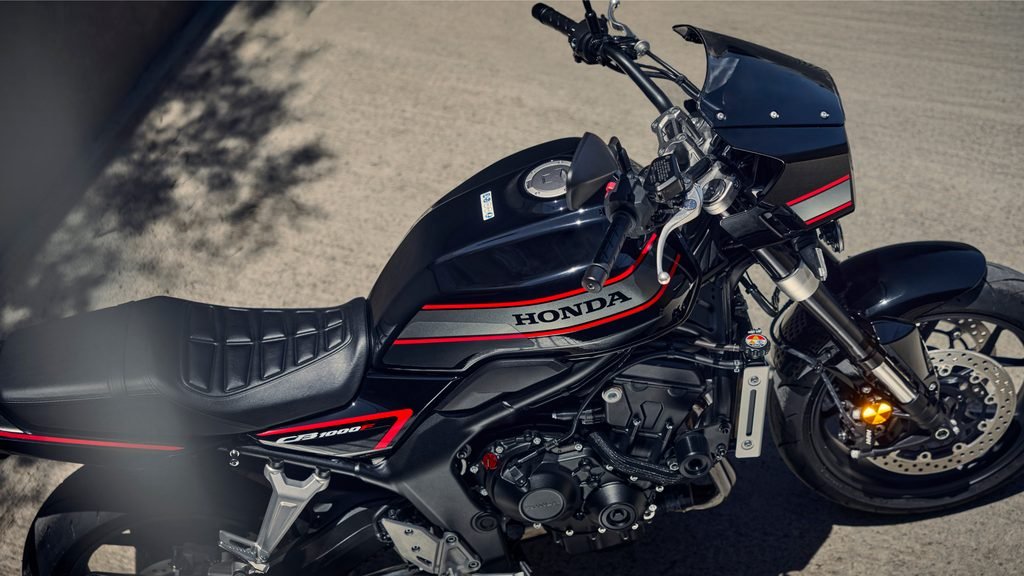
At $10,599 base ($11,374 with destination), the CB1000F is $400 cheaper than the Hornet SP while offering fully adjustable Showa front suspension, cornering ABS, and a five-inch TFT display as standard. That’s a reasonable price for a liter-class naked bike with this spec sheet, especially against rivals like the Kawasaki Z900RS or Triumph Speed Twin 1200 in the same retro-roadster space.
Real-world fuel economy from an early UK test came in at 42.3 mpg during brisk riding, giving a real-world range around 150 miles from the 4.2-gallon tank (Bennetts, 2026). That’s tighter than a lot of riders expect from a naked bike, so plan fuel stops accordingly on longer rides.
The tradeoff is wind protection. The CB1000F’s flat tank and upright stance leave you exposed at speed, with no fairing to duck behind the way you can on the Hornet SP or a competitor like the Kawasaki Z900. On a warm day that’s a non-issue; on a cold, windy highway stretch, you’ll feel it.
Frequently Asked Questions
What is the Honda CB1000F’s top speed?
The CB1000F has a manufacturer-configuration top speed of 143 mph (230 km/h), based on its gearing and engine output rather than an independently timed test run.
How much horsepower does the Honda CB1000F make?
It makes 122 hp at 9,000 rpm and 76 lb-ft of torque at 8,000 rpm, tuned for stronger low-end and midrange delivery than its Hornet SP sibling.
Is the Honda CB1000F the same bike as the CB1000 Hornet SP?
No. They share the same basic 1,000cc engine platform, but the CB1000F has different tuning, suspension, seat height, and styling, and it’s priced $400 lower at $10,599 base.
What is the Honda CB1000F’s 0-60 time?
There’s no verified 0-60 time published yet. The model is new for 2026, and no GPS-instrumented or magazine-timed test has been released as of this writing.
How much does the Honda CB1000F cost?
Base MSRP is $10,599, or $11,374 with the $775 destination charge included.