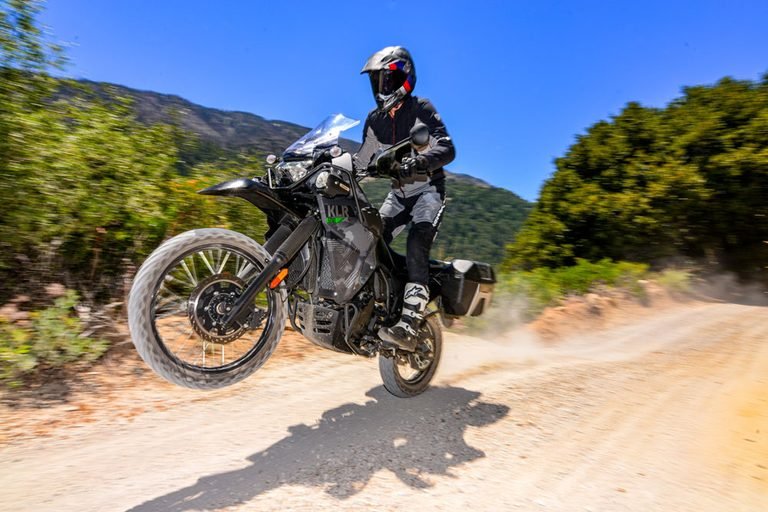
Kawasaki Eliminator 500 Specs, Top Speed & Review
TL;DR
- The 2024-2026 Kawasaki Eliminator 500 is a 451cc liquid-cooled parallel-twin cruiser with a 28.9-inch seat height and a curb weight of 176 kg (388 lb).
- Cycle World’s dyno measured 47.2 hp and 29.0 lb-ft at the wheel; certificate-of-origin figures list 52 hp at the crank.
- Top speed is approximately 110 mph; no official 0-60 figure exists from Kawasaki or independent tests.
- US MSRP starts at $6,499 (non-ABS) and reaches $7,249 for the SE ABS trim.
- Strong pick for new and returning riders who want a sporty engine in a low, light cruiser chassis.
Kawasaki Eliminator 500 Full Specs
The Eliminator 500 shares its 451cc DOHC parallel-twin with the Ninja 500 and Z500, in a cruiser-specific steel frame with a longer wheelbase, slacker rake, and lower seat.
| Spec | Detail |
|---|---|
| Engine | 451cc liquid-cooled DOHC parallel-twin |
| Bore x Stroke | 70.0 mm x 58.6 mm |
| Peak Power (at wheel) | 47.2 hp @ 10,430 rpm (Cycle World dyno, 2024) |
| Peak Power (CoO figure) | 52 hp @ 10,000 rpm (RevZilla, 2023) |
| Peak Torque | 31.4 lb-ft @ 6,000 rpm |
| Transmission | 6-speed, assist & slipper clutch |
| Front Suspension | 41mm fork, 4.7 in travel |
| Rear Suspension | Twin shocks, 5-position preload, 3.1 in travel |
| Brakes | 310mm front disc / 220mm rear disc; ABS optional |
| Tires | 130/70-18 front / 150/80-16 rear |
| Wheelbase | 59.8 in / Rake: 30° / Trail: 4.8 in |
| Seat Height | 28.9 in (735 mm) |
| Curb Weight | 176 kg / 388 lb (ABS) |
| Fuel Capacity | 3.4 gal (13.0 L) |
| US MSRP (2024-2026) | $6,499 non-ABS / $6,799 ABS / $7,249 SE ABS |
Kawasaki Eliminator 500 Top Speed
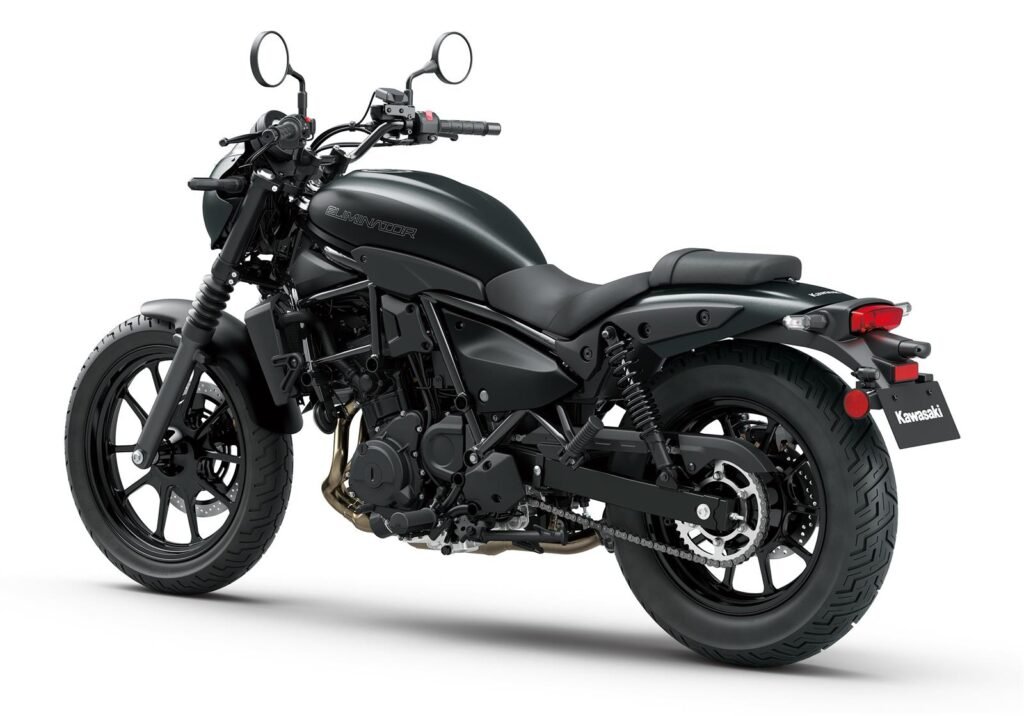
The Eliminator 500 tops out at around 110 mph. Kawasaki doesn’t publish an official figure; the 110 mph number comes from third-party sources (Autosnout, 2024; Motoplanete, 2024) and owner reports.
That’s honest for a 451cc cruiser geared for torque delivery below 8,000 rpm. The useful highway range is around 85-90 mph before the 180-degree crank’s vibration starts to register.
Kawasaki Eliminator 500 Acceleration: 0-60 and Quarter Mile
Kawasaki doesn’t publish 0-60 or quarter-mile figures. No major publication has run a timed test as of mid-2026. Third-party calculators estimate 0-60 at around 14.4-14.5 seconds (Autosnout, 2024) – rough ballpark numbers, not tested results.
RevZilla called the acceleration “exciting” relative to other cruisers in the class (RevZilla, 2023), and Cycle World noted the engine pulls freely toward a roughly 10,500 rpm ceiling (Cycle World, 2024). The torque peak at 6,000 rpm means the bike gets off the line with more urgency than the engine size implies.
Engine and Chassis: How the 451cc Twin Actually Performs
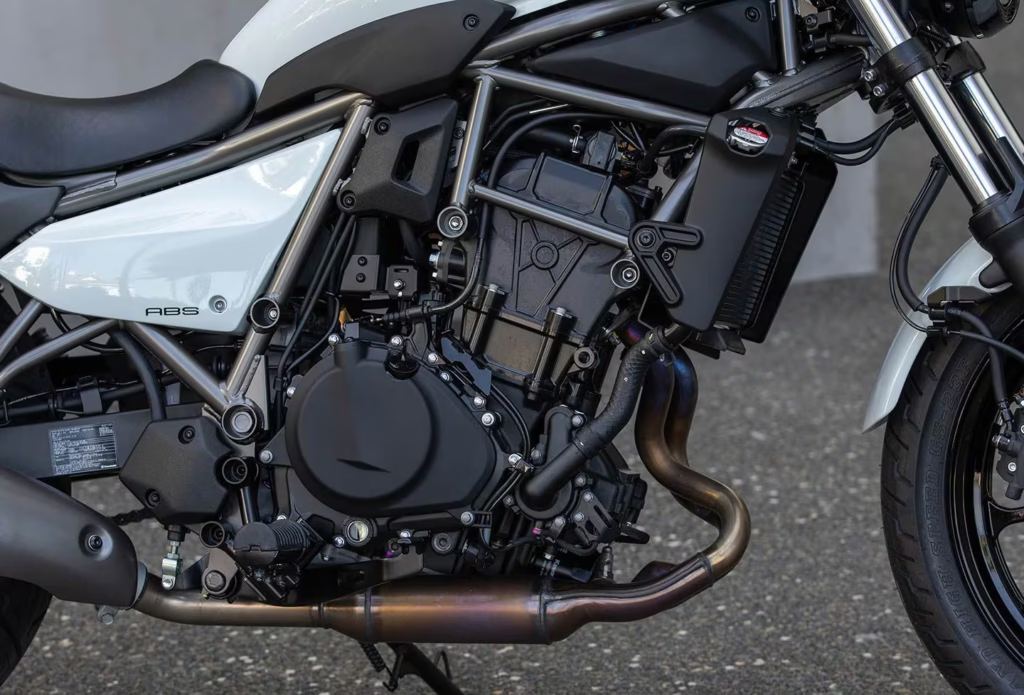
Kawasaki increased displacement from 399cc to 451cc by lengthening the stroke from 51.8mm to 58.6mm, moving the torque peak lower and adding about 4.2 lb-ft over the 400 (MCN, 2024). The engine feels punchier than its size suggests, though it’s still a high-revving parallel-twin with a 180-degree crank.
That firing order matters day-to-day. The Eliminator runs smooth at highway speeds (6,000-7,500 rpm), but buzzes in the lower revs where most commuting happens. RevZilla described it as “a lot of high-frequency vibration into the lower half of the tachometer” (RevZilla, 2023). If you want a lazy, loping cruiser feel, this engine won’t deliver it.
On the chassis, the rake opens to 30 degrees (from 24.5 on the Ninja 500), trail increases to 4.8 inches, and the wheelbase stretches 5.7 inches longer (Cycle World, 2024). That trades away cornering aggression for straight-line stability. Cycle World noted the limited lean angle is a real cap on spirited riding. Brakes are 310mm front with dual-piston caliper and 220mm rear – adequate, not exceptional.
Ergo-Fit: What the Seat Height and Riding Position Mean in Practice
The 28.9-inch seat height is genuinely low. A 5’4″ rider can get both feet flat at stops. Kawasaki also offers an optional reduced-reach seat that drops it a further 0.78 inches to 28.1 inches (SlashGear, 2024), and a taller seat option for longer-legged riders.
The riding position is relaxed without being fully reclined. Handlebars pull back toward the rider; footpegs are mid-positioned rather than forward-set. It’s closer to a standard ergonomic than a traditional cruiser, which keeps the wrists comfortable on longer rides.
At 176 kg (388 lb) wet, the Eliminator is light for its class. That low weight pays off at parking-lot speeds and tight U-turns, where a heavier bike can turn routine stops into stressful ones.
Strengths and Limitations
What works:
- Seat height and weight combination is hard to beat at this price point for shorter or newer riders.
- Engine has more top-end pull than the displacement suggests.
- $6,799 with ABS is solid value for the spec on offer.
- Assist-and-slipper clutch makes city traffic and downshifts forgiving.
Where it falls short:
- The 180-degree crank buzzes at low revs, which runs against what most buyers expect from a cruiser.
- Limited cornering clearance is a real constraint for anyone who wants to use the Ninja-derived engine hard.
- The 3.4-gallon tank limits range to around 150-160 miles before reserve.
- The Rideology app has near-unusable user reviews (1.8 stars on Google Play per SlashGear, 2024).
- OEM IRC tires are a weak point; Dunlop Sportmax or Michelin Road 5 GT would be worthwhile early swaps.
Who Should Buy the Kawasaki Eliminator 500
New riders transitioning off a 300cc machine will find the low seat, light weight, and predictable power easy to trust. Returning riders will appreciate that the short seat height removes parking-lot anxiety. Commuters get around 45 mpg at highway speeds (RevZilla, 2023) and a size that makes urban lane positioning easy.
Sport riders and canyon-carving regulars should look elsewhere. The chassis geometry prioritizes comfort, and the limited lean angle will frustrate anyone trying to use the engine’s top-end pull.
Frequently Asked Questions About the Kawasaki Eliminator 500
What is the Kawasaki Eliminator 500’s top speed?
Around 110 mph. Kawasaki doesn’t publish an official figure. Third-party sources and owner reports consistently put it between 100 and 115 mph depending on rider size and conditions (Autosnout, 2024; Motoplanete, 2024).
How much horsepower does the Kawasaki Eliminator 500 make?
Cycle World’s dyno measured 47.2 hp at the rear wheel at 10,430 rpm (Cycle World, 2024). Certificate-of-origin figures list 52 hp at the crank at 10,000 rpm (RevZilla, 2023). The gap is normal drivetrain loss between crank and wheel.
What is the 0-60 time for the Kawasaki Eliminator 500?
Kawasaki doesn’t publish one, and no major publication has run a timed test. Third-party calculators estimate around 14.4-14.5 seconds (Autosnout, 2024). These are calculated estimates, not stopwatch results.
Is the Kawasaki Eliminator 500 good for beginners?
Yes. The 28.9-inch seat height, 388 lb wet weight, slipper clutch, and available ABS make it forgiving in daily riding. It has more pull than a 300cc starter bike, so it won’t feel outgrown quickly.
What is the Kawasaki Eliminator 500’s fuel range?
With a 3.4-gallon tank and roughly 45 mpg at highway speeds (RevZilla, 2023), usable range is around 145-155 miles. The small tank is the bike’s most limiting real-world trait on longer rides.
What engine does the Eliminator 500 use?
A 451cc liquid-cooled DOHC parallel-twin with a 180-degree crank, shared with the Ninja 500 and Z500. Derived from the Ninja 400 unit with the stroke lengthened from 51.8mm to 58.6mm (Bennetts BikeSocial, 2024).
How does the Eliminator 500 differ from the Ninja 500?
Same engine, different chassis. The Eliminator gets a longer wheelbase, slacker rake, lower seat, and cruiser ergonomics. The Ninja 500 has more cornering clearance and a sportier riding position.
Key Takeaways
- The Eliminator 500 makes approximately 47 hp at the wheel and 31.4 lb-ft of torque from a 451cc parallel-twin shared with the Ninja 500 and Z500.
- Top speed is around 110 mph; no tested 0-60 figure exists – third-party calculators estimate 14-15 seconds.
- A 28.9-inch seat height and 388 lb wet weight make this one of the more accessible cruisers in the class.
- The 180-degree crank buzzes at low revs, which undercuts the cruiser character the styling promises.
- US MSRP runs $6,499 to $7,249; the ABS model at $6,799 is the sensible choice.
- The 3.4-gallon tank and OEM tires are the first two worthwhile upgrades.