Kawasaki KX85 Specs, Horsepower & Performance Review
TL;DR
- The 2026 Kawasaki KX85 runs an 84cc liquid-cooled two-stroke single, fed by a 28mm Keihin carburetor, making somewhere in the 22-29 hp range depending on whether you’re reading crank-rated or rear-wheel dyno numbers.
- Dry weight is 160.3 lb, curb weight (full tank, ready to ride) is 168.4 lb, and seat height is 32.7 inches.
- Front and rear wheel travel sit at 10.8 inches each, unchanged from the 2025 model, while braking got a real upgrade to 240mm front and 220mm rear petal discs.
- MSRP is $4,999 plus a $315 destination charge, putting it in direct competition with the KTM 85 SX and Yamaha YZ85.
- This is a closed-course motocross bike with no top speed or 0-60 rating; the numbers that matter here are horsepower, torque delivery, gearing, and suspension travel.
2026 Kawasaki KX85 Spec Sheet
| Spec | Value |
|---|---|
| Engine | 84cc liquid-cooled 2-stroke single, KIPS power valve |
| Bore x Stroke | 48.5 x 45.8mm |
| Compression Ratio | 10.9:1 (low speed) / 9.0:1 (high speed) |
| Fuel System | 28mm Keihin carburetor |
| Transmission | 6-speed, return shift, wet multi-disc manual clutch |
| Front Suspension / Travel | KYB 43mm inverted fork / 10.8 in |
| Rear Suspension / Travel | Uni-Trak single shock / 10.8 in |
| Front Brake | 240mm petal disc, dual-piston caliper |
| Rear Brake | 220mm petal disc, single-piston caliper |
| Seat Height | 32.7 in |
| Wheelbase | 49.8 in |
| Ground Clearance | 11.6 in |
| Dry Weight | 160.3 lb |
| Curb Weight | 168.4 lb |
| Fuel Capacity | 1.32 gal |
| MSRP | $4,999 + $315 destination |
Source: Kawasaki, 2026
What’s the Horsepower on a Kawasaki KX85?
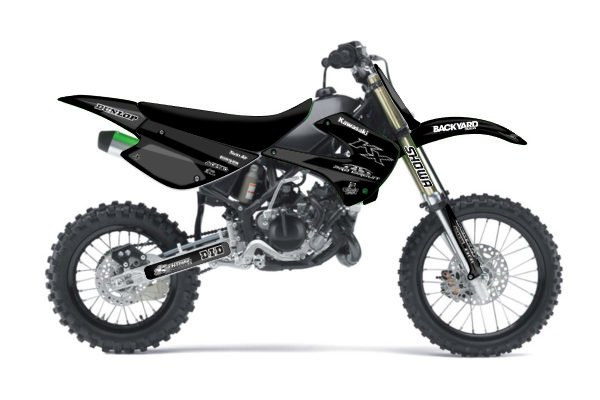
credit: https://backyarddesign.co.nz/
Kawasaki doesn’t publish an official crank horsepower figure for the KX85 (Kawasaki, 2026), which is standard practice for closed-course youth motocross bikes. Independent spec databases list the 84cc engine at roughly 21.5 kW, or about 29 hp, at the crank for recent model years (Motorbikecatalog, 2024).
That number needs context. Rear-wheel dyno testing tells a different story because it accounts for drivetrain loss. A widely cited Motocross Action Magazine dyno session on the redesigned 2014 engine, which shares the same basic architecture still used today, measured 22.68 rear-wheel horsepower and 10.02 ft-lb of torque, up from 18.79 hp on the outgoing design.
A separate owner-submitted dyno run on an earlier bone-stock KX85 came in lower, at 15.8 rear-wheel hp and 7.3 ft-lb of torque, which shows how much dyno numbers can swing based on tune, altitude, and whether the bike is fresh or has hours on the top end.
Here’s the practical takeaway: expect somewhere in the low-20s to high-20s hp range depending on measurement method, with the power valve (KIPS) keeping delivery usable across the rev range rather than making the bike hit like a light switch.
How Does the KX85’s Power Delivery Actually Feel?
The KX85 is tuned for a broad, manageable powerband rather than an aggressive midrange spike. That’s a deliberate choice for a bike aimed at riders roughly 10 to 15 years old moving up from a KX65.
The 84cc engine uses a resin block integrated into the crankshaft to reduce crankcase volume, which raises primary compression and helps the engine build power more consistently.
The compression ratio switches between 9.0:1 at high speed and 10.9:1 at low speed depending on power valve position, smoothing out the transition instead of dumping all the power at once.
Compared to a KTM 85 SX, testers have consistently found the Kawasaki easier to manage. That same Motocross Action testing noted the KTM makes more peak power and pulls harder from 8,000 to 12,400 rpm, but described the KX85’s throttle response as more linear and forgiving for novice riders. That trade-off, less outright power for more rideability, is the whole personality of this bike.
What Suspension and Chassis Setup Does the KX85 Use?
The KX85 runs a KYB 43mm inverted front fork with adjustable compression and rebound damping, delivering 10.8 inches of travel. Out back, a Uni-Trak single shock handles the rear end with dual-range compression and rebound adjustment plus preload, also at 10.8 inches of travel.
That travel number hasn’t moved for the standard KX85 this year, even though its big-wheel sibling, the KX85 L, picked up a bump from 10.8 to 12.0 inches of rear travel thanks to a revised Uni-Trak linkage. If your rider is between the two wheel sizes and rides rougher terrain, that extra rear travel on the L is worth knowing about.
The frame is a high-tensile steel perimeter design, and Kawasaki extended the steering head pipe by 25mm for 2026 to add front-end rigidity. Aluminum has replaced steel on the handlebars, steering stem, and rear sprocket, which is a real, if modest, weight and unsprung-mass improvement over the outgoing parts.
What Brakes Come on the 2026 KX85?
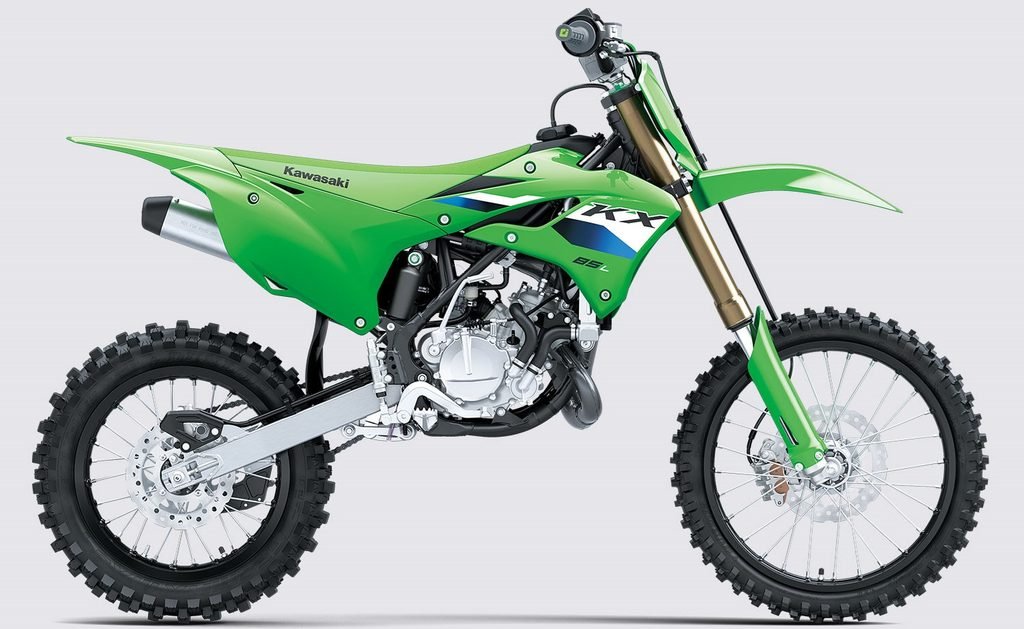
The 2026 KX85 uses a 240mm front petal disc with a dual-piston Nissin caliper and a 220mm rear petal disc with a single-piston caliper. That’s a genuine upgrade from the previous 220mm front / 184mm rear setup.
The bigger front rotor and dual 25mm pistons borrow hardware from the KX250, and the master cylinder is shared with that bike too. Kawasaki also tightened up rear brake pedal stroke for more precise control at the lever. For a bike this size, stopping power was never really the weak point, but the added front bite should help riders who are pushing lap times down and braking later into corners.
How Much Does the KX85 Weigh and What’s the Seat Height?
Dry weight (no fuel) is 160.3 lb, and curb weight with a full 1.32-gallon tank comes to 168.4 lb. Seat height sits at 32.7 inches, with a wheelbase of 49.8 inches and 11.6 inches of ground clearance.
Those numbers matter more for fit than for lap times at this displacement. A rider who can’t comfortably flat-foot or nearly flat-foot the KX85 is going to fight the bike in slow corners and starts, no matter how the engine performs. Kawasaki’s ERGO-FIT system offers six handlebar mount positions to help dial in reach, which is a genuinely useful feature for a bike that a kid might ride for two or three seasons while still growing.
What Does the Kawasaki KX85 Cost?
MSRP on the 2026 KX85 is $4,999, plus a dealer-set destination charge of $315. Total out-the-door price before tax and setup typically lands around $5,300, though your dealer’s destination charge may vary.
That price puts the KX85 squarely against the KTM 85 SX and Yamaha YZ85 in the standard-wheel 85cc class, with the Husqvarna TC 85 and Suzuki RM85 also worth a look depending on what’s sitting on your local dealer’s floor. None of these bikes differ from each other by more than a few hundred dollars at MSRP, so fit, suspension feel, and local dealer support end up mattering more than sticker price.
Frequently Asked Questions About the Kawasaki KX85
How much horsepower does the Kawasaki KX85 make?
Independent spec databases list around 29 hp at the crank for recent model years, while real-world rear-wheel dyno testing on the same basic engine design has measured closer to 22-23 hp depending on tune and condition. Kawasaki doesn’t publish an official factory horsepower rating.
What is the top speed of the Kawasaki KX85?
Kawasaki doesn’t publish a top speed for the KX85 because it’s a closed-course motocross bike, not a street-legal machine. Gearing, track conditions, and rider weight all affect how fast it actually goes on a given day.
What age or size rider is the KX85 designed for?
The KX85 is built for the 85cc amateur motocross class, which typically covers riders roughly 10 to 15 years old moving up from a 65cc machine. Seat height of 32.7 inches means the rider needs to comfortably reach the ground before stepping up to this bike.
What’s the difference between the KX85 and the KX85 L?
The standard KX85 runs a 17-inch front and 14-inch rear wheel with 10.8 inches of travel at both ends. The KX85 L uses bigger 19-inch front and 16-inch rear wheels and picked up more rear-wheel travel for 2026, up to 12.0 inches, thanks to a revised Uni-Trak linkage.
How does the KX85 compare to the KTM 85 SX?
Testing has shown the KTM makes more peak horsepower and pulls harder in the midrange, but the KX85’s power delivery is generally regarded as more linear and easier for less experienced riders to manage. Neither bike is objectively better; the right choice depends on the rider’s skill level and how they like power delivered.