What is the Primary Cause of Motorcycle Crashes?
TL;DR
- In multi-vehicle crashes, the primary cause of motorcycle accidents is a car driver failing to yield — most often by turning left across an oncoming rider’s path.
- In single-vehicle crashes, rider behavior drives the numbers: speeding was a factor in 36% of all motorcycle fatalities in 2023, and 41% of riders killed alone had a blood alcohol concentration at or above 0.08.
- Motorcyclists were killed at a rate nearly 28 times higher than passenger car occupants per 100 million vehicle miles traveled in 2023.
- 6,335 motorcyclists died in US traffic crashes in 2023 — 15% of all traffic fatalities despite motorcycles making up roughly 3% of registered vehicles (NHTSA, 2023).
- Weather is almost never the actual problem: 97% of motorcycle fatalities in 2023 occurred in clear or cloudy conditions.
The Split That Changes Everything: Multi-Vehicle vs. Single-Vehicle Crashes
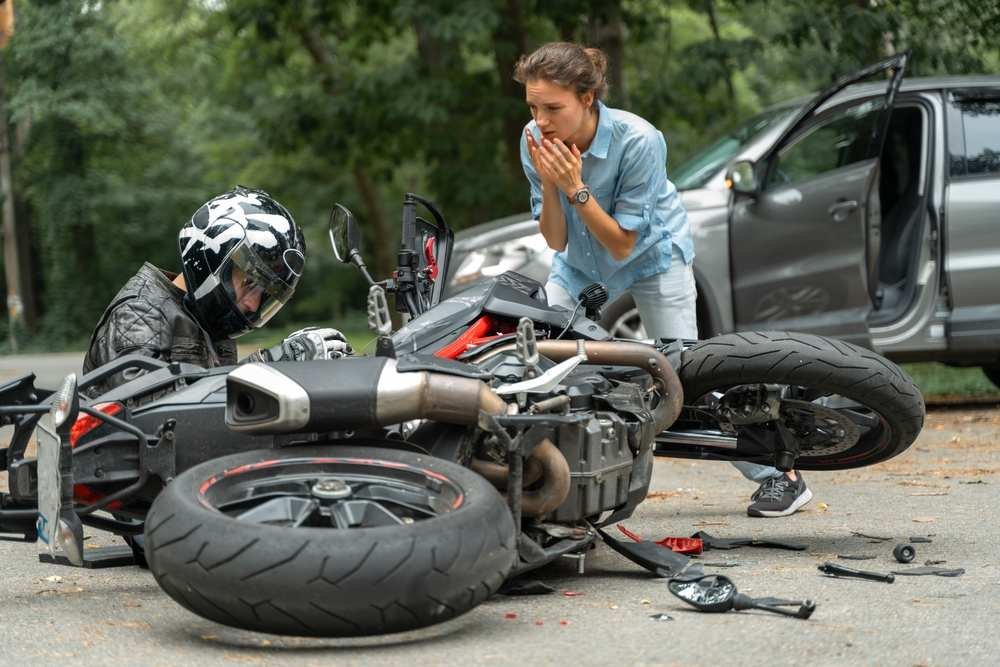
The primary cause of motorcycle crashes depends on which type of crash you’re looking at, and that distinction matters a lot. About 65% of fatal motorcycle crashes in 2023 involved another vehicle; the remaining 35% were single-vehicle incidents (NHTSA, 2023). These two categories have entirely different causes, and treating them as one problem leads to the wrong fixes.
For multi-vehicle crashes, the data points consistently at the other driver. For single-vehicle crashes, the data points at the rider. Both are worth understanding clearly.
| Crash Type | Share of Fatal Crashes | Primary Cause |
|---|---|---|
| Multi-vehicle | ~65% | Other driver failure to yield, especially left turns |
| Single-vehicle | ~35% | Rider error: speed, alcohol, loss of control |
| Weather-related | ~3% | Road conditions, reduced visibility |
| Road defects | ~2% | Potholes, pavement edges, debris |
Why “I Didn’t See the Motorcycle” Is the Most Dangerous Phrase on the Road
In multi-vehicle crashes, the leading cause of motorcycle accidents is a car or truck driver failing to detect the rider in traffic. The Hurt Report (Hurt, Ouellet & Thom, 1981), a NHTSA-commissioned study of 900 crashes that researchers still cite today, identified failure to detect and recognize motorcycles in traffic as the predominating cause of multi-vehicle motorcycle accidents. In two-thirds of those multi-vehicle crashes, the other driver violated the rider’s right of way.
The specific scenario that appears most often: a motorcycle rides straight through an intersection while a car coming from the opposite direction turns left, directly into the rider’s path. The driver either didn’t see the motorcycle at all, or saw it too late. More recent data from Berkeley SafeTREC found that approximately 42% of motorcycle crashes involved another driver failing to detect the motorcycle during a left turn (Berkeley SafeTREC, 2023).
Intersections are where this happens most. A driver’s brain is filtering an enormous amount of visual information at once, and a narrow motorcycle profile — especially one approaching head-on — is easy to miss, particularly if the driver isn’t actively looking for two-wheeled traffic. Motorcycle conspicuity is a documented problem. The Hurt Report found that headlamps on during daylight and high-visibility gear (yellow, orange, or bright red jackets) significantly reduced accident involvement.
Single-Vehicle Crashes: When the Rider Is the Risk
Single-vehicle crashes tell a different story. These are the crashes where a rider goes down without any other vehicle involved: target-fixating into a corner, running wide on a curve, losing the front end to gravel, or hitting a fixed object like a guardrail or tree.
In 2023, 24% of motorcycles in fatal traffic crashes collided with fixed objects — a higher proportion than any other vehicle type (NHTSA, 2023). When a car driver isn’t in the picture, rider inputs and decisions are doing most of the damage. Speed and alcohol are the two primary contributors, and they frequently appear together.
Speeding: The Factor That Runs Through Everything
Speeding is the most common primary crash factor in motorcycle incidents. In 2023, 36% of motorcycle riders involved in fatal crashes were speeding — compared to 22% of passenger car drivers in the same data set (NHTSA, 2023). For riders aged 21 to 24, that figure climbed to 54%. It’s the single variable that shows up most consistently across crash types, age groups, and regions.
The Hurt Report pegged the median pre-crash speed at just 29.8 mph and the median crash speed at 21.5 mph. Most crashes aren’t happening at triple-digit track speeds. They happen at parking-lot-exit velocities and suburban street speeds, where riders feel like they have more control than they do. Speeding in this context often means too fast for the available sightline, road condition, or traffic situation — which includes but goes well beyond exceeding the posted limit.
California SafeTREC data from 2023 confirms the national picture: unsafe speed was the most common primary crash factor in motorcycle fatality and serious injury crashes at 28.2%, ahead of improper turning (19.8%) and failure to yield (19.3%) (Berkeley SafeTREC, 2023).
Alcohol’s Outsized Role in Single-Vehicle Fatalities
Alcohol impairment is a major contributor to motorcycle crash fatalities, and its effect is concentrated in single-vehicle incidents and weekend riding. In 2023, 41% of riders killed in single-vehicle crashes had a blood alcohol concentration of 0.08 g/dL or higher (NHTSA, 2023). For weekend single-vehicle crashes specifically, that figure climbed to 44%.
For context, alcohol impairment ran higher among motorcyclists than any other vehicle type in 2023. Motorcycle riders involved in fatal crashes had a 26% rate of BAC at or above 0.08, compared to 24% for passenger car drivers, 20% for light-truck drivers, and 4% for large-truck drivers (NHTSA, 2023).
A motorcycle demands more of a rider than a car demands of a driver: active balance, precise throttle inputs, separate hand and foot controls for brakes, and fast visual processing. Alcohol attacks all of those simultaneously. A blood alcohol level that leaves a car driver feeling “fine” is enough to collapse a rider’s ability to read a corner or modulate a front brake under hard pressure.
Visibility: The Quiet Factor That Shapes Multi-Vehicle Odds
Motorcycle conspicuity — how visible and noticeable the bike is to other drivers — runs through nearly every multi-vehicle crash scenario. It’s not a standalone cause so much as a condition that makes every other risk worse.
In almost half of all multi-vehicle motorcycle accidents studied in the Hurt Report, the view of the motorcycle or the other vehicle was limited by glare or blocked by other vehicles. The motorcycle’s narrow profile is a real liability: car drivers frequently misjudge a motorcycle’s speed and distance because the visual cues they use for larger vehicles don’t translate accurately to a bike.
Practical conspicuity improvements are well-documented. Running headlights on during the day reduced crash involvement in Hurt Report data. High-visibility gear in yellow, orange, or bright red made a measurable difference. Lane positioning matters too — riding in the left third of your lane when approaching intersections puts you in a driver’s direct sightline rather than their peripheral blur.
What These Causes Mean for How You Ride
Understanding crash cause data changes where you put your attention on the road. For multi-vehicle exposure, intersections are the highest-risk moment. Any driver with a green light preparing to turn left is a potential threat, regardless of whether they’re looking at you. Cover the front brake, reduce speed through intersections, and position yourself where you’re hardest to miss.
For single-vehicle risk, the numbers point at two habits: riding above the pace that matches your actual skill and visibility, and riding after drinking. Neither of these is terrain-specific or equipment-specific. They follow riders onto every kind of road.
One number worth sitting with: the motorcyclist fatality rate per 100 million vehicle miles traveled in 2023 was 31.39, against 1.13 for passenger car occupants (NHTSA, 2023). That’s not a gap that gear alone closes. Awareness of how crashes actually happen — and why — is where the real margin lives.
Frequently Asked Questions About Motorcycle Crash Causes
What is the number one cause of motorcycle accidents in the US?
In multi-vehicle crashes, which make up roughly 65% of fatal motorcycle incidents, the leading cause is another driver failing to yield the right of way — typically by turning left in front of a motorcyclist at an intersection. In single-vehicle crashes, speeding and alcohol impairment are the dominant factors, with 36% of all rider fatalities in 2023 involving speed and 41% of single-vehicle crash victims testing at or above the legal alcohol limit (NHTSA, 2023).
Are most motorcycle accidents the rider’s fault?
No. In multi-vehicle crashes, the other driver caused the accident in two-thirds of cases, according to the Hurt Report (1981), which remains the most-cited crash causation study in motorcycle safety research. In single-vehicle crashes, rider behavior is the primary factor. Overall, crash fault in motorcycle incidents is roughly split between driver error and rider behavior depending on the crash type — the common assumption that riders are usually at fault is not supported by the data.
How common are left-turn crashes for motorcyclists?
Very common. The left-turn crash — where an oncoming car turns across a rider’s path at an intersection — is the single most documented multi-vehicle crash scenario in motorcycle safety research. Berkeley SafeTREC data from 2023 found that approximately 42% of motorcycle crashes involved a driver failing to detect the motorcycle during a left turn.
Does weather cause most motorcycle accidents?
No. Weather is almost never the direct cause. NHTSA data from 2023 shows that 97% of motorcycle fatalities occurred in clear or cloudy conditions. Only 2% happened in rain. The Hurt Report found the same pattern: weather was not a factor in 98% of the crashes studied. Road conditions and rider behavior are far more consequential than weather.
What role does helmet use play in crash survivability?
Helmets don’t prevent crashes, but they dramatically affect outcomes. Studies cited in NHTSA safety literature estimate that helmets reduce the risk of death by approximately 37% and head injury by 67%. In 2023, in states without universal helmet laws, 51% of motorcyclists killed were not wearing helmets, compared to 10% in states with universal helmet laws (NHTSA, 2023). Helmet use among riders reached 73.8% in 2023, the highest recorded rate to date.