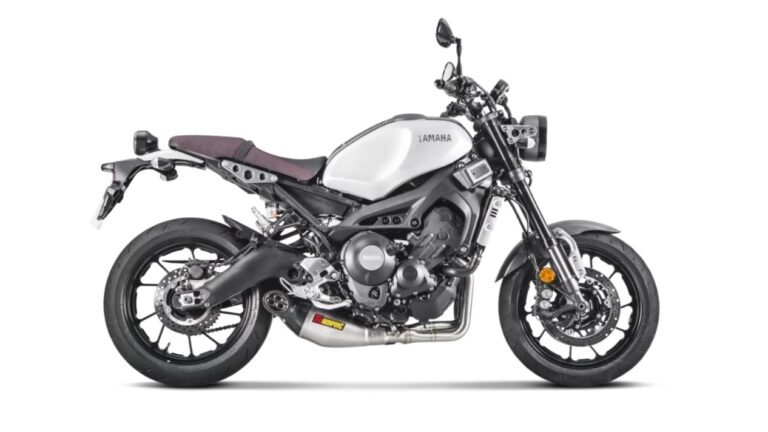
Yamaha Xsr700 Top Speed, Acceleration and Specifications
TL;DR
- The XSR700 reaches a GPS-verified top speed of 127 mph.
- It sprints 0-60 mph in 3.85 seconds and covers the quarter mile in 12.22 seconds.
- Power comes from Yamaha’s 689cc CP2 parallel-twin, making 72 hp and 50 lb-ft of torque at the crank.
- The 2024 US MSRP is $8,899 – $300 more than the mechanically identical MT-07.
- Best suited to intermediate riders, urban commuters, and anyone who wants a modern, reliable machine dressed in old-school clothes.
Yamaha XSR700 Top Speed and Acceleration

The XSR700 tops out at 127 mph, with a 0-60 mph time of 3.85 seconds and a quarter-mile pass of 12.22 seconds at 103 mph. Those numbers come from GPS-instrumented testing by MotoStatz (2026) on a 2024 model with a Mivv aftermarket exhaust fitted – a setup that likely gives it a small bump over a fully stock bike. A stock XSR700 probably sits a tick slower at the top end and through the traps, though not meaningfully so for real-world riding. For context, the quarter-mile time puts it on par with most 650-750cc middleweight naked bikes, which run in the 12.1 to 12.6 second range depending on gearing and conditions.
Yamaha doesn’t publish a top speed figure, and that’s consistent across the CP2 platform. What they do publish is 72 hp at 8,750 rpm and 50 lb-ft of torque at 6,500 rpm at the crank. Dyno testing puts wheel horsepower at around 67 hp and 47 lb-ft – typical drivetrain losses for this class.
The XSR700 won’t embarrass you on a freeway on-ramp or a two-lane pass. At highway speeds, the CP2 has enough pull in sixth gear to close gaps without a downshift. You’re not going to outrun an MT-09 or any liter bike, but that’s not what this machine is for.
Full Specs: 2024-2026 Yamaha XSR700
| Specification | Details |
|---|---|
| Engine | 689cc liquid-cooled DOHC inline twin, 4 valves/cylinder |
| Crank firing order | 270-degree crossplane (CP2) |
| Claimed power | 72 hp @ 8,750 rpm |
| Claimed torque | 50 lb-ft @ 6,500 rpm |
| Wheel power (dyno) | ~67 hp / ~47 lb-ft (MotoStatz, 2026) |
| Top speed | 127 mph (MotoStatz GPS test, 2026) |
| 0-60 mph | 3.85 seconds (MotoStatz, 2026) |
| Quarter mile | 12.22 seconds (MotoStatz, 2026) |
| Transmission | 6-speed with assist/slipper clutch |
| Frame | Aluminium Deltabox |
| Front suspension | 41mm telescopic fork, 130mm travel |
| Rear suspension | Link-type Monocross monoshock, 130mm travel |
| Front brake | Dual 298mm discs, four-piston calipers |
| Rear brake | Single 245mm disc |
| Front tire | 120/70-17 |
| Rear tire | 180/55-17 |
| Seat height | 33.5 in (835mm) |
| Wet weight | ~410 lbs (186 kg) |
| Fuel capacity | 3.7 gallons (14L) |
| Fuel economy | ~58 mpg (Yamaha estimate) |
| US MSRP (2024) | $8,899 |
Sources: Yamaha Motorsports USA; MotoStatz (2026); Cycle World (2024)
What the CP2 Engine Feels Like on the Road
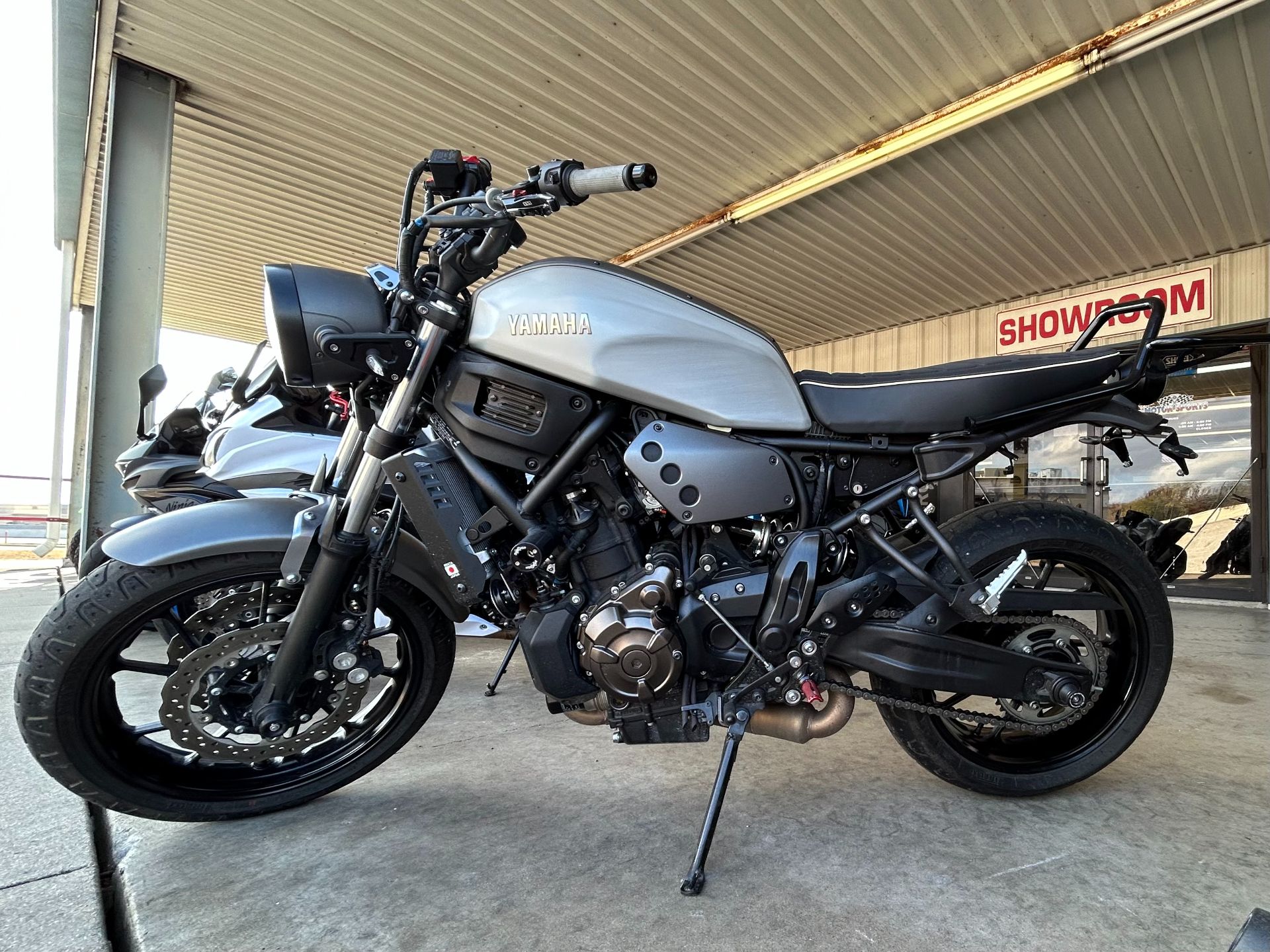
The 270-degree crank is the XSR700’s defining feature. Most parallel-twins fire both cylinders nearly simultaneously, which produces a buzzy, linear power delivery that some riders find flat. The CP2’s uneven firing interval gives it a loping, V-twin-like character – you hear the engine breathe between pulses, and the throttle response feels more organic than the numbers suggest.
Torque arrives at 3,500 rpm and holds through 8,500 rpm. That’s the usable range to keep in mind. Below 3,500 rpm, especially in higher gears, the engine chops a little before it clears its throat and digs in. Above 8,500 rpm, acceleration flattens out rather than building – short shifting between 4,000 and 7,500 rpm gets you moving faster than wringing it to the redline.
The practical payoff: overtaking at 50 mph in sixth gear requires no downshift. Filtering through traffic at 25-35 mph in third gear is effortless. The engine suits city riding better than most 700cc mills because the torque is right there under the throttle, not buried at the top of the rev range.
The CP2 has been in production since 2014. It also powers the MT-07, YZF-R7, and Tenere 700, and in over a decade of real-world use it has earned a strong reliability record – no chronic failures, no recalls specific to the engine. NGK spark plugs, a K&N or OEM air filter swap at service intervals, and fresh Motul or Castrol oil every 4,000-6,000 miles keeps it running. Valve clearance checks are due at 26,600 miles, and based on widespread owner experience, they rarely need adjustment.
Chassis and Handling: MT-07 Underneath, XSR Clothes Outside
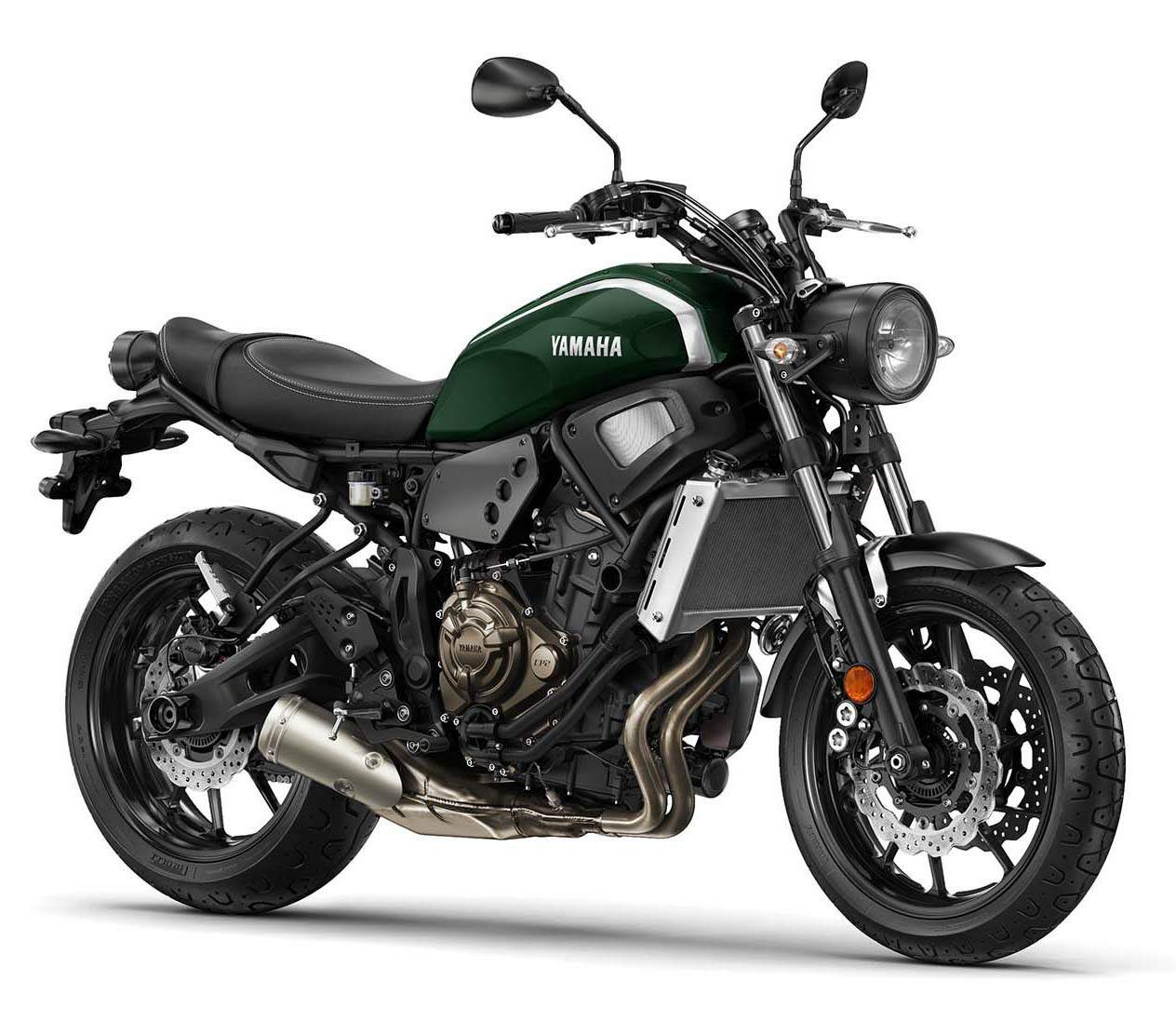
The XSR700 uses the same aluminium Deltabox frame and basic suspension hardware as the MT-07. The 41mm telescopic front fork and link-type Monocross rear shock are tuned toward street comfort rather than track precision, and that’s appropriate for what this bike is supposed to be.
Steering is light and quick. At parking-lot speeds the XSR700 feels nimble for a 410-pound machine. At highway speeds it settles into a stable cruise without feeling dead or vague. The suspension handles urban road surfaces – cracked pavement, utility covers, expansion joints – without beating you up, but it runs out of composure faster than an Ohlins-equipped bike if you push hard through broken corners.
The 2022 model update brought the front brake discs from 282mm to 298mm, a genuine improvement. Paired with four-piston calipers and Michelin Pilot Road 5 tires (the OEM fitment since 2022), braking feel is progressive and easy to modulate. The Pilot Road 5s are a solid all-weather tire – not a track-day compound, but appropriate for street use year-round.
One handling trade-off worth knowing: at 410 lbs wet, the XSR700 is about 10 lbs heavier than the 2014 MT-07. Yamaha added weight through the steel fenders, stepped seat, and retro bodywork. You don’t feel it at speed, but low-speed maneuvering in tight parking is less effortless than on lighter naked bikes.
Ergonomics and Day-to-Day Usability
The XSR700’s riding position sits somewhere between the MT-07’s forward lean and a true standard. The handlebar is wider and higher than on the MT-07, which shifts weight off your wrists and puts you in a more upright stance. Most riders 5’6″ to 6’2″ find the 33.5-inch seat height workable; shorter riders may want to check their flat-foot confidence on a dealer’s floor before committing.
Passenger accommodations are minimal. The stepped seat looks the part but gives a pillion rider a narrow, short perch. It’s not a two-up touring machine.
Instrumentation is a round LCD binnacle – retro-appropriate but limited. You get speed, rpm, gear position, fuel level, and a clock. No TFT screen, no navigation, no Bluetooth. If a full connectivity suite matters to you, the XSR700 won’t deliver it. Yamaha made a deliberate styling call here: a TFT display would look out of place on a machine built around ’70s XS-series aesthetic.
Fuel consumption averages around 58 mpg by Yamaha’s estimate, and real-world owner reports align with that figure. With a 3.7-gallon tank, you’re looking at roughly 200 miles of range before you’re running low – fine for a city and weekend bike, tight for longer touring days.
Verdict: Who Should Buy the XSR700?
The XSR700 is a well-sorted middleweight for riders who want something that works day-to-day without demanding constant management. The CP2 engine is genuinely fun at legal speeds, the chassis handles predictably, and the retro aesthetic means it draws attention without looking aggressive.
It makes most sense for intermediate riders stepping up from a 300-400cc bike who want real performance without a liter-bike’s intensity, urban commuters who want reliability and manageable fuel costs, and riders drawn to the neo-retro look who don’t want to compromise on modern mechanicals. It’s also a reasonable first bike for an experienced rider returning to motorcycles after a gap.
Where it falls short: the instrumentation is basic, the passenger setup is an afterthought, and the $8,899 price puts it $300 above the MT-07, which is functionally identical under the skin. That premium buys you the XSR’s looks and a slightly more upright riding position – whether that’s worth it comes down to personal taste. If you prefer the MT-07’s aggressive styling or want the extra money toward a Shoei helmet or a set of Alpinestars gloves, nothing mechanical changes between the two.
Used examples from 2018-2022 frequently appear in the $5,500-$7,500 range. The 2022 model is worth targeting specifically – that’s the year Yamaha upgraded to 298mm front discs and switched to Michelin Pilot Road 5 tires. Earlier models aren’t unreliable, but the brake and tire updates are genuine improvements worth having.
Frequently Asked Questions
What is the top speed of the Yamaha XSR700?
The XSR700 reaches 127 mph under GPS-instrumented testing, according to MotoStatz (2026). Yamaha does not publish an official top speed figure. The test bike carried a Mivv aftermarket exhaust, so a fully stock XSR700 may be marginally slower, though the difference at the top end is unlikely to exceed 2-3 mph in practical terms.
How fast is the XSR700 from 0-60 mph?
MotoStatz measured a 0-60 mph time of 3.85 seconds on a 2024 XSR700 in GPS-instrumented testing (2026). The bike covers the quarter mile in 12.22 seconds. These figures are competitive for the 650-700cc middleweight class and quicker than most riders expect from 72 hp.
Is the Yamaha XSR700 good for beginners?
The XSR700 is manageable for a beginner with prior riding experience, but it’s better described as an intermediate-level machine. The CP2 engine delivers torque early and strongly enough to catch a new rider off-guard. It’s an excellent second bike for someone who has already developed throttle control on a 300-400cc machine.
What is the difference between the XSR700 and the MT-07?
Mechanically, they share the same CP2 689cc engine, Deltabox frame, suspension geometry, brakes, and electronics. The XSR700 weighs about 10 lbs more due to retro bodywork, steel fenders, and a stepped seat. The riding position is slightly more upright on the XSR700 thanks to a wider, higher handlebar. The XSR700 costs $300 more than the MT-07 at US MSRP (Yamaha Motorsports USA, 2024).
How reliable is the Yamaha XSR700?
The CP2 engine has been in production since 2014 across the MT-07, XSR700, YZF-R7, and Tenere 700. In over a decade of widespread use, it has not produced any chronic or class-wide failures. Valve clearances are due at 26,600 miles and rarely need adjustment in practice. Maintained on a standard service schedule – oil changes every 4,000-6,000 miles, chain tension checks per owner’s manual intervals – the engine is one of the more dependable units in its class.