Yamaha YZF-R7 Review: Specs, Performance & Who It’s For
TL;DR
- The 2026 Yamaha YZF-R7 makes a claimed 73 hp at 8,750 rpm and 50.2 lb-ft of torque at 6,500 rpm from a 689cc CP2 parallel twin.
- Wet weight is 417 lb with a 32.7-inch seat height and a 3.7-gallon fuel tank.
- The 2026 model adds ride-by-wire throttle, a six-axis IMU, full traction/slide/wheelie/launch control suite, and Brembo master cylinder with radial-mount front calipers.
- MSRP starts at $9,399 for standard colors; the 70th Anniversary Edition is $9,699.
- Best for: intermediate riders ready to step up from a 300-400cc machine, and experienced riders who want a fun, manageable track-day weapon without a $15,000 price tag.
2026 Yamaha YZF-R7 Full Specs
| Spec | Detail |
|---|---|
| Engine | 689cc liquid-cooled DOHC parallel twin |
| Power (claimed) | 73 hp @ 8,750 rpm |
| Torque (claimed) | 50.2 lb-ft @ 6,500 rpm |
| Transmission | 6-speed, wet multiplate assist & slipper clutch |
| Throttle | Ride-by-wire (Y-CCT), new for 2026 |
| Frame | High-tensile steel tubular, redesigned 2026 |
| Front Suspension | KYB 41mm inverted, fully adjustable |
| Rear Suspension | Linked Monocross single shock, preload + rebound adj. |
| Front Brakes | Dual 298mm rotors, radial-mount 4-piston calipers, Brembo M/C |
| Rear Brake | Single 245mm disc |
| Tires (OEM) | Bridgestone Battlax Hypersport S23 |
| Wheelbase | 54.9 in |
| Rake / Trail | 24° / 3.6 in |
| Seat Height | 32.7 in |
| Wet Weight | 417 lb |
| Fuel Capacity | 3.7 gal |
| Electronics | 6-axis IMU, TCS, SCS, LIF, BC, EBM, ABS, launch control |
| Display | 5-inch TFT with smartphone connectivity |
| MSRP (US) | $9,399 (standard) / $9,699 (70th Anniversary Edition) |
Source: Yamaha Motorsports USA, Rider Magazine, 2026
What the CP2 Engine Actually Delivers on the Street and Track
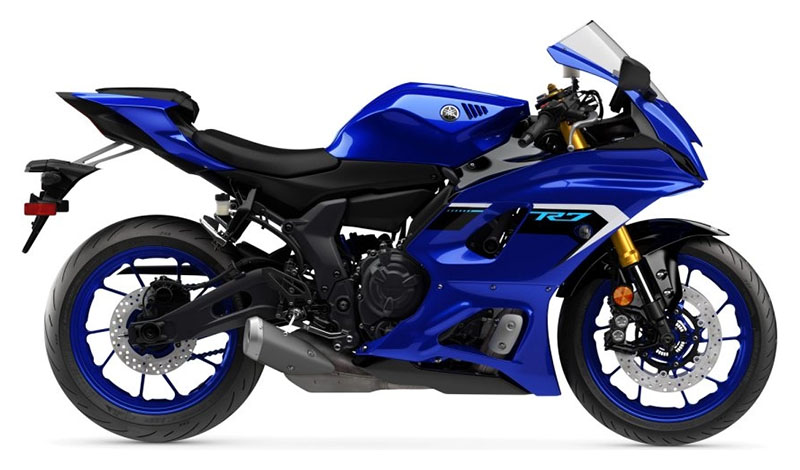
The 2026 YZF-R7 runs the same 689cc CP2 parallel twin found in the MT-07, Tracer 7, Ténéré 700, and XSR700 – a platform Yamaha has been refining for years. The mechanicals are unchanged from 2025, which means you get a 270-degree crankshaft that fires in an uneven sequence, giving the engine a characterful, slightly V-twin-like pulse that a traditional 600cc inline-four never could. Claimed output is 73 hp at 8,750 rpm and 50.2 lb-ft of torque at 6,500 rpm (Cycle News, 2026).
Those numbers won’t scare a Kawasaki ZX-6R rider. But they tell an incomplete story. The CP2’s real strength is in the low-to-mid rpm range, where everyday riding actually happens. Roll on from 4,000 rpm in third gear and the bike accelerates cleanly without fussing or needing a downshift. That kind of usability on a canyon road or a tight technical track session adds up fast.
For 2026, Yamaha added ride-by-wire throttle (Y-CCT) to the R7 for the first time. A reshaped airbox with a straight-down draft duct improves both throttle response and intake sound. The net result is sharper pickup off slow corners and smoother closed-throttle transitions – exactly the kind of refinement that makes a bike feel more expensive than it is.
The assist and slipper clutch keeps lever effort low and prevents rear wheel hop on hard downshifts. An optional quick-shift system (QSS) adds clutchless upshifts and, new for 2026, downshifts as well.
The 2026 Electronics Package: What Changed and Why It Matters
The 2026 R7’s electronics suite is the biggest jump the model has seen since its 2022 launch. A new six-axis inertial measurement unit (IMU) is the backbone of the whole system, enabling lean-sensitive versions of every major rider aid. This is the same philosophy Yamaha applies on the R9 and R1 – it’s just now trickled down to a $9,399 entry point.
Here’s what the six-axis IMU enables:
- Traction Control (TCS): Four levels plus off. Cornering-sensitive, so it reacts to lean angle, not just wheel speed.
- Slide Control (SCS): Four levels plus off. Detects lateral slides and adjusts power to manage cornering attitude.
- Lift Control (LIF): Four levels plus off. Detects front wheel lift and trims power to keep the chassis settled.
- Cornering ABS (BC): Works with the ABS system to modulate brake pressure based on lean angle.
- Engine Brake Management (EBM): Two levels. Lets you dial in how much engine braking you want on deceleration.
- Launch Control: A welcome addition for track days.
Ride modes cover Rain, Street, and Sport, plus two custom road modes and four custom track modes – the track modes allow rear ABS to be switched off (Cycle News, 2026). A new 5-inch TFT display manages all of it and adds smartphone connectivity for navigation.
Cruise control is standard and works in third gear or higher above 25 mph, which actually makes the R7 more tolerable on highway slabs than you’d expect from a full-tuck sportbike.
Chassis, Suspension, and How the 2026 R7 Feels Mid-Corner
The 2026 YZF-R7 sits on a redesigned high-tensile steel tubular frame that Yamaha stiffened without adding weight. The swingarm is a revised asymmetrical cast-aluminum unit, and a new triple clamp design draws from lessons learned on the R9 and R1. None of these are cosmetic changes – they’re targeted stiffness improvements aimed at feedback and stability under hard braking and mid-corner inputs.
Up front, the KYB 41mm inverted fork is now fully adjustable for compression, rebound, and preload, with aluminum internal components that shave roughly 0.75 lb versus the outgoing unit (Rider Magazine, 2026). Less unsprung weight means the fork follows road imperfections more faithfully, which shows up as better feel through bumpy corners rather than just better numbers on a spec sheet.
The rear is a linked Monocross single shock with adjustable preload and rebound. It’s not a fully adjustable unit, but the linkage was revised to improve stability and ground feel. Standard rubber is Bridgestone Battlax Hypersport S23 – a tire that’s roughly on par with Michelin’s Power 6 for street/track crossover use. Factory tire fitment at this price is usually a compromise; the S23 is not.
Stopping hardware pairs dual 298mm front rotors with radial-mount four-piston calipers and a Brembo master cylinder. That master cylinder matters: it gives the lever a more linear, confidence-building feel compared to a generic master cylinder, and it’s the same spec you’d expect on bikes costing several thousand dollars more. One pull and you’ll know the difference.
Ergonomics, Comfort Limits, and Who Actually Fits This Bike
The R7 is a sportbike, and the riding position says so immediately. Clip-on handlebars, elevated rear sets, and a forward lean are non-negotiable. Yamaha revised the 2026 ergonomics with higher, closer-in clip-ons (moved 8.4mm back, 3.6mm up, and 12mm wider), a flatter seat with grippier cover material, and a new fuel tank shape with deeper knee cut-outs that give riders more room to shift their weight (Cycle News, 2026). Seat height is 32.7 inches – down slightly from the previous model.
Those changes help, but they don’t turn the R7 into a sport-touring bike. Your wrists will let you know around the 30-45 minute mark on a highway. On a backroad or a track, the same position that beats you up on a straight line puts you exactly where you need to be for a fast corner.
At 32.7 inches, riders between 5’6″ and 5’11” will feel the most at home. Shorter riders can touch down with one foot at a time; taller riders will find the peg position aggressive on extended sessions. The 417 lb wet weight is light enough to feel agile at parking-lot speeds and disappears entirely once you’re rolling.
The 3.7-gallon tank gives a realistic range of 140-160 miles depending on riding style and conditions – enough for most canyon runs without a fuel stop.
Honest Assessment: Strengths, Weaknesses, and Who Should Buy It
The 2026 Yamaha YZF-R7 is the most capable version of this bike since its 2022 debut. The ride-by-wire, six-axis IMU, full electronics suite, revised chassis, and better ergonomics make it feel like a genuine step up rather than a color refresh. At $9,399, nothing in the supersport class matches this combination of features, real-world usability, and long-term reliability from the CP2 platform.
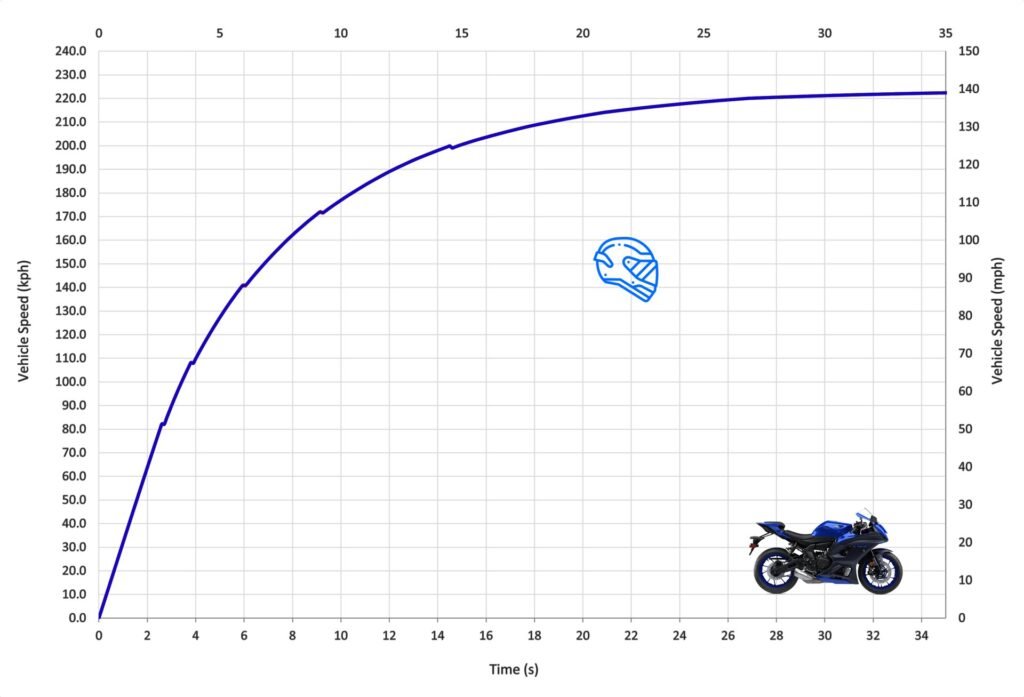
The weaknesses are predictable and honest. The parallel twin tops out before a 600cc inline-four competitor does, and riders chasing peak-power acceleration numbers will be disappointed above 9,000 rpm. Pillion comfort is minimal. The riding position, while improved, still punishes anyone expecting a sport-touring experience.
Buy it if: You want R1-derived electronics at a third of the R1’s price, you’re an intermediate rider who has outgrown a 300-400cc machine, or you want a track day bike that’s actually manageable and won’t eat you alive when you make a mistake.
Skip it if: You’re a 6’2″ rider who does 300-mile days, you want a 180+ mph top speed run on a track, or you’re a complete beginner who hasn’t yet developed throttle control instincts.
As Yamaha’s top-selling motorcycle by segment in recent years (Rider Magazine, 2026), the R7 has clearly found its audience. The 2026 update gives existing owners a reason to trade in and new buyers a much more complete package.
Frequently Asked Questions About the Yamaha YZF-R7
How much horsepower does the 2026 Yamaha YZF-R7 make?
The 2026 YZF-R7 makes a claimed 73 hp at 8,750 rpm and 50.2 lb-ft of torque at 6,500 rpm from its 689cc CP2 parallel twin (Yamaha Motorsports USA, 2026). Those figures are unchanged from the 2025 model, but the addition of ride-by-wire throttle for 2026 sharpens throttle response and improves closed-throttle transitions.
What is the seat height on the 2026 YZF-R7?
Seat height on the 2026 YZF-R7 is 32.7 inches, down slightly from the previous model following ergonomic revisions that also include higher and wider clip-ons and a flatter, grippier seat surface (Rider Magazine, 2026). Riders between roughly 5’6″ and 5’11” generally fit the bike best.
How much does the 2026 Yamaha YZF-R7 cost?
The 2026 YZF-R7 starts at $9,399 MSRP for standard colorways (Team Yamaha Blue, Breaker Cyan, and Raven). The 70th Anniversary Edition in white/red speed block livery is $9,699 (Yamaha Motorsports USA, 2026). Prices do not include tax, title, prep, or destination charges.
Is the Yamaha YZF-R7 good for beginners?
The R7 is better described as an intermediate rider’s bike. It has enough performance and a forward-leaning riding position that can overwhelm someone without prior throttle control experience. Beginners are better served starting on the YZF-R3 or a similar 300-400cc machine before stepping to the R7. Experienced riders will find the CP2 engine approachable and the new electronics suite forgiving when it counts.
What electronics does the 2026 Yamaha YZF-R7 have?
The 2026 R7 gets a full electronics package built on a new six-axis IMU. This includes four-level traction control (TCS), four-level slide control (SCS), four-level lift/wheelie control (LIF), cornering ABS (BC), two-level engine brake management (EBM), and launch control. Ride modes include Rain, Street, Sport, two custom road modes, and four custom track modes with rear ABS disable available (Yamaha Motorsports USA, 2026).