Yamaha R1 Top Speed, Specs & Review
TL;DR
- The Yamaha YZF-R1 reaches a GPS-verified top speed of 191 mph and covers the standing quarter mile in 10.12 seconds at 154 mph.
- Power comes from a 998cc crossplane CP4 inline-four making 200 hp at 13,500 rpm and 83 lb-ft of torque.
- The 2026 R1 costs $19,199 MSRP; the R1M variant starts at $27,899 and adds Ohlins ERS suspension and full carbon fiber bodywork.
- For 2025/2026, Yamaha added Brembo Stylema monobloc calipers, a new KYB fully adjustable front fork, and MotoGP-derived carbon fiber winglets.
- The R1 is a track-first machine with a 33.7-inch seat height and 448 lb wet weight. It rewards experienced riders who spend time on circuit.
2026 Yamaha YZF-R1 Specs at a Glance
| Specification | 2026 Yamaha YZF-R1 |
|---|---|
| Engine | 998cc liquid-cooled inline-4, DOHC, 4 valves/cyl |
| Bore x Stroke | 79.0 mm x 50.9 mm |
| Compression Ratio | 13.0:1 |
| Peak Power | 200 hp @ 13,500 rpm (manufacturer claim) |
| Peak Torque | 83 lb-ft @ 11,500 rpm |
| Transmission | 6-speed, wet multiplate assist/slipper clutch |
| Front Suspension | 43mm KYB inverted fork, fully adjustable, 4.7 in travel |
| Rear Suspension | KYB single shock, fully adjustable, 4.7 in travel |
| Front Brakes | Dual 320mm disc, Brembo Stylema calipers, ABS |
| Rear Brake | 220mm disc, ABS |
| Front Tire | 120/70ZR17 Bridgestone Battlax RS11F |
| Rear Tire | 190/55ZR17 Bridgestone Battlax RS11R |
| Seat Height | 33.7 in |
| Wet Weight | 448 lb |
| Fuel Capacity | 4.5 gal |
| MSRP (US) | $19,199 |
Source: Yamaha Motor Corporation USA, 2026
Yamaha R1 Top Speed: What the Numbers Actually Say
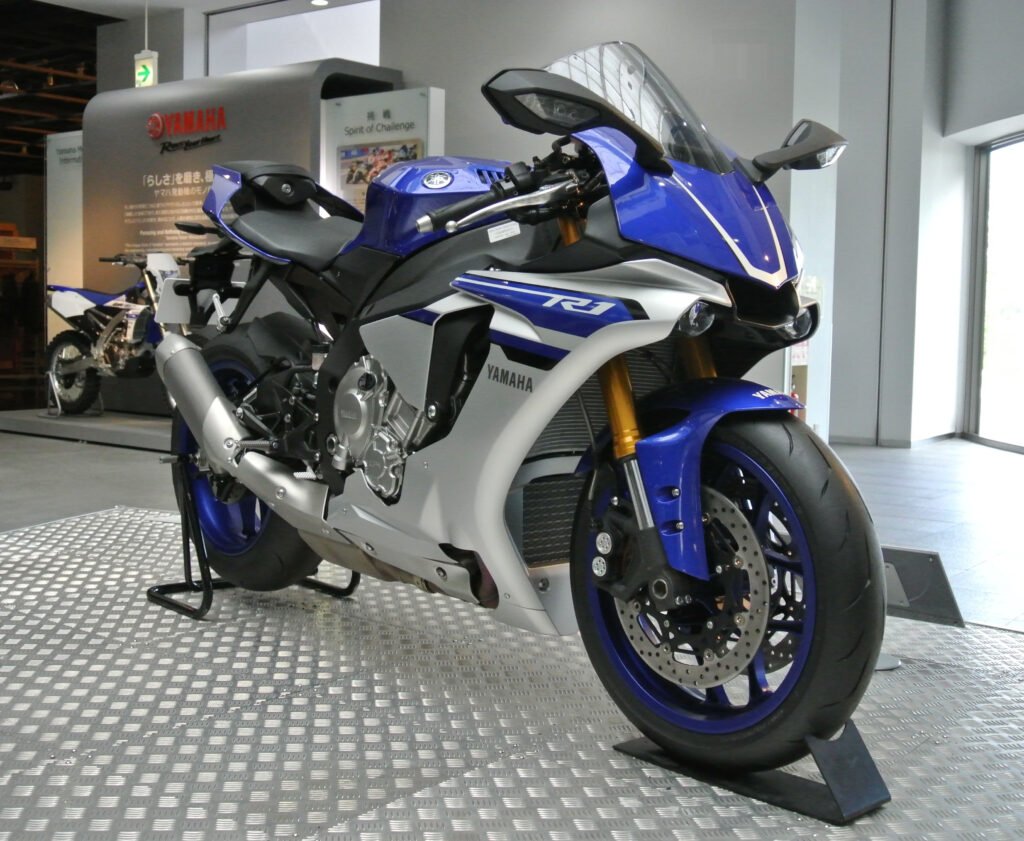
The Yamaha YZF-R1 top speed is 186 mph under normal conditions and 191 mph under optimal GPS testing conditions. Yamaha does not publish a top speed figure for the R1, so those numbers come from independent GPS testing.
MotoStatz GPS-tested the 2015-2019 generation R1 (which shares the same 998cc CP4 engine and bore/stroke dimensions as the 2026 model) and recorded a top speed of 191 mph along with the acceleration figures below (MotoStatz, 2025).
| Speed Benchmark | Time (seconds) |
|---|---|
| 0-60 mph | 3.10 |
| 0-100 mph | 5.73 |
| 0-150 mph | 9.53 |
| 0-180 mph | 16.28 |
| Top Speed (GPS) | 191 mph |
| Standing 1/4 Mile | 10.12 sec @ 154 mph |
| 0-300 km/h | 22.10 sec |
Source: MotoStatz GPS-instrumented testing, 2025. Engine architecture unchanged from tested generation.
The R1M, with its Ohlins ERS suspension and slightly better aerodynamic management, recorded a 0-60 mph time of 2.6 seconds in MotorTrend testing (MotorTrend, 2019). That extra four-tenths of a second comes from the R1M’s more aggressive launch control calibration.
Worth flagging: the R1 hits a flat torque curve only after about 9,000 rpm. Below 7,000 rpm, you’re not getting the machine’s best. Dynometer testing puts rear-wheel power around 181 hp at 13,500 rpm (MotoStatz, 2025), with the gap between claimed crank figure and wheel figure explained partly by US emissions calibration, which can reduce output compared to European spec machines.
The Crossplane CP4 Engine: Why It Feels Different From Every Other Liter Bike
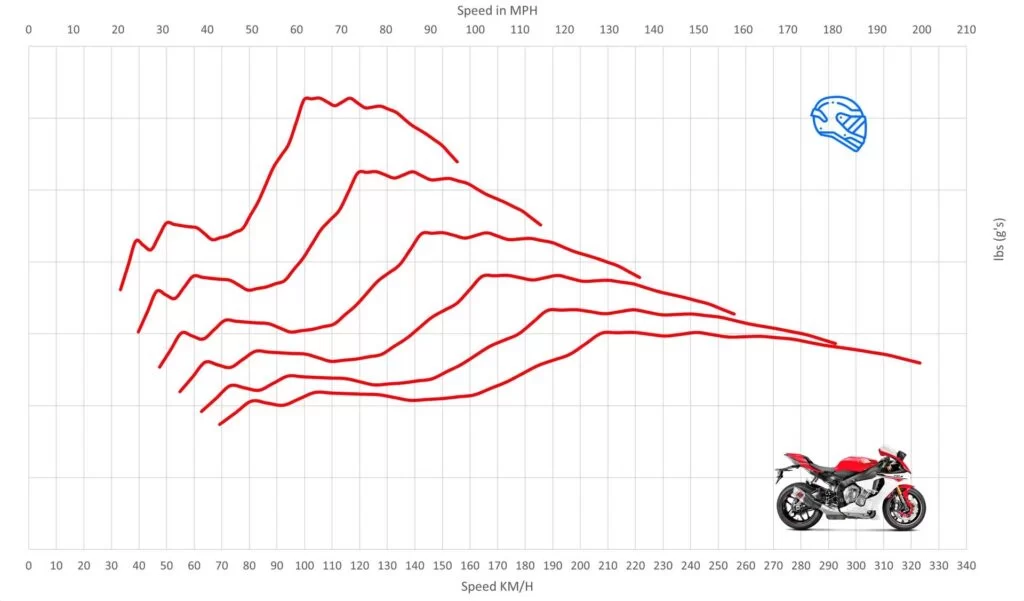
The R1 engine does something no standard inline-four does: it fires with an uneven 270-180-90-180 degree sequence instead of the conventional 180-degree rhythm. That firing order comes from the crossplane crankshaft, which spaces crankpins 90 degrees apart rather than the usual 180.
The practical effect is a reduction in what engineers call inertial torque – the crank speed variation that makes a normal inline-four feel like it’s pulling at your wrist as it spins. Take that pulsing away and you get a more linear, V4-like torque delivery. At the rear wheel, that translates to better corner-exit traction, because the tire isn’t fighting sudden surges of crank-side momentum when you roll the throttle on.
The R1 also uses Yamaha’s Chip Controlled Intake (YCC-I) system, which adjusts the length of the intake funnel based on engine speed. Below 7,600 rpm it uses a longer intake for mid-range pull. Above 7,600 rpm, it switches to the shorter funnel and the top-end opens up. Combined with titanium connecting rods, titanium intake valves, and forged pistons, the motor is built to spin hard.
The honest downside: this engine is not pleasant around town. Below 7,000 rpm in traffic it feels soft. Street riders who spend more time commuting than tracking should factor that in.
Chassis, Suspension, and Braking: What Changed for 2025-2026
The R1 runs Yamaha’s Deltabox aluminum alloy frame, which has been in continuous development since 1998 but was substantially reworked for the 2015 generation. The geometry sits at 24.0 degrees of rake with 4.0 inches of trail, figures matched to sport riding rather than relaxed touring.
For 2025, Yamaha replaced the previous front fork with a revised 43mm KYB fully adjustable unit offering individual left/right adjusters for preload, high-speed and low-speed compression, and rebound. That is a meaningful upgrade from what was a less granular setup. The rear shock is also fully adjustable KYB with 4.7 inches of travel.
The brake upgrade for 2025 was equally significant. The previous-generation calipers gave way to Brembo Stylema monobloc units, the same calliper found on track-focused bikes considerably more expensive than the R1. These calipers weigh less than the outgoing parts and run a new Brembo master cylinder matched to the system. The 320mm front discs remain the same diameter, but initial bite and modulation improved noticeably with the new hardware (Total Motorcycle, 2024).
The new carbon fiber winglets, developed from Yamaha’s MotoGP program, add measurable front-end downforce at high speed. They are not decorative. At 150+ mph they contribute to stability and front-end feel under braking.
Tires are Bridgestone Battlax RS11s front and rear – a road-legal track tire that performs well when warm but needs a few miles to come up to temperature in cold conditions.
Electronics Suite: Six-Axis IMU, Traction Control, and Ride Modes
The R1’s electronics package centers on a six-axis Inertial Measurement Unit (IMU), which feeds lean-angle data to every active system on the bike in real time. That includes the traction control, the slide control, the lift control, the ABS, and the engine brake management.
Ride-by-wire is handled by Yamaha’s YCC-T (Yamaha Chip Controlled Throttle) system, which means the throttle position sensor sends a signal to the ECU rather than a cable moving a butterfly directly. This lets the ECU intervene – smoothing inputs, cutting cylinders, adjusting throttle response – without the rider noticing the intrusion.
What this means in practice: you can run traction control on street or track and the system is genuinely smart enough to let the rear wheel slide a few centimetres before stepping in, rather than cutting power abruptly mid-corner. The Launch Control System (LCS) has three levels, and with it on you can honestly crack 2.9-3.1 second 0-60 times repeatedly without a perfect clutch technique.
Engine Brake Management (EBM) also has three levels. Turn it down and the crossplane engine’s natural braking effect becomes more pronounced. Turn it up and downshifts on the brakes tighten up considerably.
The ABS system is lean-sensitive, meaning it adjusts intervention based on your bank angle. You can brake later into corners than on bikes with conventional ABS, because the system understands you are not upright.
One area where the R1’s electronics trail the very top of the class: the standard bike does not include a data logger or GPS track-mapping system. That is an R1M feature. For track day use, you’d need to add a third-party unit like a Garmin Catalyst or Aim Solo.
Who Should Buy the Yamaha R1 – and Who Probably Should Not
The R1 is the right bike for experienced riders who track regularly, want a machine with race-born engine character, and are willing to learn its powerband. If you put serious miles on track or attend multiple track days per year, the Brembo/KYB/IMU package is genuinely world-class at $19,199.
The R1M at $27,899 is worth the premium for riders who want Ohlins ERS suspension that automatically adjusts while riding, full carbon bodywork, magnesium wheels, and a CCU data logger. That is a proper race-prepped machine. For street-only or occasional track riders, the $8,700 gap is harder to justify.
The R1 is probably not for you if street riding makes up 80% or more of your use. The aggressive ergonomics – 33.7-inch seat height with a pronounced forward lean – cause real fatigue on anything over an hour of mixed road riding. The engine’s tight powerband is also frustrating in city traffic. A Yamaha MT-10 covers the same engine architecture in a far friendlier package for street use, at a lower price.
Frequently Asked Questions About the Yamaha R1
What is the top speed of the Yamaha R1?
The Yamaha YZF-R1 achieves a GPS-verified top speed of 191 mph under optimal conditions, with 186 mph being a more typical real-world figure. Yamaha does not publish a top speed claim; both figures come from GPS instrumented testing by MotoStatz (2025). The standing quarter mile arrives in 10.12 seconds at 154 mph.
How much horsepower does the Yamaha R1 make?
Yamaha rates the 2026 YZF-R1 at 200 hp at 13,500 rpm and 83 lb-ft of torque at 11,500 rpm (Yamaha Motor Corporation, 2026). At the rear wheel, GPS-validated dyno runs show approximately 181 hp, with some variation based on emissions calibration in US-market machines compared to European spec.
What is the 0-60 time for the Yamaha R1?
The Yamaha YZF-R1 reaches 60 mph in 3.10 seconds from a standing start in GPS testing (MotoStatz, 2025). The R1M version, with its refined launch control calibration, recorded 2.6 seconds in independent testing (MotorTrend, 2019). These are real-world figures with a street-legal bike, not drag-prepped machinery.
What is the difference between the Yamaha R1 and R1M?
The R1M ($27,899 MSRP) adds Ohlins Electronic Racing Suspension (ERS) that automatically adjusts damping in real time, full carbon fiber bodywork, ten-spoke cast magnesium wheels, a titanium muffler, and a Communication Control Unit (CCU) for GPS data logging on track. Both bikes use the same 998cc CP4 engine and electronics architecture. The standard R1 ($19,199) uses manual KYB suspension and aluminum wheels.
Is the Yamaha R1 good for beginners?
The R1 is not a beginner motorcycle. The 200 hp engine does most of its work above 9,000 rpm, the seating position is track-aggressive, and the clutch is firm enough to make smooth launches a learned skill. A new rider would benefit from starting on an R3 or R7 before stepping to the R1. For experienced riders moving from a 600cc supersport, the R1 is a natural and logical step up.