Honda Gold Wing Specs, Top Speed & Performance
TL;DR
- The 2026 Honda Gold Wing GL1800 runs a 1,833cc liquid-cooled flat-six producing 125 hp at 5,500 rpm and 125 lb-ft of torque at 4,500 rpm
- Top speed is electronically capped at 105 mph; real-world cruising comfort lives at 70-80 mph where the engine barely breaks a sweat.
- 0-60 mph takes approximately 3.7 seconds for the DCT model, making it surprisingly fast for a 800+ lb touring bike
- Curb weight is 806 lb (manual) on the base model; the Tour DCT tips the scales heavier depending on trim.
- Base MSRP starts at $25,500 for the standard Gold Wing; the Tour model starts at $29,500.
What Is the Honda Gold Wing GL1800?
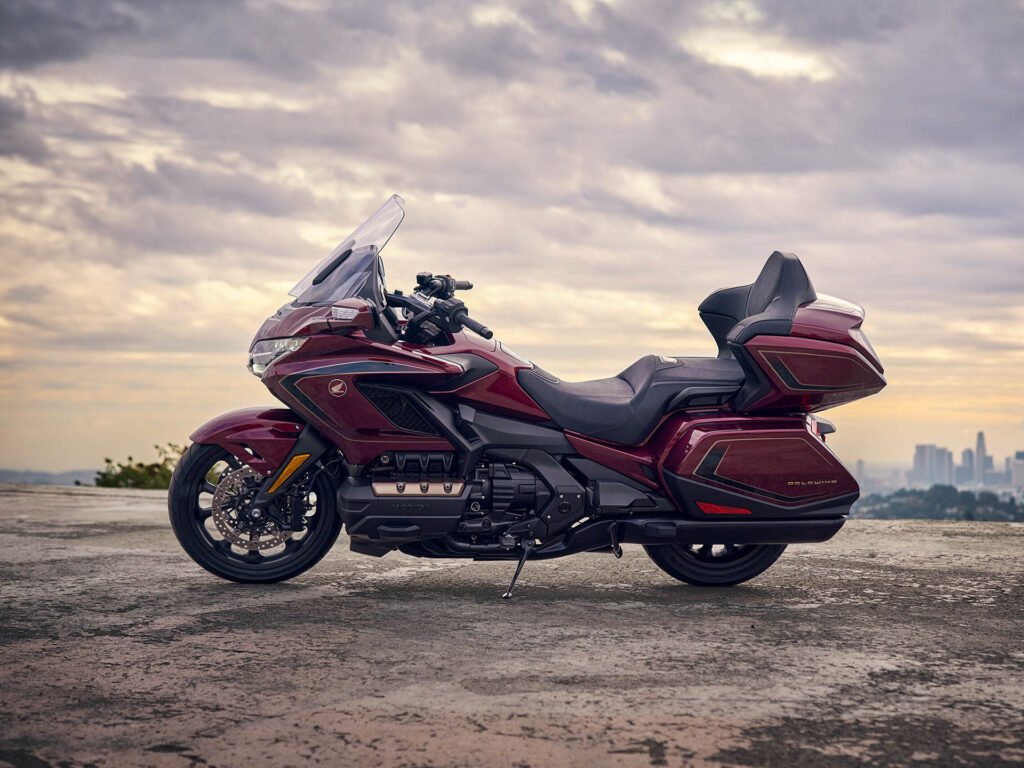
The Honda Gold Wing GL1800 is Honda’s flagship long-distance touring motorcycle, built around a horizontally opposed (flat) six-cylinder engine and shaft drive. Honda has made the Gold Wing since 1975, and the current GL1800 generation arrived in 2018 with a complete redesign that cut over 88 lb from the previous model (Honda, 2018). The 2026 model carries that same architecture with updated color options and wireless Apple CarPlay/Android Auto added for the 2025 50th Anniversary year.
This is not a bike for new riders. At 806 lb wet and 29.3 inches of seat height, it demands experience and physical confidence. For the right rider, though, it’s one of the most capable long-haul touring machines available at any price.
Honda Gold Wing Full Specs Table (2025/2026 GL1800)
| Spec | Standard (Manual) | Tour DCT |
|---|---|---|
| Engine | 1,833cc flat-six, SOHC | 1,833cc flat-six, SOHC |
| Bore x Stroke | 73.0 mm x 73.0 mm | 73.0 mm x 73.0 mm |
| Compression Ratio | 10.5:1 | 10.5:1 |
| Horsepower | 125 hp @ 5,500 rpm | 125 hp @ 5,500 rpm |
| Torque | 125 lb-ft @ 4,500 rpm | 125 lb-ft @ 4,500 rpm |
| Transmission | 6-speed manual | 7-speed DCT |
| Final Drive | Shaft | Shaft |
| Curb Weight | 806 lb (365 kg) | ~853 lb (387 kg) |
| Seat Height | 29.3 in (745 mm) | 29.3 in (745 mm) |
| Wheelbase | 66.9 in (1,700 mm) | 66.9 in (1,700 mm) |
| Fuel Capacity | 5.5 gal (21 L) | 5.5 gal (21 L) |
| Front Suspension | Double wishbone, 4.3 in travel | Double wishbone, 4.3 in travel |
| Rear Suspension | Pro-Link single shock, 4.1 in travel | Pro-Link single shock, 4.1 in travel |
| Front Brakes | Dual 320 mm discs | Dual 320 mm discs |
| Rear Brake | Single 316 mm disc | Single 316 mm disc |
| Front Tire | 130/70-18 | 130/70-18 |
| Rear Tire | 200/55-16 | 200/55-16 |
| MSRP (US, 2026) | $25,500 | $29,500+ |
Sources: Honda Powersports (2026), Torquepedia (2026)
Honda Gold Wing Top Speed: How Fast Does It Actually Go?
The Gold Wing’s top speed is electronically limited to 105 mph. BT Moto confirmed this during dyno testing, describing it as hitting a hard wall at that number in Sport mode (BT Moto, 2024). Estimated mechanical potential before the limiter kicks in runs somewhat higher, but Honda’s factory calibration holds firm.
That said, 105 mph on a 806 lb touring bike loaded with luggage and a passenger is genuinely fast. The flat-six’s torque curve is broad and linear – you’re not chasing a narrow powerband. Roll-on from 60 mph is immediate and unhesitant, which matters far more during interstate passes than any top-speed figure does.
Real-world touring sweet spot: 70-80 mph. At those speeds, the Gold Wing is whisper-quiet, the windscreen deflects wind cleanly, and the engine sits well below its power peak with plenty of reserve.
Honda Gold Wing Acceleration: 0-60 mph and Quarter Mile
The DCT version runs 0-60 mph in approximately 3.7 seconds and covers the quarter mile in about 12.1 seconds (ProfessCars, 2025). The Tour DCT, with added weight, runs 0-60 mph in roughly 3.8 seconds and a 12.2-second quarter mile (ProfessCars, 2025).
Note: These figures are ProfessCars estimations based on engine output and weight data, not independently timed dyno runs. Real-world results will vary with rider weight, road conditions, and altitude. That said, they align with what experienced Gold Wing riders report: the bike accelerates faster than its size suggests, especially from 30-70 mph where that low-RPM torque does its best work.
For context, the flat-six makes 125 lb-ft at just 4,500 rpm. That’s like having the throttle response of a lazy freeway on-ramp every time you crack it open.
How the 1,833cc Flat-Six Engine Works
The Gold Wing engine is a horizontally opposed six-cylinder – meaning three cylinders lie flat on each side of the bike. Honda uses this layout because it keeps the center of gravity low and pushes the engine forward in the frame, tightening the wheelbase and improving balance. The flat-six also cancels most primary vibration naturally, which is why long rides on a Gold Wing feel physically easier than an equivalent distance on a parallel-twin or V-twin.
Each cylinder measures 73.0 mm bore by 73.0 mm stroke – a perfectly square configuration. That geometry means the engine revs freely and delivers torque across a wide range rather than in a narrow spike. Honda’s PGM-FI fuel injection with a 50 mm throttle body handles fuel delivery, and Throttle By Wire links the four ride modes (Tour, Sport, Rain, and Econ) to the throttle map.
The 2018 redesign moved the engine forward and dropped the generator behind it in a tandem arrangement, which shortened the engine by enough to allow a longer swingarm and improve weight distribution. If you’ve ridden an older GL1500 or early GL1800, the current bike feels noticeably more neutral in corners.
Honda Gold Wing Handling and Weight: What 806 Lbs Actually Feels Like

At low speeds – parking lots, U-turns, tight gas station exits – 806 lb is very real. Riders who’ve dropped a Gold Wing will tell you it takes at least two people to lift one back up. Walking Mode on DCT models helps here: it lets the bike creep forward or backward under power at a literal walking pace, which saves knees and dignity.
Once you’re rolling, the weight largely disappears. The double wishbone front suspension (4.3 in of travel) keeps the front end planted and reduces dive under hard braking. The 66.9-inch wheelbase and 30-degree rake give it excellent straight-line stability at highway speeds – it tracks grooves and expansion joints without darting.
Honda’s double wishbone design also means there’s no traditional telescopic fork to flex under braking load. It’s the same front-end concept on far more expensive machines from other brands, and Honda’s execution is proven through decades of refinement.
Hill Start Assist (HSA) holds the bike momentarily on inclines after you release the brakes, eliminating rollback. Honda Selectable Torque Control (HSTC) manages rear wheel spin on slick surfaces. Both features make a meaningful difference when the bike is fully loaded for a two-week trip.
Gold Wing Fuel Economy and Range
The Gold Wing returns approximately 38 mpg in mixed riding (Honda, 2026 WMTC figure: 5.4 L/100 km). With a 5.5-gallon tank, real-world range sits at roughly 200-210 miles between fill-ups. That’s enough to cover a comfortable day’s worth of highway miles without constantly hunting for fuel.
If you’re running a loaded Tour with a passenger, expect that number to drop slightly. Using Econ mode on long highway stretches adds a few miles per tank by softening throttle response and managing fuel delivery more conservatively.
What the Gold Wing Gets Right and Where It Falls Short
The flat-six engine is the Gold Wing’s best argument for itself. It’s smoother than any parallel-twin or inline-four you’ve ridden, and the torque is available exactly where you need it for loaded two-up touring. Shaft drive means no chain to lube every 500 miles, no sprocket wear to check. The DCT is genuinely excellent – it shifts faster and smoother than most riders shift manually.
Where the Gold Wing struggles: at slow speeds in tight spaces. Any new rider considering it should spend serious time in an empty parking lot first. It’s not forgiving of counterintuitive reactions under 10 mph. The weight is also hard on riders with lower body issues over long seasons.
The tech package – 7-inch TFT display, wireless CarPlay/Android Auto, TPMS, cruise control, ride modes – is one of the most complete available in touring motorcycles at or near this price point. You don’t need aftermarket additions to feel connected on a cross-country trip.
Frequently Asked Questions About the Honda Gold Wing
What is the top speed of the Honda Gold Wing GL1800?
The Honda Gold Wing is electronically limited to 105 mph. BT Moto confirmed this during real-world testing with the stock ECU (BT Moto, 2024). The engine has mechanical capacity beyond that figure, but Honda’s factory calibration cuts in hard at that number. Touring riders have no practical reason to approach it.
How fast does a Honda Gold Wing go from 0 to 60 mph?
The DCT version covers 0-60 mph in approximately 3.7 seconds and runs the quarter mile in about 12.1 seconds according to ProfessCars estimations (ProfessCars, 2025). That’s fast for a fully loaded touring bike, and it’s attributable to the flat-six’s broad, accessible torque that doesn’t require high revs to move the bike urgently.
How much does the 2026 Honda Gold Wing weigh?
The base 2026 Gold Wing with manual transmission weighs 806 lb (365 kg) curb weight with a full fuel tank (Honda, 2026). The Tour DCT model weighs more – sources list figures from roughly 830 to 853 lb depending on trim. This is wet weight with all fluids and a full tank, which is the number that matters when you’re managing the bike in a parking lot.
What engine does the Honda Gold Wing use?
The Gold Wing runs a 1,833cc liquid-cooled horizontally opposed six-cylinder engine with a single overhead camshaft and 24 valves. Bore and stroke measure 73.0 mm x 73.0 mm with a 10.5:1 compression ratio. It produces 125 hp at 5,500 rpm and 125 lb-ft of torque at 4,500 rpm (Honda, 2026). Honda uses this flat-six layout specifically to lower the center of gravity and balance the bike’s mass.
How much does the 2026 Honda Gold Wing cost?
The base 2026 Honda Gold Wing starts at $25,500 MSRP in the United States. The Gold Wing Tour with DCT starts at approximately $29,500 and goes higher with airbag and navigation options (Honda, 2026). These prices put it in direct competition with the BMW K 1600 GTL, which typically runs $5,000-$10,000 more for comparable trim levels.
Is the Honda Gold Wing good for beginner riders?
No. The Gold Wing’s weight (806 lb+), physical size, and low-speed handling characteristics make it unsuitable for new or inexperienced riders. Honda itself recommends it only for experienced riders. New riders who want to eventually own one should spend at least a full season on a 500-750cc bike first and consider a dedicated low-speed maneuvering course.
Key Takeaways
- The 2026 Honda Gold Wing GL1800 produces 125 hp and 125 lb-ft from a 1,833cc flat-six engine.
- Electronically limited top speed is 105 mph; 0-60 mph runs approximately 3.7 seconds in DCT trim.
- Base curb weight is 806 lb; managing that weight at low speeds is the primary skill the bike demands.
- Fuel economy averages roughly 38 mpg for a real-world range of 200-210 miles per tank.
- US MSRP starts at $25,500 for the manual and approximately $29,500 for the Tour DCT.
- The DCT gearbox, shaft drive, double wishbone front suspension, and standard CarPlay/Android Auto make the Gold Wing one of the most technically specified touring motorcycles available at its price.