Top 10 Fastest Kawasaki Motorcycles Ranked by Top Speed
TL;DR
- The Kawasaki Ninja H2R is the fastest Kawasaki ever built, capable of 248 mph in track-modified form per a 2016 Osman Gazi Bridge run by Kenan Sofuoglu.
- The street-legal Ninja H2 tops out around 184 mph stock; the track-only H2R is in a different category altogether.
- Most of Kawasaki’s current sport bikes – the ZX-10R and ZX-14R – are electronically capped at 186 mph under the Gentlemen’s Agreement between major manufacturers.
- This list covers ten of the fastest Kawasaki models ever produced, ranked by verified or manufacturer-claimed top speed.
- Top speed figures for H2R reflect the well-documented 400 km/h bridge run; stock gearing limits the H2R to around 200-228 mph in real-world testing.
The 10 Fastest Kawasaki Motorcycles, Ranked
Here’s the full ranking before the detail. All figures are stock unless noted, and any electronic speed limiter is called out explicitly.
| Rank | Model | Top Speed | Notes |
|---|---|---|---|
| 1 | Ninja H2R (2015-present) | ~212 mph stock / 248 mph modified | Track-only; 322 hp supercharged |
| 2 | Ninja H2 (2019-present) | 184 mph | Street-legal supercharged; electronically limited |
| 3 | Ninja ZX-14R (2012-present) | 186 mph | Electronically limited; ~200 mph delimited |
| 4 | Ninja ZX-10R (2004-present) | 186 mph | Limited; matches ZX-14R at the cap |
| 5 | Z H2 (2020-present) | 176 mph | Naked supercharged; GPS-tested (MotoStatz, 2026) |
| 6 | Ninja ZX-6R (2003-present) | 164 mph | 636cc; GPS-tested (MotoStatz, 2026) |
| 7 | Ninja ZX-12R (2000-2005) | 175 mph | Aluminum monocoque; pre-limiter era |
| 8 | Ninja ZX-11 / ZZR1100 (1989-2001) | 169-176 mph | Held world’s fastest title 1989-1995 |
| 9 | Ninja ZX-10 Tomcat (1988-1990) | 165 mph | First with aluminum perimeter frame |
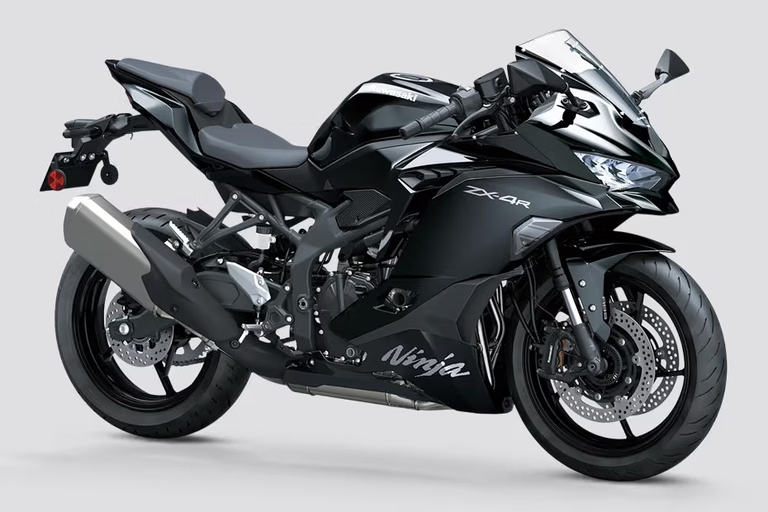
| 10 | Ninja ZX-4R (2023-present) | 146 mph | 400cc class; surprisingly capable |
#1: Kawasaki Ninja H2R – 212+ mph (Stock) / 248 mph (Modified)
The H2R is the fastest production motorcycle Kawasaki has ever made, and by a wide margin. It produces 310 hp from a supercharged 998cc inline-four, or 322 hp with ram air factored in. The track-only machine has no mirrors, no turn signals, and no street-legal path – Kawasaki built it for one purpose only.
In real-world testing, a stock H2R on standard gearing reaches approximately 200-212 mph before running out of revs (MotoStatz, 2026). The famous 248 mph figure comes from a 2016 run on Turkey’s Osman Gazi Bridge by World Supersport champion Kenan Sofuoglu on a lightly modified H2R with upgraded tires and race fuel (SlashGear, 2024). It reaches 186 mph in under 16 seconds from a standstill.
2025 MSRP: $59,100 (track-only; special order)
#2: Kawasaki Ninja H2 – 184 mph
The street-legal Ninja H2 runs the same supercharged 998cc platform as the H2R but is detuned to 240 hp claimed – and electronically limited on public roads. Wikipedia lists the stock top speed at 296 km/h (184 mph).
The H2 comes with headlights, mirrors, and a full electronics suite including traction control, cornering ABS, and multiple power modes. It’s a demanding ride: 240 hp on a 476-pound bike with a supercharger that builds boost as revs climb means the power delivery is nothing like a naturally aspirated liter bike. Riders coming from a ZX-10R should plan a serious adjustment period.
2025 MSRP: $34,400
#3: Kawasaki Ninja ZX-14R – 186 mph (Limited) / ~198 mph (Delimited)
The ZX-14R carries the largest inline-four engine ever fitted to a production motorcycle: 1,441cc producing 207.9 hp claimed and 113.2 lb-ft at the rear wheel in second-generation (2012-on) form (Wikipedia, ZX-14 article). Its top speed is electronically capped at 186 mph (299 km/h) under the Gentlemen’s Agreement – an informal arrangement between Japanese and European manufacturers that has held since the late 1990s.
Remove the speed limiter via an ECU flash and documented GPS runs push past 198 mph. In stock trim, Motorcycle USA recorded a quarter-mile of 9.78 seconds at 147 mph on the first-generation 1,352cc model. The ZX-14R’s “King of the Quarter Mile” reputation is well earned – it hits that 186 mph wall hard, with 0-60 in around 2.5 seconds.
2025 MSRP: $18,414
#4: Kawasaki Ninja ZX-10R – 186 mph (Limited)
The ZX-10R is Kawasaki’s primary liter-class superbike, developed in parallel with its World Superbike Championship program. It hits the same 186 mph electronic wall as the ZX-14R, but it does so from a 998cc engine in a much lighter package – around 450 lbs wet versus the ZX-14R’s 593 lbs. The 2025 model produces 196 hp claimed.
For 2026, Kawasaki revised the ZX-10R with a new aero package including large winglets said to improve downforce by 25 percent, along with new tri-element LED lighting (TopSpeed, 2026). Power dropped slightly to 190 hp in US spec. At the same speed ceiling, the ZX-10R is simply a sharper, more track-focused tool than the ZX-14R.
2026 MSRP: $16,999
#5: Kawasaki Z H2 – 176 mph
The Z H2 is a naked streetfighter built around the same supercharged 998cc engine as the Ninja H2, but without fairings. Losing the aerodynamic shell costs it measurably at the top end – MotoStatz recorded 176 mph in GPS-verified testing (MotoStatz, 2026), versus 184 mph for the faired Ninja H2. Below 140 mph, the Z H2 actually out-accelerates many bikes regardless of aerodynamics, since it produces close to 180 hp at the rear wheel.
The 0-60 time is 2.91 seconds and the quarter-mile runs 10.13 seconds at 146 mph (MotoStatz, 2026). For riders who want a supercharged punch in a naked form factor, there’s nothing else in production like it. The Z H2 SE adds semi-active Ohlins suspension.
2025 MSRP: Approximately $21,000 (SE version)
#6: Kawasaki Ninja ZX-6R – 164 mph
The ZX-6R is technically a 636cc bike – Kawasaki bumped displacement from 599cc starting with the 2003 model year, which gives it a horsepower edge over true 600cc rivals. The current model produces 127 hp and 52.1 lb-ft of torque. GPS testing by MotoStatz put top speed at 164 mph (MotoStatz, 2026), around 10 mph more than most comparable 600cc machines.
The quarter-mile runs 10.74 seconds at a 134 mph trap speed; 0-60 takes 3.17 seconds (MotoStatz, 2026). For 2025, Kawasaki added a 4.5-inch TFT display, updated riding modes, and a quick-shifter. The bike’s powerband – strong from 6,000 rpm through 13,000 rpm – makes it far more usable on the street than a race-spec 600 would be.
2025 MSRP: $11,399
#7: Kawasaki Ninja ZX-12R – 175 mph
The ZX-12R (2000-2005) was Kawasaki’s flagship before the ZX-14R, built to chase the Hayabusa. It used a first-ever aluminum monocoque frame that integrated the airbox into the structure to save weight and reduce width. Claimed top speed sits in the 175 mph range – enough to be electronically limited even before the Gentlemen’s Agreement fully took hold.
The ZX-12R’s real legacy is as the development platform that led directly to the ZX-14’s displacement strategy: when you can’t go faster on current tech, make the engine bigger.
#8: Kawasaki Ninja ZX-11 / ZZR1100 – 169-176 mph
From 1989 through 1995, the ZX-11 (sold as the ZZR1100 outside North America) was the fastest production motorcycle on the planet, posting a tested top speed of 272-283 km/h (169-176 mph) (Wikipedia, ZX-11 article). It beat everything else by a margin wide enough that Kawasaki held the title for six full years.
The ZX-11 introduced the first ram-air induction system on any production motorcycle – funneling pressurized air at speed into the intake to effectively increase displacement. That technology became standard on performance bikes within a decade. Honda’s CBR1100XX Blackbird finally claimed the title in 1996.
#9: Kawasaki Ninja ZX-10 Tomcat (1988-1990) – 165 mph
The 1988 Tomcat ZX-10 – the original, not the modern ZX-10R – replaced the GPZ1000RX using that bike’s engine with higher compression pistons, 36mm semi-downdraft carbs, and lighter internals. The result was a claimed 165 mph top speed and Kawasaki’s first aluminum perimeter frame, a design that became standard across Team Green’s superbike lineup.
The Tomcat only held the fastest-Kawasaki title for one model year before the ZX-11 arrived and reset expectations entirely.
#10: Kawasaki Ninja ZX-4R (2023-present) – 146 mph
The ZX-4R earns its spot by punching well above its 400cc displacement. The 399cc inline-four revs to 14,500 rpm and produces 76 hp – numbers that put it in a class separate from anything else in the 400cc segment. Wikipedia lists top speed at 235 km/h (146 mph), which is faster than many 600cc bikes from a decade ago.
Kawasaki resurrected the 400cc four-cylinder segment with this bike in 2023 at $8,999 MSRP, making it the most accessible entry into ZX-series performance. The ZX-4RR version adds a closer-ratio gearbox and Brembo radial-mount calipers for $1,000 more.
Frequently Asked Questions About the Fastest Kawasaki Motorcycles
What is the fastest Kawasaki motorcycle ever made?
The Kawasaki Ninja H2R is the fastest Kawasaki ever produced. In stock trim on standard gearing, it reaches approximately 200-212 mph. In lightly modified form with upgraded tires and race fuel, Turkish racer Kenan Sofuoglu piloted one to 248 mph (400 km/h) on Turkey’s Osman Gazi Bridge in 2016. The H2R is a track-only machine not legal for street use.
Why are so many Kawasaki sport bikes limited to 186 mph?
The 186 mph (300 km/h) cap comes from an informal arrangement known as the Gentlemen’s Agreement, reached in the late 1990s between Japanese and European motorcycle manufacturers. The agreement was intended to prevent manufacturers from escalating top speed competition on production bikes that are ridden on public roads. The Kawasaki ZX-10R, ZX-14R, and street Ninja H2 all hit this electronic ceiling in stock form.
How fast is the Kawasaki Ninja ZX-14R without the limiter?
Stock, the ZX-14R is electronically limited to 186 mph. Owners who have flashed the ECU to remove the speed limiter report GPS-verified speeds approaching 198-200 mph on long runways. The 1,441cc engine has more power available than the stock limiter allows it to use.
Is the Kawasaki Ninja H2 street legal?
Yes, the Ninja H2 is fully street legal in the US. It produces 240 hp claimed from its supercharged 998cc engine and includes mirrors, lights, and full electronics. The track-only Ninja H2R is not street legal – it has no mirrors, no turn signals, and no license plate provision.
How does the Z H2 compare to the Ninja H2 in top speed?
The Z H2 uses the same supercharged 998cc engine as the Ninja H2 but in a naked, unfaired configuration. The missing aerodynamics cost it roughly 8 mph at the top end – MotoStatz recorded 176 mph for the Z H2 versus 184 mph for the faired Ninja H2 in GPS testing. Below 140 mph, the two bikes are very close in outright acceleration.
What is the fastest Kawasaki you can legally ride on US streets?
The Ninja H2 is the fastest street-legal Kawasaki, electronically limited to 184 mph stock. It’s the only production motorcycle sold in the US with a factory-supercharged engine. The ZX-14R hits the same 186 mph electronic cap and is also street legal, but it achieves that speed from a larger naturally aspirated engine rather than forced induction.