Kawasaki KX250 Specs, Horsepower & Performance Review
TL;DR
- The 2026 Kawasaki KX250 produces 39.2 hp and 18.7 lb-ft of torque at the rear wheel, with no mechanical changes from the 2025 model.
- Curb weight is 230.9 lb without fuel, and the bike carries a 249cc four-stroke single with dual fuel injectors and a 14.1:1 compression ratio.
- Suspension is fully Showa: a 49mm coil-spring inverted fork with 12 inches of travel up front, and a Uni-Trak shock with 12.1 inches out back.
- MSRP runs $8,999 to $9,099 depending on the dealer and region, before freight, setup, and destination fees.
- The engine is tuned for low-end torque and midrange pull rather than a peaky top-end hit, which makes it more forgiving for riders stepping up from a 125 two-stroke or a smaller four-stroke.
How Much Horsepower Does the Kawasaki KX250 Make?
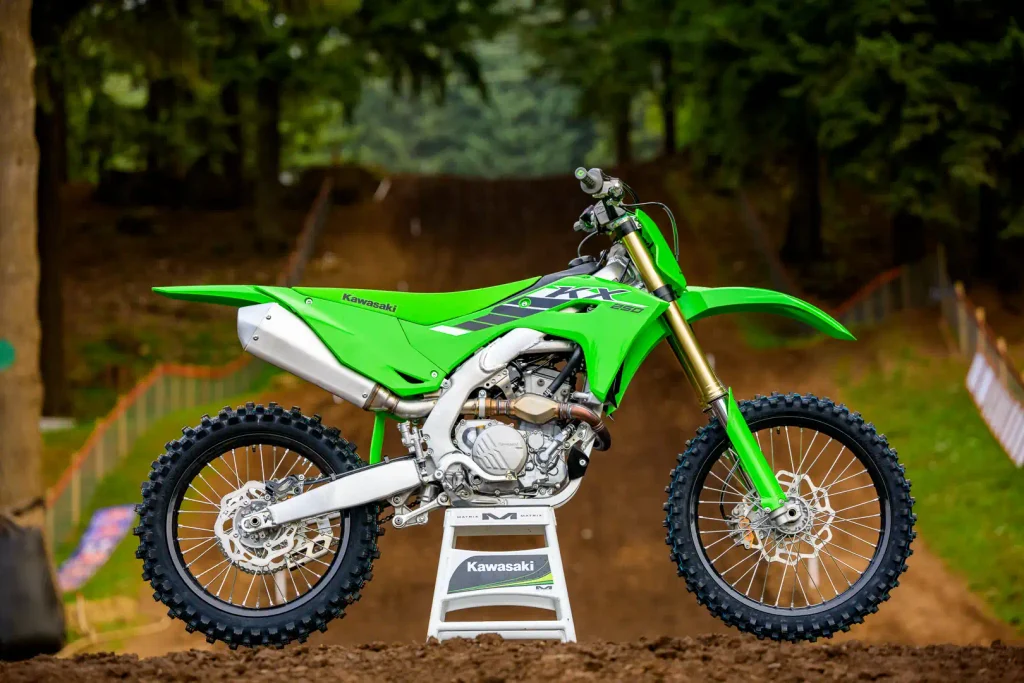
The 2026 KX250 makes 39.2 hp and 18.7 lb-ft of torque at the rear wheel, measured on Dirt Rider’s in-house Dynojet 250i dynamometer (Dirt Rider, 2025). That figure is unchanged from 2025, since Kawasaki carried the engine over with zero mechanical updates for 2026.
Worth knowing: some outlets have published higher peak numbers in the 43-44 hp range, likely reflecting crank-rated output or a different dyno methodology rather than power actually reaching the rear wheel. Rear-wheel dyno figures are the more useful number for buyers, since they account for drivetrain loss and reflect what you actually feel on the track.
The engine’s character changed more than its peak number suggests. Kawasaki’s 2025 redesign traded the sharper top-end hit of the 2021-2024 KX250 for a smoother, torquier delivery that pulls harder off idle and through the midrange. If you’ve ridden an older KX250 and expect a screamer, this one behaves differently.
What’s Inside the KX250’s Engine?
The KX250 runs a 249cc, DOHC, liquid-cooled four-stroke single with four valves per cylinder and a 14.1:1 compression ratio. Bore and stroke measure 3.07 x 2.06 inches (78 x 52.2mm), and fuel delivery comes from a 44mm Keihin throttle body with dual injectors, a setup Kawasaki first brought to mass production on this platform.
One injector sits downstream of the throttle valve in the conventional spot, and the second sits upstream near the airbox, which helps atomize fuel more evenly across the rev range. A single-shaft primary balancer cuts vibration and keeps the chassis calmer under hard throttle out of corners.
Two engine maps are selectable on the fly through a handlebar-mounted Mode button: a Normal map for smoother, more linear delivery, and an Aggressive map that sharpens throttle response for harder-charging riders. A dedicated Launch Control mode retards ignition timing off the start line to reduce wheel spin, then disengages automatically once you hit third gear.
How Does the KX250’s Suspension Perform?
The KX250 uses a fully Showa suspension package for 2026: a 49mm coil-spring inverted fork with 16-way compression and rebound damping up front, delivering 12 inches of travel, and a Uni-Trak linkage shock out back with 12.1 inches of travel. The rear shock offers dual-range compression damping (4-turn high-speed, 19-way low-speed), 22-way rebound adjustment, and adjustable spring preload.
Kawasaki switched from KYB to Showa across the board when it redesigned the KX250 for 2025, and the fork shares its basic architecture with the larger KX450. Ground clearance sits at 13.4 inches, and the shock body itself is roughly 1.25 inches shorter than the previous generation, a change tied to the redesigned downdraft intake rather than a suspension performance target.
Rake is set at 27 degrees with 4.6 inches of trail, numbers that favor stable, predictable turn-in over a bike built purely for snap-quick direction changes.
How Much Does the KX250 Weigh, and What’s the Seat Height?
Curb weight is 230.9 lb without fuel and 240.8 lb with a full 1.64-gallon tank. Seat height sits at 37.6 inches, with a 58.5-inch wheelbase and an overall length of 86.2 inches.
Those seat height and wheelbase numbers put the KX250 squarely in line with other full-size 250F motocross bikes, not a trail-friendly dual-sport. Riders under about 5’6″ often find the reach to the ground a stretch, and Kawasaki’s ERGO-FIT system helps here: four handlebar positions and two footpeg positions let you dial in cockpit fit without buying aftermarket parts.
Braking comes from a 270mm semi-floating petal disc up front with a dual-piston caliper, and a 240mm petal disc at the rear with a single-piston caliper. Wheels are 21-inch front and 19-inch rear, both wire-spoke, wrapped in 80/100-21 front and 110/90-19 rear off-road tires.
What Electronics Come Standard on the KX250?
The KX250 comes with Kawasaki TRaction Control (KTRC), selectable between Weak and Strong settings or switched off entirely via a handlebar button. Smartphone connectivity runs through the Rideology the App KX system, which lets you adjust engine mapping, check maintenance intervals, and log ride telemetry from a phone.
This puts the KX250 ahead of some rivals in its class on electronics, since traction control and app connectivity aren’t standard across every 250F motocrosser. A coned disc-spring hydraulic clutch and electric start round out the rider-facing tech, both of which were new additions during the 2025 redesign and carry over unchanged.
Kawasaki KX250 Spec Sheet
| Spec | 2026 Kawasaki KX250 |
|---|---|
| Engine | 249cc DOHC four-stroke single, liquid-cooled |
| Horsepower | 39.2 hp (rear wheel, Dirt Rider dyno) |
| Torque | 18.7 lb-ft (rear wheel, Dirt Rider dyno) |
| Compression ratio | 14.1:1 |
| Fuel system | DFI, 44mm Keihin throttle body, dual injectors |
| Transmission | 5-speed, chain final drive |
| Front suspension | 49mm Showa inverted fork, 12 in. travel |
| Rear suspension | Uni-Trak, Showa shock, 12.1 in. travel |
| Front/rear brakes | 270mm / 240mm petal discs |
| Seat height | 37.6 in. |
| Wheelbase | 58.5 in. |
| Curb weight | 230.9 lb (without fuel) |
| Fuel capacity | 1.64 gal. |
| MSRP | $8,999-$9,099 |
What Does the KX250 Cost, and What Do You Get?
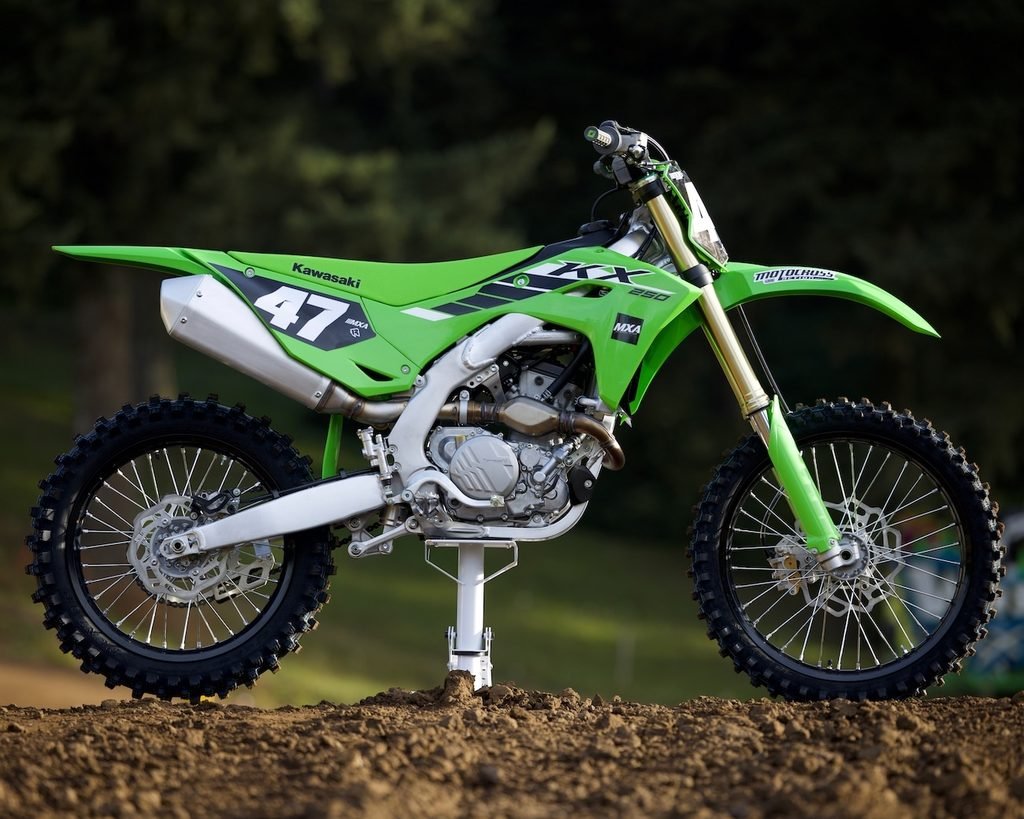
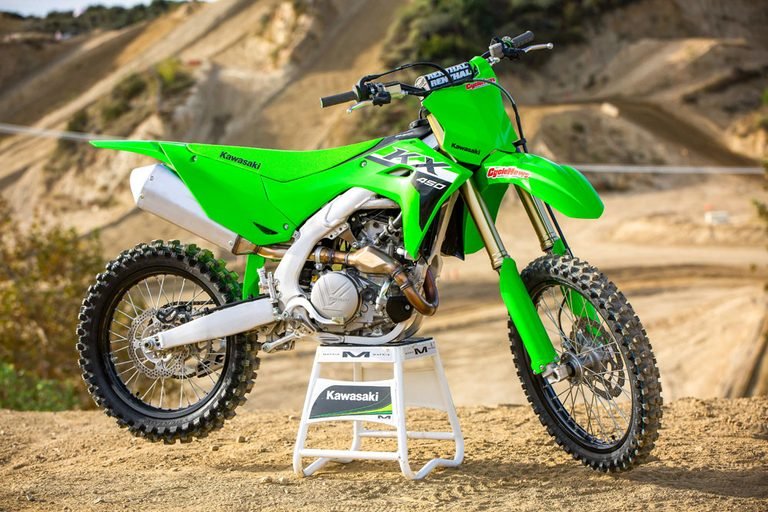
credit: https://motocrossactionmag.com/
MSRP for the 2026 KX250 runs $8,999 to $9,099 depending on the source and region, with dealer sale prices often landing lower once regional incentives and manufacturer rebates apply. That price gets you the fully redesigned aluminum perimeter frame, Showa suspension front and rear, KTRC, dual power modes, launch control, and ERGO-FIT adjustability, all standard.
Kawasaki made no mechanical changes for 2026, so the only visible difference from the 2025 model is updated radiator shroud graphics. If you’re cross-shopping a 2025 KX250 at a discount against a 2026 model at full sticker, you’re buying the same bike mechanically.
Frequently Asked Questions
How much horsepower does the 2026 Kawasaki KX250 have?
The 2026 KX250 makes 39.2 hp at the rear wheel, according to Dirt Rider’s in-house dyno testing. Torque peaks at 18.7 lb-ft. These are unchanged from the 2025 model since Kawasaki made no engine updates for 2026.
What changed on the 2026 KX250 compared to 2025?
Nothing mechanical. The 2026 model carries the same frame, engine, and suspension as 2025, with new radiator shroud graphics as the only visible update. The major redesign, including the switch to Showa suspension and the downdraft intake, happened for 2025.
How much does the Kawasaki KX250 weigh?
Curb weight is 230.9 lb without fuel and 240.8 lb with a full 1.64-gallon tank. That’s in line with other current-generation 250F motocross bikes in its class.
What is the seat height on the KX250?
Seat height is 37.6 inches. Riders on the shorter side can adjust reach somewhat using the ERGO-FIT system’s four handlebar and two footpeg positions, but the bike is built as a full-size motocrosser, not a lowered or trail-oriented model.
Is the Kawasaki KX250 good for beginners?
The current-generation engine’s smoother low-end torque and less aggressive top-end make it more forgiving than previous KX250 generations, and test riders have noted it suits entry-level and intermediate riders well. It’s still a full-size 250F motocrosser, so new riders should have solid off-road bike experience before jumping on one.