Kawasaki Vulcan 900 Custom Top Speed, 0-60 Time & Specs Review
TL;DR
- Instrumented testing puts the Vulcan 900 Custom’s top speed at 104.7 mph and its 0-60 mph time at 5.92 seconds.
- The quarter mile runs 14.19 seconds at 89.57 mph, numbers that have held steady since the 903cc engine hasn’t changed in two decades of production.
- Peak output is 51 hp at 5,500 rpm and 58.3 lb-ft of torque at 3,500 rpm, per Kawasaki’s current factory spec sheet.
- Curb weight is 610.8 lb, and the bike carries a 5.3-gallon tank good for well over 200 miles between fill-ups.
- It’s not a drag strip bike. It’s a torquey, low-slung custom cruiser built for relaxed street riding, not straight-line bragging rights.
How Fast Is the Kawasaki Vulcan 900 Custom in Real Testing?
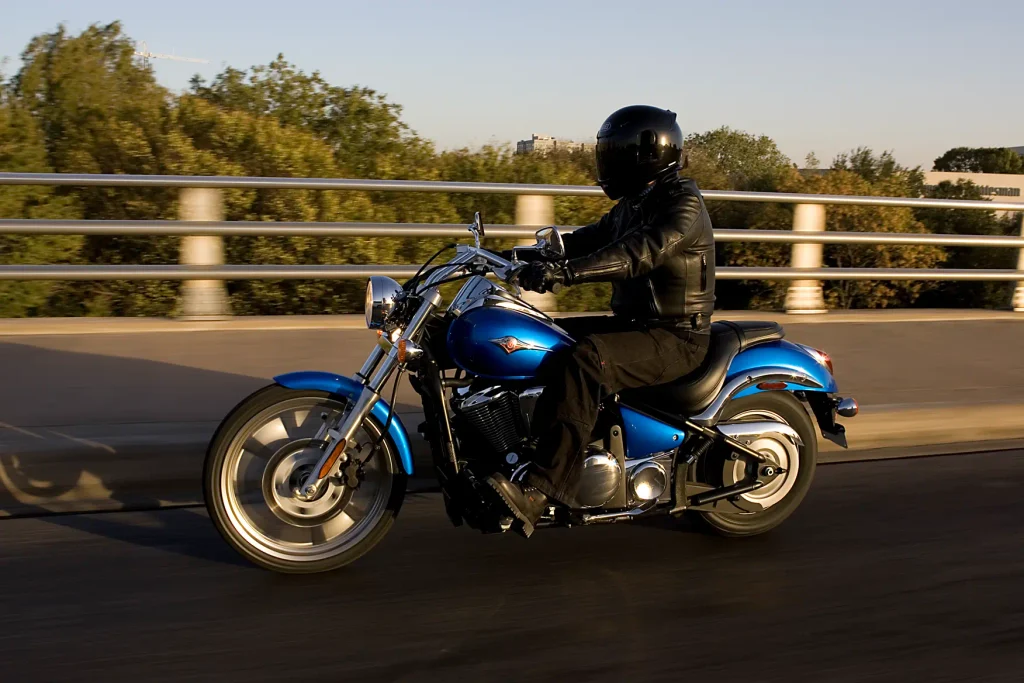
The Vulcan 900 Custom’s top speed is 104.7 mph, and it covers 0-60 mph in 5.92 seconds. That data comes from Motorcycle Consumer News’s instrumented test of the bike, published in their February 2007 issue (Motorcycle Consumer News, 2007).
A separate quarter-mile run by Cycle World, cited in a 2010 middleweight cruiser comparison, clocked the bike at 14.57 seconds and 88 mph, with 0-60 landing at 6.2 seconds (Cycle World, 2010). The two tests land close enough together to trust the range: expect 0-60 somewhere between 5.9 and 6.2 seconds depending on rider weight, tire pressure, and how aggressively you feed out the clutch.
Kawasaki hasn’t touched the 903cc engine’s bore, stroke, or compression ratio since the platform launched in 2007, so these numbers still apply to current-year Custom models. If you’ve ridden a Vulcan 900 Classic or Classic LT, you already know this power delivery. All three trims share the identical drivetrain and gearing, so the performance figures transfer directly regardless of which bodywork you’re sitting on.
None of this makes the Vulcan 900 Custom a quarter-mile weapon. A 5.92-second 0-60 run is respectable for a mid-displacement V-twin cruiser, comparable to what you’d expect from a Yamaha V Star 950 or a Honda Rebel 1100, but well off the pace of a liter-class power cruiser or anything wearing a sportbike fairing.
What Engine Powers the Vulcan 900 Custom?
The Vulcan 900 Custom runs a 903cc, 55-degree V-twin with liquid cooling and a single overhead cam per cylinder head (Kawasaki, 2026). Bore and stroke are 88.0mm x 74.2mm, with a 9.5:1 compression ratio.
Power peaks at 51 hp at 5,500 rpm, and torque tops out at 58.3 lb-ft at 3,500 rpm. That torque peak sitting low in the rev range is the whole point.
You’re not chasing redline on this bike; you’re short-shifting through a five-speed gearbox and letting the twin’s midrange do the work, the same way you’d ride a Harley-Davidson Sportster or a Yamaha V Star 950.
Fuel delivery comes from a digital fuel injection system with dual 34mm throttle bodies and sub-throttle valves for smoother roll-on throttle response, a notable upgrade over the carbureted Vulcans that came before it.
A Kevlar-reinforced belt handles final drive, which means no chain lube, no chain slack checks, and no sprocket wear to track, just a periodic visual inspection for cracking or fraying.
Full Specs: Engine, Chassis, and Dimensions
| Spec | Value |
|---|---|
| Engine | 903cc, 55-degree V-twin, liquid-cooled |
| Bore x Stroke | 88.0mm x 74.2mm |
| Compression Ratio | 9.5:1 |
| Max Horsepower | 51 hp @ 5,500 rpm |
| Max Torque | 58.3 lb-ft @ 3,500 rpm |
| Transmission | 5-speed |
| Final Drive | Kevlar-reinforced belt |
| Front Suspension | 41mm Showa telescopic fork, 5.9 in travel |
| Rear Suspension | Uni-Trak swingarm, 7-way preload, 4.1 in travel |
| Front Brake | Single 300mm disc |
| Rear Brake | Single 270mm disc |
| Front / Rear Tire | 80/90-21 / 180/70-15 |
| Seat Height | 27.0 in |
| Wheelbase | 64.8 in |
| Curb Weight | 610.8 lb |
| Fuel Capacity | 5.3 gal |
| Base MSRP | $9,999 |
Source: Kawasaki factory spec sheet (Kawasaki, 2026).
Does the Vulcan 900 Custom Have ABS?
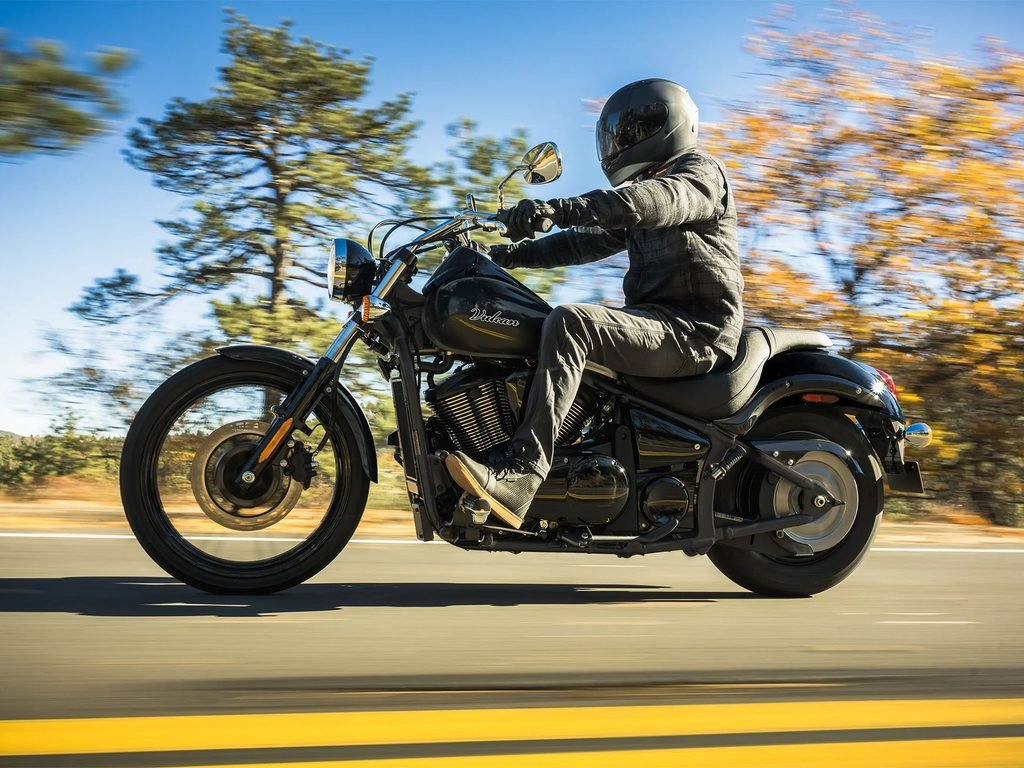
The Vulcan 900 Custom does not come with ABS as of the current model year. The spec sheet lists a single 300mm front disc and a single 270mm rear disc, both hydraulic, with no anti-lock option listed for this trim.
That puts it behind rivals like the Honda Rebel 1100, which offers ABS across its lineup. If ABS is a non-negotiable for you, especially for wet-weather commuting or riding in unpredictable traffic, that’s worth weighing against the Custom’s lower price point and classic-cruiser feel. Riders coming from older, drum-braked cruisers will still find the single front disc a real upgrade in stopping power, just without the electronic backup.
How Does the Riding Position Compare to Other Cruisers?
The Vulcan 900 Custom uses wide drag bars and forward-mounted footpegs, putting your arms up and out and your legs stretched forward. It’s the classic chopper-inspired stance, not the floorboard-and-heel-toe-shifter layout you’d get on the Vulcan 900 Classic.
Seat height sits at 27.0 inches, low enough for most riders to plant both feet flat at a stop. Combined with the 610.8-lb curb weight carried low in the chassis, the bike stays manageable in parking lots and at walking-pace maneuvers, something Cycle World’s testers noted directly in their buyer’s guide (Cycle World, 2020).
That low center of gravity matters more than the weight number itself; a top-heavy 600-lb bike feels far harder to muscle around than the Vulcan does.
The tradeoff is wind exposure. Wide bars and no windscreen mean highway speeds above 70 mph get tiring on longer rides. Riders planning regular interstate travel often add a windshield or look at the touring-oriented Vulcan 900 Classic LT instead.
Who Should Buy the Vulcan 900 Custom?
This bike fits riders who want a low, torquey cruiser for street riding, not track days or drag strips.
New riders benefit from the low seat height and predictable power delivery, and the belt drive means less time wrenching and more time riding. Commuters get strong fuel economy from that same low-stress engine tune, with owners reporting mid-to-high 40s mpg on the highway.
It’s not the right pick if you want ABS standard, a passenger-friendly setup, or a top speed that competes with a power cruiser.
The pillion seat is small, and long-distance two-up riders will feel it after an hour. The Vulcan S, also from Kawasaki, or a Yamaha V Star 950 are worth cross-shopping if outright acceleration matters more to you than the Custom’s styling.
Frequently Asked Questions
What is the top speed of a Kawasaki Vulcan 900 Custom?
Instrumented testing from Motorcycle Consumer News clocked the top speed at 104.7 mph (Motorcycle Consumer News, 2007). Expect a real-world top speed in the low 100s depending on rider weight, wind, and elevation, since none of those variables were controlled for in the original test.
How fast does the Vulcan 900 Custom go from 0 to 60?
The tested 0-60 mph time is 5.92 seconds. A separate Cycle World test put it at 6.2 seconds, so plan on the mid-5 to low-6 second range depending on conditions and rider skill.
What is the horsepower of the Vulcan 900 Custom?
The current factory spec sheet lists 51 hp at 5,500 rpm. Torque peaks at 58.3 lb-ft at 3,500 rpm, which is where most of the bike’s real-world punch comes from since that’s the rpm range most street riding happens in.
Does the Kawasaki Vulcan 900 Custom have a chain or belt drive?
It uses a Kevlar-reinforced belt for final drive. That means no chain lube schedule, no sprocket wear, and less routine maintenance than a chain-driven cruiser, just an occasional check for cracks or fraying at the belt’s edges.
Is the Vulcan 900 Custom good for beginners?
The 27.0-inch seat height, 610.8-lb curb weight, and smooth low-end torque make it approachable for new riders. The tradeoff is no standard ABS, so new riders should factor that into their comfort level with hard braking in wet conditions.